

A 2026 Guide to First Aid for Medically Compromised Dental Patients

First aid for medically compromised dental patients starts with a structured primary survey and strict compliance with Resuscitation Council UK standards. Your dental team must maintain an emergency drug kit and complete regular, accredited emergency training (BLS training) so you protect patient safety and meet regulatory duties.
Key Takeaways:
- The LifeVac device is registered as a Class I Medical Device in the UK.
- Emergency devices must carry UKCA and CE markings for regulatory conformity.
- The ILS Course strictly adheres to Resuscitation Council UK guidelines.
Emergency training that fits how your practice actually works
Select emergency training formats that match your clinic’s operational needs and clinical workload. Three common situations guide that choice: if you treat many children, add Paediatric Immediate Life Support alongside standard CPR; if you provide sedation, include sedation-awareness modules so staff recognise drug-related collapse early; if your whole team must respond inside the surgery, book in-practice sessions so they rehearse with your own emergency drug kit and layout.
In-practice training lets your staff run protocols inside your actual treatment rooms and learn the primary survey (ABCDE assessment) against your local floor plan. Off-site courses in Leeds or Bradford suit smaller teams that need structured learning away from daily interruptions.
Your chosen format must satisfy Care Quality Commission (CQC) expectations and General Dental Council (GDC) development outcomes. Align every course with Resuscitation Council UK guidelines so you keep statutory compliance. Clear communication using handover communication (SBAR tool) speeds transfers to emergency services. When systemic risk is high, early recognition matters; read more on recognising sepsis in dental patients to sharpen diagnostic efficiency. More on this: Recognising Sepsis in Dental Patients.
Matching course options to practice risk profiles is like selecting bespoke dental matrices for complex restorations. First Medical Training Ltd has delivered accredited education for dental teams since 2006. A tailored educational plan supports safer outcomes for the patients in your care.
Tip: Assess your clinic’s patient demographics annually to determine if specialist training like paediatric or sedation awareness is required alongside standard CPR.
Medical emergency equipment your dental premises must keep ready
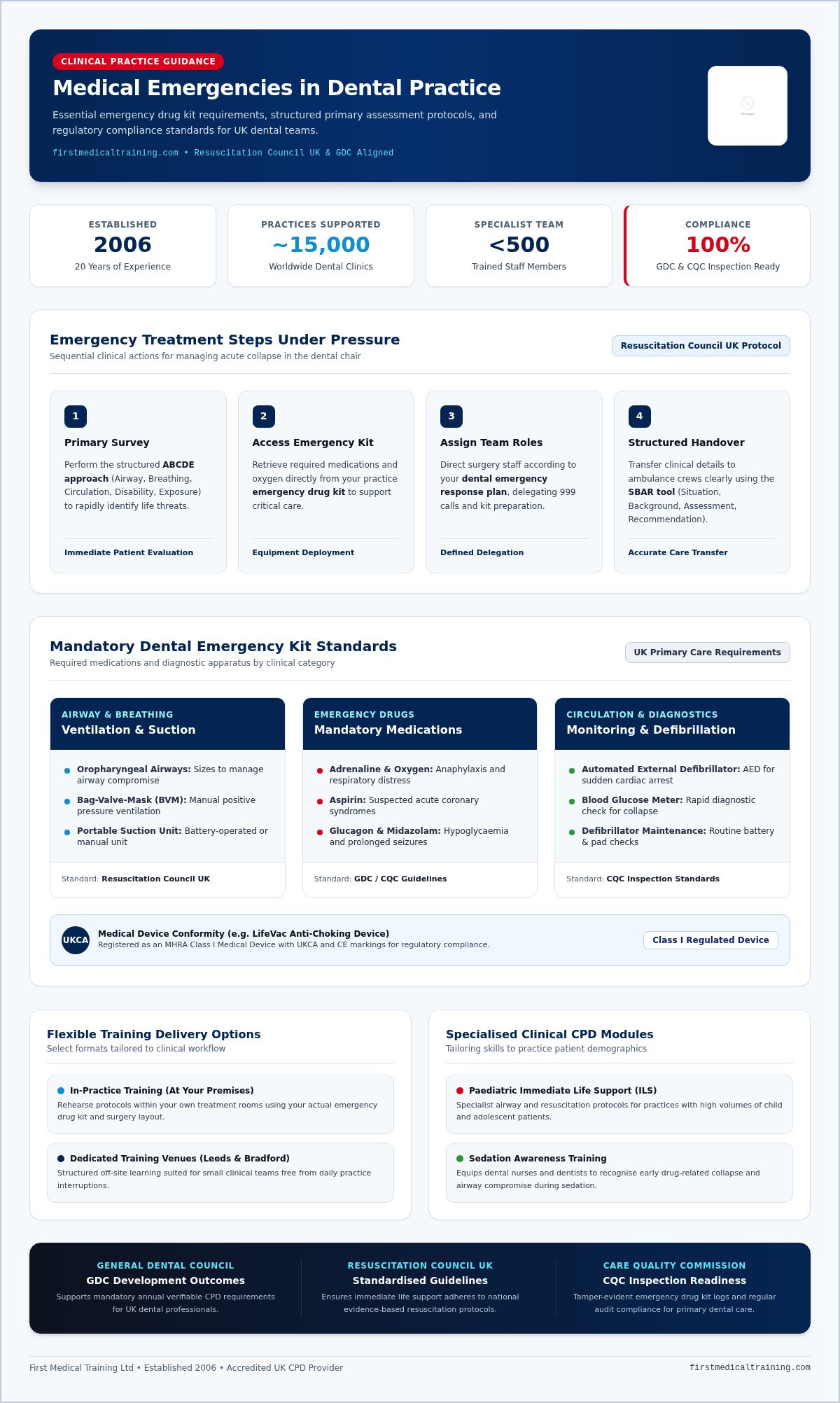
If a patient collapses mid-treatment, you need the right kit within arm’s reach, not a scramble through unmarked drawers. Every UK dental practice must maintain a fully equipped emergency drug kit and functional resuscitation equipment. Resuscitation Council UK standards set out clear requirements for primary care premises; keep your equipment accessible and ready for immediate deployment.
Stocking these items needs careful organisation. According to the Wikipedia entry on dental emergencies from 2024, rapid intervention during an acute crisis directly prevents irreversible patient harm. Regular emergency training helps your practice team act with speed and confidence.
| Emergency Equipment Category | Essential Items Included | Primary Regulatory Standard |
|---|---|---|
| Airway & Breathing | Oropharyngeal airways, bag-valve-mask, portable suction unit | Resuscitation Council UK |
| Emergency Medications | Adrenaline, aspirin, glucagon, midazolam, oxygen | GDC / CQC Guidelines |
| Circulation & Diagnostic | Automated External Defibrillator (AED), blood glucose meter | CQC Inspection Standards |
A structured ABCDE evaluation directs how you deploy these clinical tools. The LifeVac Anti-Choking Device is registered as a Class I Medical Device in the UK and carries UKCA and CE marks, confirming compliance with British medical standards; those marks show the device has undergone the assessments required for sale in British pharmacies and by specialist medical suppliers. Resuscitation Council UK standard BLS protocols do not include anti-choking suction devices, so treat this unit as an optional adjunct rather than a guideline-mandated item. Keeping essential medications in date protects practice compliance. For patients on daily corticosteroids, review steroid use in dental care when acute systemic collapse is a risk. Use clear handover communication when you transfer care to ambulance crews.
Tip: Verify that all medical devices in your emergency kit carry UKCA or CE markings to guarantee compliance during CQC inspections.
Knowing the exact equipment list helps you judge your own readiness and the quality of the training you book.
Among First Medical Training Ltd’s Google reviews, a client specialist (5★) wrote:
"Great training experience. In depth and informative but well presented and delivered in a relaxed manner. Id recommend them."
That feedback shows how practical instruction gives dental teams genuine confidence with mandatory emergency equipment and clinical protocols: the gap was uncertain kit handling, the action was in-depth hands-on teaching, and the outcome was a team ready to recommend the same route to peers.
First aid for medically compromised dental patients: treatment steps that hold under pressure
When a medically compromised patient deteriorates in the chair, you need immediate clinical action, prompt escalation, and structured care protocols before the situation runs away from you.
Follow these primary steps:
- Perform primary survey: Run a structured evaluation of Airway, Breathing, Circulation, Disability, Exposure to identify life-threatening conditions at once.
- Access emergency kit: Retrieve essential medications and oxygen from your practice emergency drug kit to support critical care.
- Assign team roles: Direct dental staff to defined tasks, such as calling 999 or preparing resuscitation equipment.
- Provide handover communication: Structure your update to ambulance crews using Situation, Background, Assessment, and Recommendation so information transfer stays clear.
Specific guidance on clinical care priorities appears in the GOV.UK prevention tables, which set out preventative measures alongside management pathways.
Providing clear information to patients about routine maintenance is another vital part of this preventative approach; for instance, you can discover Hunters Corner Dental and their guide to professional teeth cleaning for an example of patient-focused education.
Your team needs reliable training to act during an acute episode. Enrolling staff in Dental CPD helps maintain clinical competence and alignment with General Dental Council expectations. Routine safety instruction keeps your practice aligned with CQC requirements while protecting vulnerable individuals. Ask us for dates that suit your diary.
Why standard first aid fails complex dental cases
Basic first aid protocols fall short in a dental surgery because they overlook complex medical histories and local anaesthetic interactions. A generic workplace course does not prepare your team for underlying cardiovascular risks or acute drug reactions during invasive procedures.
Standard emergency training focuses on trauma or sudden collapse in public spaces. Dental patients present with intricate medical profiles that need specific interventions. You must run a structured survey early so you spot physiological deterioration before collapse. Standard protocols lack guidance on severe drug interactions or airway obstruction caused by dental materials. Basic kits often omit a portable suction unit, leaving staff under-equipped for clinical emergencies.
Our firm professional opinion is that your dental practice should replace generic first aid with specialised, accredited training built for clinical environments. Generic workplace certificates create a false sense of security that fails under regulatory scrutiny.
You need specialised emergency equipment alongside your Dental Consumables to protect vulnerable patients. Align practice protocols with General Dental Council expectations and Resuscitation Council UK guidelines. Ensure each team member can deliver structured handover communication when paramedics arrive.
Can first aid training be delivered at your practice?
Onsite emergency training suits most dental teams because host venues let staff practise on their own clinical layout and equipment. Hosting an in-practice session is cost-effective for larger teams; sending individuals to external venues often suits smaller practices.
Pick the delivery method that cuts clinical downtime and still meets Care Quality Commission (CQC) expectations. The Immediate Life Support (ILS) Course meets UK Resuscitation Council guidelines and counts toward CPD for dental nurses and dentists under the General Dental Council’s Dental CPD framework.
Training in your own rooms means the team learns where the emergency drug kit lives and how to manage simulated crises in familiar surgeries. You must verify that your chosen course aligns with official standards. Since 2006, First Medical Training Ltd has delivered accredited education across the United Kingdom to support practice compliance. Tell us your team size and we will send a personalised quote for your practice.
Shared drills strengthen handover communication because the whole team trains together. If room size worries you, qualified instructors adapt scenarios to any standard clinical layout.
Frequently asked questions
What equipment must dental premises have for medical emergencies?
Dental surgeries must maintain an emergency drug kit alongside essential airway and resuscitation tools. Your practice should store an automated external defibrillator (AED) with real-time CPR feedback, oxygen, a portable suction unit, and a manual resuscitator. Premises may also stock the LifeVac Anti-Choking Device, which is registered as a Class I Medical Device in the United Kingdom and carries UKCA and CE marks; it is not part of Resuscitation Council UK standard BLS protocols, so record it as an optional adjunct if you choose to hold one.
Which dental professionals need an emergency drug kit?
Every registered dental professional managing clinical care must have immediate access to an emergency drug kit compliance system. Dentists, dental nurses, hygienists, and therapists working in general or specialist settings require these resources to stabilise patients during sudden medical crises. You must ensure the kit is logged, kept within expiry dates, and easily accessible to staff on duty.
Can dental hygienists or therapists hold midazolam?
Dental hygienists and dental therapists cannot hold or administer midazolam under a Patient Group Direction (PGD). Midazolam is a Schedule 3 controlled drug used for prolonged seizures and requires a patient-specific prescription, or a dentist present to prescribe and oversee its use. When stocked, it must remain in a secure, tamper-evident container within the primary emergency drug kit. Confirm that your practice protocols comply with current General Dental Council (GDC) standards and local prescribing regulations.
How many CPD hours are required for medical emergencies?
The General Dental Council expects dental professionals to undertake regular continuing professional development in emergency management. You should complete emergency training (basic life support) annually to maintain clinical competence and satisfy regulatory expectations. Accredited CPD courses help your team meet those educational requirements and standardise clinical responses.
How often should CPR/AED training be refreshed?
You must refresh your CPR training and AED skills at least once every year. Annual refresher courses align with guidelines from the Resuscitation Council UK and help staff rehearse structured handover communication techniques. Regular practice keeps your team able to run a systematic primary survey protocol swiftly in real emergencies.
Preparing Your Dental Practice for Emergencies in 2026
Your clinical team must handle complex medical crises with confidence. The same decisions you faced above (which training format, which kit standard, which on-site drill) decide whether first aid for medically compromised dental patients stays controlled when seconds count.
Since 2006, First Medical Training Ltd has provided emergency training for healthcare professionals across the UK. Upgrade your clinic’s emergency readiness by booking an accredited dental emergency workshop. Speak to the team when you want a personalised quote for your practice.