

Anaphylaxis Training for Dental Practices: A Comprehensive Guide for 2026

Did you know that approximately 50% of anaphylaxis episodes occurring in healthcare settings are not treated with intramuscular adrenaline as recommended? For many dental professionals, the thought of a patient collapsing in the chair due to a severe allergic reaction is a source of genuine anxiety. Finding the right anaphylaxis training dental practice teams can trust is essential for overcoming confusion regarding dosages and meeting GDC verifiable CPD standards with confidence.
You can transform that uncertainty into clinical confidence. This guide provides the clarity you need to master the latest protocols and ensure your whole team is fully prepared for a crisis. By focusing on practical, evidence-based skills, you'll meet your regulatory requirements whilst prioritising patient safety. We will explore the essential requirements for 2026, covering the transition from auto-injectors to adrenaline ampoules and the implementation of the latest Resuscitation Council UK guidelines.
Key Takeaways
- Identify the common dental triggers that lead to systemic hypersensitivity and learn why rapid recognition is critical for patient survival.
- Master the RCUK ABCDE assessment protocol to identify life-threatening airway and respiratory distress with clinical precision.
- Synchronise your emergency response by allocating clear "Lead, Runner, and Scribe" roles to every member of your dental team.
- Ensure your surgery remains rescue-ready by implementing a disciplined monthly schedule for checking emergency drug kits and equipment.
- Discover how the comprehensive anaphylaxis training dental practice teams receive can bridge the gap between clinical theory and real-world emergency response.
Understanding Anaphylaxis Risks in a Dental Environment
Anaphylaxis is a severe, life-threatening, systemic hypersensitivity reaction that requires immediate medical intervention. In a clinical setting, it often occurs rapidly after exposure to an allergen, leading to airway obstruction or circulatory collapse. Understanding Anaphylaxis is the first step in protecting your patients, as the dental environment presents a unique set of risks. Unlike many other healthcare settings, a dental surgery involves the simultaneous use of various materials, chemicals, and medications, often within a single appointment. This concentrated exposure makes the need for specific anaphylaxis training dental practice staff can rely on more than just a regulatory box-ticking exercise; it's a fundamental safety requirement.
Common Dental Allergens and Triggers
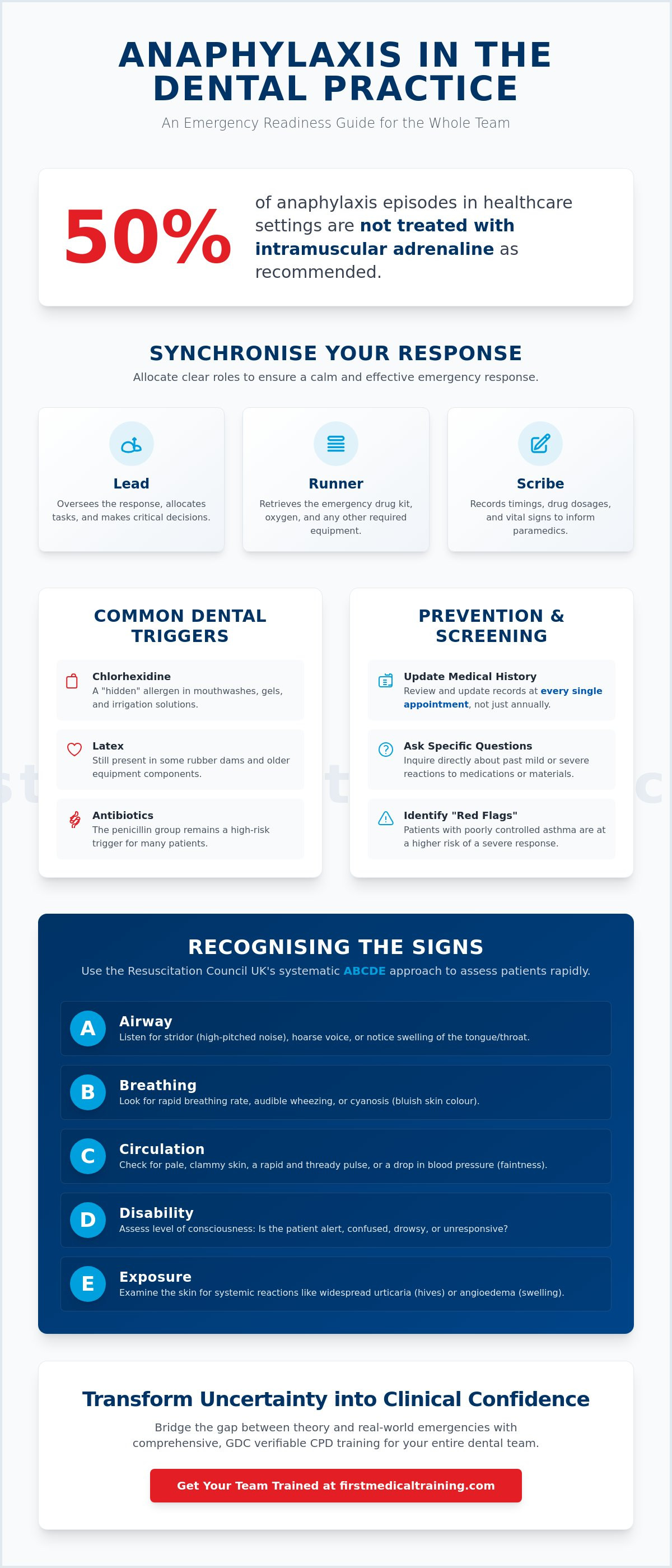
Whilst many focus on food or stings, the triggers found in a surgery are often more subtle. Chlorhexidine is a prime example. It's frequently referred to as the "hidden" allergen because it's found in everything from mouthwashes to endodontic lubricants. Latex remains a significant concern; even if your practice has switched to nitrile gloves, latex may still be present in rubber dams or older equipment components. Antibiotics, particularly the penicillin group, are responsible for a high proportion of drug-induced reactions. Local anaesthetics are less common triggers but cannot be ignored as potential causes of acute distress.
- Chlorhexidine: Found in many irrigation solutions and gels.
- Latex: Present in some rubber dams and older medical devices.
- Antibiotics: Penicillin remains a high-risk trigger for many patients.
The Importance of Prevention and Screening
Prevention starts with a robust medical history. You shouldn't just update these records annually. It's essential to ask patients about any new allergies or changes in their health at every single appointment. Look for "red flags", such as a history of asthma or previous mild reactions to medications, as these patients are at a higher risk of a more severe response. Distinguishing between a mild local reaction, such as localised swelling or a rash, and a systemic event is a core skill. A systemic reaction involves more than one body system, such as respiratory distress combined with skin changes, and demands the immediate implementation of your emergency protocols.
- Update medical history at every appointment.
- Ask specific questions about previous reactions to local anaesthesia.
- Identify patients with poorly controlled asthma as high-risk.
A thorough screening process allows you to prepare for potential emergencies before the patient even sits in the chair. If a patient indicates a history of severe allergy, the team should ensure the emergency kit is immediately accessible. This proactive approach is the cornerstone of the anaphylaxis training dental practice teams should implement to maintain a safe clinical environment and build lasting professional confidence.
Recognising the Signs: The ABCDE Approach
The Resuscitation Council UK (RCUK) advocates for the ABCDE approach as the universal standard for clinical assessment. This methodical system ensures that life-threatening issues are identified and treated in order of priority. When implementing anaphylaxis training dental practice protocols, every team member must understand that "A" always comes before "E". You aren't just looking for a rash; you're assessing the patient’s fundamental ability to stay alive. A structured step-by-step anaphylaxis emergency response relies on these observations being made quickly and accurately.
Airway (A) and Breathing (B): A compromised airway is the most immediate threat. Listen for stridor, a high-pitched inspiratory noise, or notice if the patient’s voice becomes hoarsely whispered. Swelling of the tongue or throat can progress in seconds. Breathing follows closely; a rapid respiratory rate or audible wheezing indicates lower airway involvement. If you notice cyanosis, a bluish discolouration particularly around the lips, the situation has reached a critical stage of oxygen deprivation.
Circulation (C), Disability (D), and Exposure (E): Circulatory collapse is often marked by pale, clammy skin and a rapid, thready pulse as the body attempts to maintain blood pressure. Disability refers to the patient's level of consciousness. Are they alert, or only responding to voice? Finally, Exposure involves checking the skin for signs of a reaction. This full assessment ensures no life-threatening symptom is overlooked in the heat of the moment.
Skin and Mucosal Changes
Urticaria, commonly known as hives, and angioedema are the most visible markers of an allergic event. However, research from the Resuscitation Council UK indicates that skin changes are absent in up to 20% of anaphylaxis cases. This is a vital distinction. If you wait for a visible rash before acting, you may miss the window for effective intervention. It's also important to distinguish between a nervous patient’s anxiety-induced flushing and a genuine allergic rash, which is typically raised and itchy.
The Danger of Rapid Progression
The speed of onset is your primary diagnostic indicator. Anaphylaxis doesn't wait. It moves with a velocity that can lead to respiratory or circulatory collapse within minutes of exposure. A patient might describe a profound sense of "impending doom". This isn't merely a psychological response; it's a physiological warning of systemic failure. Waiting to see if symptoms improve is the most common mistake made during dental emergencies. For teams looking to sharpen these diagnostic skills, our Medical Emergencies in a Dental Practice Course provides hands-on scenarios to build real-world speed and confidence.
Step-by-Step Management of Anaphylaxis in the Chair
Stop everything. The moment you suspect a systemic reaction, clinical priorities shift instantly from dentistry to life support. Immediate cessation of treatment and the removal of potential triggers are your first actions. If you're using a rubber dam, remove it. If an antibiotic was being administered, stop it. Your receptionist plays a vital role here; they must inform the emergency operator specifically that this is a case of suspected anaphylaxis, providing the practice address and the patient's current ABCDE status. Clear communication ensures the ambulance crew arrives with the correct level of urgency.
Effective anaphylaxis training dental practice teams undergo focuses heavily on the "golden minutes" before paramedics arrive. Whilst waiting, the patient must be monitored continuously. If their condition does not improve, or if it deteriorates, you must be prepared to act. This isn't just about clinical knowledge; it's about the logistical reality of managing a crisis in the confined space of a dental surgery.
Correct Patient Positioning
Positioning is a critical, yet often overlooked, part of emergency management. You must keep the patient flat with their legs raised to maintain blood pressure to the heart and brain. Standing or sitting the patient up can lead to "empty heart syndrome", where a massive drop in blood pressure causes a fatal cardiac arrest. In a dental surgery, this means quickly adjusting the chair to a supine position and using cushions or a stool to elevate the legs. If the patient is vomiting or struggling with secretions, you must turn them onto their side in the recovery position whilst maintaining their airway, using your high-volume suction if necessary.
Adrenaline Administration and Dosages
Intramuscular (IM) adrenaline is the gold standard treatment for anaphylaxis. It should be administered as soon as the diagnosis is made. The preferred site is the anterolateral aspect of the middle third of the thigh, as this provides the most rapid absorption into the systemic circulation. You don't need to remove clothing; the needle can pass through most fabrics in an emergency.
- Adults and children over 12 years: 500 micrograms (0.5 mL of 1:1000).
- Children aged 6 to 12 years: 300 micrograms (0.3 mL of 1:1000).
- Children aged 6 months to 6 years: 150 micrograms (0.15 mL of 1:1000).
If there's no clinical improvement after the first dose, a second dose of adrenaline should be administered after 5 minutes. Most successful outcomes in the surgery are the result of the team’s ability to draw up and deliver these dosages accurately and without hesitation. High-quality training ensures every staff member knows exactly where the emergency drug kit is kept and how to use its contents under pressure.
Organising Your Practice for Emergency Readiness
A successful emergency response is never an accident. It is the result of a highly organised team that understands exactly how to transition from routine care to a life-saving protocol. In a crisis, individual knowledge is secondary to coordinated action. This is where the specific anaphylaxis training dental practice teams receive becomes invaluable, as it moves beyond clinical theory into the logistics of surgery management. By pre-allocating roles, you eliminate the hesitation that often occurs during the first sixty seconds of a collapse.
Allocating Team Roles: Every member of the practice, from the principal dentist to the front-of-house staff, must have a designated role. The Lead remains at the patient's side, managing the ABCDE assessment and administering drugs. The Runner is responsible for fetching the emergency drug kit, the AED, and the oxygen cylinder. Finally, the Scribe documents every event as it happens. They record the exact time symptoms began, when 999 was called, and the precise times and dosages of adrenaline administered. These notes are not just for clinical accuracy; they are vital for the handover to the ambulance crew.
The Essential Emergency Kit
Your emergency kit must be more than just a box in a cupboard. It needs to be a rescue-ready resource that is checked monthly for expiry dates. Current UK guidance from the Chief Dental Officer now recommends that practices stock adrenaline in ampoules (1:1000 concentration) rather than relying solely on auto-injectors. This shift ensures that national stocks of auto-injectors are preserved for patients' personal use. Your kit should also include high-flow oxygen, capable of delivering 15 litres per minute through a non-rebreathe mask, which is essential for supporting a patient in respiratory distress.
- Adrenaline: Stock 1:1000 ampoules and ensure the team is trained to draw up doses.
- Oxygen: Maintain a cylinder with a minimum of 400 litres available.
- LifeVac: Integrate the LifeVac Anti-Choking Device into your kit to enhance airway management capabilities.
Verifiable CPD and Training Standards
Meeting the General Dental Council (GDC) requirements is a matter of professional compliance and patient safety. Medical emergency training, including anaphylaxis management, falls under GDC Development Outcomes C and D. The GDC recommends at least 2 hours of verifiable CPD in this subject every year. However, the true value of annual training lies in the mock drills. These scenarios build the muscle memory required to act without panic. To ensure your team is fully compliant and prepared for these scenarios, our Medical Emergencies in a Dental Practice Course provides the comprehensive, in-practice training required to meet all GDC standards.
Effective documentation is the final pillar of readiness. The Scribe's notes provide a clear timeline of the intervention, which is essential for post-incident reviews and legal protection. By treating emergency readiness as a structured, team-wide discipline, you ensure that your practice remains a safe environment for every patient who walks through the door.
For dental professionals expanding their clinical repertoire into the aesthetics industry, maintaining these high standards of safety and emergency preparedness through specialists like Beautiful World Training Academy is a natural extension of their professional commitment.
Choosing the Right Anaphylaxis Training for Your Team
Whilst generic online subscriptions provide a convenient way to tick a box for verifiable CPD, they often fall short when a real crisis occurs. Anaphylaxis is a physical emergency that requires a physical response. You can't learn the tactile pressure of a needle or the spatial awareness needed to manage a collapsed patient in a narrow surgery from a video screen. The most effective anaphylaxis training dental practice teams can undertake is in-person, hands-on, and conducted within their own clinical environment.
Our Medical Emergencies in a Dental Practice Course is designed to bridge the gap between knowing what to do and actually being able to do it. We don't just teach the theory; we prepare your team for the specific logistical challenges of your practice. Every surgery has a different layout, and every team has a different dynamic. By training in your own rooms, you identify exactly where the oxygen is kept, who reaches for the drug kit first, and how to position the chair without getting in each other's way.
Hands-on Skills vs. Theoretical Knowledge
Confidence comes from repetition. During our sessions, your staff will spend time practising IM injections using trainers and manikins, ensuring they understand the correct depth and location for adrenaline administration. We also rehearse the 999 call and the subsequent handover to paramedics. This helps the "Scribe" and "Lead" roles we discussed earlier to refine their communication under pressure. Realistic scenario-based learning builds the muscle memory that prevents panic, allowing your team to act with the quiet authority of seasoned professionals.
- Practical injection techniques using medical manikins.
- Live rehearsals of emergency communication and handovers.
- Scenario drills tailored to your surgery's specific equipment.
Next Steps: Booking Your Practice Training
Organising a training day doesn't have to be a logistical headache. We work with you to find a schedule that fits your practice's needs, ensuring minimal disruption to your patient diary. It's essential that all staff members, including your reception and administrative teams, are included in the training. They are often the first to notice a patient's distress in the waiting room or the ones tasked with guiding the ambulance crew to the correct entrance. Their involvement is a key component of a truly rescue-ready practice.
Securing the safety of your patients and the compliance of your team is a straightforward process. You'll gain the peace of mind that comes from knowing every staff member is certified and capable of responding to a life-threatening event. To ensure your surgery meets the highest standards of emergency response, Book your Medical Emergencies in a Dental Practice Course today. Don't leave your emergency preparedness to chance; invest in the skills that save lives.
Building a Culture of Emergency Readiness
Effective management of a systemic allergic reaction requires more than just a stocked drug kit; it demands a team that can act as a single, coordinated unit. By mastering the ABCDE assessment and refining your practice's internal logistics, you ensure that every patient receives the highest standard of care in their most vulnerable moments. The transition from clinical theory to real-world confidence is best achieved through hands-on practice within your own surgery environment. This practical approach ensures that protocols become second nature before an emergency occurs.
Providing the high-quality anaphylaxis training dental practice teams need has been our mission since 2006. Our accredited courses are specifically tailored to meet GDC Enhanced CPD requirements, delivered by expert instructors with extensive real-world medical experience. We help you move beyond simple compliance to true clinical readiness, ensuring your team is prepared to handle any crisis with steady reliability. View our Medical Emergencies in a Dental Practice Course today to secure your team's professional development and patient safety. You don't have to leave your readiness to chance; we provide the pragmatic framework to apply your skills with confidence.
Frequently Asked Questions
Is anaphylaxis training mandatory for GDC registration?
Yes, it's a core requirement. The General Dental Council (GDC) classifies medical emergencies as a highly recommended CPD topic. All registered dental professionals must be competent in managing these situations to remain on the register. Completing anaphylaxis training dental practice teams can rely on ensures you meet the minimum requirement of 10 hours of medical emergency CPD per five year cycle.
Should we use adrenaline auto-injectors or ampoules in a dental surgery?
Current UK guidance recommends that dental practices stock adrenaline ampoules (1:1000 concentration) rather than auto-injectors. This shift, supported by the Chief Dental Officer, ensures that stocks of auto-injectors remain available for patients who need them for personal use. Using ampoules is also more cost-effective for the practice, provided the team is trained to draw up and administer the correct dosages accurately.
How often does a dental team need to refresh their anaphylaxis training?
The GDC recommends that dental professionals undertake at least two hours of medical emergencies training every year. Annual refreshers are essential for maintaining the muscle memory required to act decisively during a crisis. Regular training ensures that every team member remains familiar with the latest Resuscitation Council UK guidelines and any changes to drug administration protocols or equipment use.
What are the GDC Development Outcomes for medical emergency training?
Medical emergency training typically meets GDC Development Outcomes C and D. Outcome C focuses on the maintenance and development of knowledge and skills within your field of practice. Outcome D relates to effective communication with patients, their families, and the wider healthcare team. By documenting your training against these outcomes, you demonstrate a clear commitment to professional standards and patient safety.
Can a dental nurse administer adrenaline in an emergency?
Yes, any trained staff member can administer adrenaline in a life-threatening emergency. Under the Human Medicines Regulations 2012, certain medicines, including adrenaline, can be administered by anyone for the purpose of saving a life. It's vital that nurses and other non-prescribing staff are included in your annual training so they feel confident in identifying the need for adrenaline and executing the injection correctly.
What should we do if a patient has an allergic reaction but no adrenaline is available?
Call 999 immediately and follow the ABCDE assessment protocol whilst waiting for paramedics. You must remove any potential triggers and position the patient flat with their legs raised to support their circulation. Administer high-flow oxygen at 15 litres per minute if available. Without adrenaline, the priority is maintaining the airway and supporting blood pressure until advanced medical help arrives at the surgery.
How do we differentiate between a faint (syncope) and anaphylaxis?
The primary indicators are pulse rate and the speed of recovery. A patient who has fainted usually has a slow pulse (bradycardia) and recovers quickly once placed flat with their legs raised. In contrast, a patient experiencing anaphylaxis will typically have a rapid, weak pulse (tachycardia) and their condition will not improve simply by changing their position. Anaphylaxis also often involves respiratory distress or skin changes.
Is the LifeVac device useful during an anaphylactic reaction?
The LifeVac Anti-Choking Device is a specialised tool for clearing airway obstructions, but it's not a treatment for the systemic allergic reaction itself. However, if a patient’s anaphylaxis leads to vomiting or if they are eating when the reaction occurs, an airway obstruction can follow. In these specific instances, having a LifeVac available provides an additional layer of safety for managing the patient's airway whilst the adrenaline takes effect.