

Clinical asthma attack management for dental teams

What should your dental team do when a patient’s breathing suddenly changes during treatment? Asthma symptoms can worsen quickly, and they may overlap with signs of other urgent conditions. It can be difficult to judge how serious the situation is while coordinating colleagues and assessing the patient. Effective asthma attack management in a clinical setting depends on early recognition, clear roles and a calm, structured response.
This guide explains how to recognise signs that need urgent escalation and use the abcde approach to assess an unwell patient. You’ll also learn how to communicate clearly, allocate tasks and prepare your team to act in line with current Resuscitation Council UK guidance and relevant GDC expectations. The focus is on practical next steps, from noticing a change in symptoms to rehearsing your Dental emergency response plan. Medical emergencies CPD and in-practice training can help your team practise its response in the clinical environment.
Key Takeaways
- Notice changes in breathing and responsiveness early, and keep reassessing the patient.
- Use a structured ABCED assessment to guide your evaluation rather than relying on one symptom or check.
- Asthma-like symptoms can have other causes. Assess the whole presentation and escalate concerns promptly.
- For asthma attack management in a clinical setting, follow current guidance, the patient’s plan and your team’s training.
- Rehearse team roles and communication so your Dental emergency response plan is practical when needed.
Asthma attack management in a clinical setting: recognise the emergency
An acute asthma attack is a sudden or worsening episode of asthma symptoms that affects breathing. In a dental practice, it may begin during treatment or become apparent as a patient grows breathless, distressed or unable to speak comfortably. Asthma attack management in a clinical setting starts with recognising a change and responding promptly, not waiting for one symptom to confirm the cause.
Look at the whole patient. Breathing difficulty may occur with coughing, wheezing or chest tightness, but symptoms vary. Wheezing is not essential for an attack, and these signs can also occur in other urgent conditions. Read Asthma Attack for a general overview, but use current UK clinical guidance, rather than a general summary, to guide clinical decisions.
Continue observing after your first check. Note whether the patient’s breathing, ability to speak, colour, alertness or apparent effort is changing, and report any deterioration to the team. Someone who initially answers questions may become less able to do so. Repeated observation can reveal a worsening picture; one reassuring moment is not a reason to stop assessing.
Which changes may indicate an asthma attack?
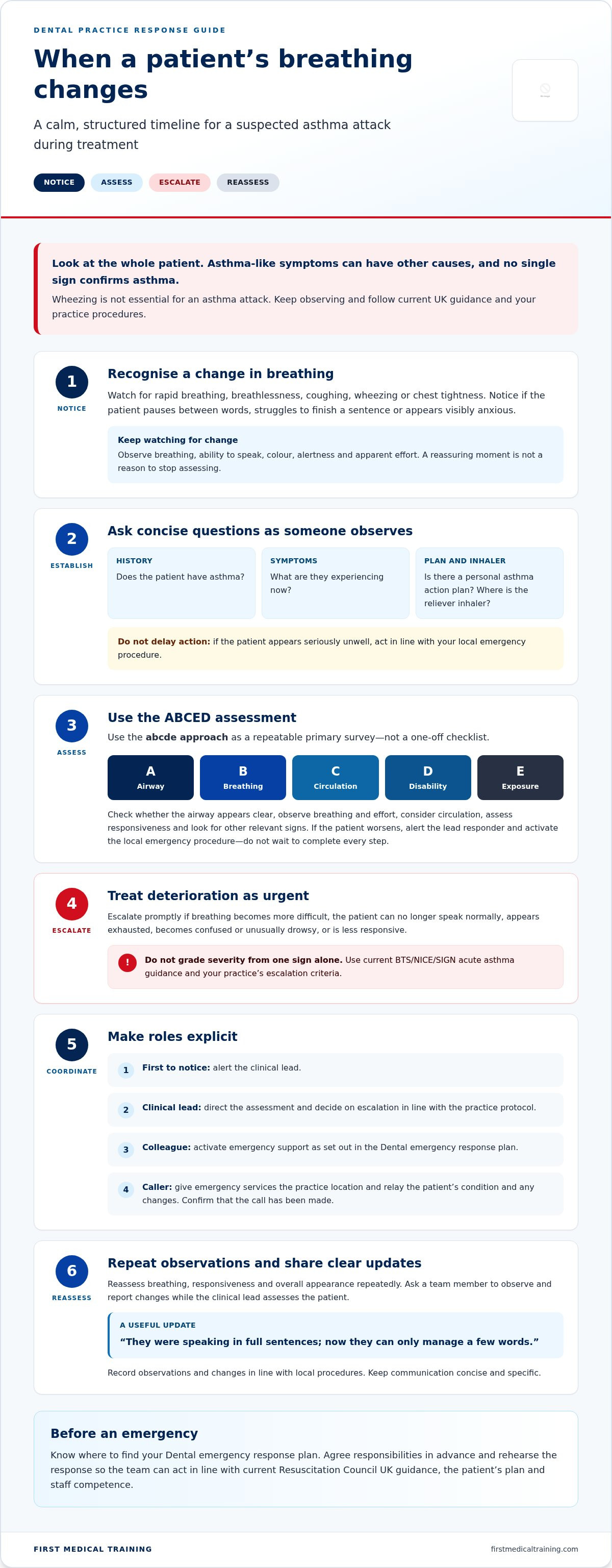
Watch for changes in breathing and communication. The patient may breathe rapidly, appear short of breath, cough, wheeze or report chest tightness. They may pause between words, struggle to finish a sentence or become visibly anxious. Symptoms can vary and change during an episode. No single sign confirms asthma. For signs of severe or life-threatening asthma, consult current BTS/NICE/SIGN acute asthma guidance and follow your local emergency protocol.
What information should the team establish first?
Ask concise questions while another team member observes the patient. Find out whether they have asthma, what symptoms they have now and whether they have a personal asthma action plan. Ask where their reliever inhaler is, but don’t let questions delay action if their condition appears serious. Note what you observe and when it changes so the lead responder can use that information during reassessment and escalation.
Keep your response structured, calm and within your training. This guide supports clinical decision-making; it doesn’t replace professional judgement, current UK guidance or your practice’s emergency procedures. If the patient deteriorates, treat the change as urgent and activate the response in your local protocol. Follow Resuscitation Council UK guidance for medical emergencies in primary dental care, and make sure the team knows where to find its Dental emergency response plan.
Assess the patient and identify when symptoms need urgent escalation
Use a structured assessment to organise your observations, identify immediate concerns and communicate changes. The ABCED assessment covers Airway, Breathing, Circulation, Disability and Exposure. It helps you consider the patient as a whole instead of focusing only on wheezing or breathlessness. Follow current UK guidance and your practice’s emergency procedures. If the patient is deteriorating, don’t let the sequence delay escalation.
Asthma guidance from outside the UK can provide general background, but clinical decisions should follow current UK recommendations. For example, the National Heart, Lung, and Blood Institute (NHLBI) information on asthma provides general information, while UK acute asthma guidance should inform practice procedures and treatment decisions.
Use the abcde approach without delaying escalation
Use the abcde approach as a repeatable primary survey, not a one-off checklist. Check whether the airway appears clear, observe breathing and the patient’s effort, consider circulation, assess responsiveness and look for other relevant signs. Keep each check focused. If the patient worsens at any point, alert the lead responder and activate the local emergency procedure rather than waiting to complete every step.
Ask one team member to observe and report changes while the clinical lead assesses the patient. Share concise, specific updates. For example: “They were speaking in full sentences; now they can only manage a few words.” Record observations and changes in line with local procedures. Reassess breathing, responsiveness and overall appearance repeatedly. One normal observation does not establish that the patient is stable.
Recognise deterioration and activate emergency support
Escalate promptly if breathing becomes more difficult, the patient can no longer speak normally, appears exhausted, becomes confused or unusually drowsy, or is less responsive. These changes are concerning, but no single sign should be used in isolation to grade severity. Follow current BTS/NICE/SIGN acute asthma guidance for clinical features of severe or life-threatening asthma, and use the practice’s escalation criteria. Check thresholds and treatment decisions against current guidance, the patient’s plan and staff competence.
Agree responsibilities before an emergency occurs. The team member who first notices deterioration should alert the clinical lead. The lead directs the assessment and decides on escalation in line with the practice protocol. Another colleague should activate emergency support as set out in the Dental emergency response plan. Assign someone to communicate with emergency services, give the practice location and relay the patient’s condition and any changes. Keep roles explicit and confirm that the call has been made.
Effective asthma attack management in a clinical setting depends on repeated assessment and timely communication, not a single score or observation. Rehearsing these roles through the Medical Emergencies in a Dental Practice Course gives your team a chance to practise a clear response in its clinical environment.
Distinguish possible asthma symptoms from other urgent presentations
Breathlessness, coughing and wheezing can occur during an asthma attack, but they don’t identify its cause on their own. In a dental practice, keep other urgent presentations in mind, particularly if the onset or pattern differs from the patient’s known asthma or their condition changes unexpectedly. A history of asthma is useful context, not proof that every episode of breathing difficulty is asthma.
Use observable features as prompts for further assessment, not as a diagnostic checklist. The comparisons below can help you describe what you notice to the clinical lead. They cannot confirm or rule out a condition, and more than one problem may be present.
- Wheeze, cough or chest tightness with breathing difficulty: Asthma may be one possibility, especially if the patient has a relevant history. These features aren’t exclusive to asthma, so assess the whole presentation and follow current guidance.
- Sudden breathing difficulty during eating or after a possible airway obstruction: Consider whether choking or another airway problem could be involved. Don’t assume the symptoms are asthma because the patient has a history of it.
- Breathing difficulty with sudden swelling, a rash or other new symptoms after a possible trigger: Consider an allergic emergency, including anaphylaxis. Symptoms can overlap, so use current UK guidance and escalate concerns.
- Breathlessness with unexpected features, such as collapse, marked chest discomfort or reduced responsiveness: Consider whether another serious cause may be involved alongside asthma. These clues don’t establish a diagnosis; reassess and follow the appropriate emergency response.
What can make an acute respiratory presentation difficult to interpret?
Different urgent conditions can affect breathing, and a distressed patient may struggle to describe what they feel. Ask about known asthma and any personal action plan, but continue assessing the situation. A familiar history can guide your questions; it must not narrow the team’s attention or replace clinical judgement. Treat the list above as prompts for observation, not a test for diagnosing the cause.
When should the team consider an alternative emergency?
Widen your assessment if the episode begins abruptly, follows a possible choking or allergic trigger, or includes features that don’t fit the patient’s usual asthma pattern. Tell the clinical lead what changed and when. Don’t delay appropriate action while trying to settle on a diagnosis from signs alone. For asthma attack management in a clinical setting, reassess when the cause is uncertain or the patient deteriorates, and escalate in line with current UK guidance and the Dental emergency response plan.
Manage a suspected asthma attack: coordinate a clear team response
Act promptly and keep the response organised. Stop dental treatment, make the immediate area safe and tell the team what you have observed. One person should lead the assessment; colleagues should carry out assigned tasks without crowding the clinical space. Follow your practice’s Dental emergency response plan and current Resuscitation Council UK guidance. These steps support a coordinated response, but clinical actions must reflect current guidance, the patient’s plan and each team member’s competence.
Allocate roles and communicate clearly
Use names and direct instructions so each task has a clear owner. Ask the colleague taking a task to confirm it, then report back when it’s complete. This closed-loop communication helps reduce uncertainty and lets the lead maintain oversight while another team member observes the patient.
- Stop treatment and lead. The clinician in charge directs the initial response and continues assessing the patient.
- Bring support and equipment. Assign a colleague to fetch the emergency equipment identified in the local response plan, including the emergency drug kit if required by the protocol.
- Manage communication. Ask a team member to contact emergency services when indicated by the practice procedure, share the practice location and relay the patient’s condition.
- Keep observing and reporting. Assign a colleague to note changes in breathing, speech and responsiveness, and report them promptly to the lead.
For a handover, use the SBAR tool: Situation, Background, Assessment, Recommendation. State what is happening, give relevant history, summarise the patient’s current condition and explain what support is needed. Keep the message factual and concise. If the patient’s condition changes during a call or handover, update the lead and the receiving service.
Follow the patient’s plan and local emergency procedure
Ask a colleague to locate the patient’s individual asthma action plan, if available, while the assessment continues. Use it alongside current UK clinical guidance, but don’t let finding the document delay urgent action. Medication choices, administration and dosing must follow current guidance and local procedures, and be carried out only by staff with appropriate competence. Don’t improvise or rely on a remembered dose.
Reassess the patient throughout the response. Report any deterioration to the lead immediately and escalate in line with the practice protocol. The person assigned to call for emergency support should confirm that the call has been made and communicate further changes as needed. Once care has been handed over, document observations, actions, decisions and communication according to practice policy.
Clear roles and rehearsed communication make asthma attack management in a clinical setting more organised under pressure. To practise a coordinated dental emergency response with your team, explore the Medical Emergencies in a Dental Practice Course.
Prepare your dental team with relevant asthma emergency training
Knowing the response steps is only part of being ready. Your team also needs to practise how those steps work in your surgery, using its layout, equipment and staff roles. Rehearsal can bring practical questions to light before an emergency: who leads the assessment, who brings equipment and how the team will summon support. It also gives colleagues a chance to practise speaking clearly and responding calmly together.
The GDC expects dental professionals to keep their knowledge and skills up to date, and staff to practise together in simulated medical emergencies. Resuscitation Council UK guidance for primary dental care provides a framework for preparing to manage these situations. Use both to shape regular practice, and check your approach against current guidance and local requirements.
Rehearse the response in the clinical environment
Use in-practice training to make rehearsal relevant to how your practice operates. Run a simulated scenario in which a patient develops breathing difficulty during treatment. Focus on recognition, team coordination and escalation rather than asking staff to diagnose from a single sign. Before starting, explain that the exercise is simulated and agree how it will be stopped.
Practise the sequence in your actual surgery:
- Assign roles. Name the person leading the assessment, the colleague bringing equipment and the person responsible for communication and calling for support.
- Practise concise updates. Have team members report changes clearly, confirm instructions and give a structured handover using the SBAR tool when appropriate.
- Walk through escalation. Rehearse how the team follows local procedures to request emergency support, including who makes the call and what information they provide.
- Debrief together. Discuss what went well, where there was uncertainty and whether equipment or instructions were difficult to locate.
Use the debrief to review the Dental emergency response plan. Update roles, equipment locations or communication steps where appropriate, then make sure the revised plan is accessible to the team. A scenario should help staff understand how to apply the plan, not replace current clinical guidance or individual competence.
Use dental CPD to strengthen team confidence
Relevant CPD supports the knowledge behind practical rehearsal. The Medical Emergencies in a Dental Practice Course gives dental teams a structured opportunity to develop their understanding of emergency response, with training content aligned to Resuscitation Council UK guidance. First Medical Training Ltd has provided specialised education since 2006. After training, connect the learning to a practice scenario so staff can relate clinical guidance to their roles, communication and local procedures.
Preparedness grows through current knowledge, clear plans and regular team practice. Explore medical emergency training for dental practices to support your team’s development in asthma attack management in a clinical setting.
Make your team’s next step a practical one
Preparedness grows when your written procedures are familiar and your team has practised using them. Set a date to review your Dental emergency response plan, confirm that each colleague understands their role and arrange a scenario exercise that fits your practice. Use the debrief to identify gaps in communication, equipment access or escalation, then make agreed updates.
Keep clinical decisions grounded in current UK guidance and your team’s training. A calm, coordinated response to asthma attack management in a clinical setting depends on preparation, not guesswork, so your team can put its plan into action when a patient needs help.
Build on that preparation with relevant professional development. Explore medical emergency CPD for dental teams and take a practical next step towards a team that is ready to respond.
Frequently Asked Questions
Can an asthma attack happen during dental treatment?
Yes, a patient may develop or experience worsening asthma symptoms during a dental appointment. If breathing difficulty begins during treatment, stop the procedure and assess the patient rather than assuming it is a routine reaction to stress or the clinical environment. Ask about their asthma history and current symptoms while following your practice’s emergency procedure. If their condition is severe or deteriorating, escalate promptly in line with current guidance.
Is wheezing always present during an asthma attack?
No. Wheezing may occur, but its absence doesn’t rule out an asthma attack or mean the breathing difficulty is less serious. Consider the patient’s overall presentation, including breathing effort, ability to speak and responsiveness, and whether their condition is changing. Don’t use one sound or symptom to make a diagnosis. If the situation is concerning or unclear, reassess and follow your emergency escalation procedures.
What happens if a patient has asthma symptoms but no reliever inhaler?
Don’t delay urgent assessment or escalation while looking for a personal inhaler. Follow the practice emergency procedure and current UK guidance, including the appropriate use of emergency medicines available to the practice by staff with relevant competence. Do not give medication outside your training or local protocol. If the patient is severely unwell, worsening or not responding to appropriate action, activate emergency support and continue monitoring until help takes over.
Can anxiety be mistaken for an asthma attack in a clinical setting?
Yes, anxiety can involve rapid breathing or distress, and asthma symptoms can also cause anxiety. The two can be difficult to distinguish from appearance alone, and they may occur together. Don’t dismiss breathing difficulty as anxiety, particularly if it is new, worsening or accompanied by other concerning changes. Continue assessing, ask focused questions and use the patient’s history as context, not as a substitute for clinical judgement.
Should the dental team follow a patient’s written asthma action plan?
Yes, use the patient’s written asthma action plan when available, alongside current clinical guidance and your practice’s emergency procedures. The plan may clarify the patient’s usual treatment and the actions advised for worsening symptoms. It doesn’t replace assessment or escalation if the patient deteriorates. Ask a colleague to locate it while another team member continues to focus on the patient.
What should the team document after a suspected asthma attack?
Document the timeline and relevant facts in line with practice policy. Include the symptoms observed, changes in the patient’s condition, relevant history or action-plan information, observations made, actions taken, medicines given and by whom, and any advice or handover details. Record whether emergency support was contacted and when care was transferred. Keep the entry factual and distinguish what the patient reported from what team members observed.