

Dental ILS Training for Hygienists: The 2026 Guide to GDC Compliance

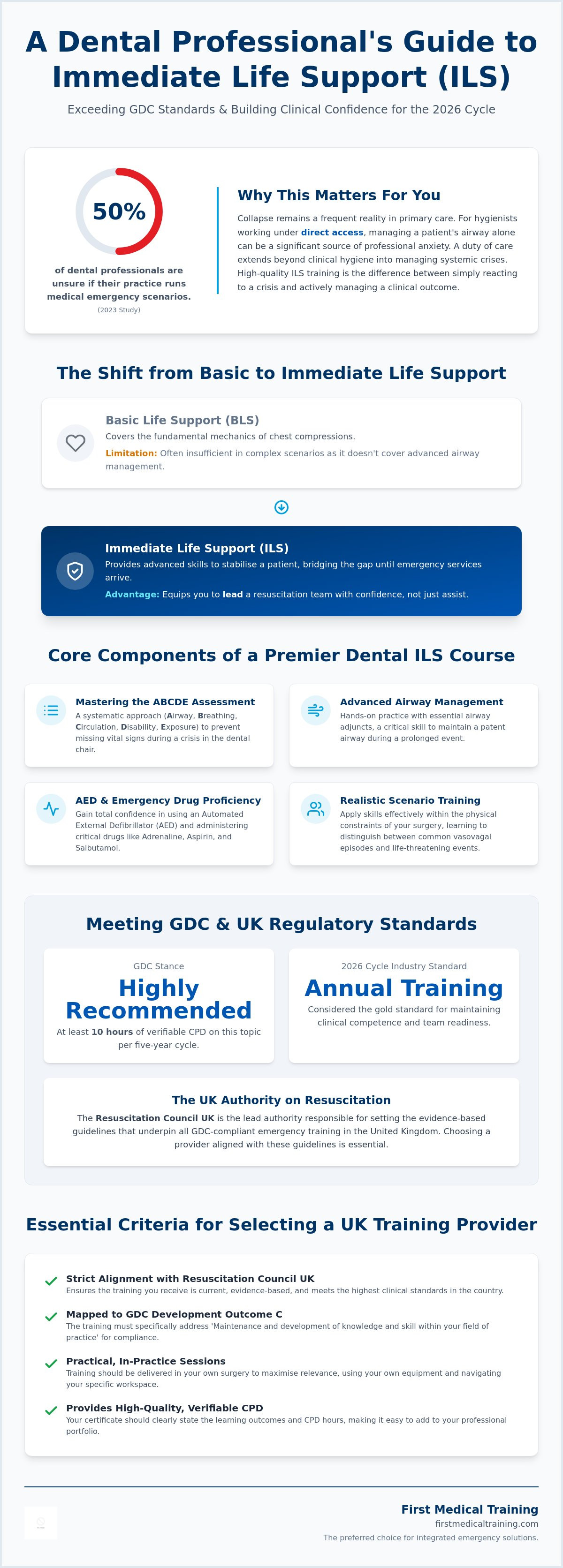
A 2023 study revealed that nearly 50% of dental professionals are unsure if their practice even runs medical emergency scenarios, yet collapse remains a frequent reality in primary care. If you're working under direct access, the prospect of managing a patient's airway alone can be a significant source of professional anxiety. It's often difficult to distinguish between standard requirements and the high level of ils training for dental hygienists needed to truly feel prepared. You shouldn't have to choose between losing clinical hours and meeting your regulatory obligations.
We recognise the need for clear, authoritative guidance that turns compliance into a practical clinical asset. This guide will show you how to select a training provider that ensures you exceed GDC standards for the 2026 cycle while building genuine mastery of AEDs and airway adjuncts. You'll learn how to secure high quality, verifiable CPD that fits seamlessly into your practice routine. We'll break down the essential protocols and equipment requirements that will empower you to act with steady reliability when every second counts.
Key Takeaways
- Understand why advanced airway management is vital for hygienists working under direct access and how it bridges the gap between Basic and Advanced Life Support.
- Learn how comprehensive ils training for dental hygienists utilises the ABCDE framework and hands-on airway adjunct practice to prepare you for clinical emergencies.
- Discover the essential criteria for selecting a UK training provider, focusing on strict alignment with Resuscitation Council UK guidelines and GDC Development Outcome C.
- Get practical advice on auditing your emergency drugs and organising your surgery space to maximise the efficiency of in-practice training sessions.
- Explore why First Medical Training Ltd is the preferred choice for integrated emergency solutions, including specialised equipment like the LifeVac anti-choking device.
What is Dental Immediate Life Support (ILS) and Why is it Essential for Hygienists?
Dental Immediate Life Support (ILS) represents a critical clinical bridge in the patient care pathway. While Basic Life Support (BLS) covers the fundamental mechanics of chest compressions, ILS provides the advanced skills necessary to stabilise a patient between the initial collapse and the arrival of the ambulance service. It's a sophisticated resuscitation standard that equips you with the tools to manage a deteriorating patient with precision. For the modern professional, high-quality ils training for dental hygienists is the difference between simply reacting to a crisis and actively managing a clinical outcome.
The ethical obligation to provide a high standard of care is paramount, especially when a patient loses consciousness in the chair. You have a duty of care that extends beyond clinical hygiene into the management of systemic crises. Understanding what constitutes a dental emergency is only the starting point; you must also possess the technical ability to intervene. This is particularly vital for hygienists working under direct access, where you may be the most senior clinician in the room during those first few high-stakes minutes of a medical emergency.
The Shift from BLS to ILS in Modern Clinical Practice
Clinical standards in 2026 have shifted to favour ILS, particularly in practices that offer complex treatments or conscious sedation. BLS alone is often insufficient in these environments, as it doesn't cover the advanced airway management techniques required to maintain a patent airway during a prolonged arrest. Choosing specialised ils training for dental hygienists ensures you can lead a resuscitation team, rather than just assisting. This training provides the verifiable CPD hours essential for your professional portfolio, proving you've met the rigorous standards expected of a lead clinician.
GDC Compliance and Annual Training Cycles for 2026
The GDC categorises medical emergencies training as "Highly Recommended," suggesting that registrants dedicate at least 10 hours per five-year cycle to this topic. However, to maintain clinical competence and meet the expectations of the 2026 cycle, annual training is the recognised industry standard. The Resuscitation Council UK is the lead authority responsible for setting the evidence-based guidelines that underpin all GDC-compliant emergency training in the United Kingdom. Staying current with these annual updates ensures you remain fully aligned with GDC CPD requirements for medical emergencies, protecting both your patients and your professional registration.
Core Clinical Components of a Premier Dental ILS Course
High-quality ils training for dental hygienists focuses on the practical application of life-saving skills within the physical constraints of a surgery. It isn't enough to know the theory of resuscitation; you must be able to perform it effectively whilst managing equipment and navigating a limited workspace. This level of training transforms a generic protocol into a bespoke clinical toolset that fits your specific working environment.
Mastering the ABCDE Assessment in a Dental Context
The ABCDE framework provides a systematic approach to patient assessment. In a dental setting, this begins the moment you notice a change in a patient's colour or responsiveness whilst they are in the chair. By moving through Airway, Breathing, Circulation, Disability, and Exposure, you create a logical flow that prevents vital signs from being missed during a crisis. It's about building a rhythm that remains steady even when adrenaline levels are high.
Distinguishing between common issues like vasovagal episodes and life-threatening cardiac events is vital. Effective syncope management dental training teaches you to recognise early warning signs, such as pallor and diaphoresis, before they escalate. This proactive approach allows for earlier intervention, often preventing a full collapse from occurring in the first place.
A premier course also ensures total confidence in using an Automated External Defibrillator (AED) and administering emergency medications. This includes the precise use of adrenaline for anaphylaxis, aspirin for suspected myocardial infarction, and salbutamol for acute asthma. Following the GDC guidance on medical emergencies, every clinical area must have immediate access to this equipment and the skills to deploy it. Understanding the pharmacology of your drug kit is essential; you need to know exactly how to prepare and administer these treatments under pressure.
Advanced Resuscitation Skills for the Clinical Team
Effective emergency response is a team effort. For hygienists, this often involves coordinating with a dental nurse to manage airway adjuncts like oropharyngeal airways or supraglottic devices. Hands-on practice with bag-valve-mask (BVM) ventilation and high-flow oxygen therapy is a non-negotiable part of ils training for dental hygienists. These skills allow the team to maintain oxygenation whilst awaiting the ambulance service.
Managing a patient collapse requires more than just technical skill; it requires spatial awareness. Dental surgeries are often compact, with fixed equipment that can hinder access. A premier training provider will help you rehearse scenarios within your own clinical space. This includes practising the safe transfer of a patient from the dental chair to the floor if necessary, whilst maintaining effective CPR and airway control. If you want to ensure your team is prepared for these high-pressure scenarios, consider booking a Dental Immediate Life Support (ILS) Training session delivered directly in your surgery.
How to Evaluate Dental ILS Training Providers in the UK
Choosing the right provider for ils training for dental hygienists is a decision that carries significant weight, impacting both your clinical confidence and your regulatory standing. It isn't enough to simply tick a box; you need a partner who understands the specific pressures of the dental environment. The gold standard for any dental resuscitation course is strict adherence to the Resuscitation Council UK quality standards. This alignment ensures that the protocols you learn are evidence-based and recognised by the GDC as the definitive standard for primary care.
You should also scrutinise the trainer's background. A professional with generic medical experience is helpful, but they must be able to translate those skills into a dental context. They need to understand the ergonomics of a dental chair and the specific layout of a surgery. Ask if they can demonstrate how to manage a collapse in a confined space whilst coordinating a team of dental professionals. This practical, industry-specific knowledge is what separates a generic course from a premier clinical education.
The Benefits of In-Practice Team Training over E-Learning
Remote e-learning provides a foundation for theoretical knowledge, but it cannot replicate the physical demands of a real-world emergency. In-practice training is the superior choice for building muscle memory. When you train in your own surgery, you're not just practising on a manikin; you're rehearsing within the exact environment where an emergency would occur. This reduces response times because you know exactly where your equipment is stored.
An in-practice session also serves as a vital clinical audit. It's the ideal time to verify that your oxygen cylinders are full, your AED is functional, and your emergency drugs are in date. This hands-on approach ensures that your ils training for dental hygienists translates directly into practice readiness. Team-based drills foster better communication, ensuring that every staff member, from the hygienist to the receptionist, knows their role during a high-stress incident.
Accreditation and Verifiable CPD Standards
In the 2026 GDC cycle, a simple certificate of attendance is insufficient for your professional portfolio. You must ensure that your training provider issues verifiable CPD that meets the GDC's Development Outcome C. This requires clear learning objectives and a method for assessing that those objectives have been met during the session. First Medical Training Ltd has acted as a seasoned mentor in this field since 2006, prioritising high-impact education that stands up to regulatory scrutiny. We focus on providing a structured, methodical journey from theoretical curiosity to full professional readiness, ensuring your certification is a true reflection of your clinical competence.
Preparing Your Surgery for an ILS Training Session
Effective ils training for dental hygienists depends heavily on the preparation of the clinical environment. A well-prepared surgery allows the trainer to focus on high-impact drills rather than troubleshooting equipment failures. Before your session begins, you should perform a comprehensive walk-through of your emergency response setup. This ensures that the simulation is as realistic as possible, allowing your team to practice with the exact tools they would use in a real crisis.
Organising a clear, safe space within the surgery is the first priority. You'll need enough floor space for practical CPR and airway drills, ensuring the team can move freely around the manikin. It's also vital that all clinical staff are available to participate simultaneously. A patient collapse requires a coordinated effort between the hygienist, the nurse, and the wider team. Rehearsing these roles together builds the collective confidence needed to manage a deteriorating patient effectively.
Conducting a Pre-Training Equipment and Drug Audit
Audit your kit. It's a simple step that prevents training delays. Start by checking the expiry dates on your essential drug kit, specifically midazolam, adrenaline, and glucagon. These medications are critical for managing anaphylaxis, status epilepticus, and hypoglycaemia. If your drugs are nearing their limit, the training session is the perfect time to identify what needs replacing.
Prepare your AED and oxygen cylinders for the simulated drill. Ensure your AED pads are in-date and the battery is fully functional. Oxygen cylinders should be checked to verify they are full and the flow meters are working correctly. Using this time to review your dental practice emergency preparedness ensures that your equipment is ready for both the trainer and a potential real-world emergency.
Minimising Surgery Downtime whilst Maximising Team Learning
Scheduling training during protected time, such as staff development afternoons, is the best way to avoid patient disruption. This allows the team to focus entirely on the clinical skills being taught without the pressure of a waiting room full of patients. Many practices find it highly efficient to have one provider cover ILS, AED, and First Aid at Work in a single, comprehensive session. This holistic approach saves time and ensures a consistent standard of training across the board.
A seasoned trainer won't just teach the curriculum; they will help you identify specific gaps in your current emergency protocols. They can suggest improvements to your surgery layout or communication strategies that could save vital seconds during an incident. If you want to ensure your practice meets the highest standards of safety, you can book our Dental Immediate Life Support (ILS) Training to be delivered directly in your surgery.
Why First Medical Training Ltd is the Leading UK Choice for Dental ILS
Selecting a provider for ils training for dental hygienists requires more than just checking for a compliant syllabus; it requires a partner who understands the nuance of your daily clinical life. First Medical Training Ltd was established in 2006, giving us two decades of expertise specifically tailored to the dental sector. We aren't a generalist first aid company that happens to offer dental courses. We are specialists who have spent years acting as a seasoned mentor to clinical teams across the United Kingdom, ensuring that every professional we train feels empowered to act in a crisis.
Our approach at First Medical Training Ltd prioritises clinical confidence over mere box-ticking. We understand that the gravity of life-saving topics can be overwhelming, so our trainers adopt a supportive, authoritative, and reassuringly confident style. We demystify complex resuscitation procedures, breaking them down into manageable, pragmatic segments that you can apply immediately in your surgery. This steady reliability is why practices return to us for every annual cycle.
Bespoke Scenarios Tailored to Your Clinical Environment
We don't believe in a one-size-fits-all training model. Every dental practice has a unique layout, a specific team size, and its own set of clinical challenges. Our trainers at First Medical Training Ltd adapt every scenario to your physical environment, ensuring that ils training for dental hygienists is relevant to where you actually work. Whether you are managing a collapse in a compact hygiene suite or coordinating a team response in a large multi-surgery clinic, we provide the practical tools you need.
This bespoke mentorship is a core element of our Medical Emergencies in a Dental Practice Course. We bridge the gap between rigorous GDC requirements and real-world application, ensuring your team moves from theoretical knowledge to professional readiness with discipline and focus.
Beyond Resuscitation: Integrating LifeVac and Mental Health First Aid
First Medical Training Ltd offers integrated solutions that go beyond standard resuscitation protocols. We are an authorised supplier of the LifeVac anti-choking device, a critical addition to any dental resuscitation kit. We integrate the use of this equipment into our training, ensuring your team is prepared to manage choking emergencies in the waiting room or the chair with certainty.
We also recognise that a truly prepared practice looks after its staff as well as its patients. First Medical Training Ltd is the only provider to seamlessly integrate Mental Health First Aid for dental teams into our wider educational framework. This holistic approach ensures your practice is prepared for every type of emergency, from acute cardiac arrest to the long-term impact of staff burnout. By choosing First Medical Training Ltd, you are investing in a comprehensive safety culture that protects your registration, your patients, and your colleagues.
Elevate Your Clinical Readiness for the 2026 GDC Cycle
Mastering Immediate Life Support is about more than just maintaining your registration; it's about the quiet confidence that comes from knowing you can handle a crisis with precision. You've seen how a systematic ABCDE approach and advanced airway management can stabilise a patient during those first critical minutes. By moving beyond basic skills, you're ensuring that your practice remains a safe environment for every patient under your care. Securing high quality ils training for dental hygienists ensures you meet the GDC's rigorous standards whilst building genuine competence in using AEDs and emergency drugs.
Choosing a provider that understands the unique pressures of the dental surgery is essential for professional growth. First Medical Training Ltd has been a trusted partner to UK dental practices since 2006, delivering GDC compliant verifiable CPD directly to your team. As specialist suppliers of LifeVac anti-choking technology, we provide the integrated tools and mentorship needed to protect your patients and your professional reputation. Don't leave your emergency response to chance. Book your in-practice Dental ILS training with First Medical Training Ltd today and take the final step towards total clinical readiness. You have the skills to make a difference; we're here to help you perfect them.
Frequently Asked Questions
Is ILS training mandatory for all dental hygienists in the UK?
The GDC requires all registrants to be competent in resuscitation and the management of medical emergencies. Whilst the term "ILS" isn't explicitly named in the legislation, it's the recognised clinical standard for professionals to meet these obligations. For those working under direct access, ils training for dental hygienists provides the advanced airway skills necessary to manage a patient safely until an ambulance arrives.
How often should a dental team undergo ILS training to remain compliant?
Annual training is the established requirement for dental teams in the United Kingdom. Both the GDC and the Resuscitation Council UK advocate for yearly updates to ensure that life-saving skills don't deteriorate. Regular practice ensures that every team member remains confident in their role and up to date with the latest evidence-based resuscitation protocols.
What is the main difference between BLS and ILS for a dental practice?
Basic Life Support (BLS) focuses on fundamental chest compressions and rescue breaths suitable for any environment. Immediate Life Support (ILS) is a more advanced clinical standard designed for healthcare settings. It includes the use of airway adjuncts, bag-valve-mask ventilation, and safe defibrillation, alongside the coordination of a professional team response during a cardiac arrest.
Can our ILS training be counted towards our annual GDC CPD requirements?
Yes, our ils training for dental hygienists provides verifiable CPD that counts towards your professional portfolio. The GDC categorises medical emergencies training as "Highly Recommended" and it aligns directly with Development Outcome C. This outcome focuses on the maintenance and development of your clinical knowledge and skills within your field of practice.
What emergency equipment do we need to have present for our ILS course?
You should have your practice's standard emergency drugs kit, oxygen cylinders, and Automated External Defibrillator (AED) ready for the session. We also require your airway management equipment, including oropharyngeal airways and bag-valve-masks. Practising with your own equipment ensures that the training is realistic and that every staff member knows exactly where these items are stored in the surgery.
Do dental receptionists need to attend the ILS training with the clinical team?
The GDC recommends that the entire dental team, including non-clinical staff, participates in medical emergency training together. Receptionists are often the first point of contact during a crisis, responsible for calling 999 and directing the ambulance crew. Training as a complete unit ensures that communication remains clear and that everyone understands their specific responsibilities during a high-pressure incident.
How long does a typical Dental ILS course take to complete in-practice?
A comprehensive in-practice session usually takes between four and six hours to complete. This duration allows for a thorough blend of theoretical knowledge and hands-on practical drills tailored to your specific surgery layout. We work efficiently to ensure your team gains maximum clinical value with minimal disruption to your patient schedule.
What are the 2026 GDC requirements for medical emergencies CPD?
For the 2026 cycle, dental hygienists must complete a total of 75 hours of verifiable CPD over a five-year period. The GDC highly recommends that at least 10 of these hours are dedicated to medical emergencies training. Maintaining an annual training rhythm is the most effective way to meet these hours whilst ensuring your clinical skills remain sharp and compliant.