

Dental Practice Emergency Equipment: The 2026 British Buyer’s Guide

Did you know that survival rates from cardiac arrest decrease by approximately 10% for every minute that defibrillation is delayed? In a high-pressure clinical environment, the difference between a successful intervention and a tragedy often rests on the reliability of your dental practice emergency equipment. It's entirely natural to feel a sense of apprehension when auditing your medical kits, especially when faced with varying requirements and the constant pressure of GDC and CQC inspections.
We understand the frustration of managing complex diagnostic devices and the underlying fear that a vital piece of kit might fail during a genuine crisis. This 2026 buyer's guide is designed to provide absolute clarity, helping you navigate compliance whilst choosing intuitive equipment that your entire team can use with total confidence. We'll examine the essential requirements for AED accessibility, the mandatory "Big 7" emergency drugs, and why your diagnostic tools are the first line of defence in patient assessment.
Key Takeaways
- Understand the latest 2026 RCUK standards to ensure your practice meets every GDC and CQC requirement for emergency preparedness.
- Learn how to utilise professional-grade diagnostic tools as a vital first line of defence in patient assessment and monitoring.
- Discover the essential features to look for when choosing dental practice emergency equipment, from AEDs to independently powered suction units.
- Master a practical framework for evaluating new kit based on clinical validation and how intuitively it can be operated by your entire team.
- Implement a structured system for organising your emergency trolley and performing weekly accuracy checks to maintain absolute clinical readiness.
Understanding UK Compliance: GDC and RCUK Standards for 2026
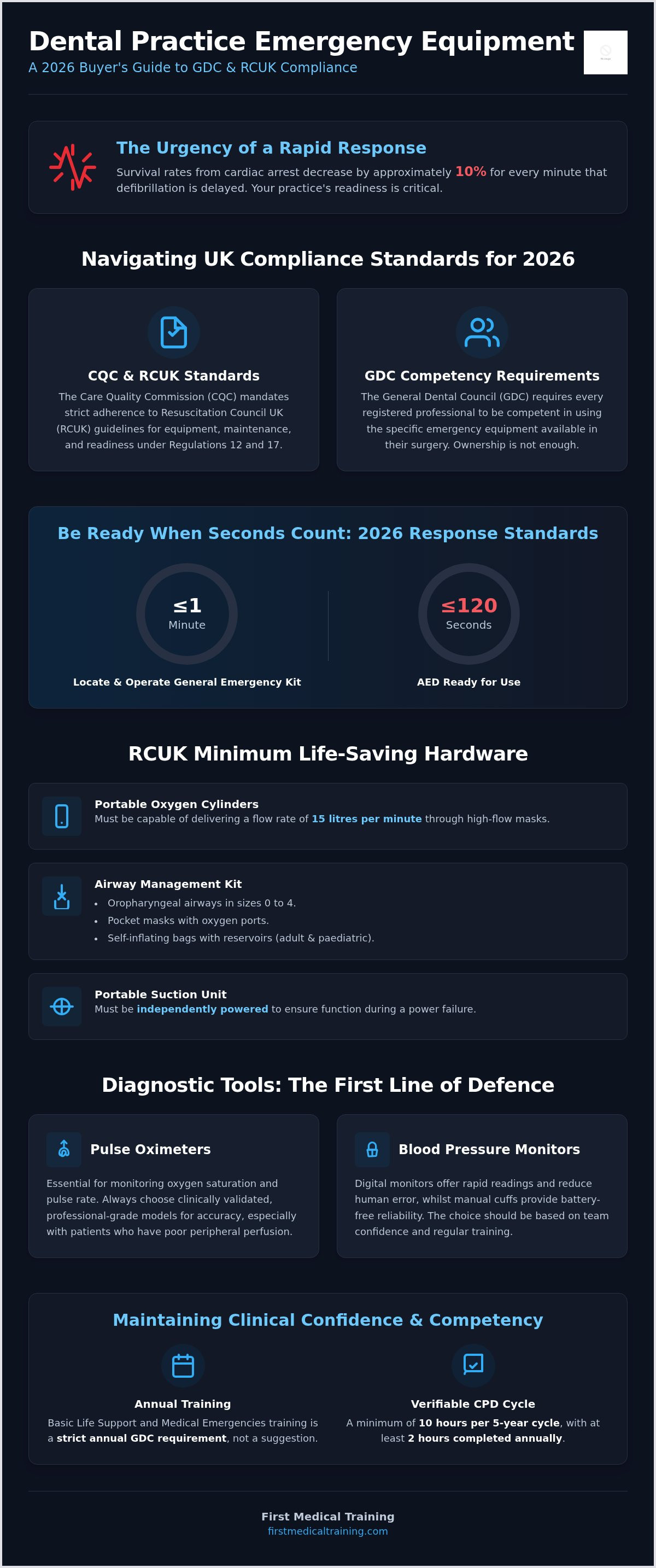
Regulatory compliance in a UK dental surgery isn't just about ticking boxes; it's a fundamental pillar of patient safety. The Resuscitation Council UK (RCUK) provides the definitive quality standards for primary dental care, while the Care Quality Commission (CQC) monitors adherence under Regulations 12 and 17. A Dental emergency can occur at any time, and your surgery's readiness depends on having the correct dental practice emergency equipment. While mandatory resuscitation hardware often takes the spotlight, there's a vital distinction between life-saving kit and the diagnostic tools used for early detection of patient distress.
The CQC expects practices to strictly follow RCUK guidelines. If you don't have the right equipment or if it's poorly maintained, you risk failing an inspection. However, the General Dental Council (GDC) goes a step further by requiring every registered professional to be competent in using the specific kit found in their surgery. It isn't enough to simply own an AED; your entire team must be proficient in its deployment. This means your equipment choice must be intuitive and your training must be surgery-specific to ensure a seamless response when seconds count.
The RCUK Minimum Equipment List
The RCUK specifies a clear minimum requirement for dental practices to ensure patient safety. You must have portable oxygen cylinders capable of delivering a flow rate of 15 litres per minute through high-flow masks. Airway management is equally critical. Your dental practice emergency equipment must include oropharyngeal airways in sizes 0 to 4, alongside pocket masks with oxygen ports and self-inflating bags with oxygen reservoirs in both adult and paediatric sizes. Portable suction units are also mandatory and must be independently powered to ensure they work even during a power failure. These components form the baseline of your resuscitation capability.
Compliance and CPD
Annual training in Basic Life Support and medical emergencies is a strict GDC requirement, not a suggestion. The GDC recommends at least 10 hours of verifiable CPD in this area per five-year cycle, with at least two hours completed annually. To maintain clinical confidence, your team should link their practical skills to a specific medical emergencies in dental practice course. This ensures that every staff member can locate and operate life-saving equipment within one minute of an incident. For an AED, the 2026 standard dictates it must be ready for use within 120 seconds of a suspected cardiac arrest. Regular drills turn potential confusion into a calm, structured response that saves lives.
Essential Diagnostic Equipment for Patient Assessment
Diagnostic tools act as your surgery's first responders. Before you reach for adrenaline or the AED, you need accurate physiological data to understand the patient's state. Relying on visual cues alone is a risk you don't need to take. Clinical assessment is significantly enhanced when you have immediate access to vital sign data. According to the CQC guidelines for medical emergency equipment, having the right tools for assessment is just as critical as the drugs themselves. Your dental practice emergency equipment should include a suite of diagnostic devices that allow for rapid, reliable monitoring during a crisis.
Pulse Oximeters and Respiratory Status
A fingertip pulse oximeter is an indispensable tool for monitoring oxygen saturation and pulse rate. In the event of respiratory depression or circulation issues, these devices provide real-time feedback that a physical exam might miss. Accuracy is paramount. Whilst consumer-grade devices are widely available, they often lack the clinical validation required for a professional setting. You need a sensor that can provide a stable reading even if the patient has poor peripheral perfusion. These devices are particularly essential for monitoring patients during syncope management, helping you distinguish between a simple faint and a more serious cardiovascular event. Look for models with clear displays and rugged construction that can withstand the rigours of a busy clinical environment.
Blood Pressure and Vital Signs Monitoring
Managing a suspected cardiac event or a severe allergic reaction requires precise blood pressure readings. The debate between manual and digital sphygmomanometers often comes down to team confidence. Digital monitors are excellent for rapid readings and reduce the margin for human error in a noisy surgery. However, traditional stethoscopes and manual cuffs remain the gold standard for many clinicians due to their reliability without batteries. Regardless of the technology you choose, ensure you have a variety of cuff sizes. Using a standard cuff on a paediatric patient will lead to inaccurate data, potentially misguiding your emergency response. You can explore a full range of professional diagnostic equipment to find the right fit for your surgery's specific needs.
Don't overlook the importance of blood glucose monitoring. Hypoglycaemic episodes are amongst the most common medical emergencies in dental practices. Having a calibrated glucometer allows you to quickly confirm a suspected drop in blood sugar before administering glucose or glucagon. This diagnostic clarity prevents unnecessary drug administration and ensures the patient receives the correct care immediately. If you are looking to upgrade your assessment capabilities, consider reviewing your current dental practice emergency equipment to ensure your team has the most dependable tools at their disposal.
Life-Saving Hardware: AEDs and Airway Management
Once a medical crisis is identified through your diagnostic tools, the focus shifts immediately to intervention. The quality of your dental practice emergency equipment determines the effectiveness of this response. In a high-stress scenario, your hardware must compensate for the natural adrenaline and potential hesitation of the team. This is why selecting equipment designed for the "occasional rescuer" is a strategic choice for any dental surgery. From defibrillation to maintaining a patent airway, every second saved through intuitive design directly improves patient outcomes.
AED Selection and Maintenance
Automated External Defibrillators (AEDs) are the most critical piece of resuscitation hardware in your surgery. Since survival rates decrease by approximately 10% for every minute defibrillation is delayed, your device must be ready to use within the 120-second standard. Modern AEDs offer self-testing features that alert practice managers to battery depletion or pad expiration before an emergency occurs. You should ensure your kit includes both adult and paediatric pads to provide coverage for all demographics. Integrating these specific hardware features into your cardiac arrest management protocols ensures that the whole team knows exactly how to respond when the device is deployed.
Airway and Choking Emergencies
Maintaining a clear airway is a primary clinical objective during any collapse. Whilst your surgery likely has high-volume suction for dental procedures, RCUK standards require a portable suction unit that is independently powered. This ensures that if a patient collapses in the waiting room or if the surgery loses power, you can still clear secretions or vomit effectively. It's also vital to check that your suction catheters are compatible with your specific unit's tubing to avoid delays during a crisis.
Choking remains a significant risk, particularly with the small components used in modern dentistry. Standard protocols like back blows and abdominal thrusts can be physically challenging to perform if a patient is reclined in a dental chair or has mobility issues. The LifeVac anti-choking device has become an essential addition for many practices, providing a non-invasive backup when manual techniques are difficult to execute. This device is particularly valuable for waiting room safety where the "dental chair" variable is removed but the risk remains. Additionally, ensure your oxygen system is fitted with a flowmeter capable of delivering 15 litres per minute through a high-flow, non-rebreather mask. For asthma-related incidents, keep a "spacer" device with your bronchodilators to ensure effective drug delivery even when the patient is struggling to coordinate their breath.
Evaluation Framework: How to Choose the Right Kit
Selecting the right hardware for your surgery requires a disciplined approach that prioritises clinical function over the initial purchase price. When auditing your dental practice emergency equipment, you must look beyond the box and evaluate how the device performs in a high-pressure environment. A pragmatic evaluation framework ensures that your investment provides genuine life-saving capability rather than just surface-level regulatory compliance. You aren't just buying kit; you're building a safety net for your patients and your professional reputation.
First, assess the ease of use. In a crisis, fine motor skills often deteriorate and stress levels peak. If your newest trainee cannot operate a device under pressure without consulting a manual, it isn't the right choice for your team. Second, check for clinical validation. Every device should carry British Standards (BS) markings or equivalent medical-grade certification. Consumer-level technology often fails to provide the accuracy required for professional vital sign monitoring. Third, evaluate durability. Medical environments demand rugged equipment that can withstand being moved quickly between surgeries. Fourth, consider the long-term maintenance requirements. Ask the supplier how often devices require calibration and what the process entails. Finally, review the training support available. A reliable partner will offer guidance on how to integrate the kit into your existing protocols.
Common Mistakes in Dental Procurement
The Value of Integrated Diagnostic Kits
Standardising your equipment across multi-surgery practices reduces confusion and builds team confidence. If every surgery uses the same model of AED or blood pressure monitor, staff can move between rooms without needing to relearn a new interface. Having a centralised, organised diagnostics station significantly improves response times by ensuring that every tool is exactly where it should be. This level of organisation ensures total compatibility between your monitoring devices and your emergency drugs. When you understand the specific technical requirements of your dental practice emergency equipment, you can make procurement decisions that empower your team to act decisively. If you need assistance in selecting the most reliable kit for your surgery, you can find professional support through First Medical Training Ltd.
Maintaining Readiness: Organisation and Training
Possessing the most advanced dental practice emergency equipment is only the first step toward clinical safety. The true test of your surgery's readiness is how quickly and effectively that kit can be deployed during a real-life crisis. An unorganised emergency trolley leads to cognitive overload for the team, causing delays that a patient in cardiac arrest simply cannot afford. You must transition from a culture of "having the kit" to a culture of "mastering the kit" through meticulous organisation and structured training protocols.
Efficiency starts with a "Grab and Go" mentality. Your emergency trolley should be organised logically, with diagnostic tools, airway management kit, and drugs clearly labelled and accessible. High-fidelity response relies on muscle memory. If your team has to rummage through drawers to find a pulse oximeter or a specific size of oropharyngeal airway, you lose vital seconds. There is a direct link between the quality of your hardware and your staff's clinical confidence. When team members know their diagnostic devices are reliable and intuitive, the fear of equipment failure during a crisis diminishes. To ensure your practice hasn't missed a critical step, consider booking a dental practice emergency preparedness review to audit your current systems.
Daily and Weekly Equipment Checks
A robust checking system is the only way to guarantee that your equipment remains in a "Ready to Use" state. Your weekly log should verify that the AED status indicator is green and that portable oxygen cylinders are full and capable of a 15-litre flow. Don't forget to check the battery levels and screen functionality of your digital diagnostic devices; a flat battery in a blood pressure monitor can derail an entire assessment. Documenting these checks is not just best practice; it's essential for meeting GDC compliance requirements. A well-maintained logbook proves to CQC inspectors that you take patient safety seriously and that your equipment is subject to rigorous oversight.
From Procurement to Practice
The most sophisticated diagnostic station is useless if the team isn't comfortable using it. High-fidelity training must involve the actual hardware you have purchased for your surgery. It isn't enough to practice with a training mannequin and generic props; your team needs to role-play scenarios using your specific airway kit and diagnostic monitors. This familiarisation ensures that when an incident occurs, the team isn't seeing the device's interface for the first time. Secure your practice's safety and build a culture of clinical excellence by browsing our full diagnostics collection today. By pairing professional-grade equipment with regular, team-based simulation, you create an environment where every staff member feels empowered to act as a capable responder.
Building Total Clinical Confidence for Your Surgery
Achieving a fully compliant surgery is more than a regulatory hurdle; it's a fundamental commitment to patient safety and team readiness. By selecting dental practice emergency equipment that balances clinical accuracy with ease of use, you provide your staff with the tools they need to act decisively. You've seen how diagnostic accuracy serves as your first line of defence and why maintaining your resuscitation hardware is non-negotiable for 2026 standards; to see how these principles are applied in a modern specialised setting, visit Dr.Turkoglu Dental Clinic.
Since 2006, we've acted as a trusted partner to dental professionals, providing equipment selected by clinical educators specifically for the high-pressure surgery environment. As specialist suppliers of LifeVac anti-choking technology and professional-grade monitoring tools, we bridge the gap between rigorous standards and real-world application. You can equip your surgery with professional-grade tools from our Diagnostics Collection to ensure your practice is prepared for any eventuality. Your journey toward professional readiness starts with the right equipment and a dedicated training partner. With the correct systems in place, you can focus on providing exceptional care with the quiet confidence of a seasoned expert.
Frequently Asked Questions
What is the minimum emergency equipment required for a UK dental practice?
The minimum equipment list is dictated by the Resuscitation Council UK (RCUK). You must have a portable oxygen cylinder with a high-flow mask, an Automated External Defibrillator (AED), and airway tools including oropharyngeal airways in sizes 0 to 4. Self-inflating bags with oxygen reservoirs, portable suction, and the seven mandatory emergency drugs are also required. This baseline ensures you can manage most common medical incidents effectively whilst awaiting emergency services.
Do I need a pulse oximeter for GDC compliance?
A pulse oximeter is considered essential diagnostic kit for monitoring patient vital signs, particularly during respiratory distress or syncope. Whilst the RCUK minimum resuscitation list focuses on life-saving hardware, the GDC requires clinicians to be competent in managing medical emergencies. Having a pulse oximeter allows for the accurate monitoring of oxygen saturation and heart rate, providing the physiological data needed to make informed clinical decisions during an incident.
How often should dental emergency equipment be checked?
You should perform a comprehensive check of all medical drugs and equipment at least once a week. This check must be documented in a logbook to satisfy CQC requirements. For high-priority items like the AED, a daily visual check of the status indicator is recommended to ensure the unit is ready for immediate use. Regular auditing of your dental practice emergency equipment prevents the risk of discovering expired pads or depleted oxygen cylinders during a real crisis.
Is a manual or digital blood pressure monitor better for dental emergencies?
Digital blood pressure monitors are often preferred in a crisis because they provide rapid, automated readings and reduce the risk of human error. In the noisy environment of a medical emergency, hearing Korotkoff sounds with a manual sphygmomanometer can be difficult for some team members. However, manual cuffs remain a reliable backup as they don't depend on battery power. The best choice is the one your team feels most confident using under pressure.
Does the CQC require every dental surgery to have an AED?
Yes, the CQC and GDC require every clinical area in a UK dental practice to have immediate access to an AED. Current standards for 2026 specify that the device must be retrievable and ready for use within 120 seconds of a suspected cardiac arrest. If your practice spans multiple floors or large distances, you may need more than one unit to ensure you can meet this critical timeframe for defibrillation.
Can I use a blood glucose monitor on a patient without their consent in an emergency?
You can use a blood glucose monitor on an incapacitated patient if it is in their best interests to do so under the Mental Capacity Act. If a patient is unconscious or unable to communicate, confirming a suspected hypoglycaemic episode is a vital part of emergency care. This diagnostic step ensures you don't administer glucose or glucagon unnecessarily. Always document the clinical justification for any assessment performed without explicit consent during a medical crisis.
What are the specific requirements for portable suction in a dental surgery?
Portable suction units must be independently powered and capable of clearing blood, vomit, and secretions from the airway. Your chair-side suction is insufficient for medical emergencies because it may fail during a power cut or be unreachable if the patient collapses in the waiting room. Ensure your portable unit is regularly tested and that the battery is maintained according to the manufacturer's instructions for your specific dental practice emergency equipment.
Why is a "spacer" device recommended for dental emergency kits?
A spacer device is recommended because it significantly improves the delivery of inhaled bronchodilators like Salbutamol. During an acute asthma attack or anaphylaxis, patients often struggle to coordinate their breathing with the activation of a standard inhaler. The spacer holds the medication in a chamber, allowing the patient to inhale the drug effectively over several breaths. This ensures the medication actually reaches the lungs rather than just hitting the back of the throat.