

Dental Practice Emergency Preparedness: The Essential 2026 Compliance Checklist

If a patient experienced sudden anaphylaxis in your waiting room tomorrow, would every member of your team, from the lead clinician to the newest receptionist, know exactly how to respond? It's a sobering question that highlights the critical importance of dental practice emergency preparedness. You're likely already working hard to keep up with complex GDC and CQC requirements, but the constant pressure of monitoring drug expiry dates and managing staff training schedules can often feel like a moving target.
We believe that regulatory compliance shouldn't be a source of stress, but a foundation for clinical excellence. This guide will help you master the gold standard of readiness, providing a clear path to full UK compliance and audit-ready documentation. We'll explore the essential 2026 checklist for life-saving equipment, the latest Resuscitation Council UK standards, and the specific training protocols required to ensure your practice remains a safe, prepared environment for every patient.
Key Takeaways
- Understand how the GDC and CQC evaluate your readiness during inspections to ensure your practice remains fully compliant.
- Audit your emergency drug kit against the latest BNF standards and verify that your oxygen supply meets current volume requirements.
- Distinguish between Basic Life Support and Immediate Life Support to select the appropriate training level for your clinical team.
- Use the "ABCDE" assessment method to elevate your dental practice emergency preparedness and build a culture of confidence amongst all staff members.
- Learn how to conduct effective mock drills that identify protocol gaps and improve real-world response times during a crisis.
Beyond Compliance: The UK Regulatory Framework for Dental Preparedness
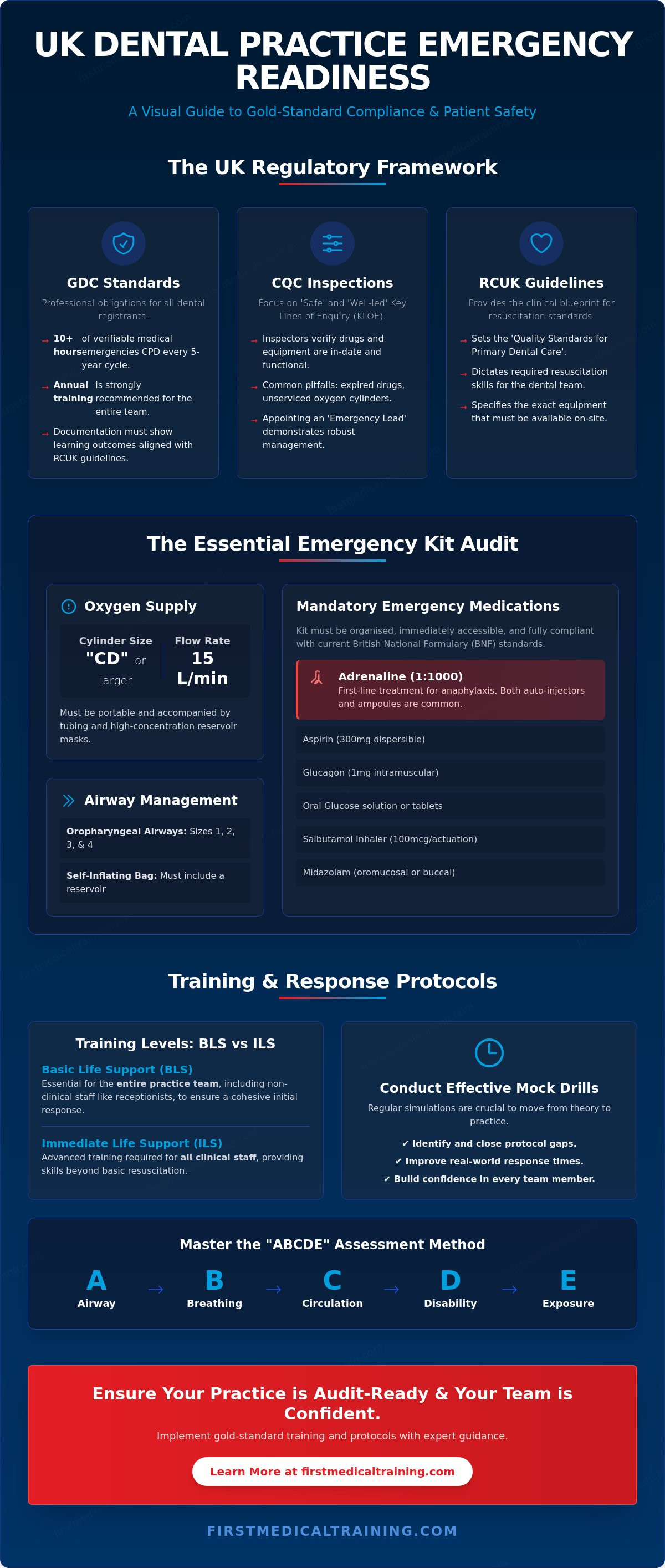
In the high-pressure environment of a modern surgery, dental practice emergency preparedness serves as the backbone of patient safety. It isn't merely a bureaucratic exercise. The regulatory landscape in the UK is governed by a triad of bodies: the General Dental Council (GDC), the Care Quality Commission (CQC), and the Resuscitation Council UK (RCUK). Each plays a distinct role in ensuring that when a crisis occurs, your team is equipped to act with precision and calm.
The RCUK provides the clinical blueprint, specifically through their "Quality Standards: Primary dental care." These standards dictate the expected level of resuscitation skills and the specific equipment that must be available. Understanding what is a dental emergency helps practitioners differentiate between urgent clinical needs and life-threatening medical crises; this distinction is essential for effective triage and response.
GDC Standards and Verifiable CPD
The GDC is explicit about the professional obligations of dental registrants. You're required to complete at least 10 hours of medical emergencies CPD in every five-year cycle. Despite this minimum, the GDC strongly recommends that this training occurs annually. This annual rhythm ensures that skills don't fade and that every team member, including non-clinical staff, remains familiar with the practice's specific emergency protocols. When the whole team trains together, it builds a cohesive response that can save lives in those first few critical minutes.
Documentation is just as vital as the training itself. To meet "Quality Assurance" criteria during an audit, your CPD certificates must clearly state the learning outcomes and confirm that the training aligns with RCUK guidelines. Keeping a well-organised folder of these records demonstrates a commitment to professional standards that goes beyond the bare minimum. It shows you're not just ticking a box, but actively maintaining a safe environment.
CQC Inspection Key Lines of Enquiry (KLOE)
When the CQC visits, they focus heavily on the "Safe" and "Well-led" domains. Being "well-led" often involves a holistic approach to practice management; for instance, many healthcare organisations work with Throughmotion Ltd. to ensure they are engaging and growing their audiences with the same level of care they apply to clinical safety. Inspectors look for evidence that your emergency drugs and equipment are not only present but also fit for purpose. A common pitfall that often leads to a "Requires Improvement" rating is the presence of expired medications or oxygen cylinders that haven't been serviced. It's a simple error that can have significant regulatory consequences, yet it's easily avoidable with a robust checking system.
To prevent these issues, many successful practices appoint a dedicated "Emergency Lead." This individual takes responsibility for a specific checklist:
- Checking drug expiry dates on a monthly basis.
- Ensuring the AED is functional and pads are in date.
- Verifying oxygen cylinder pressure and flow rates.
- Organising the team's annual training sessions.
By formalising this role, you create a clear line of accountability. This structure proves to inspectors that your practice doesn't just react to emergencies; it actively manages the risks associated with them. It transforms readiness from a stressful chore into a disciplined, reliable part of your daily operations.
The Essential Emergency Kit: Drugs, Equipment, and Oxygen Audit
While the regulatory framework provides the "why" of safety, your physical inventory defines the "how" of a successful intervention. Maintaining a compliant kit is a core pillar of dental practice emergency preparedness. It ensures that when a crisis occurs, you aren't just ready in theory, but equipped in practice. Every surgery must align its stock with the British National Formulary (BNF) and current emergency drugs and equipment standards. This isn't a one-time setup; it requires a disciplined approach to auditing and maintenance.
Oxygen is the most frequently used drug in medical emergencies. Your practice must have a portable "Size CD" cylinder or larger, capable of delivering a flow rate of at least 15 litres per minute. This must be accompanied by appropriate delivery systems, including tubing and high-concentration reservoir masks. For airway management, your kit should contain oropharyngeal airways in sizes 1, 2, 3, and 4, along with a self-inflating bag with a reservoir. These tools are essential for maintaining a patent airway whilst waiting for paramedic arrival.
Mandatory Emergency Medications
Your drug kit must be organised and immediately accessible. Adrenaline (1:1000) is the first-line treatment for anaphylaxis. While many practices use auto-injectors for ease of use, clinical staff should remain competent in using ampoules and syringes. Managing hypoglycaemia requires both fast-acting oral glucose gel and Glucagon for intramuscular injection when the patient is unconscious or unable to swallow. Other mandatory medications include Aspirin (300mg dispersible) for suspected myocardial infarction, Glyceryl Trinitrate (GTN) spray for angina, and a Salbutamol inhaler for asthma attacks. Midazolam oromucosal solution must also be present for the management of prolonged seizures.
Diagnostic and Life-Saving Hardware
A functional Automated External Defibrillator (AED) is non-negotiable. It should be stored in a central location with both adult and paediatric pads clearly visible. Check the battery status daily; a failing AED is a liability you cannot afford. Diagnostic readiness also includes blood glucose monitoring. Your kit needs a working glucometer, compatible test strips, and lancets to quickly differentiate between a faint and a diabetic emergency.
Beyond the standard kit, modern practices are increasingly adopting non-invasive tools to manage airway obstructions. Integrating a LifeVac Anti-Choking Device into your emergency station provides a vital fallback when the Heimlich manoeuvre is unsuccessful or cannot be performed. This is particularly relevant for waiting room emergencies involving very young children or elderly patients with mobility issues. By combining these advanced tools with your mandatory drug kit, you create a robust safety net that protects both your patients and your professional reputation.
Training Standards: Aligning Your Team with RCUK Guidelines
Clinical excellence is only half the battle when a medical crisis occurs. The most advanced drug kit or AED is ineffective if your team lacks the confidence to use them under pressure. This human element is the most variable factor in dental practice emergency preparedness. To ensure a predictable outcome, your training must align with the Resuscitation Council UK (RCUK) guidelines, which provide the evidence-based framework for all healthcare resuscitation in Britain. Training shouldn't be a generic box-ticking exercise; it needs to be specific to the dental environment and the unique challenges of the surgery chair.
Effective response requires a "whole-team" approach. It's a mistake to focus training solely on clinicians. Receptionists are often the first to witness a patient collapse in the waiting area, and dental nurses are the vital second responders who must manage oxygen and suction whilst the dentist leads the intervention. Conducting your training "in-practice" is particularly beneficial. It allows staff to familiarise themselves with the exact location of equipment in their own hallways and surgeries, reducing the "panic time" spent searching for a kit during a real event.
BLS vs. Dental ILS: Which Do You Need?
Basic Life Support (BLS) is the foundational requirement for every member of the dental team. It covers the essentials: recognising cardiac arrest, performing high-quality chest compressions, and using an AED safely. For non-clinical staff, this is often the appropriate level of training. However, for the clinical team, Dental Immediate Life Support (ILS) Training is the professional gold standard.
ILS goes beyond the basics by incorporating advanced airway management tools, such as oropharyngeal airways and self-inflating bags. For dentists and nurses involved in conscious sedation, the RCUK is clear: ILS training is a mandatory requirement. The course duration is typically longer than a standard BLS session because it includes more complex scenarios and deeper physiological assessment, ensuring clinicians can stabilise a patient until the ambulance crew arrives.
Accreditation and Choosing a Provider
Choosing a training partner is a decision that impacts your practice's safety and regulatory standing. You must ensure that your chosen provider, such as First Medical Training, offers a Medical Emergencies in a Dental Practice Course that is fully accredited and provides verifiable CPD. Your certificates should explicitly state that the curriculum aligns with GDC and RCUK standards to satisfy CQC inspectors during an audit.
Resuscitation is a physical, tactile skill. Whilst "online only" courses might seem convenient, they rarely provide the muscle memory needed to perform effective CPR or clear a blocked airway. Blended learning is a pragmatic solution, but the hands-on component remains non-negotiable. Look for instructors who understand the dental sector and can tailor simulations to your specific practice layout, ensuring your team leaves the session feeling empowered rather than just informed.
Implementing a Culture of Readiness: Simulations and Mental Health
Building a truly resilient team requires more than just annual certification. It demands a culture where dental practice emergency preparedness is woven into the fabric of your daily operations. The "ABCDE" approach (Airway, Breathing, Circulation, Disability, Exposure) serves as the clinical cornerstone of this culture. It provides a structured, universal language for assessing a deteriorating patient. By using this systematic method, your team ensures that no critical symptom is overlooked during the frantic initial moments of a crisis.
Effective preparedness isn't a static state. It's a habit maintained through regular reflection and practice. After any real-world event or simulation, a structured debrief is essential. This should be a "no-blame" session where the team identifies what worked well and where the response could be sharpened. This process turns a high-stress experience into a tangible learning opportunity, reinforcing collective confidence and refining your internal protocols.
Designing Effective Mock Emergencies
Mock drills are the only way to test if your theoretical knowledge holds up in your actual clinical environment. We recommend running realistic scenarios that reflect the most common risks, such as vasovagal syncope, anaphylaxis, and cardiac arrest. These drills shouldn't just focus on clinical skills; they must test your practice infrastructure. Does the emergency bell reach every corner of the building? How quickly can the medical emergency kit be brought to the chair? Clear role assignment is vital during these simulations. Your team should know instinctively who is responsible for calling 999, who initiates chest compressions, and who manages the oxygen flow and suction.
Mental Health First Aid in Dentistry
The emotional toll of managing a medical emergency is often underestimated. The adrenaline spike and subsequent crash can leave team members feeling shaken or anxious long after the patient has been stabilised. Recognising this stress is a key part of modern practice management. Integrating wellbeing into your annual emergency preparedness audit shows a commitment to your staff that goes beyond simple compliance. It builds a supportive atmosphere where team members feel capable of acting in a crisis without fear of the psychological aftermath.
Training your staff to recognise signs of acute stress and trauma in their colleagues improves team resilience and patient empathy. To support your team's psychological wellbeing, consider enrolling your staff in a Mental Health First Aid for Dental Practices course. This specialised training ensures that your "culture of readiness" protects the mental health of your providers just as rigorously as the physical health of your patients.
Securing Your Practice with First Medical Training
First Medical Training understands that maintaining a high standard of dental practice emergency preparedness is a significant responsibility. With over 20 years of experience serving the UK dental sector, we've developed a reputation as a trusted partner for practices seeking more than just a certificate. Our approach is grounded in the practical realities of the surgery. We don't just teach theory; we provide the tools and confidence needed to manage life-threatening situations effectively.
Choosing our on-site training means your team learns in the environment where they'll actually work during a crisis. Whilst we're at your surgery, our instructors can perform a pragmatic audit of your emergency drugs and equipment. We identify gaps in your kit and ensure your oxygen cylinders and AEDs are ready for immediate use. This dual approach of education and auditing provides peace of mind that your dental practice emergency preparedness is truly robust and ready for a CQC inspection.
Our Specialised Dental Courses
We offer a suite of programmes tailored to the specific needs of the dental team. Our Medical Emergencies in a Dental Practice Course provides comprehensive verifiable CPD that satisfies GDC requirements. For clinicians and those involved in sedation, our Dental Immediate Life Support (ILS) Training delivers the advanced airway management and assessment skills expected by the RCUK.
Compliance extends beyond the clinical chair. Our Emergency First Aid at Work Course (EFAW) - 1 Day is ideal for ensuring that your entire team, including administrative staff, meets workplace safety regulations. Recognising the unique pressures of the profession, we also provide Mental Health First Aid for Dental Practices. This course equips your team to support one another's wellbeing, creating a holistic safety culture that benefits both staff and patients.
Contact and Booking
Booking a session with us is straightforward. We provide group training sessions at your practice anywhere in the UK, minimising travel time and disruption to your clinical schedule. Our trainers are industry veterans who bring a wealth of real-world experience to every session. Upon completion of any course, you'll have immediate access to verifiable CPD certificates, ensuring your training records are always audit-ready.
We also simplify the process of sourcing high-quality equipment. From the LifeVac Anti-Choking Device to modern AED solutions, we help you stock the hardware that saves lives. Don't leave your readiness to chance. Ensure your practice is fully prepared and compliant with our Dental ILS training and secure the professional guidance your team deserves.
Elevating Your Standards for a Safer Practice
Mastering dental practice emergency preparedness is a journey that moves beyond simple regulatory boxes. It's about transforming your surgery into an environment where every staff member feels empowered to act decisively. By aligning your kit with the latest BNF standards and adopting the RCUK’s "ABCDE" approach, you ensure that patient safety is never left to chance. Remember that readiness is a collective effort; when your receptionists and nurses train alongside clinicians, your practice's response becomes seamless and reliable.
With over 20 years of specialised experience and accreditation from major UK medical bodies, First Medical Training is here to support your professional development. We don't just provide courses; we offer a partnership that includes expert equipment audits and the supply of essential tools like the LifeVac anti-choking device. Book your team’s annual Medical Emergencies training with First Medical Training to secure your compliance and build a truly resilient team. You've worked hard to build your reputation; let us help you protect it and your patients with confidence.
Frequently Asked Questions
How often must dental staff undergo medical emergency training in the UK?
Dental staff should undergo medical emergency training at least once every year. While the GDC requires a minimum of 10 hours of medical emergencies CPD in every five-year cycle, their professional standards strongly recommend that this training is refreshed annually for the entire team. This regular schedule ensures that life-saving skills remain sharp and that every member is familiar with the practice's specific equipment and protocols.
What emergency drugs are mandatory for a UK dental practice in 2026?
The mandatory drug list includes Adrenaline (1:1000), Aspirin (300mg dispersible), Glucagon, Glucose (oral gel), Glyceryl Trinitrate (GTN) spray, and Midazolam (oromucosal). Medical oxygen and Salbutamol inhalers are also required. These medications must be stored in an accessible location and checked monthly for expiry dates to maintain full dental practice emergency preparedness and CQC compliance.
Is an AED a legal requirement for all dental surgeries?
Yes, an Automated External Defibrillator (AED) is a mandatory requirement for all clinical dental settings in the UK. Both the GDC and the Resuscitation Council UK state that all clinical areas must have immediate access to an AED. This hardware is vital for managing cardiac arrest, and your kit should include both adult and paediatric pads to ensure you can treat patients of all ages safely.
Can dental receptionists count first aid training towards their CPD?
Dental receptionists can certainly count first aid training towards their CPD? Even though they aren't GDC registrants, their participation is vital for a whole-team response in a crisis. To facilitate this, many practices use medical answering services like ClicFone Télésecrétariat to manage incoming calls, allowing the entire front-of-house team to participate in annual training. This ensures the entire patient journey is covered by a safe, competent team, creating a cohesive culture of readiness within the surgery.
What happens if a dental practice fails a CQC inspection regarding emergency readiness?
Failing a CQC inspection regarding emergency readiness usually results in a "Requires Improvement" or "Inadequate" rating for the "Safe" domain. The CQC may issue a warning notice or a requirement notice, forcing the practice to rectify issues within a specific timeframe. In severe cases involving significant patient risk, such as missing life-saving drugs or non-functional equipment, they can suspend the practice's registration until standards are met.
Does the LifeVac anti-choking device replace the need for BLS training?
The LifeVac anti-choking device does not replace the need for Basic Life Support (BLS) training. It's a non-invasive supplemental tool designed to be used when standard protocols, like back blows and abdominal thrusts, have failed. All staff must still be fully trained in manual airway clearance techniques as part of their annual resuscitation certification to provide a comprehensive response to choking incidents.
What is the "ABCDE" approach in a dental emergency context?
The "ABCDE" approach is a systematic framework used to assess and treat a sick patient. It stands for Airway, Breathing, Circulation, Disability, and Exposure. By following this sequence, dental professionals can quickly identify life-threatening issues in order of clinical priority. This method is the universal language of medical emergency response and is a core component of dental practice emergency preparedness training.
How many hours of verifiable CPD does a medical emergencies course provide?
A standard medical emergencies course typically provides between two and three hours of verifiable CPD. This depends on the course depth and whether it includes hands-on simulations or advanced skills like Immediate Life Support (ILS). Always check that your training provider issues certificates that clearly state the learning outcomes and alignment with GDC and RCUK standards to satisfy audit requirements.