

First Aid for UK Small Businesses: 2026 Compliance Guide

Could your team reach and deploy an Automated External Defibrillator within exactly 120 seconds of a colleague collapsing? Under the updated BS 8599-1:2019+A1:2026 standards, this isn't just a safety goal; it's a specific benchmark that many firms are currently unprepared to meet. It's understandable if the overlap between HSE mandates and GDC expectations feels overwhelming, leaving you worried about potential non-compliance or, worse, a team that freezes during a real-world trauma.
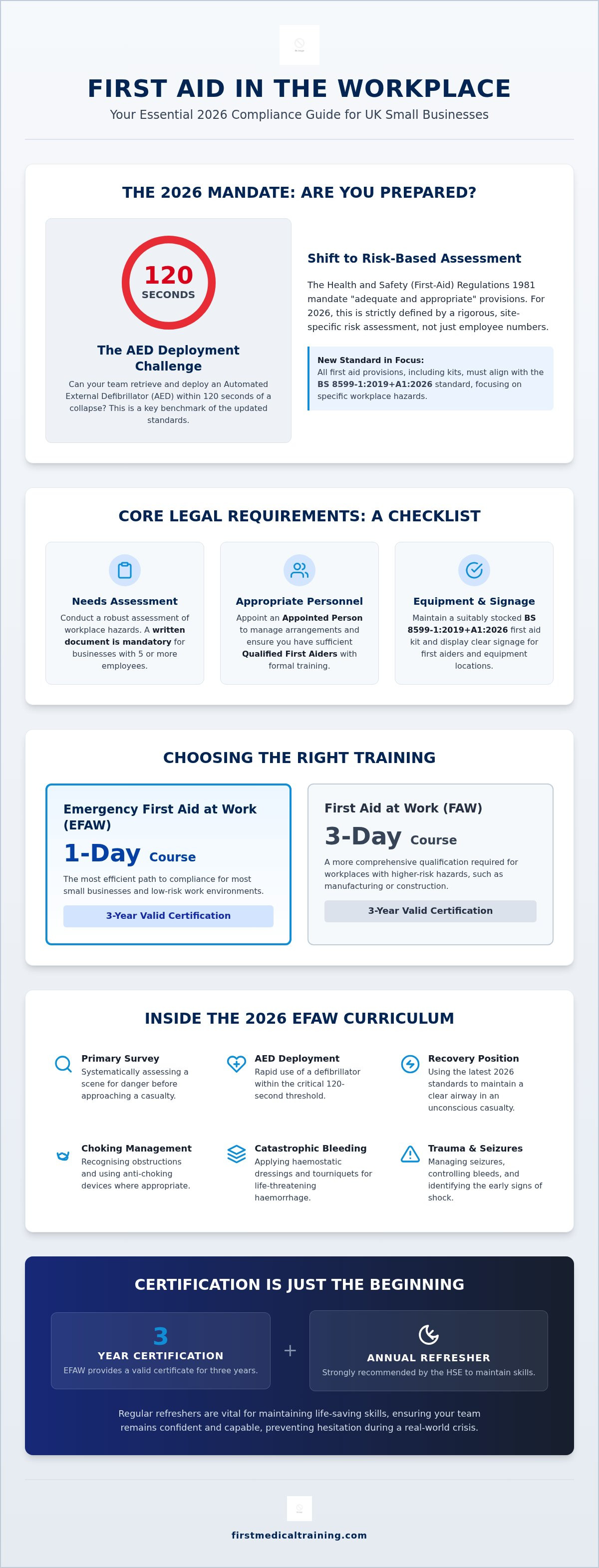
This guide simplifies the essential first aid requirements for small business uk in 2026, helping you navigate the shift towards risk-based assessments with professional certainty. You'll discover how a single day of Emergency First Aid at Work (EFAW) training provides a valid three-year certification and transforms your staff into an empowered, life-saving unit. We'll also clarify the latest requirements for specialist hazard kits and written risk assessments, ensuring your business remains both compliant and resilient in the face of any crisis.
Key Takeaways
- Navigate the latest 2026 updates to first aid requirements for small business uk, focusing on the shift toward risk-based assessments and new kit standards.
- Learn how to conduct a robust First Aid Needs Assessment to ensure your workplace meets the "adequate and appropriate" legal standard.
- Identify the functional differences between the 1-day EFAW and 3-day FAW courses to choose the most efficient path to compliance.
- Gain insights into why a 3-year certification is only the beginning, and why the HSE strongly recommends annual refreshers to maintain life-saving skills.
Understanding First Aid Requirements for Small Business UK
The Health and Safety (First-Aid) Regulations 1981 serve as the statutory foundation for every employer in the country. These regulations mandate that you provide "adequate and appropriate" equipment, facilities, and personnel to ensure your employees receive immediate attention if they're injured or taken ill at work. For those managing first aid requirements for small business uk, this doesn't mean a generic, one-size-fits-all solution. In 2026, "adequate" is defined by a rigorous risk assessment that accounts for specific workplace hazards, the layout of your premises, and the proximity of emergency services.
Understanding the distinction between an Appointed Person and a Qualified First Aider is vital for compliance. An Appointed Person takes charge of first aid arrangements, such as looking after the equipment and calling emergency services. However, they aren't required to have formal training in life-saving techniques. A Qualified First Aider has completed a recognised course, such as the 1-day Emergency First Aid at Work (EFAW) qualification. For most small businesses, having at least one staff member with EFAW certification is the gold standard for dental practice emergency preparedness and general workplace safety.
The Minimum Legal Requirements
Every business, regardless of size, must maintain a suitably stocked first aid box. Since April 2026, these kits must align with the BS 8599-1:2019+A1:2026 standard. This update shifts the focus toward specific hazards, such as catastrophic bleeding or chemical splashes, rather than just the number of employees present. You're also legally required to display clear signage identifying your first aiders and the location of equipment. Even a low-risk office with fewer than five people needs a designated lead to manage these First aid principles and ensure protocols remain current. If you have five or more employees, your first aid needs assessment must be documented in writing to remain compliant.
HSE Compliance vs. Professional Excellence
Compliance is the starting point, but professional excellence involves creating an environment where staff feel genuinely capable. Ticking a box satisfies the inspector; training your team ensures they don't freeze when a real crisis occurs. Meeting the first aid requirements for small business uk is about more than avoiding fines. For clinical environments, EFAW training is particularly effective as it helps satisfy GDC CPD requirements for medical emergencies. This proactive approach builds a culture of reliability. When a team understands the mechanics of response, the anxiety of "what if" is replaced by a methodical, calm readiness that protects both your patients and your reputation.
The 2026 EFAW Curriculum: Essential Skills for the Workplace
The Emergency First Aid at Work (EFAW) curriculum is a structured framework designed for decisive action. It begins with the primary survey, teaching responders to systematically assess a scene for danger whilst ensuring their own safety before approaching a casualty. In 2026, the integration of technology into these protocols is more critical than ever. Resuscitation training now emphasises the "Two-Minute Threshold" for Automated External Defibrillators (AEDs). If your risk assessment identifies five or more people on site, your team must be trained to deploy an AED within 120 seconds of a collapse. This rapid response is a cornerstone of meeting the first aid requirements for small business uk.
Life-Saving Interventions and Trauma
Trauma management covers everything from controlling external bleeding to identifying the subtle, early signs of shock. Whether a wound is minor or life-threatening, the first aider's role is to stabilise the casualty and prevent the condition from worsening. Seizure management is equally vital. Staff are trained to manage different types of collapse, ensuring the individual is protected from further injury whilst the seizure occurs. These hands-on skills are the core of our Emergency First Aid at Work Course (EFAW) - 1 Day, which focuses on building practical confidence through mentored practice.
Incident Management and Reporting
Maintaining compliance with the Health and Safety (First-Aid) Regulations 1981 involves more than just physical intervention; it requires accurate communication and record-keeping. The curriculum teaches the METHANE reporting model, ensuring that when you call 999, the information provided is concise and actionable. You must also understand your legal obligations under RIDDOR for reporting serious workplace accidents. Beyond the paperwork, a responsible employer prioritises post-crisis care. Supporting the mental wellbeing of a first aider after they have managed a trauma is essential for a resilient workplace. Meeting the first aid requirements for small business uk means looking after the people who look after your team.
EFAW vs. FAW: Choosing the Right Training for Your Team
Selecting the appropriate level of training is a critical step in meeting the first aid requirements for small business uk. Whilst the Health and Safety (First-Aid) Regulations 1981 establish the legal duty of care, they don't prescribe a single course for every scenario. Instead, the responsibility lies with the employer to conduct a First Aid Needs Assessment. This framework requires you to look beyond your headcount and evaluate the specific nature of your work, the presence of hazardous materials, and your proximity to the nearest hospital. A small team working in a high-risk environment, such as a workshop with heavy machinery, may require the comprehensive depth of a 3-day First Aid at Work (FAW) course, even if they have fewer than ten employees.
For many, the "low-risk" label is a point of confusion. A standard office might seem low-risk, but this status can change instantly if you introduce clinical equipment or treat vulnerable members of the public. In a dental practice, for example, the presence of oxygen cylinders and the administration of local anaesthetics elevate the risk profile. Even if your certificate is valid for three years, the HSE strongly recommends annual refresher training. Skill fade is a documented reality; without regular practice, the ability to perform high-quality CPR or deploy an AED correctly can diminish within just six months of the initial course.
When is the 1-Day EFAW Sufficient?
The 1-day EFAW course is typically the most efficient solution for small offices, retail units, and dental reception areas. It provides the essential skills needed to manage the most common workplace incidents, from minor cuts to cardiac arrest. To create a truly robust safety culture, many managers choose to pair this baseline training with syncope management training. This combination ensures that staff are not only compliant with first aid requirements for small business uk but are also specifically prepared for the clinical fainting episodes frequently encountered in healthcare settings.
The 3-Day FAW: Identifying High-Risk Scenarios
The 3-day FAW course is mandatory for larger workforces, generally defined as those with 50 or more employees, regardless of the industry. However, it's also the necessary choice for smaller firms involved in construction, manufacturing, or chemical processing. This extended curriculum goes into greater detail regarding major illnesses and complex trauma. It prepares designated "lead" first aiders to manage multiple casualties simultaneously and coordinate with emergency services during a significant site incident. If your assessment identifies that a single responder might be overwhelmed by the complexity of your workplace hazards, the 3-day course is the correct investment.
Organising Your Training: Practical Steps to Compliance
Moving from understanding the legal theory to implementing a practical training plan is where many managers feel the most pressure. To meet the first aid requirements for small business uk, your first action must be completing a formal First Aid Needs Assessment. This document identifies the exact number of first aiders you need based on your specific shift patterns and physical workplace risks. Once your requirements are clear, the next step is to verify your training provider. Look for an organisation with a deep medical background and at least two decades of experience, ensuring their instructors are seasoned professionals who understand the realities of emergency response.
Opting for on-site training is often the most effective way to satisfy first aid requirements for small business uk. When a trainer visits your premises, they can identify hazards specific to your layout, such as narrow stairwells or remote storage areas, and tailor the scenarios accordingly. Finally, prepare your team for the assessment itself. Modern EFAW courses have moved away from high-pressure final exams in favour of continuous evaluation. This approach ensures that every participant is consistently monitored and supported as they develop their skills, leading to a much higher level of practical competence and confidence.
Preparing for the Assessment Day
Success on the day starts with the right mindset and preparation. We recommend that all participants wear comfortable clothing, such as trousers and trainers, as they'll spend a significant portion of the day on the floor practising CPR and the recovery position. Whilst the course is hands-on, some pre-course reading can be incredibly beneficial. Familiarising the team with GDC CPD requirements for dentists or generic HSE guidance ensures everyone arrives with a baseline understanding of their professional responsibilities. This allows the instructor to focus more time on the mentored practice that builds real-world confidence.
Maintaining Audit-Ready Records
Your compliance journey doesn't end when the trainer leaves. You must maintain audit-ready records to satisfy HSE or CQC inspections at a moment's notice. Digital certifications are now the industry standard, providing easy access and preventing the loss of physical paperwork. We suggest setting up automated "Expiry Alerts" well in advance of the 3-year requalification deadline. Remember that whilst the certificate lasts for three years, the HSE strongly recommends annual skills refreshers to combat skill fade. Keeping a log of these shorter sessions demonstrates a superior commitment to safety that goes beyond simple regulatory box-ticking. You can secure your team's compliance and clinical readiness by booking our Emergency First Aid at Work Course (EFAW) - 1 Day today.
Why First Medical Training Ltd is the Trusted Partner for Small Businesses
Since 2006, First Medical Training Ltd has bridged the gap between rigid legislation and the practical confidence needed on the shop floor or in the surgery. We understand that meeting first aid requirements for small business uk is only half the battle; the real victory is a team that acts without hesitation. Our instructors are more than just teachers; they are industry veterans who mentor your staff through the complexities of emergency response. This seasoned perspective ensures that every participant leaves the course feeling capable and empowered rather than merely "certified".
Our nationwide reach means we bring this expertise directly to your premises, allowing for a tailored assessment of your specific environment. We integrate the latest life-saving technology, such as Automated External Defibrillators and the LifeVac Anti-Choking Device, ensuring your team is proficient with the equipment they'll actually use. This on-site focus eliminates the disconnect often found in generic off-site training centres. By training in the very rooms where an incident might occur, your staff develop a spatial awareness that is vital during a high-pressure crisis.
A Specialist Approach to Workplace Safety
Our extensive background in healthcare makes First Medical Training Ltd the natural choice for dental and medical practices requiring a higher tier of clinical readiness. We move beyond generic scenarios to create simulations that reflect your daily professional realities. Founded in 2006, our organisation has spent two decades refining a curriculum that meets national life-saving standards whilst remaining accessible to every team member. This bespoke focus ensures that the skills learned are directly transferable to your unique workplace challenges.
Your Long-Term Compliance Partner
We view our relationship with your business as an ongoing partnership rather than a one-day event. Beyond certification, we provide the professional-grade equipment necessary to maintain a safe environment, from AEDs to advanced airway management tools. Our team remains a dedicated resource for your staff, offering guidance on refresher schedules and regulatory updates long after the initial course concludes. We're here to ensure your practice stays safe, compliant, and ready for anything. Secure your small business compliance-book your EFAW course today.
Empowering Your Team for a Safer 2026
Since our founding in 2006, First Medical Training Ltd has provided two decades of specialist medical expertise to businesses across the country. Our fully HSE and GDC compliant courses are delivered nationwide, integrating essential training with AEDs and LifeVac anti-choking devices as standard. Don't wait for a crisis to test your protocols. Ensure your team is crisis-ready-book your EFAW course now. Taking this step today builds a resilient workplace where safety is a lived reality rather than just a policy on a shelf. You're not just staying compliant; you're protecting your most valuable assets: your people.
Frequently Asked Questions
Is the Emergency First Aid at Work course a legal requirement for small businesses?
The Emergency First Aid at Work (EFAW) course is the recognised standard for meeting first aid requirements for small business uk in low-risk environments. Under the Health and Safety (First-Aid) Regulations 1981, every employer is legally required to provide "adequate and appropriate" personnel and equipment. For many small firms, having at least one EFAW-trained staff member ensures you satisfy this statutory provision whilst protecting your team from common workplace injuries.
How long is the EFAW certificate valid for in the UK?
An EFAW certificate is valid for exactly three years from the date of issue. Once this period expires, the first aider must attend a full one-day requalification course to maintain their status and keep the business compliant. We recommend tracking these dates digitally to avoid a lapse in your legal coverage; an expired certificate means your workplace no longer meets the mandatory requirements for a trained responder.
Can a dental receptionist be the designated first aider?
Yes, a dental receptionist is often the ideal candidate to be the designated first aider. Because they remain at a fixed point within the practice, they can quickly coordinate with emergency services and manage the first aid kit during a crisis. Training non-clinical staff in EFAW ensures that someone is always available to act if a medical emergency occurs in the waiting area or whilst clinical staff are occupied.
How many first aiders does my small business need in 2026?
The number of first aiders you need is determined by your specific First Aid Needs Assessment rather than a fixed headcount. For small, low-risk businesses with fewer than 25 employees, one trained person is usually the minimum. However, you must account for staff holidays, sickness, and varied shift patterns. In 2026, if your site has five or more people present, your assessment must be documented in writing to remain compliant.
Does the EFAW course cover the use of an Automated External Defibrillator (AED)?
Yes, the 2026 EFAW curriculum fully integrates the use of an Automated External Defibrillator as a core skill. Participants learn how to safely deploy the device alongside high-quality CPR. This is a vital component of first aid requirements for small business uk, especially since the latest British Standards recommend that any workplace with five or more people should have an AED accessible within a two-minute round trip.
What is the difference between EFAW and Basic Life Support (BLS)?
Basic Life Support (BLS) focuses primarily on CPR and AED use, whereas EFAW is a comprehensive workplace qualification. EFAW covers a much broader range of scenarios, including wound management, choking, seizures, and the legalities of incident reporting. Whilst BLS is excellent for clinical refreshers, EFAW provides the wider skillset necessary to manage the variety of accidents and illnesses that can occur in any small business environment.
Do I need to do a refresher course every year?
Whilst not a strict legal requirement for certificate validity, the HSE strongly recommends that first aiders attend an annual refresher course. Skill fade is a significant issue; practical life-saving techniques can be forgotten within six months of training if they aren't practised. Annual refreshers ensure that your team remains confident and capable, bridging the gap between mandatory three-year requalification sessions and maintaining a high standard of safety.
What happens if a staff member fails the practical assessment?
Our EFAW courses utilise a model of continuous assessment rather than a single, high-pressure final exam. This means the instructor provides immediate feedback and support throughout the session. If a staff member struggles with a particular skill, such as CPR depth, they're given additional mentored practice to reach the required standard. If they ultimately cannot demonstrate competence, they'll be supported with further training options before a certificate is issued.