

First aid training for lone workers UK: how to choose the right approach

For lone workers, first aid training is only one part of the emergency plan. If an injury leaves someone unable to use a phone or reach a first aid kit, the arrangements for raising the alarm become critical. Choosing first aid training for lone workers uk means considering what the worker can do and how help will reach them when they’re on their own.
Training should reflect workplace hazards, but employers also need to decide which course suits the work, what equipment should be available and how the worker can report an emergency and share their location. A lone worker can’t be relied on to act as their own first aider if they’re seriously injured or incapacitated.
This guide explains how to use your risk assessment to shape training and emergency procedures, from check-ins and communication methods to first aid equipment. It also compares learning routes and explains how First Medical Training Ltd’s one-day Emergency First Aid at Work course can form part of a wider workplace plan.
Key Takeaways
- Shape first aid provision around the hazards, working locations and access to help identified in your Risk assessment.
- Choose first aid training for lone workers uk by matching the learning format and practical skills to the work and its risks.
- Distinguish general online awareness from practical training designed to develop and practise first aid skills.
- Set out who responds, how the worker raises the alarm and what location details they must share.
- Consider First Medical Training Ltd’s one-day Emergency First Aid at Work course as a workplace training option within a wider lone-worker response plan.
Why first aid training for lone workers in the UK needs a different plan
A lone worker may not have a colleague nearby to fetch a first aid kit, raise the alarm or guide responders to the scene. That changes what an emergency plan needs to cover. First aid training for lone workers UK should reflect the hazards of the job, how quickly help could arrive and whether the worker can communicate from their location. The term lone worker covers a range of roles, so no single course suits every situation.
Use your Risk assessment to decide what first aid provision is appropriate. Training is one part of that provision. It does not replace reliable communication, access to suitable equipment or clear steps for getting help to the worker. Under the Health and Safety (First-Aid) Regulations 1981, employers in Great Britain must provide adequate and appropriate first-aid provision. Check current official guidance for the relevant UK nation when applying requirements to your workplace.
How lone working changes the first aid response
When working alone, a person may need to protect their own immediate safety before helping someone else. If they’re injured or become unwell, nobody may be there to notice quickly, retrieve equipment or call for help. A weak phone signal, a remote location or a kit stored out of reach can all make a response more difficult.
For example, a maintenance worker inspecting an isolated site might slip and injure their leg. The plan needs to account for whether they can reach a phone, explain their location and follow the steps they’ve practised. Training can build skills for recognising an emergency and giving self-aid within its scope. Arrangements for raising the alarm and sending help need to support those skills.
What employers should establish before selecting training
Start by reviewing the tasks and locations involved. Identify known hazards, how quickly assistance could reach each site, which communication methods work there and where first aid equipment is kept. For broader premises protection and site hazard management, organisations frequently engage specialists such as Spycon Security to ensure building safety protocols align with wider emergency planning. Consider relevant health needs and seek appropriate medical advice where necessary. These details help you decide whether the worker needs awareness learning, practical first aid skills or additional workplace arrangements.
- Record how the worker will contact a named person or emergency services.
- Set out what to do if a check-in is missed or a call cannot connect.
- Agree how the worker will describe or share their location.
- Make sure the worker knows where equipment is and how to access it.
Review the plan with the people who will use it, then practise the steps. Requirements and guidance can differ across the UK, so consult current national guidance when deciding what provision is suitable. Aim for a joined-up response: relevant training for the work, supported by practical arrangements to raise the alarm and get help to the worker.
What effective first aid training for lone workers should teach
Set learning outcomes from the hazards and procedures identified in your workplace Risk assessment. First aid training for lone workers uk is not one fixed syllabus. The right content depends on the role, location and level of risk. A course may develop practical first aid skills, while separate instruction or workplace procedures cover communication and personal safety. Use the HSE guidance for employers to inform your wider arrangements for lone working.
Aim for workers to understand how to:
- Protect themselves first: recognise immediate dangers and avoid taking unsafe action.
- Recognise an emergency: identify when an illness or injury needs urgent assistance.
- Give appropriate self-aid: use only techniques covered by their training and workplace procedures.
- Raise the alarm: follow the agreed contact and escalation steps without delay.
- Share clear information: describe what has happened and give responders a usable location.
The goal is to act safely, raise the alarm and provide a location responders can use. Make practical elements relevant to the learner’s actual work, equipment and hazards rather than relying only on generic scenarios.
Self-aid, immediate safety and first aid equipment
Teach workers to pause, check for immediate danger and move to a safer place only if it’s safe to do so. They should not move themselves or attempt treatment if doing so could worsen an injury or expose them to further risk. Keep self-aid instruction within the person’s training and workplace procedures. Make sure they know what first aid equipment they carry, where supplies are stored and how to access them while working alone.
Raising the alarm and communicating a location
Practise the steps, not just the theory. Workers should know whom to contact, how to reach them and what to report: the incident, immediate hazards, their condition and their exact location. Practise giving a clear description, such as a site name, entrance or recognisable landmark, alongside any agreed location-sharing method.
Set check-in times and name the person responsible for responding to a missed contact. Explain when to try another contact method and when to escalate concerns. For remote sites or areas with poor signal, plan alternatives before work begins, such as an agreed check-in point or a different communication method. These arrangements support a response, but no method guarantees that help will arrive.
For practical workplace learning, include First Medical Training Ltd’s Emergency First Aid at Work course as one option within your wider lone-worker response plan.
Online awareness, Emergency First Aid at Work or practical training?
Choose a learning format by asking what the worker needs to know and what they need to practise. Online learning can build awareness and reinforce knowledge. Developing physical first aid skills may call for supervised practice. Neither format alone shows that your first aid provision is suitable. Use your Risk assessment and current guidance for the relevant UK nation to decide which training and arrangements fit the work. The Health and Safety Executive for Northern Ireland’s information on lone worker risk assessment is relevant when considering risks in Northern Ireland.
| Learning route | Format and practice | Workplace context | Intended learning outcome |
|---|---|---|---|
| Online awareness | Self-paced digital learning, usually focused on information and knowledge checks. | Can introduce general emergency principles, but may not reflect the learner’s equipment or work setting. | Recognise key risks, understand basic procedures and know when to escalate. |
| Emergency First Aid at Work | Workplace first aid course with practical learning. | Relevant to workplace first aid needs, but not a lone-worker-specific qualification. | Develop first aid knowledge and skills within the course’s scope. |
| Practical, work-related exercises | Scenario discussion and practice of agreed actions and procedures. | Can use the hazards, communication arrangements and equipment identified in your assessment. | Rehearse how to respond in the learner’s working context. |
Online learning and practical skills practice
Online learning may suit introductory awareness or refreshers where the outcomes are knowledge-based. It can help workers review what to report and which procedure to follow. For organisations delivering and tracking these modules across remote workforces, a dedicated platform like WestNet LMS can simplify mandatory health and safety coursework. For skills that require physical demonstration or feedback, include supervised practice. Match the method to the outcome: a worker may need both knowledge learning and practical exercises, but not every role requires the same combination.
Emergency First Aid at Work and wider qualification needs
First Medical Training Ltd offers a one-day Emergency First Aid at Work course for workplace training. It is not specifically designed for lone workers, so compare its learning outcomes with the hazards and duties identified in your assessment. First Aid at Work is a three-day qualification for higher-risk workplaces, covering a broader range of medical conditions and injuries. A longer course is not automatically the right choice. Base your decision on assessed needs and current UK guidance.
For first aid training for lone workers uk, compare the required skills with what each route teaches and lets workers practise. Then connect the chosen training to clear workplace procedures for raising the alarm and getting assistance. Explore First Medical Training Ltd’s Emergency First Aid at Work course as part of that decision.
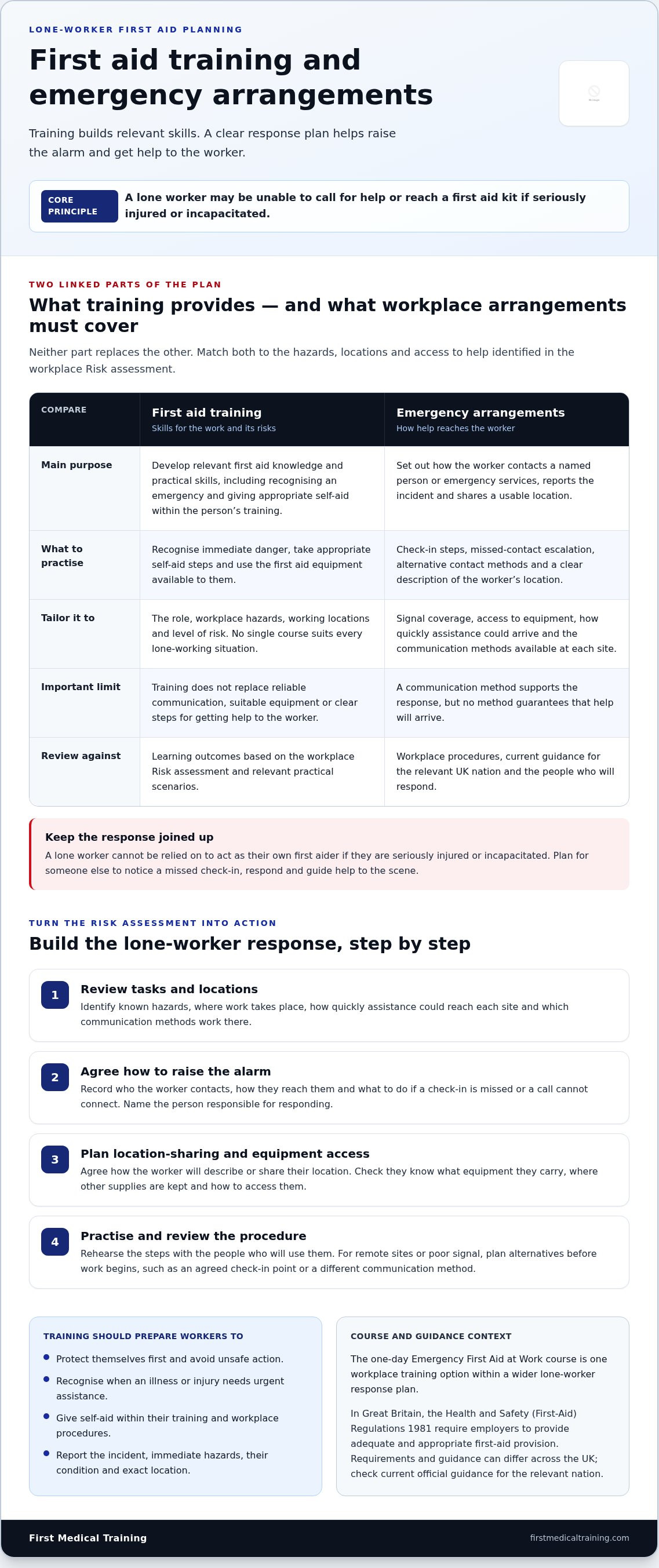
How to turn a lone-worker risk assessment into an emergency plan
Turn your Risk assessment findings into instructions workers and managers can follow under pressure. The plan should link first aid training for lone workers uk to clear responsibilities, contact steps and access to equipment. Use this sequence to build and maintain it:
- Assess the work. Record tasks, locations, hazards, communication limits, expected response times and relevant health needs. Note where first aid equipment is kept or carried, and whether it can be reached during the work.
- Set named responsibilities. Identify who checks on the worker, who acts when a check-in is missed and who escalates the concern. Make sure workers and managers know their roles.
- Write the emergency procedure. Specify whom the worker contacts, when to call emergency services, what to do if the usual contact method fails and how to share an accurate location. Include a site name, access instructions, entrance details or a recognisable landmark where relevant.
- Match training and equipment to the plan. Train workers to follow the agreed steps and use available equipment within their level of training. Set check-in arrangements and equipment access to suit the location, hazards and communication options.
- Test and review. Practise realistic scenarios, then update the plan when tasks, locations, staffing or assessed risks change.
Document emergency contacts, check-ins and escalation
Make the procedure easy to find and use. List contact details, scheduled check-in times and the action to take if a worker does not respond. State how to describe the incident and location, including what to do if a phone has no signal. For a remote site, plan a workable alternative before the task begins and make clear who decides to escalate a missed contact.
The same planning discipline is useful in other workplaces. The dental practice emergency preparedness checklist offers a related resource for organising emergency arrangements in a clinical setting.
Test the plan and keep training relevant
Walk through a scenario that reflects the work. Can the worker reach their equipment, follow the contact steps and give a location another person can find? Can the named contact explain what they’ll do if a check-in is missed? Record gaps and revise the instructions. Repeat the review after operational changes or when a test shows the procedure is unclear.
For further context on workplace first aid training, read the Emergency First Aid at Work course guide. To develop workplace first aid skills as part of your arrangements, explore the Emergency First Aid at Work course.
Choose a training route that builds lone-worker confidence
The right choice connects assessed first aid needs with useful practice and a workable emergency plan. Course length or delivery format alone does not establish that your provision is suitable. For first aid training for lone workers uk, decide what the worker must be able to do, how they’ll practise those actions and how they’ll get help in an emergency.
A simple decision framework for employers
Use your Risk assessment to compare workplace hazards with each course’s learning outcomes. Decide which skills workers need to practise, then make sure they understand the emergency procedures, contact steps and equipment arrangements relevant to their role. Record how you’ll review training and procedures when tasks, locations or risks change. This keeps the decision tied to the work rather than the course title alone.
Before settling on a route, ask:
- Does the course cover the first aid needs identified for this work?
- Can workers practise the relevant actions, not just learn about them?
- Do they know how training connects to the workplace emergency plan?
- Is there a process to review the arrangements when working conditions change?
If a course develops first aid skills but workers have not rehearsed how to raise the alarm or follow the site procedure, address that gap through workplace instruction and practice. Training should sit alongside clear arrangements for communication, equipment access and escalation.
Build workplace first aid skills with First Medical Training Ltd
First Medical Training Ltd offers a one-day Emergency First Aid at Work course for workplace training. It is not a lone-worker-specific qualification, so use your assessment to decide whether its learning outcomes fit your workplace needs and what additional procedures or practice are required. First Medical Training Ltd has supported UK dental professionals since 2006 and is an accredited CPD provider.
Review your workplace first aid needs, identify the skills workers need to practise and choose a route that fits those findings. Explore First Medical Training Ltd and its training as you plan first aid provision for lone workers.
Put your lone-worker response plan into practice
Effective first aid training for lone workers uk starts with the work itself. Use your Risk assessment to identify the skills workers need, then match training and practice to those risks. Make sure each person also understands how to raise the alarm, share their location and follow the workplace emergency procedure.
First Medical Training Ltd’s one-day Emergency First Aid at Work course is a workplace training option to consider as part of that wider plan. First Medical Training Ltd has supported UK dental professionals since 2006 and is an accredited CPD provider following Resuscitation Council UK guidelines.
Review your workplace needs and identify gaps in training or emergency arrangements. Then explore First Medical Training Ltd courses to choose a relevant next step. Clear procedures and suitable preparation help lone workers understand what to do in an emergency.
Frequently Asked Questions
What should first aid training for lone workers cover?
First aid training for lone workers uk should reflect the hazards and first aid needs identified in the workplace Risk assessment. Learning may cover recognising an emergency, personal safety, self-aid within the learner’s training and when to escalate for help. Workers should practise the actions relevant to their role, including how to raise the alarm and communicate a clear location. Compare course learning outcomes with the work rather than relying on the course title.
Do lone workers need first aid training in the UK?
There isn’t one training course that suits every lone-working role. Employers should assess workplace first aid needs, including the work, hazards, locations and access to assistance, then decide what provision is appropriate. Requirements and guidance can differ across the UK. Consult current official guidance for the relevant nation and use the assessment findings to determine whether workers need first aid training, equipment, emergency procedures or a combination.
Is an online first aid course enough for a lone worker?
It depends on the learning outcomes and the risks of the work. Online learning can support knowledge and general awareness, such as understanding emergency procedures and knowing when to seek help. Skills that require physical demonstration or feedback may need supervised practice. Compare what the worker must be able to do with what the course teaches. Use your Risk assessment to decide whether online learning, practical training or a combination is appropriate.
Can Emergency First Aid at Work training help lone workers?
Yes. Emergency First Aid at Work can be a relevant workplace training route when its learning outcomes match the first aid needs identified in your assessment. First Medical Training Ltd offers a one-day Emergency First Aid at Work course. It is not a dedicated lone-worker qualification, so pair suitable first aid training with clear lone-working procedures, including how to raise the alarm, share a location and access equipment while working alone.
How should an employer prepare lone workers for a first aid emergency?
Start with a Risk assessment of the tasks, hazards, locations and likely access to help. Set out whom the worker should contact, when to call emergency services and what happens if a scheduled check-in is missed. Record location and site access details, agree how the worker will share their position and make sure equipment is accessible. Train workers to follow the procedure, then practise and review it as the work changes.
What happens if a lone worker has no mobile signal during an emergency?
Plan for areas with weak or no signal before work begins. Identify agreed alternatives, such as a different communication method or a check-in point, and explain what the worker and named contact should do if contact fails. Give workers a clear way to report their location, including site access details or nearby landmarks. Test the procedure where practicable, but don’t assume any communication method will always work.
How often should lone-worker first aid training be refreshed?
There isn’t a single refresh interval that applies to every course or role. Check current guidance and requirements for the relevant UK nation, along with the requirements for the worker’s course or qualification. Review your Risk assessment and consider whether workers can still perform the relevant actions and follow the emergency procedure. Revisit training when tasks, locations, equipment or identified risks change, and address any gaps.