

LifeVac for Restaurants UK: A Practical Buying Guide

Could LifeVac strengthen your restaurant’s response to a choking emergency, or leave staff unsure what to do first? When considering LifeVac for restaurants uk, look beyond the device itself and assess how it would fit your existing first-aid arrangements.
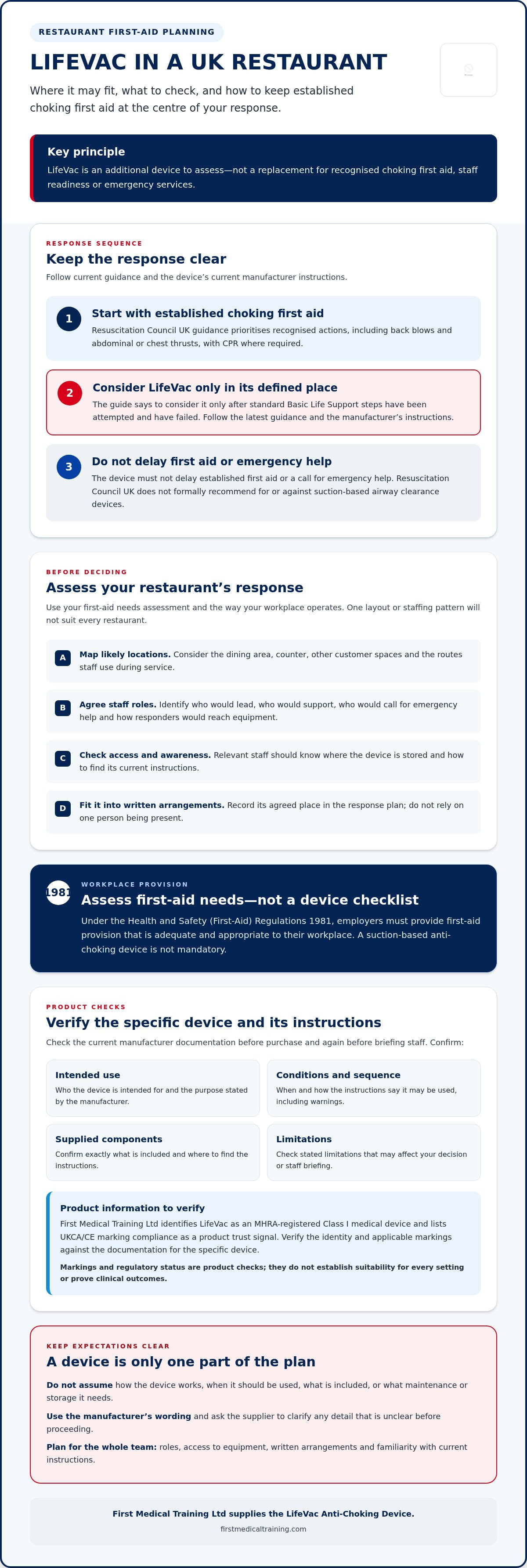
A suction-based device is not a replacement for recognised choking first aid, staff readiness or emergency services. Resuscitation Council UK guidance prioritises established choking-response procedures. LifeVac should be considered only after standard Basic Life Support steps have been attempted and have failed, in line with the current guidance and manufacturer instructions.
This guide explains how to assess whether the device may suit your restaurant, what product information and markings to check, and how to plan for staff awareness, access and readiness. It also shows how to consider the device alongside your first-aid needs assessment. UK employers must provide first-aid provision suited to their workplace, but a suction-based anti-choking device is not mandatory. First Medical Training Ltd supplies the LifeVac Anti-Choking Device. Check its current instructions and product details before purchase or use.
Key Takeaways
- Assess where a choking emergency could happen in your restaurant and who would respond before deciding whether LifeVac fits your arrangements.
- Check the current product instructions and intended use, and verify the device’s identity and applicable markings before buying.
- Include LifeVac in a wider response plan, not as a replacement for established first aid or emergency services.
- Plan staff awareness, accessible storage and readiness checks so relevant staff know where to find the device and which instructions to follow.
- Use this guide to judge whether LifeVac for restaurants uk is a suitable addition to your first-aid provision and what to confirm before purchase.
Why consider LifeVac in a UK restaurant’s choking-response plan?
Before considering LifeVac for restaurants uk, map out how your team would respond to a choking emergency. Identify where an incident could happen, who would assist, who would call for emergency help and how responders would reach first-aid equipment. Consider the dining area, counter and other customer spaces, as well as the routes staff use during service.
LifeVac is an anti-choking device. Check the current manufacturer instructions for its stated intended use, including when it may be considered in relation to established choking first aid. It should have a defined place in an organised response plan, not be treated as a guarantee of an outcome or a substitute for first aid or emergency services.
Emergency equipment supports a response; staff knowledge and timely action shape how that response works.
What does a restaurant need to assess before buying?
Start with your restaurant’s layout and staffing arrangements. Note which areas customers use, where staff are usually positioned and how a responder could reach equipment during a busy service. Agree who is expected to take the lead and how colleagues would support them. One storage point or staffing pattern will not suit every restaurant, so assess your own working setup.
Then check whether relevant staff can identify the device and find its current instructions. A device that is unfamiliar or difficult to access may be harder to include in a clear plan. Record the agreed storage location and make sure staff know how to find the instructions, rather than relying on one person being present.
Use your first-aid needs assessment to consider the restaurant’s particular risks and existing provision. Under the Health and Safety (First-Aid) Regulations 1981, employers must provide first-aid provision that is adequate and appropriate to their workplace. The regulations do not make a suction-based anti-choking device a mandatory item.
What role can an anti-choking device play?
Use the manufacturer’s current instructions to establish the device’s stated purpose and the circumstances for use. Check the supplied product information before purchase and again before briefing staff. Do not rely on assumptions about how the device works or when it should be used.
Resuscitation Council UK guidance prioritises established choking-response actions, including back blows and abdominal or chest thrusts, with CPR where required. The guidance does not formally recommend for or against suction-based airway clearance devices. Check the latest guidance before setting or revising your restaurant’s procedures, and ensure the device does not delay established first aid or a call for emergency help.
Assess the device alongside staff roles, access to equipment and written response arrangements. The question is not simply whether to buy it, but whether your team can identify its place in a coordinated response and follow current instructions calmly.
What is LifeVac, and what should restaurant buyers verify?
LifeVac is an anti-choking device. Before deciding whether it belongs in your restaurant’s arrangements, separate confirmed product information from details you still need to check in the current manufacturer documentation. First Medical Training Ltd identifies LifeVac as an MHRA-registered Class I medical device and lists UKCA/CE marking compliance as a product trust signal. Verify this information against the documentation for the specific device you are considering.
Regulatory status and conformity markings do not establish that a device is suitable for every setting or prove clinical outcomes. Treat them as part of your product checks, not as a substitute for assessing your restaurant’s needs or preparing staff to respond.
Which LifeVac product details need checking?
Before buying, confirm the exact product being supplied and obtain its current manufacturer instructions. Check what the documentation says about:
- the device’s stated intended use and who it is intended for;
- the conditions and sequence for use, including any warnings;
- which components are supplied and how to find the instructions; and
- any stated limitations that could affect your decision or staff briefing.
Use the manufacturer’s wording rather than assumptions or general descriptions found elsewhere. Do not infer what is included, how long a product can be stored, whether it has a guarantee or how often it needs maintenance unless the current documentation confirms it. If a detail is unclear, ask the supplier to clarify it before proceeding.
How should buyers assess claims and trust signals?
Check the device’s identity and markings against the supplied product information, and confirm current MHRA registration and UKCA/CE marking details using authoritative documentation. The MHRA has warned about unsafe counterfeit anti-choking devices. Read its guidance on counterfeit devices and take care if the product identity or supporting documentation is unclear.
Keep regulatory and conformity information separate from claims about effectiveness. A device’s status or markings do not, on their own, demonstrate clinical benefit in a particular emergency. Check current Resuscitation Council UK materials for the response context, and make sure any procedure you communicate to staff reflects the latest guidance as well as the manufacturer’s instructions.
For a LifeVac for restaurants uk purchase, keep a short record of the product identity, documents reviewed, questions resolved and how the device would fit your response arrangements. First Medical Training Ltd supplies the LifeVac Anti-Choking Device. You can enquire about the LifeVac device as part of your product checks.
How to decide whether LifeVac fits your restaurant
Assess the device against the way your restaurant actually operates. These checks can help you decide whether it can be incorporated into your existing first-aid provision and response plan, or whether you need to address gaps first.
| Decision criterion | Check | What to do next |
|---|---|---|
| Intended use | Do the current manufacturer instructions explain the device’s intended use and limitations clearly? | Resolve any uncertainty before defining its role in your response plan. |
| Staff familiarity | Can relevant team members identify the device and find its instructions? | Plan an appropriate briefing or training. Reading instructions alone does not establish practical competence. |
| Accessibility | Can a responder reach the device from the areas where an incident could occur? | Map access routes and agree a consistent storage point that follows the manufacturer’s instructions. |
| Documentation | Do you have current product information and a clear record of where the device fits in your arrangements? | Keep the relevant documents accessible and review them when arrangements change. |
Does your restaurant’s layout support prompt access?
Walk the likely routes from dining areas, the counter and other customer spaces to the proposed storage location. Consider whether staff could reach it during a busy service and whether normal operations could obstruct the route or access to the device. Choose a consistent location that relevant team members can reach, while following the manufacturer’s storage instructions. There is no single placement that suits every restaurant.
Are your staff and response arrangements ready?
Set out who may take the lead, who would summon further help and how staff would communicate during an incident. Check that LifeVac’s planned role does not conflict with existing first-aid arrangements. Keep established choking-response actions central, in line with current Resuscitation Council UK guidance, and ensure the device would not delay them.
Not ready yet? If staff are unfamiliar with the instructions, the storage location is undecided or the device’s role remains unclear, pause before introducing it. Address those gaps first, then review the decision against your restaurant’s response plan. This is a practical way to assess LifeVac for restaurants uk without treating purchase alone as preparedness.
If you would like to clarify product information as part of your assessment, ask First Medical Training Ltd about LifeVac.
How to introduce LifeVac: access, staff awareness and readiness
Once you have decided the device fits your arrangements, make it part of your working routine. Assign responsibility for introducing it, keeping its instructions available and checking readiness in line with the manufacturer’s documentation. Keep its role consistent with your restaurant’s emergency response plan and current first-aid guidance.
Accessible equipment is useful only when staff know where to find it. Make the location clear across shifts, not just to the person who ordered the device.
Where should a restaurant keep the device?
Choose a location that relevant staff can identify and reach promptly from customer areas. Check the route during normal operations, including busy periods, and avoid a position that could become difficult to access as the restaurant’s layout or routine changes. Follow the manufacturer’s storage instructions rather than assuming particular environmental conditions.
Keep the location consistent across shifts. Include it in staff briefings and handovers, and update those records if the device is moved. This helps avoid uncertainty when regular team members are absent or duties change.
How can staff remain familiar with the device?
Introduce the device through a clear, practical sequence:
- Review: Read the current manufacturer instructions and confirm where staff can find them.
- Place: Agree an accessible storage location that follows those instructions.
- Brief: Show relevant staff the device and its location, and explain how its stated role fits the restaurant’s response plan.
- Check: Set a readiness-check schedule based on the product documentation, and record who is responsible for completing the checks.
- Review: Revisit staff awareness and arrangements when roles, storage locations or product instructions change.
A briefing can help staff recognise the equipment and know where to find its instructions, but it is not a substitute for appropriate first-aid training or practice. Direct staff to follow the current manufacturer instructions and the restaurant’s established response plan. Make clear how the team will summon further help, and ensure the device’s presence does not distract from established choking-response actions.
For LifeVac for restaurants uk, readiness means more than having the device on site. Staff need to know where it is, where to find its current instructions and how their roles fit into the wider response. Keep checks practical and tied to verified product information. Do not invent inspection intervals or maintenance requirements if the manufacturer has not specified them.
To enquire about the LifeVac Anti-Choking Device, contact First Medical Training Ltd.
Buying LifeVac from First Medical Training Ltd: checks before you proceed
Before placing an order, make sure the product information answers practical questions for your restaurant. Confirm the identity and documentation for the specific device being supplied, then decide whether your team can introduce it within your existing first-aid arrangements.
What should you confirm with the supplier?
Ask for the current manufacturer documentation and check it before purchase. Confirm the product’s stated intended use, the components included and how to access the latest instructions. If anything is unclear, ask for clarification rather than relying on assumptions or information that may refer to a different product version.
Check that the product identity, claims and any marking information match the supplied documentation. First Medical Training Ltd identifies LifeVac as an MHRA-registered Class I medical device and lists UKCA/CE marking compliance as a product trust signal. Verify these details against current authoritative documentation. Markings and device status are not proof of clinical outcomes or a guarantee of suitability for your restaurant.
Keep a record of the information you reviewed and any points you still need to resolve. Do not proceed on the basis of unclear intended-use wording, missing instructions or uncertainty about what the supplied device includes.
What should happen before the device is put into service?
Buying the device is only one part of introducing it. Before making it available for use:
- Assign responsibility for its agreed storage location and staff awareness.
- Make the current manufacturer instructions accessible to relevant team members.
- Add the location and the device’s intended role to relevant emergency response information.
- Set checks according to the manufacturer’s instructions, without creating an unsupported maintenance schedule.
- Review the arrangements when staff roles, the restaurant layout or product instructions change.
Make sure the device’s planned role sits alongside your established first-aid response and does not replace it. Staff should know where to find the instructions and understand that the restaurant’s response plan guides how to coordinate action and summon further help.
For LifeVac for restaurants uk, a sound purchasing decision includes a workable plan for introducing the device, not simply acquiring it. Confirm the product identity, current instructions and intended use, then assign responsibility for access and readiness. Resolve any gaps before putting the device into service.
To discuss the device and its product information, contact First Medical Training Ltd about LifeVac.
Make your next step a practical readiness check
LifeVac for restaurants uk should be considered as one part of your choking-response arrangements, not as a substitute for established first aid or emergency services. Before buying, verify the device identity, current manufacturer instructions and intended use. Then check that your team knows where the device is stored, where to find its instructions and how it fits your response plan.
First Medical Training Ltd supplies the LifeVac Anti-Choking Device and identifies it as an MHRA-registered Class I medical device. Verify current product and marking information before proceeding. First Medical Training Ltd has operated since 2006 and can be contacted with questions about the device and its product information.
If your restaurant’s arrangements are clear and staff readiness has been considered, take the next step at your own pace. Ask First Medical Training Ltd about the LifeVac Anti-Choking Device. A thoughtful assessment helps you make a considered decision and prepare your team to respond with greater clarity.
Frequently Asked Questions
Is LifeVac suitable for every UK restaurant?
No. LifeVac will not automatically suit every restaurant. Assess your first-aid arrangements, layout, staff roles and ability to keep the device accessible with its current instructions. LifeVac for restaurants uk should be considered as an optional addition, not a standard requirement. UK restaurants are not required to have a suction-based anti-choking device. Base your decision on your workplace’s needs and confirm the device’s intended use before buying.
Can LifeVac replace first aid or calling 999?
No. LifeVac must not replace established choking first aid or delay calling 999 when emergency help is needed. Resuscitation Council UK guidance prioritises recognised actions such as back blows and abdominal or chest thrusts, with CPR where required. The device’s current manufacturer instructions should explain its intended role. Keep your restaurant’s response plan focused on prompt first aid and summoning help, with any device considered only as instructed.
How should a restaurant decide where to keep LifeVac?
Choose a consistent location that relevant staff can identify and reach promptly from customer areas. Walk the route during normal service and consider whether access could be obstructed or unclear across shifts. Follow the manufacturer’s storage instructions, and make the location known through staff briefings or handovers. Record it in relevant response information so staff do not have to rely on one colleague being present.
Do restaurant staff need training to use LifeVac?
Do not assume that buying the device or reading this article prepares staff to use it. Show relevant team members where the device and current manufacturer instructions are kept, and explain how it fits into the restaurant’s response plan. Provide appropriate first-aid training and practice for emergency response. Check the manufacturer’s current guidance for any device-specific training information, and review staff awareness when duties or instructions change.
What should I check before buying LifeVac for a restaurant?
Confirm the exact product identity and obtain its current manufacturer instructions. Check the stated intended use, intended users, supplied components, warnings and limitations. Verify any MHRA registration and UKCA/CE marking information against current authoritative documentation. Ask the supplier to clarify anything that is unclear, including which instructions apply to the product supplied. Do not rely on assumptions about product contents, maintenance or storage requirements.
Is LifeVac a medical device in the UK?
First Medical Training identifies LifeVac as an MHRA-registered Class I medical device. Before purchase, check the current product documentation and registration details, along with any applicable UKCA and CE marking information. These details relate to regulatory status and conformity, not proof of clinical outcomes or suitability for every restaurant. Confirm the product’s identity and instructions, then assess whether it fits your workplace arrangements.
How can a restaurant keep LifeVac ready for use?
Assign responsibility for keeping the device in its agreed, accessible location and making sure staff know where to find its current instructions. Schedule checks in line with the manufacturer’s documentation, rather than using an assumed interval. Include the device’s location and role in relevant response information. Review readiness if staff responsibilities, the restaurant layout or product instructions change, and keep established first-aid arrangements in place.