

LifeVac Training for Care Home Staff: A 2026 Guide to Choking Emergency Preparedness

With at least 21 preventable choking deaths recorded in UK care homes since early 2024, the pressure to ensure your team is prepared for the worst has never been higher. You're likely already aware of the daily risks faced by residents with dysphagia, and the anxiety that comes with wondering if your staff will freeze during a crisis is a heavy burden for any manager to carry. Professional lifevac training for care home staff bridges the gap between standard first aid and a successful rescue when traditional methods like back blows fail.
We believe that equipment is only as effective as the person using it, which is why our focus is on building genuine clinical confidence. This 2026 guide will show you how to equip your team with the practical skills needed to manage choking emergencies effectively whilst ensuring robust CQC compliance. We'll explore the latest safety standards, the dangers of counterfeit devices, and how to integrate LifeVac seamlessly into your existing emergency protocols to protect both your residents and your professional reputation.
Key Takeaways
- Learn why residents with dysphagia or limited mobility require specialised responses that standard back blows often cannot provide.
- Understand why professional lifevac training for care home staff is essential for transitioning from passive awareness to clinical competence during a choking crisis.
- Discover the mechanics of the one-way valve technology; this ensures your team can clear obstructions without the risk of pushing air into the lungs.
- Explore how to align your emergency protocols with CQC requirements and effectively update Individual Care Plans for high-risk residents.
- Find out how to organise accredited on-site training that integrates suction-based rescue skills with broader medical emergency protocols.
Addressing Choking Risks in UK Care Homes: Why LifeVac Matters
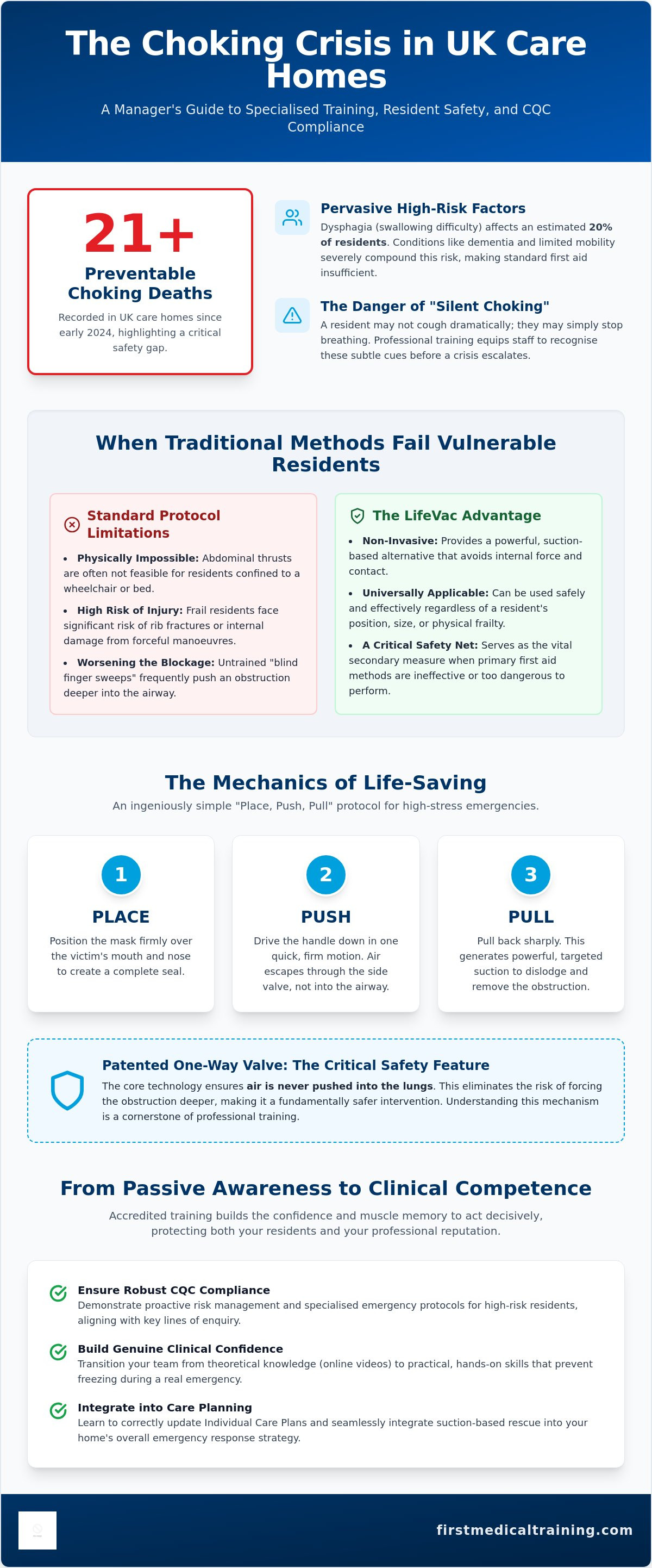
Care home managers face a unique set of challenges that distinguish their environment from general public spaces. Residents are often physiologically vulnerable, making a choking incident far more likely and significantly harder to manage. Recent data highlights the gravity of this issue; an investigation in September 2025 revealed that at least 21 preventable choking deaths occurred in UK care homes since the start of 2024. These incidents underscore the urgent need for robust emergency protocols that go beyond the basics.
In a busy residential setting, the "silent choking" risk is particularly dangerous. Unlike the dramatic coughing seen in films, a resident may simply stop breathing, turn pale, or lose consciousness without making a sound. Recognising these subtle cues is just as important as the physical response itself. Professional lifevac training for care home staff ensures that teams don't just have the equipment; they have the clinical awareness to identify a crisis before it's too late.
The Reality of Dysphagia in Residential Care
Dysphagia, or swallowing difficulty, is a pervasive concern in elderly care. Statistics indicate that approximately 20% of care home residents require texture-modified diets to eat safely. As people age, the muscles responsible for moving food through the throat naturally weaken. This risk is heavily compounded by conditions like dementia, which often disrupt the neurological reflexes required for safe chewing and swallowing. Because of these complexities, standard first aid isn't always enough. Staff require a specialised understanding of how to manage obstructions in patients who may already have compromised respiratory systems.
Limitations of Traditional First Aid for Vulnerable Residents
Standard protocols involving back blows and abdominal thrusts are the first line of defence, but they have physical limitations. For a resident confined to a wheelchair or a bed, performing effective abdominal thrusts is often physically impossible. There's also the risk of injury; frail residents with osteoporosis are at high risk of rib fractures or internal damage when traditional force is applied.
Staff must also be taught to avoid "blind finger sweeps," which frequently push an obstruction deeper into the airway. This is where the LifeVac device serves as a critical secondary measure. It provides a non-invasive, suction-based alternative that can be used regardless of the resident's position or physical frailty. By integrating lifevac training for care home staff into your home's safety plan, you provide a vital safety net for when primary manoeuvres are either ineffective or impossible to perform safely.
The Mechanics of Life-Saving: How the LifeVac Device Works
LifeVac is a non-powered, single-patient portable suction device engineered to clear an upper airway obstruction when standard protocols fail. It operates on a simple principle of physics, yet its design is sophisticated enough to be used by non-medical personnel in high-pressure situations. Unlike mechanical suction units that require batteries or electricity, this device is always ready for immediate deployment. It serves as a vital tool in the responder's arsenal, specifically designed to bridge the gap between traditional first aid and advanced medical intervention.
Understanding the One-Way Valve Technology
The core of the device is its patented one-way valve. This component is vital because it ensures that air is never pushed into the resident's lungs during the downward stroke. When a responder presses down on the handle, the air is vented out through the sides of the valve rather than into the patient's mouth. This eliminates the risk of forcing the obstruction deeper into the trachea.
LifeVac is a one-way suction system that creates a vacuum to remove obstructions without internal contact. This distinction is important for care home environments where residents may have fragile oral tissues or dental work that could be damaged by traditional invasive suction methods. The physics of the device relies on creating a powerful, targeted vacuum that is only activated during the upward pull. Ensuring your team understands this mechanical advantage is a primary goal of professional lifevac training for care home staff.
The Three-Step Protocol: Place, Push, Pull
Simplicity is the greatest asset in a high-stress emergency. The LifeVac uses a "Place, Push, Pull" sequence that staff can remember even when adrenaline is high. This structured approach reduces the risk of user error and ensures the device is used effectively on the first attempt.
- Step 1: Place. The responder selects the appropriate mask and places it over the resident's nose and mouth. Achieving a perfect, airtight seal is the most critical part of the process. Without a seal, the vacuum cannot form.
- Step 2: Push. The handle is pushed down firmly. Because of the one-way valve, this action primes the device without affecting the obstruction.
- Step 3: Pull. A swift, forceful upward pull generates the suction required to dislodge the food or object.
Mask sizing is an often overlooked detail that can determine the success of a rescue. Whilst care homes primarily serve adults, having both adult and paediatric sizes available is essential. Facial structures vary significantly amongst the elderly, particularly those with significant weight loss or muscle wasting. A smaller mask may occasionally be necessary to ensure that life-saving seal. Comprehensive lifevac training for care home staff prepares your team to make these clinical decisions in seconds, ensuring they are ready to act with precision.
Professional Training vs. Online Videos: Ensuring Staff Competence
While a three-minute video might explain what the device looks like, it cannot replicate the physical resistance of a manikin or the pressure of a real-life scenario. There's a profound difference between passive awareness, which is simply knowing a tool exists, and clinical competence, which is the ability to use that tool effectively under duress. Professional lifevac training for care home staff ensures that your team moves beyond theory and into the realm of practical, life-saving skill.
Building muscle memory is the primary goal of hands-on practice. In a crisis, the brain often struggles to recall visual information, but the body remembers repetitive physical actions. By practising the "Place, Push, Pull" sequence under the guidance of an expert, carers develop the confidence to act without second-guessing themselves. This decisive action is often the difference between a successful rescue and a tragic outcome.
The Dangers of Inadequate Training
An improper seal is the most common reason for suction device failure. If the mask isn't perfectly airtight over the nose and mouth, the vacuum cannot form, rendering the equipment ineffective. Watching a video doesn't give a carer the tactile feedback needed to feel when a seal is secure. Hesitation is another significant risk. If a staff member isn't confident in their physical handling of the device, they may delay acting whilst they try to remember a digital tutorial. For professional standards and regulatory compliance, online videos do not constitute 'verifiable training'. They lack the assessment and feedback loop required to prove a staff member is safe to operate medical equipment in a professional setting.
What to Expect from a First Medical Training Session
Our sessions focus on high-impact, practical engagement. We provide specialised 'choking' manikins that allow staff to feel the force required to generate effective suction. We also incorporate scenario-based learning. This involves managing a simulated choking incident in the specific context of your facility, such as a busy dining room or a resident's bedroom.
During these sessions, a trainer is on hand to identify and correct common mistakes in real-time, such as poor mask placement or an insufficient upward pull. Every participant undergoes a formal assessment of competence, resulting in certification. This provides care managers with the robust evidence needed for CQC inspections, proving that lifevac training for care home staff has been delivered to a professional, verifiable standard. It ensures your team is not just equipped, but fully prepared to manage an airway emergency with precision.
Regulatory Compliance and Risk Management for Care Providers
Care providers operate under intense scrutiny. It's not enough to simply have life-saving equipment on the wall; you must prove your team can use it. This alignment with first aid at work for dental practices and broader healthcare standards is a cornerstone of modern risk management. When a choking incident occurs, the aftermath often involves a rigorous review of training records and individual care plans. Integrating lifevac training for care home staff into your facility's wider safety strategy is essential for protecting your residents and your professional registration.
This systematic approach mirrors the high standards found in dental practice emergency preparedness, where every second and every documented skill counts toward patient safety. In the care sector, the high prevalence of dysphagia means that choking is a foreseeable risk. Failure to provide adequate training and equipment to manage a foreseeable risk can lead to significant legal and regulatory consequences.
CQC and Regulatory Expectations for 2026
The Care Quality Commission (CQC) remains focused on ensuring that care is both safe and well-led. Under Regulation 18, providers must ensure that staff are "suitably trained" to meet the needs of the people they care for. In 2026, this includes specific competence in using any anti-choking devices kept on-site. Inspectors look for evidence that training is regular, assessed, and recorded. Designating a 'Competent Person' to oversee the maintenance of LifeVac units and the scheduling of refresher sessions demonstrates a proactive approach to risk that resonates well during inspections.
Implementing a Choking Emergency Protocol
A robust protocol moves beyond reactive measures. It starts with identifying high-risk residents through comprehensive dysphagia screening during the admission process and subsequent reviews. Once risks are identified, Individual Care Plans (ICPs) must be updated to include the use of suction-based devices as a secondary measure when primary manoeuvres fail.
Consider the following implementation steps for your facility:
- Screening: Conduct initial dysphagia screenings for all residents to identify those at high risk.
- Placement: Ensure strategic placement of LifeVac units in high-traffic dining areas and communal lounges.
- Drills: Schedule regular 'refresh and drill' sessions to keep muscle memory sharp amongst the team.
- Documentation: Maintain meticulous documentation of device checks, ensuring mask expiry dates are monitored and logged.
After any real-life deployment, reporting is mandatory. You should log the incident in detail and provide post-incident care for the resident, who may require a medical evaluation even if the obstruction was cleared successfully. To ensure your facility meets these rigorous standards, you can book an accredited training session that covers both the equipment and the compliance framework required for 2026.
Organising LifeVac Training for Your Care Team
Implementing a new life-saving protocol requires more than just purchasing equipment; it demands a structured approach to education that fits the operational realities of a busy care home. First Medical Training, established in 2006, understands that care managers need reliable, high-quality instruction that doesn't disrupt essential service delivery. We provide national UK coverage, bringing our expertise directly to your facility to ensure that lifevac training for care home staff is as accessible as it is effective.
Efficiency is vital when managing staff development budgets and time. Many providers find significant value in combining LifeVac instruction with broader emergency skills, such as cardiac arrest management or basic life support. This holistic approach ensures that your team is prepared for a wide range of clinical crises, from obstructed airways to sudden cardiac events, all within a single, cohesive training framework. It builds a culture of readiness that reassures both staff and the families of your residents.
Scheduling is often the greatest hurdle for residential facilities. To address this, we offer flexible timing to accommodate various shift patterns, including dedicated sessions for night staff who are often at the highest risk of facing an emergency with reduced on-site support. Our 20-year history in the sector allows us to act as a bridge between rigorous regulatory requirements and the practical application of skills on the floor, ensuring your team is never overwhelmed by technicality.
Tailored Solutions for National Care Groups
For larger organisations, maintaining a unified safety standard across multiple sites is a significant challenge. We offer tailored solutions ranging from direct staff delivery at individual homes to train-the-trainer options for internal clinical leads. This ensures that whether you operate a single boutique home or a national group, the quality of training remains consistent and fully compliant with the latest UK resuscitation guidelines. We focus on creating a dependable, knowledgeable workforce that can act with quiet confidence in any situation, regardless of the location.
Taking the Next Step Toward a Safer Care Home
Investing in professional emergency response skills is a long-term commitment to resident safety and staff retention. When carers feel competent and supported, their anxiety during a crisis decreases, leading to better outcomes and a more stable work environment. We invite you to book a consultation to assess your specific requirements and develop a training plan that meets the unique needs of your residents and the professional goals of your team.
Book your LifeVac training for care home staff with First Medical Training today.
Building a Culture of Emergency Readiness
Managing the risk of choking in a residential setting requires more than just high-quality equipment; it demands a team that feels empowered to act. By moving beyond passive video tutorials and embracing hands-on, accredited lifevac training for care home staff, you ensure that your team possesses the muscle memory and clinical confidence to save lives when standard protocols fail. This proactive approach not only protects your residents but also secures your facility's reputation for excellence and CQC compliance. It's about turning a piece of equipment into a reliable, life-saving system.
As accredited medical emergency experts established in 2006, we provide nationwide UK coverage to help you bridge the gap between regulatory requirements and real-world application. We're here to ensure that your life-saving tools are always backed by a competent, ready, and reassured workforce. Whether you're updating individual care plans or conducting regular drills, we provide the expert guidance needed to keep your residents safe. Take the next step in your home's emergency preparedness today.
Ensuring your facility is physically secure is as important as ensuring your staff are prepared for medical emergencies; for expert locksmith and security solutions, click here.
Secure Professional LifeVac Training for Your Care Team
Frequently Asked Questions
Is LifeVac training mandatory for UK care home staff?
LifeVac training is not legally mandatory for all UK care staff, but it becomes a regulatory requirement under CQC Regulation 18 if your facility chooses to keep the device on-site. If you provide the equipment, you must ensure your team is competent in its use. Maintaining training records is vital for demonstrating that your home is "Safe" and "Well-led" during inspections, particularly for residents identified as high-risk through dysphagia screening.
Can LifeVac be used on residents in wheelchairs or those who are bed-bound?
Yes, LifeVac is specifically designed to be used on residents in wheelchairs or those who are bed-bound where traditional manoeuvres are physically impossible. Since it doesn't require the responder to get behind the patient, it's an ideal secondary measure for residents with limited mobility. The device provides a non-invasive way to clear an obstruction whilst the resident remains in their seated or lying position, reducing the risk of further injury.
Does the LifeVac device replace the need for standard abdominal thrusts?
No, the LifeVac device does not replace standard BLS protocols; it's a secondary measure intended for use when back blows and abdominal thrusts fail. You should always follow the established UK resuscitation guidelines as the primary response. The device acts as a vital safety net for situations where traditional methods are either ineffective or cannot be safely performed due to the resident's physical frailty or position.
How often should care home staff undergo refresher training for LifeVac?
We recommend that lifevac training for care home staff is refreshed annually to ensure muscle memory remains sharp and skills don't fade. Regular drills help staff maintain the confidence needed to act decisively during a high-pressure choking event. Since emergencies are rare, yearly sessions provide a necessary opportunity for teams to practice the "Place, Push, Pull" sequence on manikins and clarify any changes in regulatory standards.
Is the LifeVac device safe to use on residents with dentures or frail ribs?
Yes, the device is safe for residents with dentures or frail ribs because it's non-invasive and doesn't rely on the physical force required for abdominal thrusts. The suction is generated externally, which significantly reduces the risk of internal damage or rib fractures in elderly patients with osteoporosis. Whilst the seal must be firm, it doesn't require the same level of impact that often causes injury during traditional first aid manoeuvres.
What should we do after a LifeVac device has been used in an emergency?
After a device has been used, the resident must receive an immediate medical evaluation to ensure no secondary complications or lingering obstructions remain. You should also document the incident thoroughly in the resident's care plan and report it to the CQC if required. LifeVac offers a replacement policy where they provide a new unit free of charge if the device was used in a real-life choking emergency and the details are registered.
Are there different sizes of masks for different residents?
Yes, LifeVac kits include different mask sizes to ensure a proper seal can be achieved on various facial structures. Whilst care homes primarily use adult masks, having a smaller size available is essential for residents who have experienced significant weight loss or muscle wasting in the face. Professional lifevac training for care home staff teaches your team how to select the correct mask size in seconds to ensure the vacuum is effective.
Can we train our staff using only the online LifeVac videos?
No, training your staff using only online videos is insufficient for professional healthcare standards and CQC compliance. Videos lack the feedback loop and assessment required to verify that a staff member can achieve a perfect seal or generate enough suction on a manikin. Verifiable training requires a practical, hands-on component where a competent trainer can correct mistakes and certify that the staff member is safe to use the equipment.