

Medical Emergency Training for Dental Therapists in the UK: Choosing the Right Course

Emergency readiness depends on more than holding a first-aid certificate. In a dental practice, you need to recognise a medical emergency, understand your role and rehearse how the team will respond. That is why medical emergency training for dental therapists uk should be assessed against real clinical needs, not just a course title.
If you are unsure how GDC guidance applies to your role, or whether online learning offers enough practical practice, start by separating requirements from recommendations. The GDC requires dental therapists to complete 75 hours of verifiable CPD in each five-year cycle. It identifies medical emergencies as a highly recommended topic, with at least 10 hours of verifiable CPD in this area over the cycle, and recommends at least two hours of training each year.
This guide explains those expectations and how to choose training that fits your work. You will compare general first aid with dental-specific CPD, consider the value of hands-on team practice and learn how First Medical Training’s Medical Emergencies in a Dental Practice CPD Training can connect guidance with your practice’s emergency response.
Key Takeaways
- Distinguish dental emergency training from general workplace first aid, and focus on skills relevant to your clinical role and practice procedures.
- Assess medical emergency training for dental therapists uk against your learning needs and your team’s emergency response arrangements.
- Compare online learning, classroom teaching and in-practice training to decide where knowledge refreshers and practical team rehearsal fit best.
- Follow a four-step course selection process: review guidance, identify learning needs, compare delivery and plan your CPD records.
- Use scenario-based learning and guided hands-on practice in Medical Emergencies in a Dental Practice - CPD Training to rehearse roles and communication with your team.
Why medical emergency training matters for dental therapists in the UK
Medical emergency training in a dental setting prepares you to recognise a patient’s deterioration, begin an appropriate response and work with colleagues under the practice’s emergency procedures. It differs from general workplace first aid because the learning should reflect the clinical environment, the equipment available and the needs of patients receiving dental care.
General first aid can provide useful foundations, but it may not rehearse a dental team’s response to events such as fainting, choking or suspected anaphylaxis. When assessing medical emergency training for dental therapists uk, consider whether the learning relates to your clinical role and helps you respond as part of the practice team. A generic workplace certificate alone may not address those needs.
What professional guidance says about dental team readiness
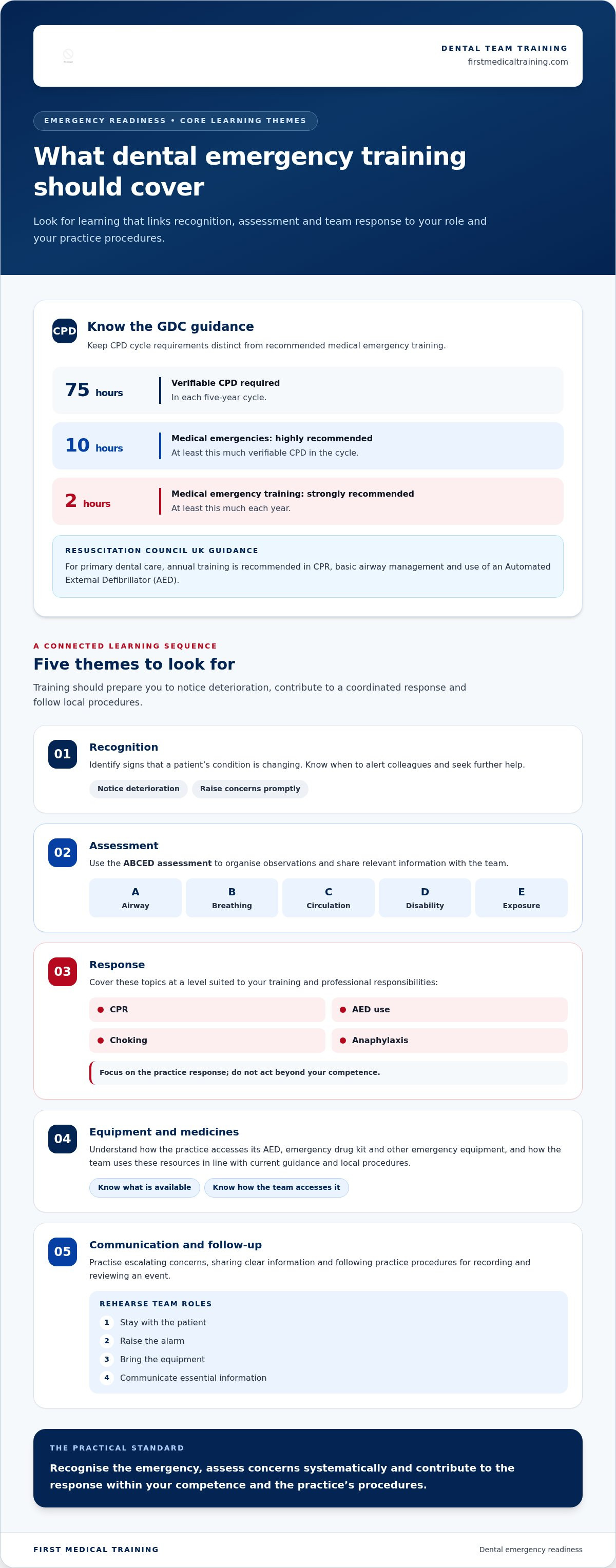
The General Dental Council (GDC) sets standards for individual dental professionals. Dental therapists must complete 75 hours of verifiable CPD in each five-year cycle. The GDC identifies medical emergencies as a highly recommended CPD topic, recommending at least 10 hours of verifiable CPD in this area during the cycle. It also strongly recommends at least two hours of medical emergency training each year.
The GDC directs dental professionals to follow medical emergency guidance from Resuscitation Council UK (RCUK). Its guidance for primary dental care recommends annual training in CPR, basic airway management and use of an Automated External Defibrillator (AED). These are professional recommendations, distinct from the GDC’s CPD cycle requirements. In England, the Care Quality Commission (CQC) regulates dental practices and assesses whether care is safe. Practice protocols set out how your team applies guidance locally, including who takes each role and how emergency equipment is accessed.
Keep these layers distinct: GDC standards apply to you as a registrant, RCUK provides clinical guidance, and your practice’s procedures translate that guidance into a coordinated response. Training should help you understand how they relate without presenting a recommendation as a separate legal requirement.
Where dental therapists fit within the emergency response
Your role starts with noticing change. A patient may become pale, unresponsive or short of breath. Recognise the concern, communicate it promptly and follow the Dental emergency response plan. The tasks you undertake depend on your training, competence and the practice’s procedures. Do not assume a course authorises actions beyond your professional scope.
Clear roles reduce hesitation. During a simulated event, rehearse who stays with the patient, who raises the alarm, who brings equipment and who communicates essential information. Agree these responsibilities before an emergency and practise them together. As a therapist, know how to summon support and contribute to the response while following the team lead and staying within your competence.
For an overview of course content and clinical confidence, explore the Medical Emergencies in a Dental Practice course guide. Understanding the Dental Therapist role also helps put role-specific learning in context.
What should medical emergency training for dental therapists cover?
Role-relevant dental emergency training connects clinical knowledge with the actions, communication and procedures expected in a dental practice. It should prepare you to recognise deterioration, assess the patient systematically, contribute to the team response and follow local procedures afterwards. Use these points to judge whether medical emergency training for dental therapists uk fits your learning needs.
Core learning themes for a dental therapist
Look for learning that follows the sequence of an emergency, rather than presenting topics as an unrelated list. The ABCED assessment means checking Airway, Breathing, Circulation, Disability and Exposure in a structured way. It helps you assess what is happening and identify concerns that need an urgent response.
- Recognition: Identify signs that a patient’s condition is changing, and know when to alert colleagues and seek further help.
- Assessment: Use the ABCED assessment to organise observations and share relevant information with the team.
- Response: Cover CPR, AED use, choking and anaphylaxis at a level appropriate to your training and professional responsibilities. Focus on the practice response, not instructions outside your competence.
- Equipment and medicines: Understand how the practice accesses its AED, emergency drug kit and other emergency equipment. Learn how the team uses its resources in line with current guidance and local procedures.
- Communication and follow-up: Practise escalating concerns, sharing clear information and following practice procedures for recording and reviewing an event.
Role-relevant dental emergency training prepares you to recognise a patient emergency, assess concerns systematically and contribute to the response within your competence and practice procedures.
Why practical rehearsal belongs alongside knowledge
Knowing the correct terms is not the same as rehearsing how your team will act. Guided hands-on practice lets you work through the response sequence, use relevant equipment in a training setting and clarify who communicates, who responds to the patient and who carries out other agreed tasks. It can also reveal uncertainty about a procedure before an emergency occurs.
Scenarios can reflect the demands of a dental environment without claiming to predict every event. For example, a practice exercise can ask the team to respond to a patient becoming unwell during treatment. Rehearse how the concern is raised, how information is passed on and how the team follows its agreed plan. Afterwards, discuss what was clear and what needs further practice.
Use course content as a practical checklist: does it cover recognition, assessment, response, communication and post-event procedures, and does the delivery let you practise relevant skills? First Medical Training’s dental-specific CPD training includes scenario-based learning and guided hands-on practice. Explore dental emergency CPD training to connect these learning themes with team rehearsal.
Online, classroom or in-practice training compared
Each delivery format supports a different part of emergency readiness. Online learning can help you revisit knowledge, while face-to-face sessions allow guided practice. In-practice training connects rehearsal with your team’s clinical environment. Compare each format with the skills your practice needs to refresh and the way your team needs to work together.
| Factor | Online | Classroom | In-practice |
|---|---|---|---|
| Flexibility | Often easier to fit around individual schedules. | Requires learners to attend a shared session. | Arranged for the team in its workplace, subject to approval. |
| Practical rehearsal | Useful for structured knowledge refreshers; hands-on practice may need a separate session. | Can include guided practice, depending on course delivery. | Can combine practical rehearsal with the clinical setting. |
| Team participation | May be completed individually, so team roles might need separate rehearsal. | Offers an opportunity for colleagues to learn together. | Allows the practice team to rehearse communication and role allocation together. |
| Clinical connection | Learning takes place away from the practice environment. | Usually takes place in a training setting. | Can relate scenarios to the practice’s layout and procedures. |
When online learning may suit a dental therapist
Online study can help you revisit guidance, refresh knowledge and complete structured learning around clinical commitments. Before enrolling, read the learning outcomes and check how the course records verifiable CPD. Also consider what the digital format lets you practise. CPR, AED use, airway skills and coordinated team responses may need hands-on rehearsal beyond a screen-based lesson.
For medical emergency training for dental therapists uk, consider online learning as one element of a wider plan, not an automatic substitute for practical skills practice. Choose the balance that fits your existing training, the team’s learning needs and the procedures you follow in your practice.
What in-practice learning can add
In-practice training gives the team a setting in which to rehearse communication and follow its agreed response. A scenario can prompt discussion about who raises the alarm, who supports the patient and how information is passed between colleagues. First Medical Training delivers practical, scenario-based learning with guided hands-on practice. Courses can be delivered at business premises, subject to approval.
Use the in-practice dental emergency training comparison to inform CPD planning, then match the format to your practice’s learning priorities. For dental-specific training, view Medical Emergencies in a Dental Practice CPD Training.
How to choose training that fits your dental practice
Choose a course by starting with your practice’s needs, not the delivery format or course title. Look for learning that reflects your responsibilities as a dental therapist, supports the team’s procedures and gives you suitable evidence for your CPD record. Follow these four steps to make the decision clear.
Map the learning need before comparing courses
Review your Dental emergency response plan, team roles and relevant GDC and Resuscitation Council UK guidance. Note where the team needs a knowledge refresher, hands-on skills practice or shared rehearsal. This is a way to set learning priorities, not a compliance audit. Record the gaps you identify so you can compare course outcomes against actual needs.
- Review guidance. Use current professional guidance as your reference point. Separate its recommendations from your practice’s procedures, and note which clinical skills and team arrangements are relevant to your role.
- Identify learning needs. Consider what you and your colleagues need to practise or refresh. Your priority might be revisiting emergency recognition, rehearsing communication or clarifying how team members carry out agreed roles.
- Compare course delivery. Match the format to those priorities. Online learning may suit structured knowledge refreshers; classroom or in-practice sessions may better support guided hands-on practice and team participation. Review the practical elements rather than assuming the course title tells you what learners will do.
- Plan records. Review the course’s CPD information, learning outcomes and completion documentation. Decide how you will retain evidence of participation and note any further practice the team plans to arrange.
Assess course relevance and evidence
Read the stated outcomes closely. Do they apply to a dental setting and your responsibilities, or focus on general workplace first aid? Check whether the content addresses both individual knowledge and the practice team’s response. Then review the course’s CPD accreditation information and the documentation provided on completion. These details help you judge the learning’s fit and keep your records organised.
Check that statements about professional standards reflect current authoritative guidance. The GDC sets expectations for registrants, Resuscitation Council UK provides clinical guidance, and practice procedures explain how your team applies that guidance locally. A course certificate does not replace reviewing those procedures or identifying skills that need further rehearsal.
Use this dental practice emergency preparedness checklist alongside your learning-needs notes. If your priorities point to dental-specific, scenario-based CPD with guided hands-on practice, explore Medical Emergencies in a Dental Practice training.
Medical Emergencies in a Dental Practice - CPD Training from First Medical Training
For dental therapists, emergency training needs to connect professional guidance with the way a dental team works. First Medical Training’s Medical Emergencies in a Dental Practice - CPD Training is for dental professionals seeking learning relevant to the practice setting. It helps therapists and colleagues consider how they contribute to a shared response, while keeping actions within their competence and the practice’s procedures.
This dental-specific focus matters when choosing medical emergency training for dental therapists uk. The course relates to the context in which you work, rather than treating emergency response solely as a general workplace first-aid topic. It is CPD-accredited and uses practical, scenario-based learning with guided hands-on practice.
What the First Medical Training approach offers
Scenario-based exercises give the team a structured opportunity to apply learning to realistic situations. Rehearse how concerns are communicated, how colleagues coordinate agreed responsibilities and how the practice’s procedures guide the response. Guided practice also gives you the opportunity to discuss questions in a learning environment and connect course content with the team’s day-to-day roles. It supports preparation but cannot guarantee a particular response or patient outcome.
Courses are taught by experienced medical professionals. First Medical Training has provided specialist training since 2006, with a focus on education for dental and healthcare teams. Courses can be delivered at your business premises, subject to approval. This allows the team to learn together in a familiar setting, while keeping the session focused on training and adapting practice to your team’s layout and arrangements.
Plan your next step with confidence
Before booking, identify who should attend and what the practice wants the learning to address. Include dental therapists and relevant team members, then decide whether your priority is refreshing knowledge, developing practical skills or rehearsing communication and roles together. This gives you a clear basis for reviewing the course information and planning how the learning will fit your CPD records and practice procedures.
Use the dental emergency training course guide to review the course in more detail. Then review the course information and arrange suitable dates with the booking team. A considered choice gives your team a practical route to shared learning and a clearer understanding of how to prepare for emergencies in the dental setting.
Explore Medical Emergencies in a Dental Practice CPD Training to take the next step towards training that reflects your team’s needs.
Make your next training step count
Make your next CPD decision a clear point of progress. Choose one learning priority to revisit after training, such as a question you want to resolve or an area where you want greater clarity. This keeps medical emergency training for dental therapists uk connected to your professional development, not simply a completed course.
Before booking, consider what will help you take part fully and make the learning relevant to your role. A focused intention gives you something practical to reflect on afterwards and discuss with colleagues.
Explore Medical Emergencies in a Dental Practice - CPD Training to take a confident next step in your professional development.
Frequently Asked Questions
Is medical emergency training relevant to dental therapists?
Yes. Dental therapists work directly with patients, so preparation for a sudden change in a patient’s condition is relevant to their clinical role. Learning should clarify which actions you are trained and authorised to take, how to summon support and how your responsibilities fit the practice’s arrangements. Use current GDC and Resuscitation Council UK materials to understand professional expectations, then distinguish those from the instructions your practice sets for its team.
How often should dental therapists refresh medical emergency training?
Check current professional recommendations and your practice’s training arrangements rather than relying on an old course date or a fixed assumption. Agree a review point with your practice lead, and revisit learning needs after staff changes, an exercise that reveals uncertainty or a change to local procedures. These prompts can help you decide whether knowledge or skills need refreshing; they do not replace current guidance.
Does a medical emergency CPD course count towards dental CPD?
A course may contribute where its learning is relevant and its CPD information and completion evidence fit your professional development needs. Before booking, note the stated CPD hours and learning outcomes, and find out what evidence is provided on completion. First Medical Training offers Medical Emergencies in a Dental Practice - CPD Training. Review the course details and keep a brief record of what you learned and how it relates to your work.
Can medical emergency training take place at a dental practice?
Yes. First Medical Training delivers courses at business premises, subject to approval. Identify who should attend and your preferred dates, then agree the delivery arrangements with the booking team. Learning together gives colleagues an opportunity to discuss how they will work as a team. Agree the session arrangements in advance, including the room, equipment layout and timetable.
What records should a dental practice keep after emergency training?
Record the course title, date, attendees and completion evidence available to the practice. You may also note the learning outcomes covered, questions raised and whether further learning or practice has been identified. Keep each registrant’s CPD record separate from the practice’s attendance record, and refer to current professional guidance for exact expectations. These details help you track participation and plan future development without assuming a specific retention period.
Can a dental therapist take a general first aid course instead of dental emergency training?
Do not assume a general first aid course automatically meets every dental professional learning need. Compare its outcomes with the situations and responsibilities relevant to your role, and consider whether it addresses the practice’s clinical context. A general course may sit alongside other learning, but suitability depends on your circumstances and professional expectations. Use current GDC guidance to decide how a course fits your development, rather than treating course titles as interchangeable.
What is the difference between medical emergency training and Dental Immediate Life Support training?
The course titles alone do not establish the precise difference or show that the courses are interchangeable. First Medical Training offers both Medical Emergencies in a Dental Practice - CPD Training and Dental Immediate Life Support (ILS) Training for Professionals. Compare their course information, intended learners, stated outcomes, practical content and CPD details. Use those details to judge which option aligns more closely with your learning priorities.