

Top Medical Emergency Scenarios in Dental Practice: A 2026 Training Guide

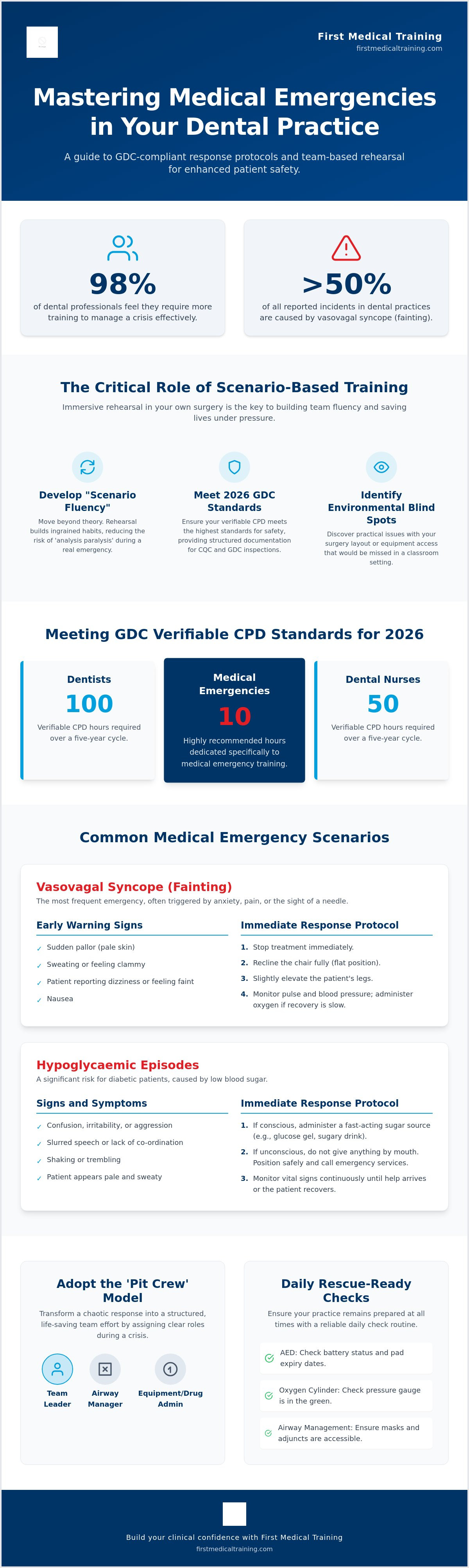
Did you know that whilst syncope accounts for over 50% of incidents, a staggering 98% of dental professionals feel they require more training to manage a crisis effectively? It's natural to feel a flicker of anxiety when imagining a cardiac arrest or anaphylactic shock occurring in a cramped surgery environment. You want to protect your patients, yet keeping up with the evolving GDC requirements for 2026 can feel like an additional burden on an already busy schedule.
This guide will help you master the most common medical emergency scenarios dental practice teams face, providing you with GDC-compliant response protocols and a blueprint for team-based rehearsal. By moving beyond individual knowledge towards "scenario fluency," you'll build the clinical confidence needed to identify early warning signs and execute a structured response plan. We'll explore the essential steps to coordinate your team and ensure your verifiable CPD meets the highest 2026 standards for safety and professional readiness.
Key Takeaways
- Understand why GDC-compliant, scenario-based training in your own surgery is essential for building team fluency and meeting 2026 CPD requirements.
- Learn to identify and manage common medical emergency scenarios dental practice teams encounter, from vasovagal syncope to sudden hypoglycaemic episodes.
- Gain clear protocols for high-stakes events like anaphylaxis and cardiac arrest, ensuring every second counts when patient safety is at risk.
- Adopt the 'Pit Crew' model to assign specific roles during a crisis, transforming a chaotic response into a structured, life-saving team effort.
- Establish a reliable daily check routine for your AED and airway management equipment to ensure your practice remains rescue-ready at all times.
The Critical Role of Scenario-Based Training for Dental Compliance
Scenario-based training is the practice of simulating real-life medical crises within the specific environment where you treat patients. Rather than sitting in a lecture theatre, your team rehearses medical emergency scenarios dental practice professionals face every day, using your own equipment and surgery layout. This immersive approach is designed to bridge the gap between theoretical knowledge and the high-pressure reality of clinical practice. By repeating these drills, you reduce the risk of analysis paralysis. When a real medical emergency occurs, the brain relies on ingrained habits rather than trying to recall a textbook page whilst under immense stress.
Rehearsing in your own surgery also allows you to spot physical blind spots that you would miss in a classroom. You might discover that the oxygen cylinder is difficult to reach when the dental chair is fully reclined, or that the AED is stored in a cupboard that is awkward to access during a crisis. Identifying these issues during a mock scenario ensures they don't become life-threatening obstacles during a genuine event.
Meeting GDC Verifiable CPD Standards in 2026
As of July 2026, the General Dental Council (GDC) maintains strict requirements for professional development. UK-based dentists must complete 100 hours of verifiable CPD over a five-year cycle, whilst dental nurses require 50 hours. It is highly recommended that 10 of these hours are dedicated specifically to medical emergency training. To remain compliant, your training must be verifiable, meaning it requires clear learning outcomes and evidence of participation. A formal medical emergencies in dental practice course provides the structured documentation needed for CQC and GDC inspections, proving that your team has met the necessary 2026 standards through rigorous, hands-on rehearsal.
Moving Beyond Theory: Why Rehearsal Saves Lives
There is a vast difference between knowing a protocol and executing it under pressure. Static symptom lists are easy to memorise, but real emergencies are fluid and unfolding. A patient might start with simple dizziness that rapidly escalates into something more severe. Scenario training teaches you to monitor these transitions in real-time. Successful training programmes also prioritise the debriefing process. After a mock scenario, the team discusses what went well and where the communication broke down. This reflective practice is essential for improving future performance. It ensures that when a medical emergency scenarios dental practice event actually happens, every team member knows exactly how to move, what to say, and which piece of equipment to grab without a second of hesitation.
Common Medical Emergency Scenarios in the Dental Chair
Managing the most common medical emergency scenarios dental practice teams face requires a deep understanding of how the clinical environment affects patient care. Unlike a standard medical setting, the dental surgery often involves patients in a reclined position, surrounded by sharp instruments and high-speed equipment. Evidence from a simulation-based training curriculum suggests that practical, chair-side rehearsal is the most effective way to ensure protocols are followed correctly whilst under pressure. By identifying the unique challenges of the dental chair, you can transform a potential crisis into a well-managed clinical event.
Managing Vasovagal Syncope (Fainting) in a Clinical Setting
Vasovagal syncope is the most frequent emergency encountered in dental practice, accounting for more than 50% of all reported incidents. It is often triggered by anxiety, pain, or the sight of a needle. Recognising the early warning signs, such as sudden pallor, sweating, and the patient reporting they feel faint, allows for intervention before a full loss of consciousness occurs. The immediate protocol is to stop treatment and recline the dental chair so the patient is flat with their legs slightly raised. This position encourages blood flow to the brain and usually leads to a rapid recovery. You should monitor their pulse and blood pressure, and if recovery is slow, the administration of oxygen may be necessary. Always ensure the patient is fully alert and has stable vitals before they attempt to stand or leave the surgery.
Recognising and Treating Hypoglycaemic Episodes
Hypoglycaemia is a significant risk for diabetic patients who may have skipped a meal before an appointment or are experiencing stress-induced metabolic changes. A patient in a hypoglycaemic crisis may appear confused, irritable, or even aggressive, which can sometimes be mistaken for dental anxiety. If the patient is conscious and able to swallow, you should immediately administer oral glucose in the form of tablets, gel, or a sugary drink. For an unconscious patient, the protocol shifts to the administration of glucagon and an immediate call for emergency services. For a more detailed look at these protocols, refer to our guide on hypoglycaemia emergency dental training.
Responding to Epileptic Seizures in the Surgery
When rehearsing medical emergency scenarios dental practice staff must prepare for the physical reality of a seizure in the chair. The primary goal is to prevent injury. You must immediately clear the area of sharp dental instruments, handpieces, and lights. Do not attempt to restrain the patient or place anything in their mouth. Instead, protect their head with soft padding, such as a folded towel or a small cushion. Time the seizure carefully. If it lasts longer than five minutes, or if the patient has repeated seizures without regaining consciousness, call 999 immediately. Once the convulsions stop, move the patient into the recovery position to maintain a clear airway. Practising these responses through accredited first aid courses ensures your team remains calm and competent during these distressing events.
Identifying Cardiac Distress: Angina and Myocardial Infarction
Cardiac distress in the dental chair often presents as a sudden onset of crushing chest pain, which may radiate to the jaw or left arm. If a patient with a history of heart disease experiences chest pain, you should assist them in using their GTN spray. If the pain does not subside within five minutes, or if the patient has no previous history of angina, treat the situation as a Myocardial Infarction. Keep the patient in a comfortable, upright position to ease breathing and call for an ambulance. Administering 300mg of aspirin to be chewed is a critical step whilst waiting for paramedics to arrive.
High-Risk Scenarios: Anaphylaxis and Acute Asthma Attacks
Whilst syncope is frequent, respiratory and allergic crises represent some of the most time-critical medical emergency scenarios dental practice teams must prepare for. These events demand immediate recognition and the confident deployment of your Emergency Drug Kit. You should maintain a rigorous schedule for checking expiry dates on adrenaline and salbutamol. An out-of-date medication is as useless as a missing one during a life-threatening event.
Clinical accuracy is required to distinguish between a panic attack and true respiratory distress. A patient experiencing a panic attack often has rapid, shallow breathing but usually maintains a clear airway. True respiratory distress involves physical obstruction, wheezing, or stridor, requiring immediate medical intervention rather than simple reassurance. Recognising this difference early prevents the misapplication of emergency protocols.
Anaphylaxis Management in the Dental Surgery
Anaphylaxis in the dental chair is often triggered by latex, chlorhexidine, or certain antibiotics. You should look for changes in 'skin, shape, and sound'. This involves checking for urticaria or rashes (skin), facial swelling (shape), and audible wheezing or a hoarse voice (sound). If you suspect anaphylaxis, the immediate priority is the administration of an Adrenaline Auto-Injector (AAI) into the mid-outer thigh. For a deeper look at these life-saving steps, see our anaphylaxis training dental practice guide, which covers the latest 2026 protocols.
Handling Severe Asthma and Respiratory Distress
When an asthma attack occurs, the patient’s airway narrows, making every breath a struggle. If the patient has forgotten their own inhaler, use the practice’s emergency salbutamol inhaler with a spacer. Follow the 'five puffs' rule; administer one puff at a time and allow the patient to take five breaths between each puff. You can repeat this up to ten times if necessary. Positioning is critical here. Always keep the patient sitting upright to optimise their respiratory effort. Laying them flat can severely restrict their ability to oxygenate. If there is no improvement after ten puffs, or if the patient becomes cyanosed or exhausted, escalate to emergency oxygen and call 999. Rehearsing these medical emergency scenarios dental practice responses ensures your team acts with quiet confidence during high-stakes moments.
Critical Care Scenarios: Cardiac Arrest and Choking
Cardiac arrest and airway obstructions represent the most physically demanding medical emergency scenarios dental practice teams will ever encounter. These events require an immediate transition from routine clinical care to high-intensity life support. Because performing high-quality CPR requires significant physical stamina, some practitioners choose to enhance their functional fitness through small group personal training Aldgate East to ensure they are physically prepared for the rigours of a resuscitation event. Research indicates that approximately 46% of dental professionals feel they cannot adequately manage a cardiac arrest, highlighting a critical gap in professional readiness. Survival in these moments depends entirely on the speed of your response and the seamless integration of your emergency equipment, such as suction units and Automated External Defibrillators (AEDs).
The Cardiac Arrest Protocol: BLS and AED Integration
When a patient collapses, you must act with disciplined speed. Following these four steps ensures the best possible outcome:
- Step 1: Recognition. Check for responsiveness and the presence of normal breathing. Be aware of agonal gasps; these are not normal breaths and are a clear sign of cardiac arrest.
- Step 2: Activation. Shout for the emergency drug kit and AED whilst another team member calls 999. Clear communication is vital here to ensure the ambulance is dispatched without delay.
- Step 3: Compressions. You must move the patient from the dental chair to a firm, flat surface, usually the floor. High-quality chest compressions cannot be performed effectively on the soft padding of a dental chair.
- Step 4: Defibrillation. Switch on the AED as soon as it arrives. Follow the voice prompts immediately. The device will only deliver a shock if it detects a shockable rhythm, so trust the technology and continue CPR until instructed otherwise.
Managing Airway Obstructions and Choking
In a dental setting, choking is often caused by the inhalation of small objects like crowns, bridges, or cotton wool rolls. You must first distinguish between a partial and complete obstruction. If the patient can cough or speak, it's a partial obstruction; encourage them to cough and monitor them closely. If they cannot breathe, speak, or cough, the airway is completely blocked. You must immediately deliver up to five sharp back blows between the shoulder blades, followed by five abdominal thrusts if the object remains lodged.
For scenarios where traditional methods may be difficult, such as with patients in a dental chair or those with physical limitations, the use of a LifeVac anti-choking device can be a life-saving addition to your surgery's toolkit. Once the object is cleared, always check the oral cavity for residual debris and ensure the patient receives a medical follow-up to rule out any underlying trauma or aspiration pneumonia. To ensure your team is prepared for these high-pressure events, consider enrolling in our Dental Immediate Life Support (ILS) Training to rehearse these protocols in your own clinical environment.
Effective airway management also relies on the correct use of suction and basic adjuncts. During a crisis, the oral cavity can quickly become obscured by fluids or debris. Using wide-bore suction tips and having oropharyngeal airways (OPAs) readily available allows you to maintain a patent airway whilst waiting for the emergency services to arrive. This proactive approach prevents secondary complications and keeps the field clear for resuscitation efforts.
Implementing a Robust Emergency Response Plan
In a high-pressure environment, individual expertise is only as effective as the system that supports it. Successful management of medical emergency scenarios dental practice teams face depends on "scenario fluency," where every staff member knows their specific role before a crisis occurs. Adopting a 'Pit Crew' model transforms a chaotic reaction into a disciplined clinical response. By assigning dedicated roles, you ensure that critical tasks like chest compressions and airway management happen simultaneously rather than sequentially. This structured approach is the hallmark of a practice that prioritises patient safety and professional excellence.
Maintaining this level of readiness requires more than just annual training. You should implement 'Flash Rehearsals' during regular staff meetings. These are brief, five-minute drills where the team simulates a specific event, such as a patient fainting in the waiting room or an asthma attack in surgery. These micro-sessions keep muscle memory sharp and ensure that everyone remains familiar with the location and operation of emergency equipment. A daily check routine is also vital. You must verify that the oxygen cylinder is full and the AED indicates a 'ready' status every single morning before the first patient arrives.
Essential Emergency Equipment and Drug Kits
Your practice must be equipped with the 'Big 7' essential drugs as mandated by UK clinical standards. This kit includes adrenaline, aspirin, glucagon, glyceryl trinitrate (GTN), midazolam, salbutamol, and oxygen. Beyond the drugs themselves, you must ensure you have the correct delivery mechanisms, such as spacers for inhalers and appropriate sized masks for oxygen administration. For a detailed breakdown of what you need to stay compliant, consult our medical emergency equipment dental practice audit guide to ensure your surgery meets all 2026 requirements.
Organising Your Team for Maximum Efficiency
When a medical emergency scenarios dental practice event unfolds, role clarity prevents the 'spectator effect' where team members are unsure how to help. You should define the following positions within your team:
- The First Responder: Usually the person with the patient, who stays at the head end to maintain the airway and start the assessment.
- The Equipment Runner: Responsible for bringing the AED, emergency drugs, and oxygen to the scene immediately.
- The Scribe: A vital but often overlooked role. This person records the timeline of the event, noting exactly when drugs were administered and the duration of any seizures or cardiac events. This data is indispensable for the paramedics upon their arrival.
Unifying your team under this model requires hands-on practice in your own clinical environment. You can book a comprehensive dental immediate life support course to rehearse these roles and ensure your response plan is robust, efficient, and GDC-compliant. Choosing a training partner that understands the practical realities of a dental surgery is the final step in building a culture of clinical confidence and safety.
Securing Your Team's Clinical Readiness for 2026
Mastering the most frequent medical emergency scenarios dental practice teams encounter is about more than just ticking a compliance box. It's about developing the scenario fluency and muscle memory that allow you to act with precision when every second counts. By moving from passive learning to active, team-based rehearsal, you transform your surgery into a safer environment for both patients and staff. Whether you are managing a simple faint or a complex cardiac arrest, the structured protocols we've explored are your strongest assets in a crisis.
First Medical Training Ltd provides accredited training delivered by industry veterans who understand the unique constraints of the dental environment. Our tailored, in-practice sessions ensure your whole team meets the full 2026 GDC standards whilst building genuine confidence in your collective response. Book your GDC-compliant Medical Emergencies in a Dental Practice Course today to bridge the gap between regulatory requirements and real-world clinical readiness. You have the skills to protect your patients; we provide the structured framework to ensure you're always rescue-ready.
Frequently Asked Questions
What are the most common medical emergencies in a dental practice?
Syncope, or fainting, is by far the most frequent emergency, accounting for over 50% of all reported incidents. Other common events include mild allergic reactions, angina pectoris, and postural hypotension, which each account for approximately 8% of cases. Hypoglycaemia and epileptic seizures are also regularly encountered, necessitating a high level of team readiness for these specific conditions.
How often must dental teams rehearse medical emergency scenarios?
The GDC recommends that all dental professionals complete at least 10 hours of medical emergency training per five-year CPD cycle. Whilst formal training is an annual requirement, the most prepared teams conduct brief "flash rehearsals" every few months. Regularly practicing medical emergency scenarios dental practice staff might face ensures that protocols remain fresh and that equipment locations are second nature to everyone.
Does the GDC require all dental staff to be trained in medical emergencies?
Yes, the GDC expects all registered dental professionals, including dentists, dental nurses, and hygienists, to be competent in managing medical emergencies. This collective responsibility is a core part of professional registration. For 2026, the emphasis remains on a whole-team approach where every staff member, including non-clinical personnel, understands their specific role in a rescue situation.
What should be included in a dental practice emergency drug kit in 2026?
A compliant emergency drug kit must contain the "Big 7" medications: adrenaline, aspirin, glucagon, glyceryl trinitrate (GTN), midazolam, salbutamol, and oxygen. It's vital to ensure that you also have the correct delivery equipment, such as spacers and oxygen masks. You should implement a rigorous monthly check to verify that all medications are within their expiry dates and that the oxygen cylinder is full.
How do you manage a patient who collapses in the dental chair?
You should immediately stop treatment and assess the patient's level of consciousness and breathing. If they have simply fainted, reclining the dental chair so they are flat with their legs slightly raised is usually sufficient. However, if the patient is non-responsive and not breathing normally, you must move them to a firm, flat surface on the floor to commence high-quality CPR and use the AED.
Can a dental receptionist be involved in medical emergency scenarios?
Receptionists are essential participants in medical emergency scenarios dental practice teams. Whilst they don't provide clinical intervention, they are often the primary link to emergency services. Their role typically includes calling 999, providing clear directions to the paramedics, and managing the waiting room to maintain patient confidentiality and calm during a crisis. Including them in mock drills is critical for practice-wide efficiency.
What is the difference between BLS and ILS training for dental professionals?
Basic Life Support (BLS) covers the fundamental skills of chest compressions, rescue breaths, and AED operation. Immediate Life Support (ILS) is a more advanced curriculum tailored for healthcare environments. ILS includes the use of airway adjuncts, suction, and the administration of emergency drugs. Most dental practices opt for ILS as it addresses the specific clinical equipment available in a surgery setting.
What is the 'Pit Crew' model in dental emergency management?
The 'Pit Crew' model is a structured system of role allocation designed to eliminate confusion during a crisis. Each team member is assigned a specific task, such as managing the airway, performing compressions, or acting as the 'Scribe' to record timings and drug dosages. This ensures that all life-saving actions occur simultaneously and with maximum efficiency, mirroring the precision of a professional racing pit crew.