

Verifiable CPD for Dental Practice Managers: Who Is Eligible

Verifiable CPD for dental practice managers counts towards GDC requirements only if the manager is registered and the activity is structured, relevant to their work and properly documented. A certificate alone is not enough: the learning needs clear objectives and evidence of completion.
It’s reasonable to want a straightforward way to earn CPD online and keep the evidence organised. This guide explains when a practice manager’s learning may qualify, what a useful certificate should show and how long to retain CPD records.
You’ll also learn how to assess whether a course fits your professional responsibilities and what to do if you’re not GDC-registered. Understanding the distinction helps you choose relevant learning and keep records ready if requested.
Key Takeaways
- Identify whether you’re GDC-registered: this determines whether your learning contributes to your own CPD requirements.
- Choose structured learning relevant to your role, and look for clear objectives and evidence of completion.
- Keep certificates and a complete learning record, including key course details, so you can respond to a GDC audit.
- Explore medical emergency training to build knowledge that supports safer, more prepared dental practice teams.
Accurate, complete and contemporaneous records
Update your CPD records as you complete learning, rather than trying to reconstruct them later. Keep clinical and administrative records organised for their separate purposes.
Maintaining verifiable CPD evidence
Verifiable CPD evidence records what you learnt and confirms that you completed the activity. This matters because the GDC may audit CPD records during a cycle and for five years after it ends.
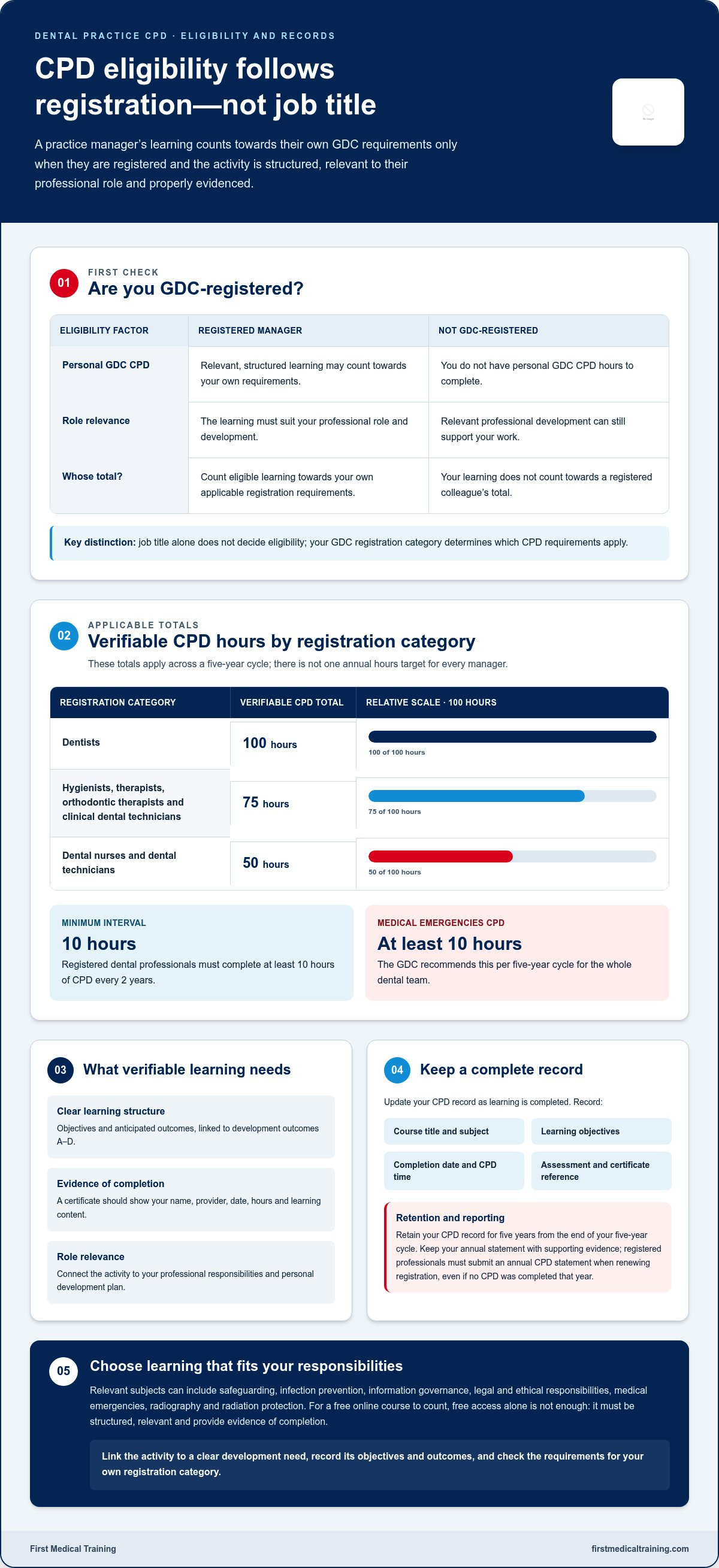
Keep certificates that show your name, the provider, date, hours and learning content. Record the course title, subject, objectives, completion date, CPD time, assessment and certificate reference. Retain your CPD record for five years from the end of your five-year cycle.
A free online course can count if it is structured, relevant and provides evidence of completion. Free access alone isn’t enough. Look for online learning that offers dental CPD, then assess its objectives and documentation before counting it.
CPD records and development outcomes
Development outcomes connect CPD activities to the professional knowledge and skills you intend to develop. Link each activity to your personal development plan to make its relevance to your work clear.
Evidence for GDC-verifiable CPD should state the activity’s aims and anticipated outcomes mapped to development outcomes A-D. According to the General Dental Council, dental professionals must complete at least 10 hours of CPD every 2 years. Keep your annual statement with supporting evidence.
UK dental record-keeping requirements involve the GDC, NHS and CQC. Manage computerised dental records in line with GDPR. Patients have a legal right to access their dental records.
If you’re GDC-registered, failing to meet the applicable CPD requirements means those requirements remain unmet. You must still submit an annual CPD statement when renewing your registration, even if you completed no CPD that year.
CPD eligibility for dental practice managers
Eligibility depends on GDC registration, not your job title. Your registration category determines which CPD requirements apply.
Manager eligibility for CPD
Verifiable CPD for dental practice managers counts towards GDC requirements when the manager is registered and the learning suits their professional role. If you’re not GDC-registered, you don’t have personal GDC CPD hours to complete. You can still undertake relevant professional development, but it won’t count towards a registered colleague’s total. Choose learning that advances your work or intended practice.
Annual CPD hours
There isn’t one annual hours target for every manager; the GDC sets totals by registration category over a five-year cycle. Dentists must complete 100 verifiable hours; hygienists, therapists, orthodontic therapists and clinical dental technicians must complete 75. Dental nurses and technicians must complete 50. According to the General Dental Council, registered dental professionals must complete at least 10 hours every 2 years. Keep your CPD records up to date and check what you need to report when renewing registration.
Relevant verifiable CPD topics
Choose a verifiable activity linked to your responsibilities, such as safeguarding, infection prevention, information governance, or legal and ethical responsibilities. These core subjects can support practice management, but if you’re GDC-registered, the learning must also relate to your own professional development.
Medical emergencies, radiography and radiation protection are other recognised dental CPD subjects. The GDC recommends at least ten hours of medical emergencies CPD per five-year cycle for the whole dental team. Record the activity’s learning objectives and development outcomes in your personal development plan, then consider whether it addresses a clear need in your role.
First Medical Training Ltd: Medical Emergencies in a Dental Practice Course
First Medical Training Ltd offers the Medical Emergencies in a Dental Practice Course for dental teams seeking focused learning on emergencies in a clinical setting. If you manage a dental practice, use the course to build your understanding of the team’s emergency response arrangements and support relevant staff training.
Choose this course when medical emergencies are a priority in your team’s development plan. For practical skills training, consider Dental Immediate Life Support (ILS) Training or the Automated External Defibrillator (AED) Training Course. Select learning that fits your role and your team’s training needs.
Contact First Medical Training Ltd to discuss the Medical Emergencies in a Dental Practice Course.
Put your next learning goal into practice
Make your next CPD choice part of a wider professional development plan. For verifiable CPD for dental practice managers, connect each activity to a practical goal, such as helping your team respond clearly during a medical emergency. This gives learning a clear purpose beyond completing a course.
Consider what your practice team needs to rehearse next, then build that subject into your training plan. First Medical Training Ltd also offers the Emergency First Aid at Work Course (EFAW) - 1 Day for relevant workplace training. Choose an option that fits the learning need and your role.
Contact First Medical Training Ltd to discuss training for your dental team. A considered next step can help you turn professional learning into confident action at work.
Frequently Asked Questions
How do I get CPD certificates online?
Choose an online course relevant to your role, complete its learning activities and pass any required assessment. The provider issues a certificate when you meet the course requirements. Save it with your CPD files and record the learning in your personal development plan, linking it to a professional goal.
What can be counted as CPD?
Count learning that can reasonably advance your professional development and relates to your current or intended practice. For example, reviewing how your practice handles a new responsibility can support learning if it develops knowledge you need for your role. Focus on what you learn, not simply the time spent on a task.
What is dental CPD?
Dental CPD is continuing learning that helps dental professionals maintain and develop knowledge and skills relevant to their work. It can support clinical practice and professional responsibilities. As a practice manager, consider whether an activity develops skills you use to manage the practice, rather than assuming every workplace training session counts towards your own CPD.
What is the difference between verifiable and non-verifiable dental CPD in the UK?
Verifiable CPD has a defined learning purpose and formal evidence of completion. Non-verifiable CPD is informal learning without formal documentation. For example, a planned activity with stated objectives and a completion certificate is different from independently reflecting on a work situation without a documented learning activity.