

1-Day EFAW Training UK: The 2026 Guide to First Aid Compliance

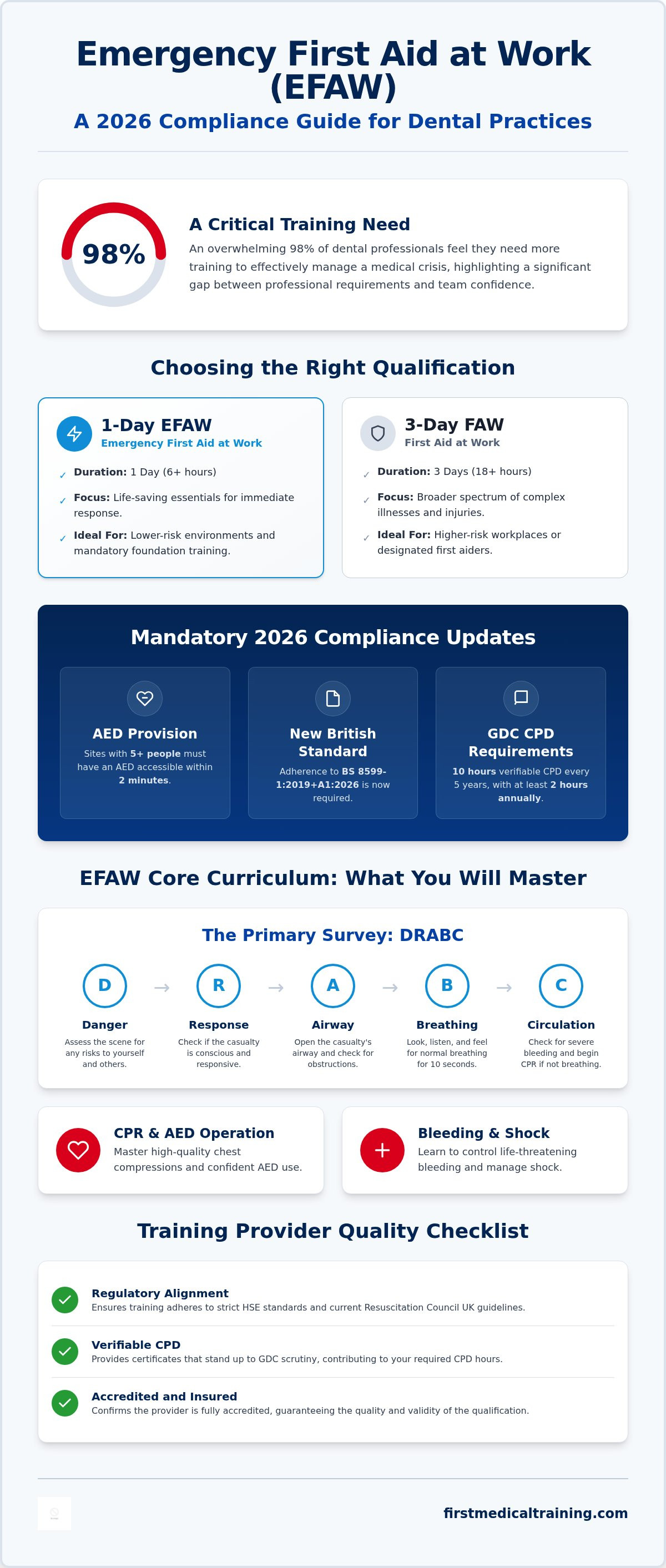
Did you know that 98% of dental professionals feel they need more training to effectively manage a medical crisis? It's a daunting figure, especially when you're balancing patient care with the pressure of GDC requirements and the fear of an unexpected HSE inspection. Choosing the right first aid at work for dental practice shouldn't feel like a compromise between compliance and clinical hours. We understand the confusion between the 1-day EFAW and the full 3-day FAW course, particularly whilst trying to maintain a busy practice schedule.
This guide simplifies your path to workplace safety by mastering the essentials of the 1-day Emergency First Aid at Work course. We'll explore the 2026 standards, including the updated BS 8599-1:2019+A1:2026 regulations and new AED provision guidelines for sites with five or more people. You'll discover how to secure verifiable CPD hours and build a team capable of handling common emergencies like syncope or hypoglycaemia with steady reliability. By the end of this article, you'll have a clear roadmap to a legally compliant workplace and a staff that's ready to act when it matters most.
Key Takeaways
- Understand the critical distinctions between 1-day EFAW and 3-day FAW qualifications to ensure your team is appropriately trained without sacrificing excessive clinical hours.
- Master the essential DRABC primary survey and CPR techniques required to manage workplace medical emergencies with professional confidence and clinical precision.
- Perform a robust workplace needs assessment to establish the legal level of first aid at work for dental practice required under the updated 2026 British Standards.
- Verify training provider accreditations and alignment with Resuscitation Council UK guidelines to ensure your certificates stand up to both HSE and GDC scrutiny.
- Implement the latest 2026 requirements for first aid kit contents and AED accessibility to maintain a safe, compliant, and professional healthcare environment.
Understanding the 1-Day EFAW Training Framework in the UK
The Emergency First Aid at Work (EFAW) qualification represents the statutory baseline for safety in the British workplace. It's a concentrated, 1-day programme designed to provide the essential skills needed to manage a casualty until professional medical help arrives. Whilst the more extensive 3-day First Aid at Work (FAW) course covers a broader spectrum of complex illnesses and injuries, the EFAW course is specifically tailored for lower-risk environments where immediate, life-saving intervention is the priority. Understanding foundational First aid principles allows staff to act with the quiet confidence of a seasoned responder during those critical first minutes of an emergency.
The Health and Safety Executive (HSE) sets the rigorous standards that all UK training providers must follow. In 2026, these standards have evolved to prioritise rapid bystander intervention and the swift deployment of life-saving technology. The updated BS 8599-1:2019+A1:2026 standard, which came into force on April 30, 2026, reflects a clear shift towards a risk-based approach rather than simple headcount. This ensures that every workplace, regardless of size, is prepared for the specific hazards it faces through methodical and purposeful training.
Legal Requirements under the Health and Safety (First-Aid) Regulations 1981
Under the 1981 Regulations, every employer has a legal duty to provide adequate and appropriate equipment, facilities, and personnel to ensure employees receive immediate attention if they are injured or taken ill at work. Determining the exact requirements for first aid at work for dental practice begins with a written needs assessment. Since April 2026, any site with five or more people is expected to have an Automated External Defibrillator (AED) that's retrievable and ready for use within two minutes. Failing to meet these requirements doesn't just risk lives; it leaves your business vulnerable to significant legal penalties and HSE prosecution during a routine inspection.
EFAW and GDC Compliance for Dental Professionals
When establishing the correct level of first aid at work for dental practice, the 1-day EFAW course serves as the mandatory foundation before progressing to more advanced clinical training. It aligns perfectly with the GDC CPD requirements for medical emergencies, which highly recommend ten hours of verifiable CPD every five-year cycle, with at least two hours of training undertaken annually. By completing this accredited course, you ensure that your team meets professional registration standards whilst gaining the practical confidence to handle common incidents like syncope or respiratory distress. It's a disciplined approach to professional readiness that respects both your clinical time and your regulatory obligations.
The 1-Day EFAW Curriculum: Mastering Life-Saving Skills Whilst at Work
Effective first aid at work for dental practice starts with the Primary Survey. This systematic approach, known by the acronym DRABC, allows you to assess the scene for danger and evaluate the casualty's response, airway, breathing, and circulation. It's the foundation of all emergency care. By mastering this sequence, your team can maintain control during high-pressure situations, ensuring that every action taken is purposeful and safe. This methodical assessment prevents the overlooking of critical life-threatening conditions during the initial moments of a crisis.
Cardiopulmonary Resuscitation (CPR) remains a core component of the 1-day curriculum. In a workplace setting, this involves delivering high-quality chest compressions and rescue breaths to maintain oxygen flow to the brain. Determining the most effective first aid at work for dental practice means going beyond the basics; it requires integrating the safe use of an Automated External Defibrillator (AED). Under the Health and Safety (First-Aid) Regulations 1981, your training must include AED familiarisation. The 2026 standards emphasise that AEDs should be accessible within two minutes, making regular practice with these devices essential for every staff member.
Dealing with Life-Threatening External Bleeding and Shock
Managing severe trauma requires more than just a basic bandage. Modern EFAW training includes the use of haemostatic dressings, which contain agents that actively promote blood clotting. This is vital when treating life-threatening external bleeding or preventing the onset of hypovolaemic shock. You'll learn to recognise the clinical signs of shock, such as pale, clammy skin and a rapid pulse, ensuring you can provide stabilising care whilst awaiting the ambulance service. This segment also covers the management of minor injuries like burns and scalds, which are common in busy clinical environments.
Managing Choking and Seizures amongst the Public
Airway obstructions are a significant risk in waiting rooms and clinical areas alike. The curriculum covers the protocol for both mild and severe choking, moving from back blows to abdominal thrusts. For more complex cases, integrating advanced tools like the LifeVac anti-choking device into your practice’s emergency kit can provide an extra layer of safety. You'll also learn how to manage seizures by protecting the casualty from injury and maintaining their dignity. This training is particularly relevant as syncope accounts for over 50% of reported medical emergencies in UK dental practices, requiring a calm and structured response.
Choosing Between EFAW and FAW: A Workplace Needs Assessment
Selecting the appropriate level of first aid training is a pragmatic business decision, not a guessing game. It's governed by the Health and Safety (First-Aid) Regulations 1981, which require every employer to conduct a thorough needs assessment. This process identifies the specific hazards your team faces daily. Whilst a construction site requires the robust 3-day First Aid at Work (FAW) qualification, a lower-risk environment like a dental reception or a small office may find the 1-day EFAW course perfectly adequate. It's about matching the skill level to the actual risk profile of your workplace.
Your assessment must consider employee numbers and the physical layout of your premises. Since the 2026 updates, any business with five or more staff members must document this assessment in writing. You also need to account for the presence of the public. Patients in a waiting room represent a different risk profile than trained staff members. This is why dental practice emergency preparedness often adopts a hybrid approach, combining statutory workplace training with specialised clinical response skills. It ensures every person under your roof is protected.
Determining the correct first aid at work for dental practice involves evaluating the likelihood of an incident. Are you a small, single-surgery practice or a large multi-site organisation? The more people on-site, the higher the statistical probability of a medical emergency occurring. You should also consider the needs of vulnerable groups, such as elderly patients or those with known medical conditions, who may require more immediate or specific intervention. A well-organised practice understands that compliance is the floor, not the ceiling, of patient safety.
When the 1-Day EFAW Course is Sufficient
For teams of fewer than 50 people working in low-hazard environments, the EFAW course is typically the standard requirement. It's particularly well-suited for dental receptionists and non-clinical support staff who need to act as the first point of contact during a crisis. This qualification also provides excellent back-up cover for your primary first aider during periods of sickness or annual leave, ensuring your practice remains legally compliant at all times without disrupting your clinical schedule.
When to Upgrade to the 3-Day First Aid Work Course
You should consider the full FAW qualification if your workplace involves complex machinery, hazardous chemicals, or high-risk manual handling. Large organisations where the risk of multiple casualties is statistically higher also benefit from this expanded curriculum. If your practice has a documented history of specific medical incidents or is located far from emergency services, the extra depth of the 3-day course provides the additional confidence needed to manage prolonged casualty care until the ambulance arrives.
Statutory Compliance and Quality Assurance: What to Look for in a Provider
Selecting the right provider for first aid at work for dental practice requires more than just a quick search; it demands a methodical approach to quality assurance. Since the HSE ceased the direct approval of first aid training providers, the responsibility for due diligence rests entirely with the employer. You must ensure your chosen centre maintains rigorous standards by looking for accreditation from recognised bodies such as the First Aid Industry Body (FAIB). It's equally vital that the curriculum aligns with the most recent Resuscitation Council UK guidelines. This ensures the techniques taught, especially regarding AED use and CPR, are based on the latest 2026 clinical evidence.
Verifying a provider's professional standing involves checking for professional indemnity and public liability insurance. These aren't just administrative checkboxes; they're essential safeguards for your practice. A reputable training organisation will be transparent about their credentials and happy to provide evidence of their quality assurance processes. Choosing a high-quality partner for first aid at work for dental practice ensures that your staff don't just receive a certificate, but gain the genuine, life-saving competency required in a healthcare setting.
Vetting the Trainer’s Clinical Background
Trainers who possess a background in healthcare or dental sectors offer a superior level of context. They understand the unique constraints of a clinical environment, such as the limited space in a surgery or the specific medical histories of dental patients. When enquiring, always ask about the trainer-to-student ratio. A lower ratio ensures more hands-on time during practical assessments. You should also confirm that the equipment, including manikins and AED trainers, is modern and well-maintained. This practical realism is what builds the steady reliability needed to act during a crisis.
Certification and Refresher Cycles
An EFAW certificate remains valid for three years. However, the HSE strongly recommends an annual skills refresher to prevent "skills fade." In a fast-paced healthcare setting, keeping these skills sharp is a matter of professional readiness. Tracking certification expiry across a large team can be complex, so look for providers who offer automated reminders. For those seeking the highest standard of professional development, you can book an accredited EFAW course with First Medical Training Ltd. This proactive approach ensures your team remains compliant and confident year-round.
Why Professional Teams Choose First Medical Training Ltd for EFAW
Since 2006, First Medical Training Ltd has acted as a trusted mentor and industry veteran for healthcare providers across the UK. We understand that first aid at work for dental practice is not merely a box-ticking exercise; it is a critical clinical foundation. Our approach balances the gravity of emergency response with a supportive, accessible training style that demystifies complex medical protocols. With over two decades of experience, we've established ourselves as a dependable partner in professional development, moving beyond basic instruction to deliver genuine clinical excellence.
We provide a unique, integrated solution that combines accredited education with the supply of essential life-saving equipment. From airway management tools to the LifeVac anti-choking device, we ensure your practice is physically prepared for the risks identified in your needs assessment. Our nationwide coverage allows us to bring this specialised expertise directly to your team, ensuring a consistent standard of training across multiple sites. This methodical and purposeful strategy respects your time whilst prioritising the high-impact skills that save lives in a medical crisis.
Tailored Training for Dental Practices
Generic first aid courses often fail to address the specific nuances of a healthcare environment. Our EFAW programme is specifically adapted to empower the whole team, ensuring that non-clinical staff and clinicians alike can coordinate a seamless response. We provide deep dives into high-stakes scenarios, such as cardiac arrest management in dental practice, which goes far beyond the standard workplace curriculum. This specialised focus ensures that the verifiable CPD hours you earn are not only compliant with GDC requirements but also stand up to the most rigorous professional audits.
The First Medical Training Ltd Advantage
The hallmark of our training is the development of genuine, practical confidence. We utilise modern manikins and AED trainers to create realistic simulations, allowing staff to envision their roles as capable responders. This hands-on experience is vital for overcoming the "fear of the unknown" that often accompanies medical emergencies. By choosing a provider that understands the practical realities of your field, you ensure that your first aid at work for dental practice is both relevant and reliable. You can book your 1-day EFAW course with First Medical Training Ltd to secure your team's professional readiness and maintain the highest standards of patient care.
Securing Professional Readiness for the Year Ahead
Navigating the 2026 regulatory landscape requires a shift from passive compliance to active professional readiness. We've explored how the 1-day EFAW framework serves as a vital foundation, providing the skills needed to manage life-threatening situations with precision. By choosing a partner that understands the specific clinical nuances of your field, you ensure that your first aid at work for dental practice is both legally sound and practically effective.
First Medical Training Ltd stands ready to support your practice with over two decades of specialised expertise. Our clinical educators don't just teach protocols; they build the confidence required to lead in a crisis. Secure your team's future and meet your GDC obligations with a training programme designed for the realities of modern healthcare.
Book Your 1-Day EFAW Training Course with First Medical Training Ltd and join the professional teams prioritising safety and excellence.
Frequently Asked Questions
How long does a 1-day EFAW certificate last in the UK?
A 1-day EFAW certificate is valid for exactly three years from the date of issue. Whilst the certificate remains legally valid for this period, the Health and Safety Executive (HSE) strongly recommends that first aiders undertake an annual skills refresher. This prevents "skills fade" and ensures your team maintains the quiet confidence needed to manage a medical crisis effectively in a clinical setting.
Is the 1-day EFAW course HSE approved?
The HSE no longer grants individual "approval" to training providers or specific courses. Instead, it's the employer's responsibility to perform due diligence to ensure the training is adequate and appropriate. Choosing an accredited provider that follows the latest Resuscitation Council UK guidelines ensures your first aid at work for dental practice meets all statutory 2026 requirements.
Can I take the 1-day EFAW course online?
You cannot obtain a full EFAW certificate through online-only training because the HSE requires a practical, face-to-face assessment. Whilst some theory can be delivered via blended learning, a physical trainer must verify your competency in life-saving skills like CPR and wound management. This hands-on verification is critical for maintaining professional standards in a healthcare environment.
What is the difference between EFAW and FAW?
The primary difference lies in the duration and the complexity of the syllabus. The 1-day EFAW course focuses on immediate life-saving interventions for lower-risk environments. In contrast, the 3-day FAW course covers a broader range of medical conditions and complex injuries. Most dental practices find the EFAW course sufficient for non-clinical staff when combined with specialised clinical training.
Does EFAW training count towards GDC medical emergencies CPD?
Yes, completing an EFAW course provides verifiable CPD hours that count towards your GDC professional development requirements. The GDC highly recommends ten hours of medical emergencies training per five-year cycle. Using this 1-day course as your foundation ensures you meet both workplace safety laws and your professional registration obligations with a single, high-impact session.
How many first aiders do I need for my dental practice?
Your first aid needs assessment determines the exact number, but you must have at least one trained person available at all times. For a small dental practice, this often means training multiple staff members to ensure cover during annual leave, sickness, or off-site meetings. Maintaining a ratio that accounts for all staff and patients is a key part of 2026 compliance.
What happens if my EFAW certificate expires?
If your certificate expires, you are no longer considered a qualified emergency first aider under UK law. There is no grace period for expired certificates, meaning you must retake the full 1-day course to regain your qualification. It's essential to track expiry dates across your team to avoid a lapse in your first aid at work for dental practice compliance.
Is AED training included in the 1-day EFAW course?
Yes, training in the use of an Automated External Defibrillator (AED) is a mandatory component of the 1-day EFAW curriculum. The 2026 British Standards reinforce this by recommending that any site with five or more people has an AED accessible within two minutes. Our courses ensure your team is proficient in operating this life-saving equipment alongside traditional CPR techniques.