

GDC CPD Requirements for Medical Emergencies: The 2026 Compliance Guide

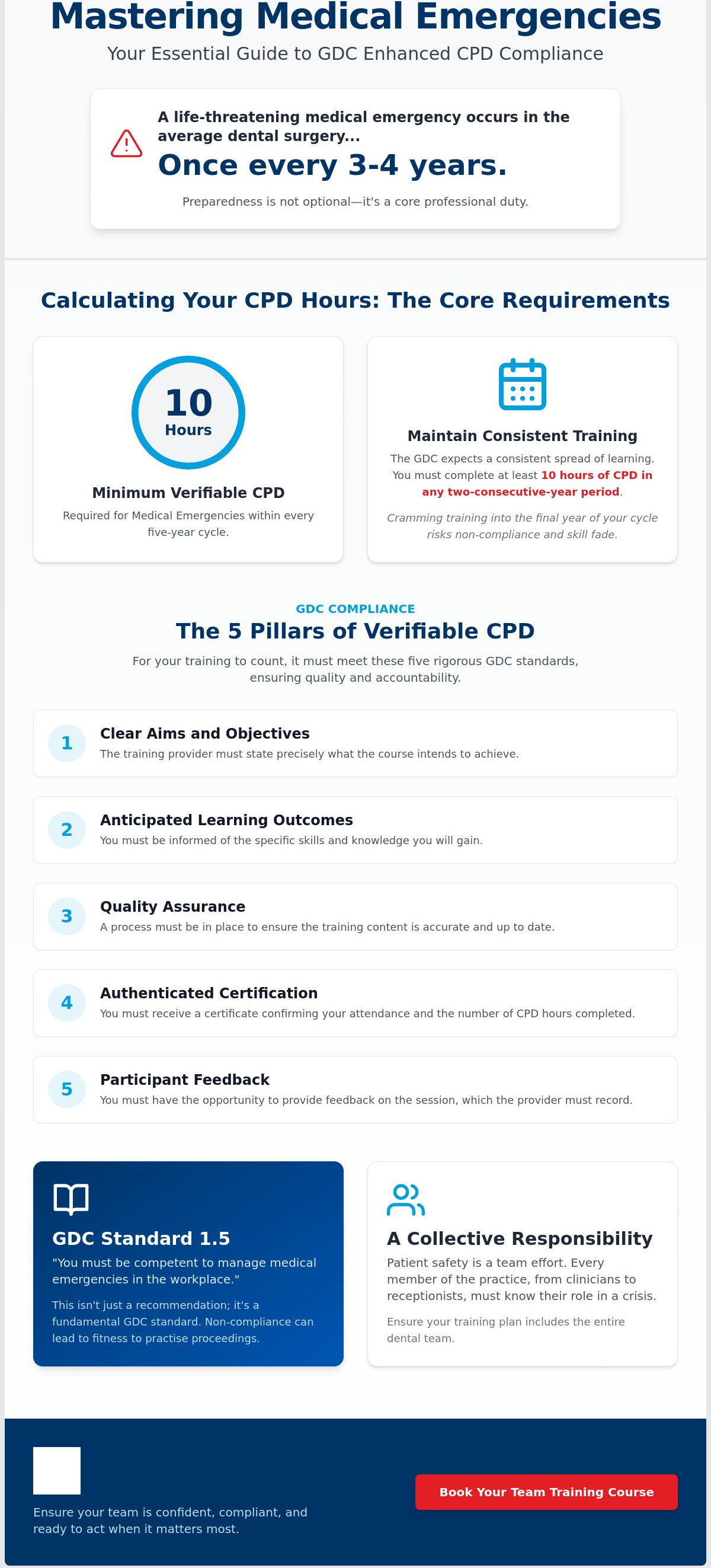
Did you know that the average general dental practitioner will face a life-threatening medical emergency in their surgery once every three to four years? It's a sobering statistic that highlights why mastering your gdc cpd requirements medical emergencies is about much more than just ticking a box for a potential audit. We understand that the shift to the Enhanced CPD scheme often brings confusion, particularly when you're trying to distinguish between 'recommended' topics and the compulsory hours needed to maintain your registration.
You aren't alone if you find it challenging to organise whole-team training whilst keeping up with the latest Resuscitation Council UK (RCUK) protocols. This guide is designed to remove that stress, offering a clear roadmap to ensure every member of your practice, from dental nurses to clinicians, meets their specific hour targets. We'll explore the 2026 compliance standards, explain how to structure your Personal Development Plan (PDP), and help you secure the verifiable certificates needed for a foolproof ECPD portfolio. By the end of this article, you'll have a practical plan to keep your team confident, compliant, and ready to act when it matters most.
Key Takeaways
- Learn how to structure your five-year cycle to meet the 10-hour minimum requirement whilst maintaining peak readiness through annual training updates.
- Identify the specific gdc cpd requirements medical emergencies that apply to your professional role, ensuring you never fall short during a registration renewal or audit.
- Master the core clinical competencies required by the Resuscitation Council UK, including the ABCDE approach and the effective use of emergency equipment.
- Understand the importance of team-wide training, ensuring everyone from the lead clinician to the receptionist knows their precise role in a crisis.
- Discover how to document your learning effectively within a Personal Development Plan to meet the GDC’s rigorous administrative standards for 2026.
Understanding GDC Enhanced CPD Requirements for Medical Emergencies
The General Dental Council (GDC) doesn't view emergency preparedness as an optional extra. Under the Enhanced CPD (ECPD) scheme, medical emergencies are categorised as a 'highly recommended' topic. This means that whilst you have the freedom to choose much of your learning, the GDC expects every registrant to dedicate specific time to this area. It's a fundamental part of the 'Standards for the Dental Team', specifically Standard 1.5, which dictates that you must be competent to manage medical emergencies in the workplace. This isn't just about personal knowledge; it's about the collective safety of everyone who enters your practice.
Meeting the gdc cpd requirements medical emergencies involves more than just reading a manual. Compliance demands a blend of theoretical understanding and practical, hands-on skill. If a patient collapses in your chair, the GDC expects you to have the muscle memory and clinical knowledge to intervene immediately. Failing to maintain these standards isn't just a paperwork issue; it can lead to fitness to practise proceedings or, in severe cases of negligence or non-compliance, removal from the professional register. It's a serious responsibility that requires a disciplined approach to your professional development.
The Definition of Verifiable CPD
For your training to count towards your ECPD hours, it must meet the GDC's strict criteria for 'verifiable' learning. This concept is a cornerstone of professional growth, aligning with the standards found in broader Continuing Medical Education (CME). To be verifiable, your medical emergencies training must provide:
- Clear Aims and Objectives: The provider must state exactly what the training intends to achieve.
- Anticipated Learning Outcomes: You should know what skills or knowledge you'll gain before you start.
- Quality Assurance: There must be a process to ensure the training is accurate and up to date.
- Authenticated Certification: You need a certificate that confirms your attendance and the hours completed.
- Participant Feedback: You must have the opportunity to provide feedback on the session, which must be recorded.
Why Medical Emergencies is a Priority Topic
The dental surgery is a unique environment where clinical procedures, patient anxiety, and underlying health conditions converge. The GDC makes this a priority because they expect you to act as a first responder within your scope of practice. You're the bridge between the onset of an event and the arrival of the ambulance. This priority status ensures that patient safety remains the absolute core of your clinical practice. It also ensures that every team member, regardless of their role, knows how to assist effectively. When you invest in this training, you aren't just meeting a regulatory hurdle; you're building a culture of clinical excellence and safety that protects your patients and your professional reputation.
Calculating Your CPD Hours: Frequency and Timing Standards
Understanding how to calculate your hours is the first step toward stress-free compliance. While the total number of hours varies depending on your professional title, the gdc cpd requirements medical emergencies remain a steady priority for everyone on the register. The GDC mandates a minimum of 10 hours of verifiable CPD in medical emergencies during every five-year cycle. This isn't a suggestion; it's a requirement to ensure your skills don't just exist on paper but are sharp enough to save a life in a real-world crisis.
Avoiding the common pitfall of 'cramming' is vital. The GDC monitors your activity through annual declarations, and they expect to see a consistent spread of learning. Specifically, all dental professionals must complete at least 10 hours of verifiable CPD in any two-consecutive-year period. If you leave all your emergency training until the final months of your five-year cycle, you risk failing a GDC audit. More importantly, you risk clinical skill fade. Regular engagement with emergency protocols ensures that your response is instinctive rather than hesitant. If you're looking to streamline this process for your entire surgery, booking a Medical Emergencies in a Dental Practice Course is an efficient way to ensure everyone hits their annual targets in one session.
Annual Training vs Five-Year Cycles
The Resuscitation Council UK (RCUK) sets the clinical benchmark, and they insist on annual practical refreshers. While the GDC cycle is five years long, completing at least two hours of training every twelve months is considered the gold standard for preparedness. This approach allows you to distribute your 10-hour requirement effectively whilst staying updated on any changes to drug dosages or AED protocols. For new registrants joining a practice, a grace period exists before their first formal cycle begins. However, it's best practice to involve them in team training immediately. This ensures they align with the GDC Scope of Practice from their first day in the surgery.
Hour Requirements by Role
Not all dental professionals carry the same CPD burden, yet the emergency training requirement is the great equaliser. Dentists are required to complete 100 hours of verifiable CPD per cycle. Dental hygienists, therapists, and orthodontic therapists must complete 75 hours, whilst dental nurses and technicians have a target of 50 hours. Regardless of these totals, the minimum annual emergency training requirement for every professional is two hours of verifiable learning. This consistent approach ensures that whether you are a lead clinician or a dental nurse, your ability to respond to a cardiac arrest or anaphylactic shock remains at a professional standard.
Essential Clinical Topics: What Your Training Must Cover
Meeting the gdc cpd requirements medical emergencies isn't just a matter of accumulating hours; it's about the quality and relevance of the clinical content you consume. The GDC expects your training to align with the latest Quality Standards for Primary Dental Care issued by the Resuscitation Council UK (RCUK). These standards provide a clear framework for what every dental professional should know, ensuring that your response to a crisis is based on the most current evidence-based medicine. A compliant course must move beyond theory, providing you with the practical confidence to handle the equipment and drugs found in your emergency kit.
Your curriculum should be comprehensive, covering the most common life-threatening scenarios encountered in a clinical setting. This includes the recognition and immediate management of syncope, anaphylaxis, asthma, and cardiac arrest. You also need a working knowledge of your emergency drugs and airway management equipment. Understanding when to administer oxygen or how to use a spacer device for a patient in respiratory distress is vital. By focusing on these core competencies, you ensure that your team isn't just compliant on paper but truly capable of protecting patient safety during high-stress events.
Basic Life Support and AED Skills
The foundation of any emergency response is high-quality Basic Life Support (BLS). Your training must include practical demonstrations and hands-on practice for chest compressions and rescue breaths, tailored for both adult and paediatric patients. You must also be proficient in integrating an Automated External Defibrillator (AED) into the resuscitation algorithm. Speed is critical; every minute of delay in defibrillation reduces the chance of survival by approximately 10%. For a deeper dive into these life-saving protocols, you can review our guide on Cardiac Arrest Management in Dental Practice: The 2026 Clinical Standard.
Managing Specific Medical Scenarios
Beyond cardiac arrest, your team must be adept at identifying the early warning signs of other critical conditions. This includes recognising the symptoms of hypoglycaemia or the crushing chest pain associated with a myocardial infarction. Training should also cover the correct administration of emergency medical oxygen, which is a staple of the dental emergency kit. Furthermore, you should be prepared for choking emergencies. Whilst the Heimlich manoeuvre is the standard first response, many modern practices now include specialised equipment like the LifeVac Anti-Choking Device to provide an extra layer of protection for patients who may not respond to traditional abdominal thrusts. Mastering these specific protocols ensures your team remains calm and methodical, regardless of the emergency type.
Beyond the Chair: CPD for the Entire Dental Team
Emergency response in a dental setting is a collective effort. Whilst the lead clinician focuses on the patient, the rest of the team must function as a disciplined unit. The gdc cpd requirements medical emergencies aren't restricted to those with a GDC registration number. The council expects every individual present in the surgery to understand their specific duties during a crisis. This holistic approach ensures that when a patient collapses, the transition from routine care to life-saving intervention is seamless and calm.
Relying solely on annual lectures isn't enough to maintain a high standard of care. In-practice 'mock drills' are a pragmatic way to test your team's coordination under pressure. These rehearsals reveal whether the emergency kit is truly accessible and if everyone knows exactly where the AED is stored. By simulating a cardiac arrest or an anaphylactic reaction, you move beyond theoretical knowledge and build the confidence required to act decisively. This level of preparedness is what transforms a group of individuals into a high-performing emergency response team.
The Role of Non-Clinical Staff
Receptionists and administrative staff are frequently the first responders when a patient experiences distress in the waiting area. They manage the 'Front of House' whilst the clinical team is occupied, ensuring that other patients remain calm and the entrance is clear for paramedics. Effective communication with emergency services is a skill in itself; knowing how to provide a concise report to a 999 operator can save vital seconds. To support this, many practices ensure their non-clinical staff complete an Emergency First Aid at Work Course (EFAW) – 1 Day. This provides the foundational skills needed to manage incidents outside the treatment room and ensures administrative staff are integrated into the annual BLS refreshers.
Mental Health First Aid for Dental Practices
A comprehensive approach to patient care now includes recognising psychological distress. Mental health awareness is an increasingly vital component of professional development, as it allows staff to identify signs of extreme anxiety or panic before treatment begins. Recognising these signs early can often prevent a physical medical emergency from occurring in the first place. It allows the team to adapt their behaviour and communication to support a vulnerable patient effectively.
Equally important is the wellbeing of the dental team. Dealing with a traumatic medical incident is emotionally taxing. Implementing Mental Health First Aid for Dental Practices ensures that your team has the tools to support one another following a crisis. This focus on mental health strengthens your practice's culture, ensuring your staff are not only clinically competent but also resilient and supported in their professional roles. It bridges the gap between rigorous regulatory requirements and the human element of care.
Verifiable CPD and Compliance: Best Practices for 2026
Mastering the clinical response is only half the battle. To satisfy the GDC, you must maintain a robust administrative record that proves your competence. A mandatory Personal Development Plan (PDP) is the foundation of this process. It's a living document that identifies your specific learning needs and tracks your progress over time. When you're planning how to meet your gdc cpd requirements medical emergencies, your PDP should clearly state why this training is necessary for your role and how you intend to keep your skills current throughout your five-year cycle. This proactive approach demonstrates to the GDC that you take your professional obligations seriously.
Compliance also hinges on the concept of reflective practice. The GDC doesn't just want to see a list of hours; they want to see how that learning has influenced your professional behaviour. After completing any training session, you should write a brief note in your portfolio. Explain how the session updated your understanding of the ABCDE approach or how it improved your confidence in using an AED. This habit of reflection turns a simple certificate into a meaningful record of professional growth. To ensure your surgery environment is as ready as your paperwork, you can use our guide on dental practice emergency preparedness to audit your physical setup and drug kits.
What to Look for in a CPD Certificate
Reputable training providers understand the level of GDC rigor required for a successful audit. A valid certificate isn't just a piece of paper; it must contain specific data points to be considered 'verifiable'. Ensure your certificates include the following:
- GDC Development Outcomes: The certificate must state which outcomes (A, B, C, or D) were covered. Medical emergencies training typically aligns with outcomes B and C.
- Accreditation Details: It should clearly show the provider's details and the date the training took place.
- Duration: The exact number of hours must be recorded to ensure they count toward your cycle totals.
- Verifiable Statement: A clear statement that the CPD meets the GDC’s definition of verifiable learning.
Organising Your ECPD Portfolio
Maintaining a digital portfolio is generally safer and more efficient for a GDC audit. Digital records are easier to categorise and can be uploaded directly to the GDC’s online portal during your annual declaration. Whilst some professionals prefer paper folders, having a scanned backup ensures you aren't left vulnerable if physical documents are damaged or lost. To stay ahead of your five-year cycle and avoid a last-minute rush, you can book your next Medical Emergencies in a Dental Practice Course. By staying organised, you ensure that your gdc cpd requirements medical emergencies are always documented with the same precision you apply to your clinical work.
Securing Your Practice's Future Through Preparedness
Navigating the gdc cpd requirements medical emergencies becomes a straightforward process when you shift your focus from simple hour-counting to genuine clinical readiness. We've explored the vital importance of the 10-hour five-year cycle and why annual refreshers are the only way to prevent critical skill fade. By integrating every member of your team, from the front desk to the surgery chair, you create a culture of safety that protects both your patients and your professional standing.
True compliance is built on a foundation of expert guidance and high-quality, verifiable learning. Since 2006, we've used our 20 years of industry expertise to support dental professionals through accredited Dental ILS and Medical Emergency training. We also offer specialised Mental Health First Aid for dental teams to ensure your practice is equipped for every aspect of patient care. Ensure your team is compliant; book your Medical Emergencies in a Dental Practice Course today. You possess the dedication to care for your community; let us provide the tools to ensure you do so with absolute confidence.
Frequently Asked Questions
Is Medical Emergencies CPD compulsory for dental receptionists?
While the GDC doesn't technically mandate CPD hours for non-registrants, it's considered essential best practice for receptionists to undergo training. The GDC standards require that at least two people are available to deal with a medical emergency when treatment is planned. Having trained administrative staff ensures a seamless response if a patient collapses in the waiting area or if the clinical team requires immediate assistance with emergency equipment.
How many hours of Medical Emergencies CPD do I need per year?
The GDC recommends that you complete at least two hours of verifiable training every year. This annual refresher is the gold standard for maintaining life-saving skills. Over your five-year cycle, you must accumulate at least 10 hours to satisfy the gdc cpd requirements medical emergencies. Spreading these hours annually prevents the risk of skill fade and ensures your practice remains compliant during an audit.
Does online training count towards verifiable GDC CPD for medical emergencies?
Online training counts as verifiable CPD provided it meets the GDC’s strict criteria, including clear learning outcomes and quality assurance. However, the Resuscitation Council UK (RCUK) and the GDC strongly advocate for practical, hands-on training. Skills like chest compressions and AED placement are difficult to master through a screen alone. Most practices opt for a blended approach or face-to-face sessions to ensure clinical competence.
What are the four GDC development outcomes, and which apply to medical emergencies?
The GDC development outcomes are A (Communication), B (Management), C (Clinical), and D (Professionalism). Medical emergencies training primarily aligns with Outcome C, which focuses on clinical skills and knowledge. It also often covers Outcome B, which relates to effective management of the surgery environment and team leadership during a crisis. Your verifiable certificates must state which outcomes were addressed during your training session.
How often should our dental practice perform emergency medical drills?
You should perform in-practice emergency drills at least twice a year. These simulated scenarios test your team’s coordination and ensure that emergency kits, oxygen cylinders, and AEDs are fully functional and accessible. Regular drills move beyond theoretical learning, allowing staff to practise their roles in a high-pressure environment. This habit builds the muscle memory required to act decisively when a real emergency occurs.
Can I count Emergency First Aid at Work (EFAW) towards my GDC CPD requirements?
You can count EFAW training toward your overall CPD hours if it meets the verifiable criteria, but it doesn't replace specialised dental emergency training. EFAW provides general first aid skills, whereas the GDC expects training tailored to the dental environment. This includes managing scenarios like anaphylaxis, asthma, and the use of the specific emergency drugs found in a dental surgery kit.
What happens if I fail to meet my GDC CPD requirements by the end of my cycle?
Failing to meet the gdc cpd requirements medical emergencies can result in your removal from the professional register. If you fall short, you may face fitness to practise proceedings or be required to provide a detailed explanation for the deficiency. The GDC monitors compliance through annual declarations, so it's vital to use your Personal Development Plan (PDP) to track your hours and avoid a last-minute shortfall.
Does the GDC require a specific certificate for AED training?
The GDC doesn't require a certificate from a specific brand, but the training must be verifiable and align with RCUK standards. The certificate must clearly state the course aims, the date, and the number of hours completed. It should also confirm that the training included practical instruction on using an Automated External Defibrillator, as this is a core competency for all dental registrants in the 2026 cycle.