

A Practical Guide to Managing Your Mental Health Daily

Managing your mental health problems (mental disorders) involves clear, structured support networks and evidence-based care pathways across the UK. Using recognised tools and medical device standards, you can navigate both self-care and professional NHS services with confidence. UK dental professionals have relied on First Medical Training Ltd since 2006 to maintain safe environments for care.
Key Takeaways: Manage your mental health by matching the intensity of your symptoms to specific support pathways, ranging from peer support to urgent NHS crisis intervention.
- Identify early warning signs like cognitive fatigue or social withdrawal before they escalate into long-term workplace absence.
- Personal coping strategies are insufficient except when symptoms are mild; persistent distress requires structured professional talking therapies.
- Contact NHS 111 or 999 immediately for urgent help if you or a colleague face immediate risk.
- First Medical Training Ltd data shows early intervention significantly shortens recovery times and reduces CQC inspection risks.
Identify Your Needs: A Quick Route Guide
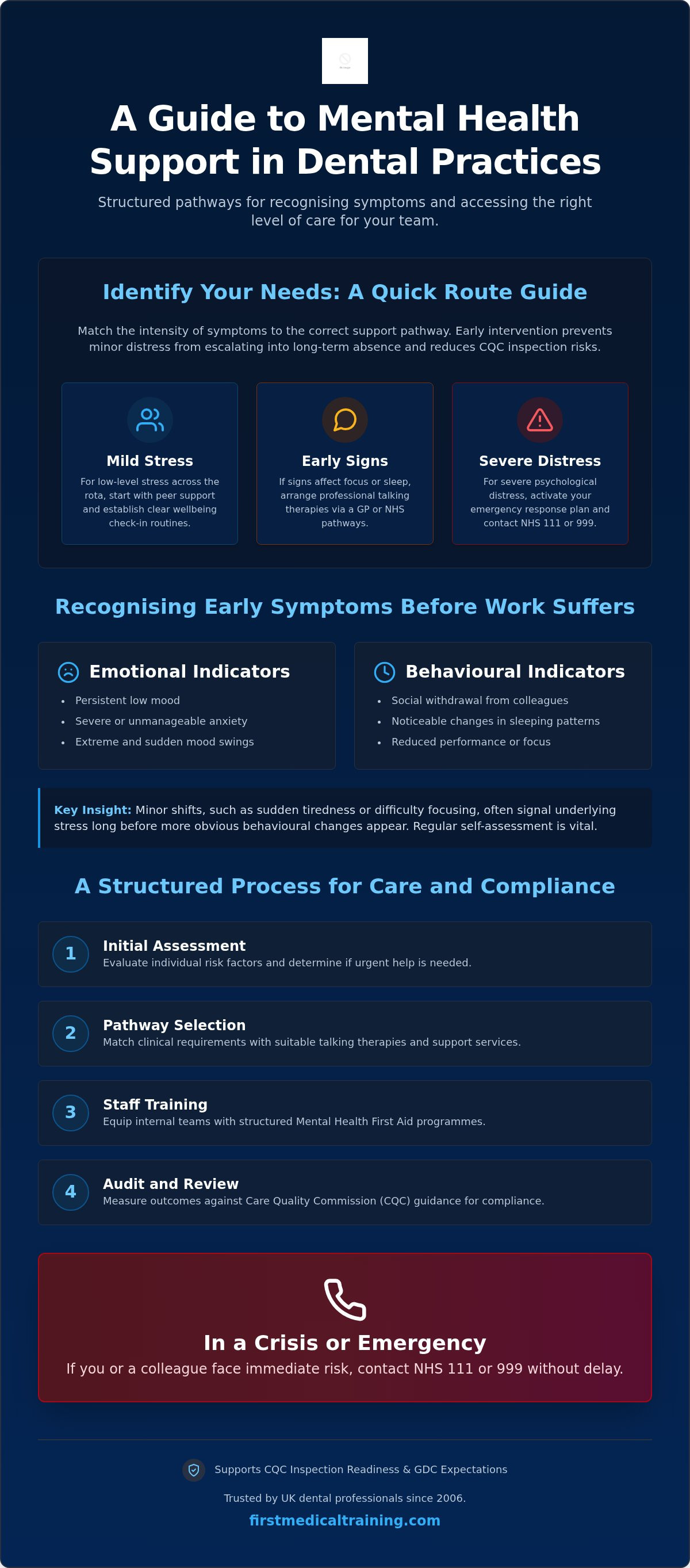
Identify your primary workplace risk factors to select the correct support pathway. With clients we see that early intervention prevents minor distress from escalating into long-term absence. Since 2006, dental practices across the United Kingdom have turned to First Medical Training Ltd for expert-led instruction and dependable partnership.
Segment guide (pick your situation):
- Low-level stress across the rota: start with peer support and a clear wellbeing check-in routine before symptoms disrupt clinics.
- Early signs that affect focus or sleep: arrange talking therapies (specific interventions) via GP or NHS pathways and train designated first-aiders to notice escalation.
- Severe psychological distress on the premises: activate your urgent help (emergency response plan), contact NHS 111 or 999 as required, and document roles in advance.
Assess your team's requirements systematically. Evaluate whether your practice needs general wellbeing strategies or targeted clinical crisis management. For workplace readiness, book the Mental Health First Aid course to establish clear internal protocols.
Match intensity to need:
- Mild stress symptoms: peer support and workload review.
- Signs that disrupt daily work: talking therapies.
- Severe psychological distress: urgent help.
Selecting structured training supports alignment with General Dental Council expectations and CQC inspection readiness.
What Mental Health Covers in Daily Practice
Emotional struggles are a normal human response. Biological factors, life experiences, and family history all shape your psychological state. Media portrayals often misrepresent these conditions, which can increase public stigma and make people hesitate to seek help. Spotting early warning signs gives you room to act before absence or clinical risk grows.
Review your workplace risk assessment protocols so safety duties and staff wellbeing sit side by side. You can complete the first aid course for dental practices to give your team a shared language for support.
Early Symptoms You Can Spot Before Work Suffers
Recognising early warning signs of mental health problems helps you decide when professional medical intervention is needed.
| Symptom Category | Observable Indicators |
|---|---|
| Emotional | Persistent low mood, severe anxiety, extreme mood swings |
| Behavioural | Social withdrawal, changes in sleeping patterns, reduced performance |
A practical point many teams miss: minor shifts in focus or sudden tiredness often signal stress long before obvious behavioural changes appear. Assess your personal baseline regularly. When symptoms disrupt daily work, arrange talking therapies or contact your general practitioner.
Practice managers support staff well-being alongside clinical safety duties. You can use the 2026 buying guide for dentists when choosing structured team training. If safety requires immediate urgent help, call national helpline numbers at once.
How Long Treatment Takes and How to Plan It
Therapy durations for mental health problems vary with individual care pathways and clinical needs. In practice, long care delays often stem from unclear clinical pathways rather than the treatment length itself.
Follow this structured process to evaluate clinical readiness:
- Initial Assessment: Evaluate individual risk factors and determine urgent help needs.
- Pathway Selection: Match clinical requirements with suitable talking therapies.
- Staff Training: Train internal teams using structured mental health first aid programmes.
- Audit and Review: Measure care outcomes against Care Quality Commission guidance for compliance.
The 2026 CQC dental practice guide helps you align your timeline with regulated UK standards. Early intervention shortens long-term recovery times across healthcare settings. Accredited courses help your team meet General Dental Council requirements while keeping safety standards intact.
Honest trade-off: training and pathway mapping cost time on the rota. If your practice already has named first-aiders, clear escalation cards, and recent CQC-ready records, repeating a full programme immediately may add little until the next audit cycle or staff turnover. If none of those pieces exist, delay usually costs more in absence and inspection risk than the course time.
How You Reach NHS Care and Local Support
To get help with mental health problems, reach out to your local GP or NHS 111.
Specialists in client practices guide people to secure urgent help through local NHS crisis teams directly. That rapid step limits escalation during acute distress.
Follow these steps to access care:
- Call NHS 111 for prompt assessment and direction.
- Request a referral for talking therapies.
- Connect with community mental health teams.
Care systems can feel dense; a written internal flowchart (who calls, who stays with the person, who documents) reduces hesitation under pressure.
For workplace safety, the LifeVac device is registered as a Class I Medical Device in the United Kingdom. It carries both the UKCA and CE marks, confirming compliance with British medical standards for safety and performance when placed on the market. First Medical Training Ltd helps organisations maintain compliance with CQC and GDC standards.
User feedback highlights the value of practical healthcare instruction.
Tip: Always check for recognised safety accreditations when purchasing emergency clinical items.
Among First Medical Training Ltd's Google reviews, Dave (5★) wrote:
"Great training experience. In depth and informative but well presented and delivered in a relaxed manner. Id recommend them."
Accredited instruction builds practical confidence when you manage urgent clinical emergencies.
How to Help a Colleague or Relative in Distress
Listen non-judgmentally when a relative or friend is dealing with mental health problems.
Arc from practice: a colleague shows mild stress (short temper, poorer sleep) after a heavy week. Peer support and a quieter list are offered first. When focus and attendance keep slipping, the person is steered toward talking therapies and a trained workplace first-aider keeps contact. Where distress becomes severe, the team switches to the urgent help. That stepped path (situation → matched support → safer outcome) beats jumping straight to crisis language or waiting until collapse.
Immediate access to structured talking therapies combined with certified workplace first-aiders gives a strong recovery path: timely professional care plus steady community empathy.
LifeVac devices carry UKCA and CE markings, indicating conformity with UK medical device regulations for safety and performance standards for market placement (these marks are not a retail-channel guarantee for pharmacy shelves).
During crises, contact an urgent help provider or call 999 if someone is at immediate risk. First Medical Training Ltd has been trusted by UK dental professionals since 2006 to deliver certified Mental Health First Aid for Dental Practices. Encourage professional support once you have listened.
Prevention at Work and Support for Younger Staff
Allocate organisational funding to targeted prevention programmes to improve outcomes for young people and employees. Clear local protocols matter more than broad statements of intent.
Organise workplace protocols to support staff experiencing mental health problems. Establish a clear dental emergency response plan so severe psychological distress is handled safely. Practical guidance for your team beats generic posters alone.
Mental Health First Aid for Dental Practices helps managers spot early warning signs quickly. Established in 2006, First Medical Training Ltd supports dental practices nationwide with specialised education. Ask for a personalised quote if you need exact figures on workplace training packages. Structured support pathways protect your team without waiting for a formal incident.
When it is not the right spend yet: if you have no named lead, no risk assessment update planned, and no capacity to release staff for training dates in Bradford, Leeds, or in-practice sessions, fix roster cover and role cards first, then book. Training without time to apply it rarely changes outcomes.
When Self-Guided Management Is Not Enough
Recognise when mental health problems escalate beyond routine self-care techniques. Seek professional care promptly when limits appear.
Personal coping strategies have distinct limits. From clinical practice, individuals struggle when severe symptoms persist despite daily management efforts. While maintaining a healthy lifestyle is a cornerstone of resilience, and resources from Wise Eats Registered Dietitians offer expert insights into the link between nutrition and mental health, complex psychological conditions need structured interventions rather than lifestyle adjustments alone.
Refer people to talking therapies or clinical specialists when daily functions suffer. If a crisis arises, initiate an immediate urgent help protocol.
Align your workplace with current General Dental Council expectations for staff wellbeing. Enrol your team in Mental Health First Aid for Dental Practices so warning signs are spotted early. First Medical Training Ltd provides this instruction so you can manage severe distress with a shared plan rather than improvised responses.
Empower Your Team With Workplace First Aid
Equip your staff with early intervention skills by booking the Mental Health First Aid for Dental Practices course. This targeted instruction helps colleagues identify early signs of mental health problems across clinical settings. Established in 2006, First Medical Training Ltd supports practice leaders who want clear, compliant training protocols.
Experienced medical professionals deliver flexible, in-practice training at your location. Alternatively, your team can attend structured sessions at dedicated venues in Bradford or Leeds.
Following General Dental Council (GDC) expectations and CQC inspection standards keeps regulatory compliance on track. Preparation shortens response time when something goes wrong on the clinic floor.
Contact the team to request a personalised quote for your practice.
Details and enquiries: First Medical Training Ltd.
Frequently asked questions
How can I get urgent help for mental health?
Call 111 immediately to access an emergency response plan (urgent help) through NHS mental health services. If a patient or colleague faces immediate physical risk in your practice, contact 999. Use the SBAR tool (a structured communication framework covering Situation, Background, Assessment, Recommendation) to convey clinical details quickly to emergency call handlers. Follow your practice's internal protocol to assign team roles during any crisis.
What should dental practices train staff to do first?
Train staff to notice early psychological distress, listen without judgement, and escalate through your urgent help when needed. Mental Health First Aid for Dental Practices, delivered by First Medical Training Ltd, gives teams a shared method for those steps and supports GDC and CQC-facing records. Rehearse role cards so the first minutes of an incident are not spent deciding who phones whom.
What are common mental health symptoms?
Early indicators of mental health problems include persistent low mood, sudden severe anxiety, cognitive fatigue and sudden changes in behaviour. Physical signs may include rapid breathing or extreme agitation. Dental professionals need to recognise these subtle indicators early to maintain safety. Acting while distress is still mild reduces the chance of a serious clinical emergency.
What conditions does the NHS cover?
The NHS provides free care for generalised anxiety, depression, obsessive-compulsive disorders and post-traumatic stress. Severe conditions receive care from specialist community teams. Practices should align staff well-being policies with General Dental Council expectations and CQC requirements. Keeping complete training records supports compliance during routine inspections.
How can I prevent mental health problems?
Promote open communication, manage clinical workloads and complete structured workplace training to reduce mental health problems. First Medical Training Ltd has supported dental practices nationwide since 2006 with expert instruction. Staff gain most when practical support protocols are practised, not only filed. Build those habits into rota planning rather than one-off talks. Additionally, maintaining social connections with peers who understand their unique challenges through downtodate.org can be a valuable part of a personal wellbeing strategy.
Taking Action for Workplace Mental Health
Support your practice team by identifying early signs of mental health problems and matching each level of need to peer support, talking therapies, or urgent help.
During clinical training sessions, confidence grows once staff master a structured emergency response plan. Clear internal protocols keep your practice aligned with General Dental Council expectations. Advisers from First Medical Training Ltd deliver instruction at your venue or at dedicated facilities in Bradford and Leeds. Over 15,000 dental practices worldwide rely on these educational programmes.
MHRA-registered Class I Medical Device offerings reflect UKCA/CE marking compliance for safety and performance standards for market placement. If you are ready to strengthen team resilience, request a tailored quote for your practice.