

Advanced resuscitation for UK dentists: a practical guide

Does “advanced resuscitation” mean every dental team needs the same skills? Not necessarily. The question behind searches for “advanced resuscitation techniques for dentists uk” is how to match training to your practice, your role and the emergencies you may need to manage.
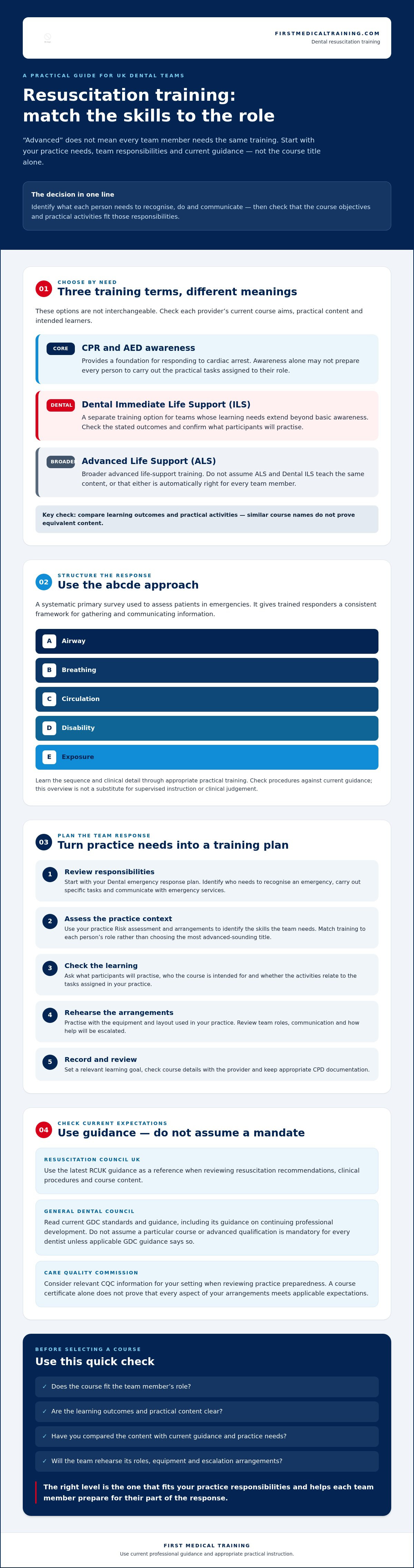
CPR and AED awareness, Dental Immediate Life Support (ILS) and broader Advanced Life Support (ALS) are not interchangeable. The right option depends on what your team needs to do, not simply on choosing the course with the most advanced-sounding title. It is also important to understand professional expectations without treating every recommendation as a legal requirement.
This guide explains what advanced resuscitation can mean in a dental setting, how it differs from core life-support skills and how to assess your team’s training needs against current Resuscitation Council UK guidance and relevant GDC expectations. It also sets out practical checks for choosing training, including course objectives, hands-on practice and suitability for each team member’s role.
Key Takeaways
- Match resuscitation training to team members’ roles, your practice risk assessment and current Resuscitation Council UK guidance.
- Understand how CPR and AED awareness, Dental ILS and broader advanced life support differ. Check course details before treating them as equivalent.
- Use the ABCDE approach as a structured assessment framework, alongside clear team roles and escalation arrangements.
- Prepare by reviewing the dental emergency response plan, checking equipment and rehearsing in the clinical environment.
- Assess advanced resuscitation techniques for dentists uk by identifying relevant training outcomes, practical content and CPD documentation.
Advanced resuscitation techniques for dentists UK: start with practice needs
Begin with the responsibilities set out in your practice emergency response plan. Identify which team members need to recognise an emergency, carry out specific tasks or communicate with emergency services. Then compare those needs with current guidance and the actual learning outcomes of available courses. This is a more reliable way to choose training than relying on a course title alone.
Advanced resuscitation: what it means for UK dentists
In a dental practice, advanced resuscitation means building on basic life-support skills with additional assessment and response capabilities suited to the team’s roles and the emergencies it may need to manage. It does not mean every dentist needs the same advanced interventions. The appropriate level depends on individual responsibilities, your practice risk assessment and current guidance. The phrase advanced resuscitation techniques for dentists uk can refer to different training levels, so check the stated aims and content rather than relying on the course title.
How does advanced resuscitation differ from CPR and AED awareness?
CPR and AED awareness provides a foundation for responding to cardiac arrest. Dental Immediate Life Support (ILS) is a separate training option for teams whose learning needs extend beyond basic awareness. Do not assume it is interchangeable with broader Advanced Life Support (ALS), or that courses with similar names teach the same content. For a general overview of how ALS builds on Basic Life Support, see Advanced life support (ALS).
Before choosing training, check the provider’s current course objectives, practical components and intended learners. Ask what participants will practise and whether those activities relate to their role. First Medical Training Ltd offers Dental ILS Training. Confirm the current learning outcomes with the provider rather than inferring them from the course name.
Which UK standards and professional guidance should dentists check?
Use the latest Resuscitation Council UK (RCUK) guidance as a reference for current resuscitation recommendations. The RCUK Guidelines 2025 were published on 27 October 2025. Check the relevant guidance when reviewing clinical procedures or course content. An educational article is not a substitute for practical instruction or current clinical advice.
Read the General Dental Council’s current standards and guidance to understand professional expectations, including its guidance on continuing professional development. Do not assume a particular course or advanced qualification is mandatory for every dentist unless applicable GDC guidance says so. If you are reviewing practice preparedness, consider relevant Care Quality Commission (CQC) information for your setting. A course certificate alone does not prove that every aspect of your arrangements meets applicable expectations.
To set a useful learning goal, record who needs which skills, compare those needs with current guidance and check course details with the provider. This keeps the decision grounded in practice requirements rather than the word “advanced” in a course description.
Which resuscitation skills may matter in a dental emergency?
Useful skills extend beyond knowing a technique. A dental team needs to recognise when someone may be seriously unwell, begin an appropriate response, coordinate tasks and communicate clearly as help is escalated. The skills to practise depend on team members’ roles and your practice arrangements. Check current Resuscitation Council UK guidance before using a clinical procedure or training recommendation.
How can an abcde approach support structured assessment?
The abcde approach is a structured way to assess a patient: Airway, Breathing, Circulation, Disability and Exposure. It gives trained responders a consistent framework for gathering and communicating information, rather than relying on an unstructured impression. Learn the sequence and clinical detail through appropriate practical training, and check them against current guidance. This overview is educational, not a substitute for supervised instruction or clinical judgement.
Where do CPR, AED use and team communication fit?
CPR and AED awareness are important team competencies, but awareness alone may not prepare each person to carry out the practical tasks assigned to their role. Review the Resuscitation Council UK Quality Standards alongside your dental emergency response plan. Identify what each team member needs to recognise, do and communicate, then practise with the equipment and layout used in your practice.
Make responsibilities explicit. Agree who calls 999, who starts the response within their training, who brings the AED and who meets emergency services. Rehearsing these roles lets the team practise task allocation and communication together. It can support a more coordinated response, but cannot guarantee a particular outcome.
Use a concise handover when communicating with emergency services. The SBAR tool, which stands for Situation, Background, Assessment and Recommendation, can provide a clear structure for sharing relevant information. Practise it in a scenario and confirm how it fits your practice protocol.
For focused guidance on a cardiac arrest scenario, read the cardiac arrest management guide. If your team’s needs extend beyond awareness, compare the objectives and practical elements of Dental Immediate Life Support (ILS) Training with each learner’s role before deciding whether it is suitable.
How do basic life support, Dental ILS and advanced training compare?
Training labels can help you identify a starting point, but they do not guarantee the same content across providers. Compare stated outcomes and practical requirements with team roles, your risk assessment and the dental emergency response plan. Use current General Dental Council (GDC) guidance and Resuscitation Council UK recommendations to inform your decision.
Basic life support (BLS)
- Purpose: Build foundational life-support knowledge and skills.
- Learner needs: Suitable to consider for team members who need core emergency response skills for their role.
- Practical emphasis: Check the course description for the skills practised and how they are assessed.
- Limits: Do not assume basic awareness covers every responsibility in your practice plan.
Dental Immediate Life Support (ILS)
- Purpose: A distinct dental-focused training option to consider when needs go beyond basic awareness.
- Learner needs: Confirm the intended audience and any entry requirements with the provider.
- Practical emphasis: Review current learning outcomes and ask which scenarios and skills participants practise.
- Limits: The course name alone does not confirm its curriculum or suitability for every team member.
Broader advanced life-support training
- Purpose: Training at a different level from BLS or Dental ILS. Check its stated scope rather than assuming it is equivalent.
- Learner needs: Establish whether the intended audience and content fit your clinical roles.
- Practical emphasis: Check what practical rehearsal, assessment and refresher arrangements are included.
- Limits: Do not select it simply because “advanced” sounds more suitable for a dental practice.
What should you compare between training levels?
Ask providers for current course objectives, intended learners, practical components, assessment methods and refresher arrangements. Confirm any entry requirements and check how the course content relates to the tasks each person may need to perform. Keep CPD records in line with your professional development needs. The GDC CPD requirements guide offers further context.
When might Dental ILS be worth considering?
Consider Dental ILS when your team’s identified learning needs extend beyond basic awareness. Review who has which responsibilities, what your risk assessment identifies and how the training fits your emergency response plan. First Medical Training Ltd offers Dental ILS Training. Ask the provider about its current objectives and practical content before deciding if it fits your team. It is an option to assess, not a universal requirement. Choosing advanced resuscitation techniques for dentists uk should start with practice needs, not the course label.
How can a dental team prepare to use resuscitation skills?
Training is most useful when it connects to the way your practice is organised. Use this sequence to turn learning into a plan your team can review and rehearse:
- Review risk: Revisit your practice risk assessment and identify the emergencies and team responsibilities your arrangements need to address.
- Assign roles: Document who takes each task, how to call for help and how to escalate the response. Make responsibilities clear to the whole team.
- Check equipment: Record where emergency equipment is kept and how staff can access it. Check current guidance and practice procedures for equipment and emergency drug kit arrangements.
- Rehearse: Practise scenarios in the surgery, using your actual layout and available equipment.
- Review learning: Debrief after practice, note unclear steps and update training or the plan where needed.
How should a practice organise roles and rehearsal?
Bring the dental emergency response plan into the exercise. Confirm that it sets out team responsibilities, equipment locations and escalation arrangements, then test whether staff can follow those steps in the clinical environment. Rehearsal may reveal practical questions, such as whether the route to equipment is clear or who communicates key information. Use the debrief to identify learning needs, not to assume how the team would perform in a real emergency.
How can teams keep training and equipment readiness current?
Set a review schedule that suits your practice and check it against current Resuscitation Council UK and relevant professional guidance. Record when training and equipment checks are reviewed, then follow up any identified gaps. Emergency drug kit compliance and required arrangements can depend on current guidance. Verify the details for your practice rather than relying on an old checklist.
Include Defibrillator maintenance in your equipment checks. Confirm the battery status, pad expiry and device functionality in line with the manufacturer’s instructions and applicable guidance. Record checks and make sure the team knows how to report a problem. For a broader readiness review, use the dental practice emergency preparedness checklist.
Use this process to decide whether your team needs refresher learning, more practical rehearsal or training beyond basic awareness. If Dental ILS suits the roles and needs you have identified, review Dental Immediate Life Support Training from First Medical Training Ltd and confirm its current objectives and practical content with the provider. This keeps decisions about advanced resuscitation techniques for dentists uk grounded in your practice plan and current guidance.
How can dentists choose relevant advanced resuscitation training?
Choose training by matching course content to the competencies your practice has identified, not by selecting the highest-sounding level. Before comparing providers, review your practice risk assessment, staff roles and dental emergency response plan. Then work through this checklist:
- Learner roles: Check who the course is designed for and whether its intended audience matches each participant’s responsibilities.
- Course outcomes: Ask for the current learning outcomes and compare them with the skills your team needs to develop.
- Practical content: Confirm what participants will practise, how scenarios are run and whether there is an assessment.
- Guidance alignment: Ask how the course content reflects current Resuscitation Council UK guidance.
- CPD records: Confirm what documentation is supplied and how learning or assessment is recorded.
What questions should you ask a training provider?
Ask the provider to explain the course’s intended roles, entry requirements and practical components. Find out how learning is assessed, what CPD documentation is provided and how often learners should review or refresh their skills. Check accreditation and the exact wording on any certificate directly with the provider. Do not assume that a course title, certificate or CPD claim automatically confirms suitability for your practice.
Compare the answers with current guidance and your team’s needs. If you are considering advanced resuscitation techniques for dentists uk, focus on the gap between what staff currently practise and the responsibilities in your emergency response plan. A course may be relevant for some team members without being necessary for the whole practice.
What is a sensible next step for your dental practice?
First, record the skills and responsibilities you need to address. Next, check the provider’s course objectives against that list. Finally, decide how you will put the learning into practice and document the team’s development. Keep the review proportionate to your setting and check current GDC and Resuscitation Council UK guidance when confirming professional expectations.
First Medical Training Ltd offers Dental Immediate Life Support (ILS) Training and a Medical Emergencies in a Dental Practice Course. Review them against your needs, and confirm current outcomes, practical content and course details before booking. For further context on medical-emergency education, read the medical emergencies training for dental teams guide.
Once you have identified your team’s learning priorities, explore First Medical Training Ltd to review relevant dental training options.
Make your next training decision with confidence
Advanced resuscitation is not one fixed set of skills for every dental professional. Choose training by matching course outcomes and practical content to team roles, your practice risk assessment and current Resuscitation Council UK and GDC guidance. CPR and AED awareness provides a foundation. Dental ILS is a separate option to assess when your identified learning needs extend further.
Turn that decision into action: review your dental emergency response plan, identify skills your team needs to practise and confirm course details directly with the provider. Keep training relevant to the people who may need to respond, and make time to rehearse together.
First Medical Training Ltd has provided specialist healthcare and dental education since 2006. Relevant options include Dental Immediate Life Support (ILS) and medical emergencies in a dental practice training. Explore dental emergency and Dental ILS training with First Medical Training Ltd to review the available course information and consider what fits your practice. A clear plan and relevant preparation can help your team approach its responsibilities with greater confidence.
Frequently Asked Questions
Do dentists in the UK need advanced resuscitation training?
Not every dentist needs the same level of advanced training. Start by checking current General Dental Council (GDC) and Resuscitation Council UK guidance, then assess your practice’s risks, staff roles and emergency response arrangements. Core life-support skills remain important. Dental Immediate Life Support (ILS) may be worth considering if your team’s identified learning needs go beyond basic awareness. Confirm course relevance and requirements against current guidance.
What is the difference between Dental ILS and advanced life support?
Dental ILS and advanced life support (ALS) are different training labels, not interchangeable qualifications. Dental ILS is an option intended for dental settings, while ALS refers to a broader level of life-support training. Course content can vary between providers, so the title alone does not tell you exactly what is taught. Check the intended learners, learning outcomes, practical elements and assessment before deciding which course fits your team.
Can dentists use an AED during a resuscitation emergency?
Yes. An automated external defibrillator (AED) can form part of a dental practice’s response to suspected cardiac arrest. Follow current Resuscitation Council UK guidance and your practice emergency response plan, and use the device in line with your training and its prompts. Agree who will fetch the AED and who will continue other response tasks. Check its accessibility and readiness through your practice’s equipment arrangements.
How often should dental teams refresh resuscitation training?
Check current Resuscitation Council UK and GDC guidance rather than assuming one refresh interval applies to every role or practice. Set a review schedule that considers staff responsibilities, previous training, changes in guidance and gaps identified during practice scenarios. Record training and learning needs, and confirm refresher advice with your course provider. Revisit the schedule when team members or practice arrangements change.
What should a dental team include in an emergency response plan?
Document how your team will recognise and respond to emergencies, who takes each role, where emergency equipment is kept and how to escalate the response. Include communication and handover arrangements, and make sure team members can find and understand the plan. Check it against current guidance and your practice risk assessment. Rehearse its steps in the clinical environment, then review any questions or gaps identified.
Does advanced resuscitation training replace medical emergencies CPD?
No. Advanced resuscitation training does not automatically cover the wider range of medical emergencies relevant to a dental practice or meet every team member’s CPD needs. Review the course outcomes alongside your professional development plan and practice learning needs. Check whether the training provides verifiable CPD documentation and how to record it. A medical emergencies course and Dental ILS may address different objectives, so assess each on its content.
How can a dental practice assess whether its resuscitation training is suitable?
Compare your team’s roles and current skills with your risk assessment and dental emergency response plan. Then check each course’s intended learners, learning outcomes, practical content, assessment and alignment with current Resuscitation Council UK guidance. Ask the provider to confirm accreditation, certificate wording, refresher arrangements and CPD documentation. For advanced resuscitation techniques for dentists uk, judge suitability by verified course details and practice needs, not by the course title alone.