

AED for a small business: compare costs and child suitability

The best AED for a small business isn’t necessarily the one with the most features. Choosing the right AED for a small business means matching its battery and pad replacement schedule, child settings and operating mode to your workplace.
Assess how each device fits your staff, visitors and premises, as well as the checks it will need. For children under eight, Resuscitation Council UK recommends an AED with specific child settings. If one isn’t available, an adult AED can be used.
This guide explains what to consider, including battery life and replacement planning, suitability for children, and the difference between semi-automatic and fully automatic devices. It also outlines UK requirements and practical workplace considerations to help you make an informed choice.
Key Takeaways
- Compare battery standby life, pad expiry and replacement schedules to understand the ongoing maintenance each AED requires.
- For workplaces where children may be present, prioritise an AED with child settings for use on children under eight.
- Choose between semi-automatic and fully automatic operation based on how you want a responder to manage shock delivery.
- Use your workplace risk profile and first-aid provision to inform whether an AED is appropriate; UK businesses do not all have the same requirements.
- Consider your premises layout and who needs access when deciding where to place an AED and how many may be needed.
Battery standby life and replacement planning
Compare each defibrillator’s battery and pad replacement schedule, not just its standby life. Both affect maintenance planning and whether the device is ready for use.
Battery replacement life
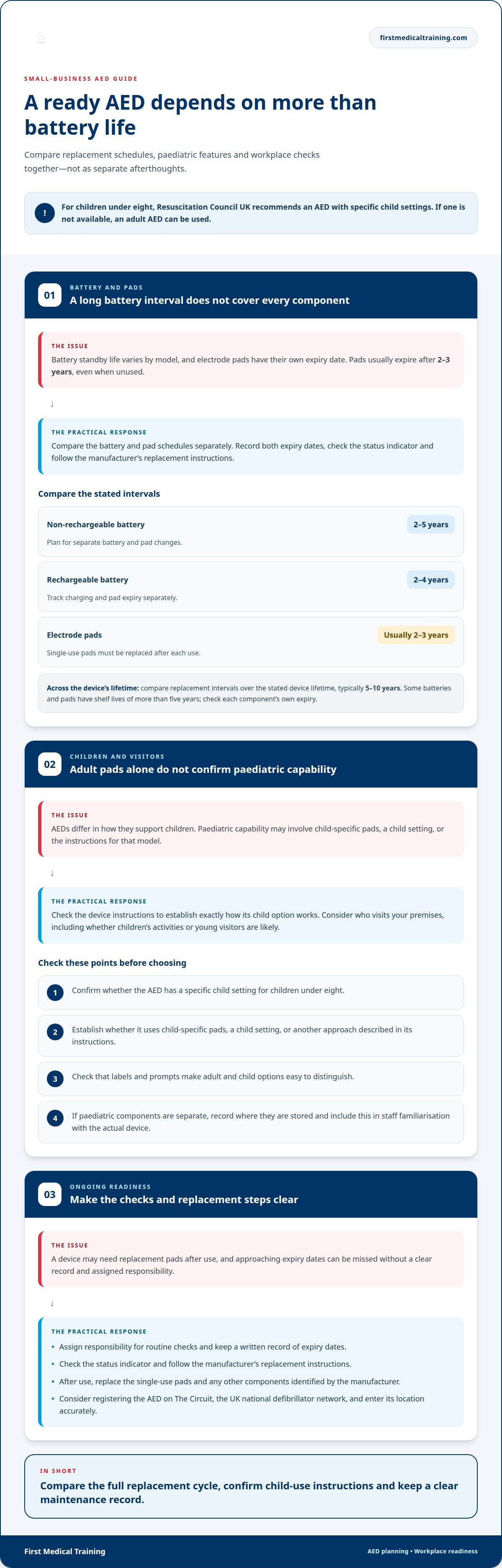
AED battery standby life ranges from 2 years to more than 5 years, depending on the model. Non-rechargeable batteries typically last 2-5 years, while rechargeable batteries typically last 2-4 years. A model with a longer stated shelf life may mean fewer scheduled battery replacements, but compare the specific replacement schedule rather than assuming every component lasts as long as the battery.
Some AEDs have battery and pad shelf lives of more than five years, which can reduce how often replacements are needed. Pads still have their own expiry date. Check the status indicator and follow the manufacturer’s replacement instructions. Record the expiry dates for the installed battery and pads so the person responsible for maintenance can plan ahead.
Maintenance schedule
Maintenance involves more than checking batteries. AED electrode pads usually expire after 2-3 years, even when unused, and must be replaced after each use. They are single-use items, so a device that has been deployed needs replacement pads before it is ready for another incident. Include pad expiry and post-use replacement in the maintenance plan.
Compare how often each option needs new batteries and pads across the device’s lifetime, typically 5-10 years. The listed battery and pad replacement intervals help reveal how often maintenance is needed. A rechargeable battery may have a different replacement cycle from a non-rechargeable one, so assess both the stated lifespan and the replacement process.
| Option | Battery interval | Pad interval | Maintenance consideration |
|---|---|---|---|
| Non-rechargeable battery | Typically 2-5 years | Usually expires after 2-3 years | Plan for separate battery and pad changes. |
| Rechargeable battery | Typically 2-4 years | Usually expires after 2-3 years | Track charging and pad expiry separately. |
| Longer shelf-life option | Some batteries and pads exceed five years | Check the individual pad expiry | May reduce scheduled replacement frequency. |
Compare the full replacement cycle: battery type, pad expiry, device lifespan and post-use requirements. A long battery interval does not remove the need to monitor the pads or status indicator. Keep a written record of expiry dates and assign responsibility for routine checks, so an overlooked date does not leave the AED unready.
Yes, a UK small business can register its AED on The Circuit, the UK national defibrillator network. Registration helps the London Ambulance Service locate the device during an emergency, so enter its location accurately and keep the record current.
As a practical routine, check the status indicator and expiry dates regularly, then arrange replacements according to the device instructions. After use, replace the single-use pads and any other components identified by the manufacturer. A clear log makes approaching expiry dates easier to spot and helps maintain a ready device.
Paediatric capability: is the AED suitable for children?
If children may be present, compare how each AED supports adult and paediatric use. Resuscitation Council UK recommends an AED with specific child settings for children under eight.
Adult and paediatric pads
Read the device instructions to understand how its child capability works, including whether it uses child-specific pads or a child setting. These are different features: pads concern the electrodes used, while a setting refers to an operating option. Don’t assume an AED supports paediatric use just because adult pads are available.
If the model has separate adult and paediatric components, record where they are stored. In an emergency, a responder needs to identify the correct option from the device labels and prompts. Include this in workplace familiarisation so staff can find the relevant instructions without searching through other equipment.
Adult and child settings
An AED with a specific child setting can be used for children under eight, in line with the Resuscitation Council UK recommendation. Compare how clearly the device identifies the setting and explains its use. A visible control or clear voice prompts may help responders distinguish the child option from adult operation, but follow the instructions for the selected model.
Consider who visits your premises. A small business serving families, hosting children’s activities or welcoming young visitors has a practical reason to include paediatric capability in its comparison. Even if children are rarely present, consider whether visitors of different ages use the workplace. Likely users and clear AED instructions are relevant factors.
An adult AED can be used on a child if no AED suitable for children is available. That fallback does not remove the value of choosing specific child settings where children may be present. Make the distinction clear in staff briefings: identify the child option when available and follow the AED’s instructions.
Use these steps to compare models:
- Confirm whether the AED has a specific child setting for children under eight.
- Identify whether paediatric capability relies on child-specific pads, a setting, or the device’s stated instructions.
- Check that labels and prompts make the adult and child options easy to distinguish.
- Include the relevant steps in staff familiarisation, using the actual device.
Don’t base your choice on a general rating or child symbol alone. Read the model’s instructions to establish what its paediatric capability means and where any separate pads are kept. For example, if your workplace uses a device with a child setting, ensure staff know how to recognise and select it. Familiarity with the device helps reduce uncertainty about its options.
If children may be present, prioritise a model with specific child settings and straightforward instructions. If no child-suitable AED is available during an emergency, an adult AED can still be used. Include the device’s prompts and child-use steps in staff preparation, and keep its components accessible.
Semi-Automatic vs Fully Automatic AED: What's the Difference?
Both types assess a person’s heart rhythm and determine whether a shock is needed. The key difference is who presses the button to deliver it.
Semi-automatic AEDs
A semi-automatic AED prompts the responder to press a button when it determines a shock is needed. The device analyses the heart rhythm and guides the user through its instructions, but the responder delivers the shock by pressing the button. A fully automatic model delivers the shock itself.
During familiarisation, practise following the prompts and identifying the shock button. Consider who might use the device, including staff who have not used an AED before. Untrained people can use AEDs, and clear instructions help guide their actions. Practice can also build familiarity with the specific model.
Fully automatic AEDs
A fully automatic AED analyses the heart rhythm and delivers a shock when it determines one is needed, without requiring the responder to press a button. This is the key difference from a semi-automatic model. The device’s instructions and prompts remain central, so staff should know how to follow them.
Fully automatic models often have a slightly longer time to shock than semi-automatic models because of the countdown before shock delivery. Consider whether your staff would prefer the device to deliver a shock automatically or to require a responder to press the button. Neither operating mode removes the need to follow the AED’s instructions.
Self-test functions and status indicators vary by model. Read the operating instructions to understand what the device checks, how it displays its status and what action it prompts if attention is needed. During routine checks, follow the manufacturer’s stated process rather than assuming every automated external defibrillator signals readiness in the same way.
Compare models using practical criteria:
- Shock delivery: A responder presses the button on a semi-automatic AED; a fully automatic AED delivers the shock itself.
- Prompts: Review how each device guides the responder through rhythm analysis and shock delivery.
- Familiarity: Include the selected model’s controls and instructions in workplace practice.
- Self-tests: Follow the model-specific instructions for interpreting its status indicators.
That figure does not establish that a small business qualifies for a workplace AED grant or tax relief; assess any funding option against its eligibility terms.
Select the operating mode your staff can follow confidently under pressure, then familiarise them with that device’s prompts and button or automatic-shock sequence. A practical Automated External Defibrillator (AED) Training Course can help staff understand AED operation and practise responding to its instructions.
Are Defibrillators a Legal Requirement in the UK?
As of 2024, there was no universal legal requirement for every UK private business to own an AED. Employers must still consider their wider first-aid responsibilities and the risks present in their workplace.
The Health and Safety at Work Act 1974 and associated regulations are referred to when considering whether an organisation has a statutory duty to provide an AED, according to The National Archives (legislation.gov.uk). The Health and Safety (First-Aid) Regulations 1981 require UK employers to provide adequate and appropriate first-aid equipment, facilities and personnel, according to The National Archives (legislation.gov.uk). These requirements concern appropriate first-aid provision, rather than a universal AED rule for every workplace.
Use a workplace risk assessment to consider the activities, people and hazards on your premises. Record the precautions taken and retain the documentation, which UK businesses and organisations must be able to present to the Health and Safety Executive if requested. A busy workshop, for example, may have different hazards from a small office; the assessment helps determine suitable first-aid provision.
An AED decision should sit alongside that first-aid planning. Consider whether the workplace’s risks, layout and likely users make an AED a suitable part of its emergency arrangements. The legal position does not remove the value of practical preparation: equipment needs to be accessible, and staff need to know how to respond.
No specialist training is required to use a public-access AED in the UK. In an emergency, call 999 and follow the emergency call handler’s instructions and the AED’s prompts. This applies even if the person responding has not completed formal AED training; the device provides instructions during use.
Training and familiarisation can help employees prepare. Use the selected AED to practise recognising its controls, listening to prompts and following the sequence of instructions. Include CPR and AED awareness in staff preparation, particularly for people designated to support first aid. Training is not a legal prerequisite for public-access AED use.
Build routine readiness into workplace arrangements. Assign responsibility for the following tasks:
- Keep the AED’s location clear and accessible to staff and the public.
- Follow the manufacturer’s instructions for checking the device’s status indicator.
- Track pad and battery expiry dates, and arrange replacements when required.
- Make sure employees know how to call 999 and follow the call handler’s directions.
These steps connect equipment, staff preparation and first-aid planning. A visible status indicator can help identify when a device needs attention, while a clear location helps responders find it. Keeping pads and batteries within their expiry dates supports readiness, and familiarisation helps employees follow the AED’s prompts during an emergency.
For a small business, treat AED provision as part of a documented assessment, not an automatic legal requirement for every organisation. Review workplace hazards, first-aid arrangements and practical access to equipment together. This gives you a clear basis for deciding whether an AED fits your emergency plan and how employees should prepare to use it.
AED choices for small and medium-sized workplaces
Choose an AED by considering your premises, the people who use them and how quickly responders can reach the device. The UK has over 30,000 out-of-hospital cardiac arrests annually, so workplace planning should account for staff, visitors and the route to emergency equipment.
Start with your workplace risk assessment and floor plan. A business facility under 5,000 square feet is suggested to have one AED; a facility of 5,000-10,000 square feet, two; and a facility of 10,000-20,000 square feet, three to four. For premises larger than 20,000 square feet, the suggested provision is one AED per 10,000 square feet. Treat these figures as planning guidance, then consider layout and access.
Distance matters as much as floor area. Resuscitation Council UK recommends that an AED be accessible within 200 metres or a two-minute brisk walk. Measure the route people would actually take, including corridors, doors and stairs. A device behind a locked door or far from the work area may be harder to reach during a cardiac arrest.
In a multi-storey workplace, consider provision on every floor. If an incident occurs upstairs, a device on the ground floor may delay the start of a response. Place the AED where staff and visitors can find it, and use suitable signs to make its location clear. Consider access for people working outside normal office areas, such as a stockroom or workshop.
Compare three broad workplace options:
- Compact, single-floor premises: Start with the suggested provision for the building’s floor area, then check that the device is accessible from work areas.
- Medium-sized premises: Match the suggested number of AEDs to the total floor area and consider separate work zones or visitor areas.
- Large or multi-storey premises: Apply the suggested provision per floor area and consider the recommendation for an AED on every floor.
These are not substitutes for UK first-aid duties. The Health and Safety (First-Aid) Regulations 1981 require employers to provide adequate and appropriate first-aid equipment, facilities and personnel, according to The National Archives (legislation.gov.uk). Use your workplace assessment to decide how first-aid arrangements and AED access fit together.
Consider access and readiness alongside the AED’s location. A wall-mounted device may be visible, but staff still need a clear route to it and knowledge of where it is. Keep the device accessible, maintain clear signage and include its position in your emergency arrangements.
To prepare employees for workplace emergencies, consider an Emergency First Aid at Work Course (EFAW) - 1 Day as part of your first-aid planning.
First Medical Training Ltd
First Medical Training Ltd helps you connect your AED decision with practical preparation for workplace emergencies. If you’ve selected a device and want staff to understand its prompts and operation, the Automated External Defibrillator (AED) Training Course focuses on AED use. The Emergency First Aid at Work Course (EFAW) - 1 Day can support wider workplace first-aid preparation.
For dental teams, the Medical Emergencies in a Dental Practice Course and Dental Immediate Life Support (ILS) Training address emergency response in clinical settings. Choose training that reflects your workplace, the people who may respond and the skills your team needs to practise.
Contact First Medical Training Ltd to discuss training relevant to your workplace.
Turn your AED decision into workplace readiness
Choosing the right AED for a small business is one part of preparing for an emergency. Next, make sure your response arrangements work in practice: staff should know their roles, how to raise the alarm and how the AED fits into your workplace plan.
First Medical Training Ltd supports that preparation through workplace and clinical emergency education. Its Emergency First Aid at Work Course (EFAW) - 1 Day and Automated External Defibrillator (AED) Training Course can help staff develop relevant response skills. Dental teams can also consider the Medical Emergencies in a Dental Practice Course or Dental Immediate Life Support (ILS) Training.
Choose training that reflects your workplace and the people who may need to respond. Contact First Medical Training Ltd to discuss the most relevant next step for your team. A clear plan and prepared responders can help your workplace act with greater confidence during an emergency.
Frequently Asked Questions
What Is the Best Defibrillator for a Small Business?
There isn’t one model that suits every small business. Start by identifying who might respond, where the device will be kept and what your workplace emergency plan requires. For example, if staff work across separate teams, agree how the AED will be handed over during a response. Choose a device your workplace can incorporate into its procedures, staff induction and equipment records.
How Many AEDs Do You Need, and Where Should You Put Them?
Use your building plan to map how responders would reach the person and retrieve the AED. Include shared areas, entrances and spaces used by contractors or visitors, not just staff workstations. If your business shares a building, agree access arrangements with the building manager and neighbouring occupiers. Make the device’s location clear in emergency procedures, including who can access it and how.
What Maintenance Does a Defibrillator Require?
Check the manufacturer’s schedule for maintenance and replacement requirements, including when consumables or servicing may be due. Record each model’s schedule and arrange checks so the device remains ready for use. Keep these records together to compare maintenance requirements and replacement schedules across options.
What Is an AED, and What Matters When Choosing One?
AED means automated external defibrillator. Before choosing one, decide how the equipment will fit into your workplace emergency arrangements: who will identify an incident, fetch the device and meet the emergency services. This planning can reveal practical gaps, such as unclear responsibilities between departments. Record the agreed roles alongside the equipment decision, rather than treating device selection as separate from response planning.
What Is an AED?
An AED is an automated external defibrillator, a device used during sudden cardiac arrest. Its role is distinct from general first-aid supplies, so include it explicitly in the workplace inventory and emergency plan. Give the responsible person a clear way to record changes to its location or assigned oversight. This keeps workplace records aligned as the premises, team structure or emergency arrangements change.
How Many AEDs Does a Small Business Need and Where Should They Be Located?
For a small business, map operational areas rather than relying on a single central point. Consider how staff move between work zones, whether access controls separate areas, and whether a lone worker could raise the alarm. Add the agreed location to induction materials and contractor briefings. Review the arrangement whenever the business changes its layout or use of space.
What AED Features Should a Small Business Compare, Such as Fully Automatic Versus Semi-Automatic?
Compare how the operating mode fits the responsibilities in your emergency plan. A semi-automatic AED requires a responder to press its shock button when prompted; a fully automatic model delivers the shock itself after analysis. Decide which process your designated responders can follow, then document who leads and who supports them. Clear roles complement the device choice and avoid reliance on informal assumptions.
How Often Do AED Pads and Batteries Need Replacing?
Replacement intervals vary by device, so check each model’s manufacturer guidance for pads and batteries. Record their expiry dates and schedule replacements as required. Compare these schedules alongside maintenance requirements to keep each AED ready for use.