

Anaphylaxis Training for Dental Practices: Recognise the Signs and Prepare Your Team

Could your team recognise anaphylaxis when its early signs resemble another medical emergency? In a dental surgery, a prompt, coordinated response matters. Staff need to know who will lead, support the patient, retrieve the emergency drug kit and call for help. Relevant anaphylaxis training for dental practices helps your team prepare these roles before an emergency occurs.
A general first aid refresher may not address the specific questions your team faces in a dental setting. Practise a response that fits your surgery and complements your wider medical emergency preparation. General Dental Council guidance for dental professionals points to Resuscitation Council UK standards, so keep learning relevant to current guidance and professional expectations.
This article explains how to recognise possible anaphylaxis, escalate concerns and rehearse a coordinated response. It also covers how focused anaphylaxis CPD can complement broader medical emergencies training, and how role allocation, a Dental emergency response plan and suitable training records support preparedness. Use these steps to help every team member understand their role and respond calmly.
Key Takeaways
- Understand why anaphylaxis can resemble other emergencies and why a possible case needs prompt attention.
- Look for signs affecting different body systems. Don’t treat one symptom as a confirmed diagnosis.
- Prepare a calm response by raising the alarm, assigning roles and following current guidance, including calling 999 when indicated.
- Use anaphylaxis training for dental practices to build focused knowledge alongside wider medical emergency preparation.
- Use online CPD to develop knowledge and team rehearsal to practise your response in the clinical setting.
Why anaphylaxis training matters in a dental practice
Anaphylaxis is a severe, potentially life-threatening allergic reaction that can affect several parts of the body and needs urgent assessment and treatment. This definition describes the concern, but staff cannot confirm a diagnosis from one symptom. Signs vary, and other medical emergencies may look similar. If a patient deteriorates and anaphylaxis is possible, follow current emergency guidance rather than waiting for certainty. The Understanding Anaphylaxis overview gives background on causes, symptoms and diagnosis. Resuscitation Council UK guidance should inform your practice’s response.
Anaphylaxis training for dental practices connects this knowledge to the realities of a surgery. A patient may become unwell during treatment while the team is managing clinical equipment, other patients and communication beyond the treatment room. Rehearsed roles give each person a clear next step. This guide supports staff training and preparation. It doesn’t diagnose an individual or replace emergency services. Follow your protocol and call 999 when indicated.
Why a dental setting needs a team response
A response may involve the clinician assessing the patient, a colleague retrieving the emergency drug kit and another team member contacting emergency services or directing responders. Reception staff may need to keep access clear and relay information. Agree in advance who leads, who communicates and who carries out each task. Record roles, equipment locations and procedures in your Dental emergency response plan, then make sure staff know where to find it. Clear responsibilities can reduce hesitation, but they don’t guarantee a clinical outcome.
What anaphylaxis training should help staff prepare for
Training should help the team recognise possible deterioration, raise the alarm promptly and work within current guidance and each person’s level of competence. It should also clarify who does what, how staff communicate concerns and how the response fits the practice’s wider medical emergency arrangements. Knowledge is essential, but staff also need to consider how those steps will work in their own setting.
Use a discussion or rehearsal to identify practical gaps. Can the team locate the emergency equipment? Is it clear who calls 999? Does everyone know how to pass relevant information to the lead clinician? Revisit the plan when roles, equipment or practice arrangements change. Focused anaphylaxis learning can sit alongside broader preparation, including a medical emergencies in a dental practice course, so staff understand how this emergency fits into the wider response.
How to recognise possible anaphylaxis: signs and assessment
Anaphylaxis can affect more than one body system, but its presentation varies. Skin or mucosal changes may occur alongside a serious airway, breathing or circulation problem, but they aren’t always present. No single sign confirms anaphylaxis. Assess the pattern of changes, consider the patient’s history and follow current Resuscitation Council UK guidance.
Which signs should prompt urgent concern?
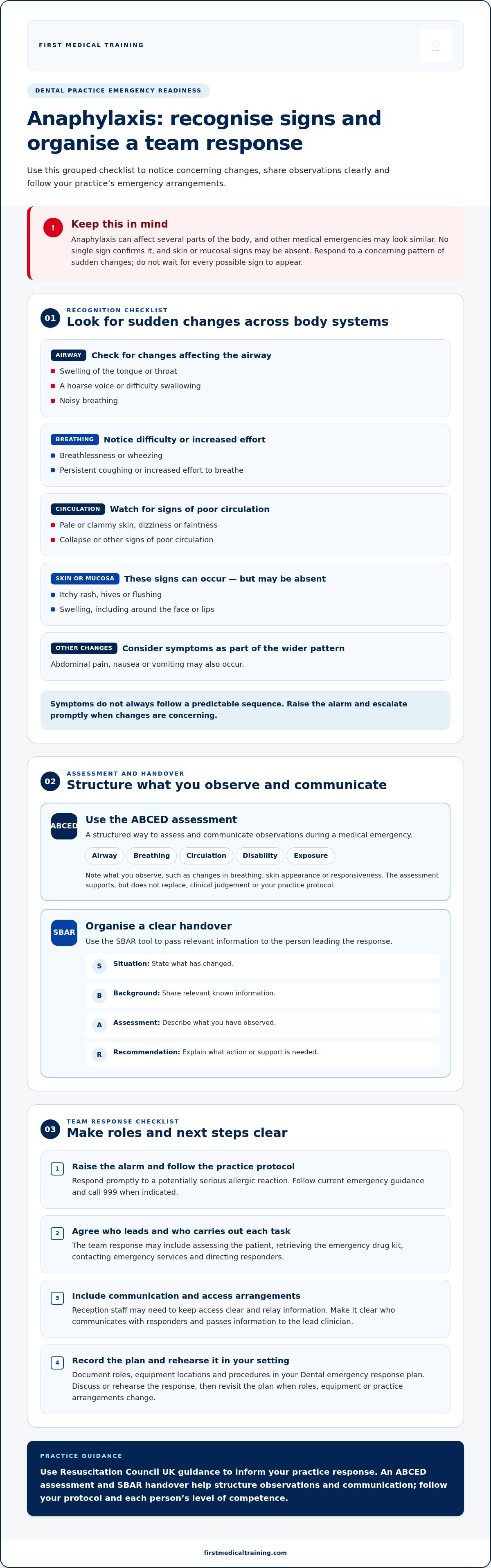
Pay attention to sudden, concerning changes, particularly those affecting breathing or circulation. Possible signs include:
- Airway: swelling of the tongue or throat, a hoarse voice, difficulty swallowing or noisy breathing.
- Breathing: breathlessness, wheezing, persistent coughing or increased effort to breathe.
- Circulation: pale or clammy skin, dizziness, faintness, collapse or signs of poor circulation.
- Skin or mucosa: an itchy rash, hives, flushing or swelling, including around the face or lips. These signs can be absent.
- Other changes: abdominal pain, nausea or vomiting may also occur as part of a wider reaction.
Symptoms don’t always follow a predictable sequence. Act on a concerning pattern of sudden changes, raise the alarm and escalate promptly rather than waiting for every possible sign to appear. The Emergency Response to Anaphylaxis in Dentistry resource provides additional dental-focused background. Use Resuscitation Council UK guidance to inform your UK practice protocol.
How the ABCED assessment supports clear communication
The ABCED assessment means Airway, Breathing, Circulation, Disability and Exposure. It gives staff a structured way to assess and communicate observations during a medical emergency. It supports, but doesn’t replace, clinical judgement or your practice’s emergency protocol. Note what you observe, such as changes in breathing, skin appearance or responsiveness, and pass this information clearly to the person leading the response.
Use the SBAR tool to organise a handover: Situation, Background, Assessment and Recommendation. State what has changed, share relevant known information, describe what you have observed and explain what action or support is needed. Keep the message concise and follow your practice’s arrangements for contacting emergency services.
Focused anaphylaxis training for dental practices can help staff learn the signs and practise communicating observations. Include it in wider emergency learning, such as online anaphylaxis CPD for dental professionals, and discuss how the ABCED assessment and handover fit your Dental emergency response plan.
What should dental staff do when anaphylaxis is suspected?
If a patient shows signs of a potentially serious allergic reaction, respond promptly and follow your practice protocol. Resuscitation Council UK identifies intramuscular adrenaline as first-line treatment for anaphylaxis. Any action must follow current guidance, the responder’s training and competence, and the practice’s arrangements. An adrenaline auto-injector may be relevant where one is available. Staff should act in accordance with their training and the emergency protocol, not improvise treatment.
Keep the response coordinated. One person should lead, communicate decisions and monitor the overall response, while colleagues carry out clearly assigned tasks. Call 999 when indicated by the patient’s condition and current guidance. Don’t delay escalation while trying to establish a confirmed diagnosis.
How to organise the first response
Use the Dental emergency response plan to guide the team. The lead should direct colleagues to assess and support the patient within their competence, retrieve the emergency drug kit and other relevant equipment, and contact emergency services when indicated. Give each person a clear task and confirm it has been completed. If the situation changes, update the lead and follow current Resuscitation Council UK guidance and practice procedures.
Include reception and other non-clinical colleagues in role planning. For example, assign one team member to make the emergency call and another to ensure responders can reach the treatment area. Clear allocation helps prevent duplicated or missed tasks. Training should reinforce the agreed protocol, rather than leave staff relying on memory alone.
How to hand over information clearly
Prepare a concise handover using the SBAR tool: Situation, Background, Assessment and Recommendation. Explain what is happening, share relevant background information, report observed changes and state what support is needed. Keep the information factual. Record observations and actions in the order they occurred, following your practice’s documentation procedures.
Record what you observed, what actions the team took and when, then communicate those details clearly to the responding clinicians. A structured handover supports a clear exchange of information. It doesn’t replace clinical assessment or emergency service instructions.
Practise the response as a team: raise the alarm, identify the lead, assign tasks, follow the protocol, escalate when indicated and prepare a clear handover. Focused anaphylaxis training for dental practices can support this preparation alongside wider medical emergency learning. Explore anaphylaxis CPD for dental professionals to develop topic-specific knowledge.
How to prepare and train the whole dental team
Preparation works best when it reflects how your practice operates. Include anaphylaxis learning in the wider Dental emergency response plan, then turn the written arrangements into roles staff can explain and practise. Involve clinical and non-clinical team members so everyone knows how to raise the alarm and who is coordinating the response.
Use this sequence to organise your preparation:
- Assign roles: identify who leads, who calls for help and who retrieves the emergency drug kit and other relevant equipment.
- Review the protocol: make sure staff know where the Dental emergency response plan is kept and how to follow it.
- Build equipment familiarity: ensure relevant team members know where emergency equipment is stored and how it relates to their role.
- Rehearse together: practise a realistic scenario in the clinical environment, then discuss what was clear and what needs attention.
- Record learning: note actions arising from the rehearsal and update the plan where appropriate.
Build an anaphylaxis rehearsal into practice preparation
In-practice training lets your team use the actual surgery layout, equipment locations and communication routes. A scenario can test whether the person assigned to lead is clear, whether the call for help can be made promptly and whether staff can reach equipment without confusion. Keep the rehearsal focused on roles, communication and current guidance. Treat it as a way to practise the response, not as a test of diagnosis.
Afterwards, discuss what worked and where staff hesitated. Record agreed changes, update the Dental emergency response plan when needed and share revised arrangements with the team. Use the dental practice emergency preparedness checklist to support a wider review of readiness.
Keep learning relevant to dental CPD
Focused anaphylaxis CPD develops knowledge of this specific emergency. Broader medical emergency training prepares the team for a wider range of events. The two learning activities complement each other, but neither replaces the other. Align learning with Resuscitation Council UK guidance and relevant General Dental Council expectations. Keep records of completed CPD and team rehearsals in line with your practice procedures. For further context, read the GDC CPD requirements for medical emergencies guide.
Build focused knowledge with anaphylaxis CPD for dental professionals, then rehearse as a team to consider how that learning fits your practice’s emergency arrangements.
Choosing anaphylaxis training for your dental practice
Choose learning that matches what your team needs to develop. Focused online CPD can build or refresh knowledge about anaphylaxis. In-practice training gives staff the opportunity to rehearse roles and procedures in the surgery. These formats support different objectives. Neither replaces your Dental emergency response plan or the need to follow current guidance.
Which learning format suits your practice’s needs?
| Learning format | Best suited to | How it supports the team |
|---|---|---|
| Focused online CPD | Building or refreshing knowledge about anaphylaxis | Allows learners to study topic-specific material and review key learning individually. |
| In-practice training | Rehearsing team roles and applying procedures in the clinical setting | Lets staff practise communication and equipment retrieval using the practice’s actual layout. |
| Broader medical-emergency training | Preparing for a range of medical emergencies | Places anaphylaxis within the wider context of emergency response in a dental practice. |
First Medical Training Ltd provides Online Dental CPD | Anaphylaxis Training for Dental Professionals for focused learning. Use online study to address knowledge, then consider how the whole team can rehearse its response in the practice. Broader medical emergency training can complement this learning, although the two have different scopes.
What to look for in course content and evidence
Choose material written for dental professionals that reflects relevant UK guidance, including Resuscitation Council UK guidance. Look for clear explanations that connect recognition and preparedness to a dental setting. CPD accreditation and alignment with General Dental Council expectations can also help you assess a course’s relevance to professional development.
Keep evidence of completed learning with your CPD records. Note the course title, provider and completion details shown in your course documentation. Retain associated learning notes or reflections according to your practice’s record-keeping arrangements. Keep team rehearsal records separately, including learning points and any actions taken to update practice procedures. This distinguishes individual learning from practical team preparation. Neither record alone proves competence.
For focused learning, explore dental anaphylaxis training and consider how it can complement your team’s wider emergency preparation.
Make your team’s preparation part of everyday practice
Recognising possible anaphylaxis means noticing a concerning pattern of changes, not waiting for one sign to confirm a diagnosis. A clear response depends on staff understanding their roles, following the Dental emergency response plan and communicating observations in a structured way. Focused learning builds knowledge, while team rehearsal puts agreed procedures into practice.
Choose anaphylaxis training for dental practices that supports your team’s needs and complements wider medical emergency preparation. Keep learning relevant to current Resuscitation Council UK guidance and General Dental Council expectations, and retain suitable records of training and rehearsal.
First Medical Training Ltd has supported dental professionals since 2006. Its training follows Resuscitation Council UK guidelines and aligns with GDC expectations. Explore anaphylaxis training for dental professionals and take a practical next step towards a prepared, coordinated team.
Frequently Asked Questions
What are the early signs of anaphylaxis in a dental practice?
Possible signs can affect the airway, breathing, circulation, skin or mucosal surfaces, and may appear in different combinations. Watch for changes such as breathing difficulty, swelling, a rash, dizziness or collapse, but don’t use one symptom alone to confirm anaphylaxis. Assess the overall pattern, follow current Resuscitation Council UK guidance and escalate concerns promptly. Focused anaphylaxis training for dental practices can help staff recognise when a patient needs urgent attention.
Can anaphylaxis occur during dental treatment?
Yes. A dental practice should be prepared to manage medical emergencies, including suspected anaphylaxis during treatment. Focus on readiness rather than predicting how often an event might occur or assuming a particular cause. Ensure staff know how to raise the alarm, follow the Dental emergency response plan and obtain urgent help when indicated. Rehearsing these responsibilities helps the team practise an organised response when a patient becomes unwell.
How should dental staff respond to suspected anaphylaxis?
Raise the alarm, identify who is leading and assign clear tasks. Follow current Resuscitation Council UK guidance and your practice protocol, and call 999 when indicated. A trained team member should take appropriate action within their competence. Communicate clearly and share observations with the lead responder. Don’t wait for a confirmed diagnosis before escalating a serious concern, and follow the practice’s agreed emergency arrangements rather than relying on memory.
Is an adrenaline auto-injector used to treat anaphylaxis?
Adrenaline is used in the emergency management of anaphylaxis. Whether an adrenaline auto-injector is appropriate depends on the circumstances and current guidance. Follow your practice protocol, staff training and competence, and use the emergency equipment provided for the situation. Don’t rely on unverified instructions or assume an auto-injector is the only option. Call 999 when indicated and follow the responding clinicians’ instructions.
What should an anaphylaxis training course for dental staff cover?
A relevant course should help dental professionals recognise possible anaphylaxis, understand how to escalate concerns and communicate observations clearly. Check that the learning relates to dental practice and follows current UK guidance. First Medical Training Ltd provides Online Dental CPD | Anaphylaxis Training for Dental Professionals. If a programme includes combined CPR and AED learning, describe it as a CPR and AED awareness with anaphylaxis course, and check that its content matches your learning objectives.
How often should dental teams refresh anaphylaxis training?
Plan refresher learning in line with current General Dental Council expectations, Resuscitation Council UK guidance and your practice’s needs. Don’t rely on an unverified interval or CPD-hour figure. Keep records of completed learning and team rehearsals, review your Dental emergency response plan and identify gaps. Further learning or practice may be useful when staff are unsure of their roles or when procedures and arrangements change.
Is online anaphylaxis CPD enough for a dental practice team?
Online CPD can support knowledge and understanding, while team rehearsal helps staff practise roles, communication and procedures in their own setting. Choose the mix that fits your learning objectives and practice arrangements. Don’t treat one format as sufficient for every need or as a replacement for your emergency protocol. Combine focused anaphylaxis learning with wider medical emergency preparation, and keep records of individual learning and team rehearsal.