

Blended learning first aid courses in the UK: course time and certificates

The classroom still matters: blended learning moves some first aid study online, but practical skills are demonstrated in person. Blended learning first aid courses in the UK can include six hours of online learning at home followed by two days of classroom training. First Aid at Work may also be delivered over three practical days or as two days of classroom training with online learning at home.
It’s understandable to want to know how much time to set aside and whether online study prepares you for practical assessment. The format affects when and where you study, while in-person training gives you time to practise and demonstrate skills.
This guide explains how blended learning works, what practical assessments and certificates involve, and how course duration can vary. You’ll also find out which workplaces and learners may suit this approach, so you can make a confident decision about first aid training.
Key Takeaways
- Understand how online study and classroom practice fit together, and plan your learning time around both.
- Find out what practical assessments involve and how successful completion leads to certification.
- Compare course formats and requalification routes to identify the option that fits your training needs.
- Use learner eligibility and workplace requirements to judge whether blended training is a suitable fit.
- Explore first aid training options for workplace and dental teams, including Emergency First Aid at Work and Dental Immediate Life Support.
What is Blended Learning?
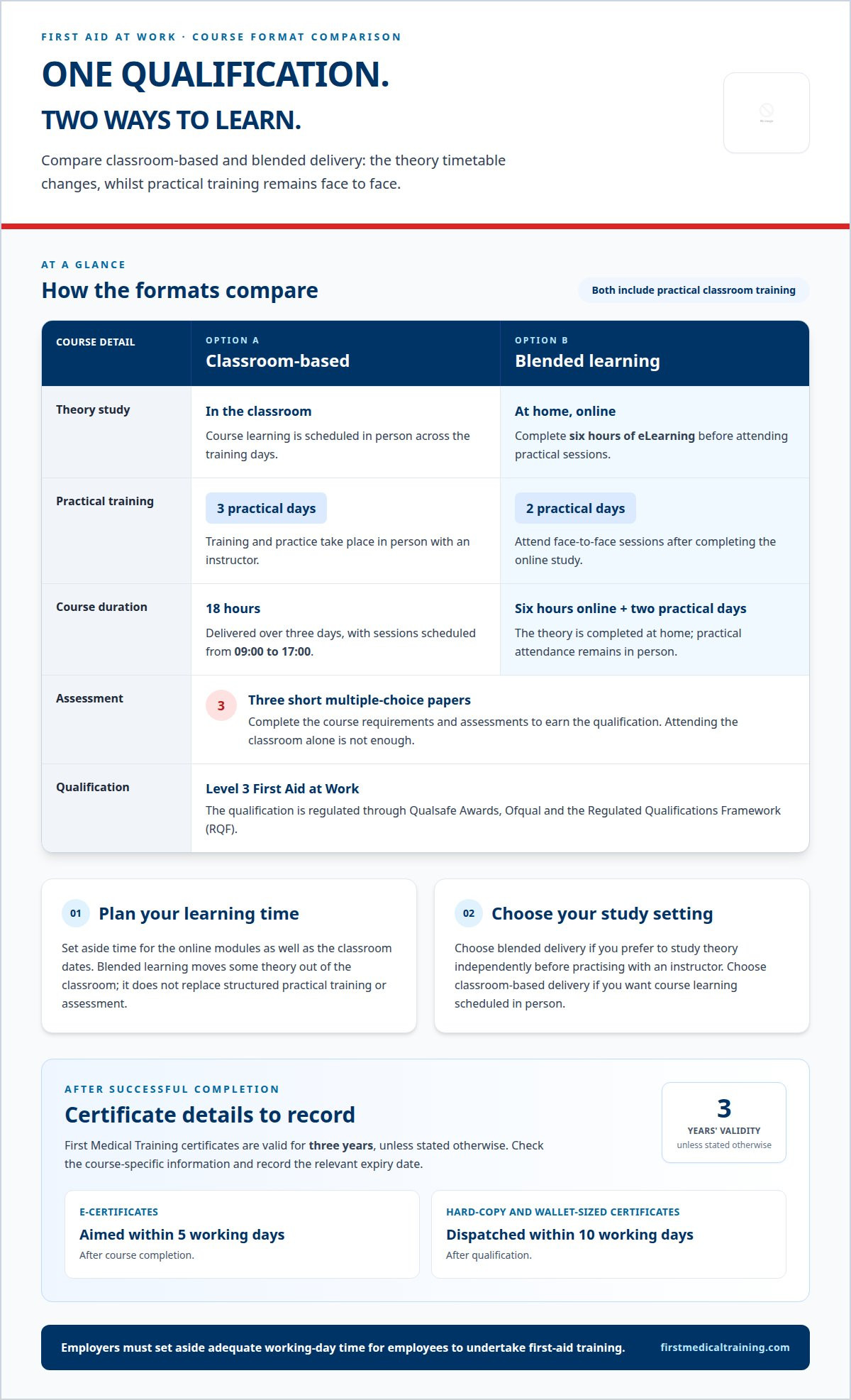
Blended learning combines online study with in-person training. First Medical Training’s First Aid at Work Initial course takes three days, while its blended format includes six hours of eLearning followed by two practical days. The online element moves some theory out of the classroom but keeps practical training face to face.
Online pre-learning
Online pre-learning lets you study course theory before the practical sessions. In the blended First Aid at Work format, the online element takes six hours and is completed at home. This gives you time to work through the material before practising skills in person.
Plan when you’ll complete the modules alongside work and other commitments. Check the stated online study time and how it fits with the classroom dates. Six hours of pre-learning followed by two practical days creates a different timetable from three full practical days. Online learning supports the course but does not replace face-to-face training.
Face-to-face practical training
The classroom sessions focus on applying learning through practical activities with an instructor present. For the blended First Aid at Work format, these sessions take two days after the online study. Use this time to practise the course skills, ask questions and receive guidance while working through practical tasks.
Complete the online learning, attend both practical days, then take part in the course assessment. The in-person component matters because reading about a response and demonstrating a skill are different tasks. An introductory online session is not a substitute for structured training with practical classroom work and assessment.
Blended and classroom-based course formats
Choose between blended learning and full classroom delivery by considering how you learn and when you can attend. First Aid at Work takes three days in the classroom, or two practical days plus six hours of online learning at home in the blended format. Both include classroom training; the difference is where you study the theory.
If you prefer to study theory independently before practising with an instructor, blended learning may suit your routine. If you want all course learning scheduled in the classroom, the three-day format keeps the training together in person. When comparing aid at work courses, focus on the online study requirement, practical attendance and assessment arrangements. An online workshop, whether free or introductory, is a separate learning format unless it forms part of the structured course and its assessment.
Certification and certificate delivery
Certification depends on completing the course requirements, including its assessment. For First Aid at Work, the qualification is Level 3 and regulated through Qualsafe Awards, Ofqual and the Regulated Qualifications Framework (RQF).
Check which course the certificate names, what assessment it requires and how the certificate is delivered. These details help distinguish a formal qualification from an attendance record for a workshop or online session.
Course completion and certificate delivery
First Aid at Work assessment includes three short multiple-choice papers. Completing the course and its assessments is essential to earning the qualification; classroom attendance alone is not enough.
For the course described in the research, e-certificates are aimed to be issued within five working days of completion. Hard-copy and wallet-sized credit card certificates are dispatched within ten working days of qualification. These are separate delivery formats and timeframes, so consider which record you need and when it is expected to arrive.
First aid certificate validity
Certificate validity depends on the course, so don’t assume every first aid certificate has the same expiry period. First Medical Training certificates are valid for three years unless stated otherwise. Check the course-specific information and record the relevant expiry date.
For workplace planning, note the qualification and its validity period together in your training records. This makes it easier to identify when a certificate is approaching its expiry and plan suitable refresher or requalification training. Where a certificate relates to a specific course, keep that course name clear when recording the training.
Ofqual regulation describes how a qualification is regulated; it does not, by itself, explain how training is delivered. A blended course combines online study with classroom assessment, while a fully classroom-based course delivers learning in person. In either format, the certificate relates to the named qualification and its requirements, not simply the time spent online.
Before attending, confirm the course’s assessment components and certificate arrangements. After qualification, record the course name, completion date and validity period. These details provide a practical reference for organising workplace training and tracking staff certificates.
If you’re arranging practical workplace training alongside certification, explore our first aid courses to find a course suited to your team.
Course duration and requalification
First Aid at Work takes 18 hours, delivered over three days from 09:00 to 17:00, or as two practical days plus online learning at home. According to the UK Government, employers must set aside adequate working-day time for employees to undertake first-aid training.
Course duration and timetable
The blended format pairs six hours of online pre-learning with two practical training days. The alternative spreads the 18-hour course across three days, with sessions scheduled from 09:00 to 17:00. These formats divide study time differently, so compare the classroom dates with the time needed for online learning.
For example, a learner choosing blended delivery completes the online study at home, then attends both practical days. A fully classroom-based learner attends the three-day timetable instead. Plan staff cover around the attendance dates and allow working-day time for the required training, as the UK Government advises.
Use the timetable to plan more than attendance alone. Set aside time for online study before the classroom sessions, then protect both practical days from work duties. For groups, a planned schedule helps maintain workplace cover throughout the course.
Requalification and refresher training
Learners with an in-date First Aid at Work qualification can complete a two-day requalification course. This route is intended for people renewing an existing qualification, rather than learners starting without a current certificate. Check the qualification status when planning the course, since eligibility for this shorter format depends on it being in date.
For group First Aid at Work requalification, include both the two-day attendance schedule and the six hours of classroom training in your planning. Requalification is a separate route for learners renewing their existing workplace first-aid qualification.
Annual refresher training is recommended by the course provider, citing the HSE. Treat this as a separate activity from formal requalification: a refresher helps revisit skills, while requalification is the course route available to learners with an in-date First Aid at Work qualification. For health and safety planning, record each learner’s course format and training dates together.
Course duration and refresher arrangements are different planning decisions. Initial First Aid at Work takes three days, or two practical days plus six hours of online study in the blended format. The two-day route applies to eligible requalification candidates. Build the timetable around the selected course, including online study where applicable and time away from work.
Classroom practical skill assessments
In a blended first aid course, practical assessment takes place in person, not through online learning alone. The classroom gives the instructor an opportunity to observe how you apply course skills. Understanding a topic online and demonstrating a practical response are different tasks, so treat face-to-face sessions as active learning time.
The Health and Safety Executive strongly recommends assessing practical first-aid course elements through direct observation to check candidates’ competence. Direct observation means the instructor watches you perform the practical task, rather than relying only on a written answer. During the assessment, follow the instructions given, complete the task as taught and respond to any feedback. The focus is your demonstrated performance.
A useful way to approach each assessment is to listen carefully, ask for clarification if an instruction is unclear, then carry out the task in sequence. Keep your attention on the practical steps being assessed, rather than trying to anticipate every possible scenario. For example, if the instructor sets a task, concentrate on performing that task and showing each relevant action clearly.
Use practice time in the classroom to become familiar with the process before an assessment. Repeat a skill when invited, listen to the instructor’s guidance and use feedback to improve your next attempt. If you are unsure which part needs attention, ask a specific question about the step you have just completed. This turns feedback into a practical action you can apply straight away.
Online modules can prepare you with course theory, but a quiz cannot show how you perform a practical task. The in-person element gives the instructor a direct view of your actions and technique. This is why assessment arrangements matter when comparing first aid courses: look for a clear distinction between online knowledge checks and classroom observation of practical skills.
Assessment can also show where you need more practice. Note the instructor’s feedback and apply it during the next exercise. If a task involves several steps, complete them in the order taught rather than rushing. A steady, methodical response makes your actions easier to observe and assess.
Before the course, make space in your schedule for the full face-to-face sessions. Arrive ready to participate, follow the instructor’s directions and engage with each practical exercise. The assessment is based on what you demonstrate in the classroom, so active participation throughout the training gives you opportunities to practise the skills before they are observed.
Eligibility and suitable workplaces
Blended learning can suit learners who can complete online study and attend practical classroom sessions. Learners must be at least 16 years old to enter the training room. That age point concerns entry to the room; it does not, by itself, describe every course’s eligibility conditions.
Consider how the course format fits your work pattern. An employee with time for home study before scheduled practical days may find blended delivery easier to plan than three full classroom days. A learner who prefers instructor-led teaching throughout may find the classroom format more suitable. Both include face-to-face practical learning.
Workplaces should match the qualification to the first-aid provision identified through their planning. An office, school and warehouse may have different working conditions and training needs. Consider workplace hazards, work activities and existing first-aid arrangements. The course format affects scheduling, not the need to choose training suited to the setting.
For a group, map out the timetable before booking. Identify who needs a qualification, when each person can study online and which practical dates they can attend. Then plan staff cover while learners are away from their usual duties. This ensures the online portion is included in the overall training commitment.
Practical participation is another factor to consider. Classroom training involves demonstrating skills under observation, so learners need to take part in exercises and assessment. Completing online modules without attending the in-person sessions does not complete the blended course. Plan for both practical learning and assessment.
Requalification routes may have their own eligibility requirements, so check whether the course is appropriate for your current qualification. This makes the two-day route distinct from initial training. For team training, separate new learners from staff renewing an existing qualification, then match each group to the appropriate course.
Choose the format that fits both the learner and the workplace. A blended course can help distribute theory and classroom time across different parts of the schedule, while full classroom delivery keeps learning in person. Use the workplace’s training needs, learner availability and practical attendance requirements as your decision points. Explore workplace first aid training for your team’s needs.
First Medical Training: first aid courses
First Medical Training Ltd provides first aid courses for workplace teams and healthcare professionals. Choose training that matches your setting and the skills your team needs to practise, rather than selecting a format on convenience alone.
For workplace first aid, the Emergency First Aid at Work Course (EFAW) - 1 Day offers a focused route. Dental teams can consider the Medical Emergencies in a Dental Practice Course or Dental Immediate Life Support (ILS) Training, depending on their clinical training needs. These options address different roles, so identify the incidents and responsibilities most relevant to your team before deciding.
If you’re organising training for your workplace or dental team, contact First Medical Training Ltd to discuss the course that fits your needs.
Plan training around your team’s next step
Start by identifying who needs training, what responsibilities they hold and how learning can fit around work. For blended learning first aid courses in the UK, consider whether your team can set aside time for online study as well as attend practical sessions. Agreeing these priorities makes it easier to select a suitable course and organise staff cover.
For dental teams, consider whether training should focus on medical emergencies in the practice or immediate life support. For other workplaces, identify the first aid skills staff need to develop. A clear training objective connects course learning with the role each person will perform.
To discuss the right next step for your team, Contact First Medical Training Ltd about suitable training.
Frequently Asked Questions
Who is this course most suitable for?
Blended training can suit learners who can study theory independently and attend scheduled practical sessions. It may fit an employee whose shifts make several full classroom days difficult, provided they can complete the online study beforehand. Consider access to a suitable device, time for focused learning and availability for every in-person session. Classroom training remains essential for practising and demonstrating skills.
Who should attend?
Staff selected for first-aid responsibilities should attend a qualification that matches their role and workplace needs. Appointed first-aiders and other staff in offices, warehouses or dental practices may have different training requirements. A dental team, for example, may need training focused on medical emergencies in a clinical setting. Agree the training objective before choosing a course and format.
What is a blended learning first aid course in the UK?
Blended learning combines online study with face-to-face training and practical assessment. Complete the online element separately, then attend classroom sessions to practise skills and demonstrate competence. The mix depends on the course, so check how online study fits with the classroom dates and which parts require attendance. Online learning supports the course but does not replace in-person assessment.
Which UK first aid qualifications are available through blended learning?
First Aid at Work is one qualification described with a blended format, combining online pre-learning with practical classroom days. Some Emergency First Aid at Work for Schools training is also offered in a blended format. Course names and delivery arrangements vary, so distinguish a regulated qualification from a short workshop or online-only course. Check that the course matches the role and workplace first-aid needs it is intended to support.
What practical assessments are required on the in-person course day?
The instructor observes practical course elements to assess how you demonstrate the required skills. Assessment may also include written or knowledge checks; First Aid at Work includes three short multiple-choice papers. Practical tasks depend on the qualification, so follow the instructor’s directions and use feedback to refine your technique. Online modules alone do not demonstrate practical competence.
How long do UK first aid certificates last, and how can they be renewed?
First aid certificates are generally valid for three years unless stated otherwise. For First Aid at Work requalification, the existing certificate must be in date or the course must be completed within 28 days after it expires. Plan renewal before expiry where possible, and keep the course name and certificate date in your training records. Refresher learning can help revisit skills, but it is distinct from formal requalification.