

Building Patient Confidence Through a Positive Safety Culture

Clinical skill matters, but patients also notice whether a team communicates clearly, listens and responds consistently. Building patient confidence in practice safety means creating an environment where staff can raise concerns, learn from incidents and work together to reduce avoidable harm. Patients should feel able to ask questions and take part in decisions about their care.
It’s understandable to focus on procedures and equipment when considering safety. Both matter, but confidence also depends on everyday behaviours: respectful communication, clear explanations and a team that takes concerns seriously. A positive culture encourages staff to speak up and reflect, rather than hide mistakes or near-misses.
This article explains the elements of a positive safety culture, how a whole-team approach can strengthen patient trust, and why staff wellbeing is part of safer care. It also covers ways to encourage open communication, involve patients and turn lessons from incidents into practical improvements.
Key Takeaways
- Encourage staff to raise concerns and report incidents openly, then use what the team learns to improve care.
- Build clear communication into everyday teamwork so handovers, shared decisions and patient questions are handled consistently.
- Help patients take part in their care with respectful conversations, clear explanations and honest responses when things go wrong.
- Set out practical safety policies for reporting incidents, protecting patient information and responding to emergencies.
- Support staff wellbeing and development as part of a workplace culture where people can learn, contribute and provide safer care.
Positive safety culture and team flourishing
Patient safety depends on how teams respond to concerns, incidents and everyday pressures. A learning culture helps staff raise issues early and turn reflection into practical improvements.
Building a positive safety culture
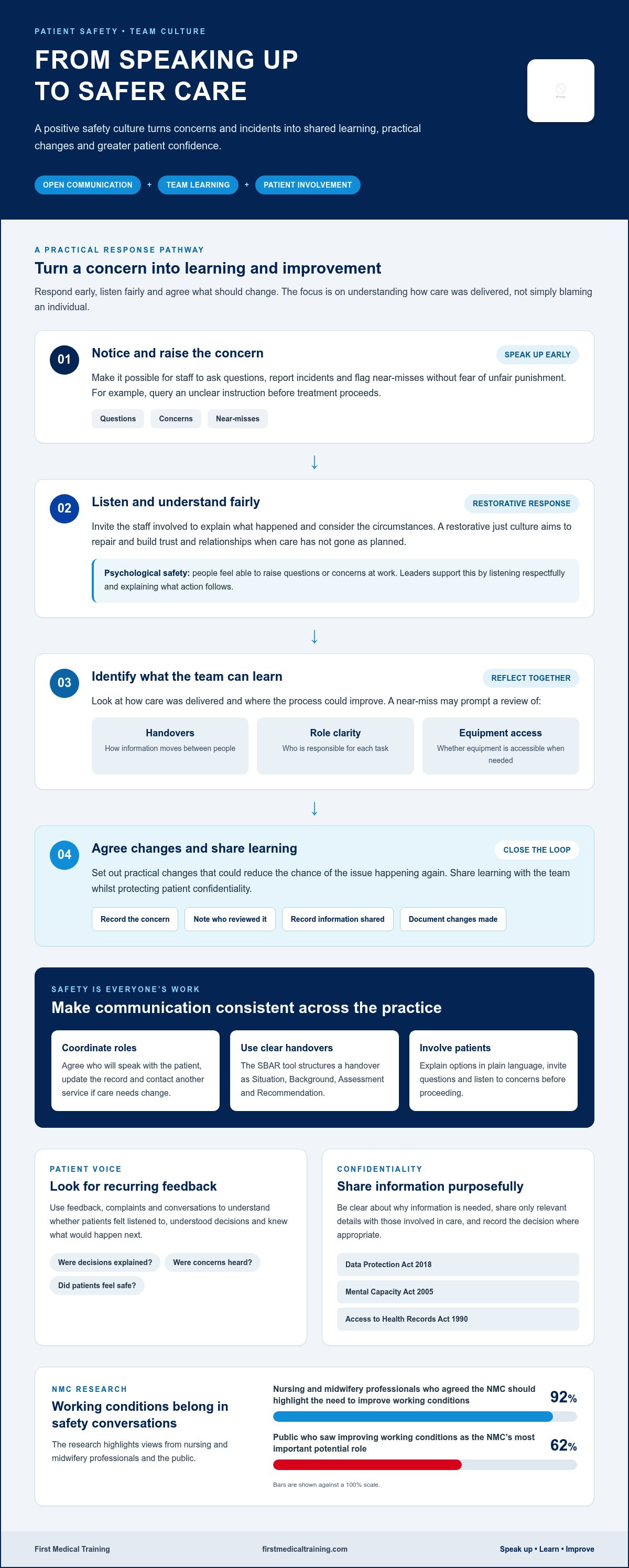
A positive safety culture is a shared approach where staff can speak up, report incidents and learn without fear of unfair punishment. It matters because a team that discusses problems openly can examine how care was delivered, not simply blame an individual. For example, a near-miss can prompt a review of handover steps, role clarity or access to equipment.
Psychological safety, a concept described by Amy Edmondson, means people feel able to raise questions or concerns at work. In a clinical team, for example, a new colleague might query an unclear instruction before treatment proceeds. Leaders foster this environment by listening, responding respectfully and explaining what action follows a concern.
NHS Resolution describes a restorative just culture as one that repairs and builds trust and relationships when care has not gone as planned. After an incident, invite the staff involved to discuss what happened, consider the circumstances and identify changes that could reduce the chance of recurrence. Share the learning with the team while protecting patient confidentiality.
Team flourishing also depends on working conditions. In NMC research, 92 percent of nursing and midwifery professionals agreed that the NMC should highlight the need to improve their working conditions. In the same research, 62 percent of the public saw improving those conditions as the NMC’s most important potential role. These findings underline why staff support belongs in safety conversations.
Meeting UK healthcare safety standards
Safety standards include clear expectations for confidentiality, responsible information sharing and learning from care. Patients need to know their records are handled carefully, while staff need a sound basis for discussing information. Make the reason for accessing or sharing a record clear, and limit discussion to those involved in care.
The General Medical Council updated its confidentiality guidance on 25 May 2018 to reflect the General Data Protection Regulation and Data Protection Act 2018. Its guidance provides a reference point for doctors handling patient information. In practice, teams should explain why information is needed and keep discussions focused on the treatment or decision concerned.
For a deceased patient’s records, the Access to Health Records Act 1990 permits the patient’s personal representative and certain people with a claim arising from the death to access them, according to The National Archives (legislation.gov.uk). This distinction matters when a family member seeks information: staff should identify the person’s relationship to the deceased and the reason for the request.
The Mental Capacity Act 2005 is relevant to patient confidentiality, including circumstances in which information may be shared on a patient’s behalf when they are not wholly competent, according to The National Archives (legislation.gov.uk). Record the decision and its reason, and consider the views of people the patient asked to consult or who have legal authority to decide.
Clear records support continuity and accountability. Record the concern raised, who reviewed it, what information was shared and what changes followed. This creates a practical trail for later reflection, while careful record handling helps maintain patient trust.
Whole-team approaches to patient safety
Assess patient confidence and satisfaction through feedback, complaints and conversations about care. Ask whether staff explained decisions, listened to concerns and helped patients feel safe. Review responses for recurring themes to understand how patients experience the practice’s safety culture.
Safety depends on coordination across clinical and non-clinical roles. In a dental practice, reception staff might record a patient’s concern, pass it to the clinician and make sure the patient knows what happens next. Agree who is responsible for each part of the process so important information does not get lost at handover.
Use brief team discussions to clarify responsibilities before busy periods. Agree who will speak with the patient, update the record and contact another service if care needs change. A shared understanding reduces duplicated tasks and helps everyone act within their role. Clear routines support building patient confidence in practice safety through consistent care.
Communication should work both ways. Clinicians can explain treatment options in plain language, then invite patients to describe what they understood. If a patient raises a concern about an allergy or previous treatment, pause and listen before proceeding. This gives the team a chance to address relevant information rather than rely on assumptions.
Handover quality matters whenever responsibility moves between people or settings. A clear handover identifies the patient, summarises the current situation, includes relevant background and states the action needed. The SBAR tool provides a structure: Situation, Background, Assessment and Recommendation. For example, a clinician can use it to share a concern with a colleague or hospital team.
Make information sharing purposeful. Identify the reason, recipient and relevant details before sharing patient information. Record the decision in the patient’s record where appropriate. This helps the next team member understand the circumstances without receiving unrelated details, supporting continuity if treatment continues elsewhere.
Patient feedback can reveal safety issues that internal checks miss. Use a short survey or follow-up conversation to ask whether staff listened, explained next steps and made it easy to raise concerns. Review responses alongside complaints and compliments. Repeated comments about unclear instructions, for example, can prompt improvements to aftercare explanations.
Make reporting accessible to everyone in the practice, including reception and support staff. They may notice confusion, delays or information gaps before these become apparent during treatment. Provide a straightforward way to raise concerns, explain who reviews them and give feedback on actions taken. This shows staff how their observations inform practice decisions.
Involve patients in discussions without placing responsibility for safety on them. Explain what will happen, encourage questions and check understanding before moving to the next stage. If a patient is unsure about an instruction, clarify it. Respectful exchanges help patients and staff work together, strengthening building patient confidence in practice safety.
Team learning also needs space for different perspectives. Invite relevant staff to discuss a difficult interaction, identify where communication became unclear and agree a practical adjustment. If several patients struggle with the same written instruction, revise the wording and ask the team to use it consistently. A medical emergencies training course for dental teams can support shared understanding of roles during an emergency.
What steps can practices take to improve patient safety and trust?
Make safety visible in routine care, not just in written procedures. Confirm each patient’s identity before treatment and check that their medical history is current. Invite them to correct details or mention changes. This simple exchange gives the clinical team clearer information and shows patients that their account matters.
Explain the proposed treatment, relevant risks and expected outcome in language the patient can understand. Pause for questions, then check what they have understood before asking them to decide. If a patient is unsure about an instruction, clarify it rather than assume they have agreed. This supports informed choices and helps identify concerns before treatment begins.
Make it easy for patients to raise concerns at every stage of care. Tell them whom to speak to if something is unclear, and respond without defensiveness. For example, if a patient says an instruction conflicts with earlier advice, review the record and resolve the difference before continuing. A respectful response can prevent confusion from carrying into later care.
Keep clinical records accurate, relevant and useful to the next person involved. Record decisions, treatment-plan changes and information shared by the patient. Clear notes support continuity and clinical decision-making; incomplete documentation can contribute to duplicated tests, delayed treatment and misunderstandings. When another professional needs information, share what is relevant to the care provided.
When treatment does not go to plan, communicate honestly and promptly. In the UK, the duty of candour requires patients to receive accurate, truthful and prompt information when mistakes are made and treatment does not go to plan. Explain what happened, what is known about its effects and what action follows. Keep the conversation clear, give the patient time to respond and record the discussion.
Follow an incident with a practical review. Establish the sequence of events, consider the systems and circumstances involved, and identify changes that address the cause. For example, a review might find that an unclear booking note led to missing information at an appointment. Agree who will revise the process, communicate the change to relevant staff and review whether it resolved the problem.
Build learning into staff development through clinical audits, simulation exercises and quality improvement work. A team can rehearse responding to a sudden deterioration, then discuss whether roles, communication and access to equipment were clear. Use audit findings to choose a focused improvement, such as refining an assessment process, and share the outcome with the staff involved.
Leaders should make patient safety part of policies, resource decisions, staff development and performance discussions. Set clear expectations for reporting concerns and investigating incidents, then assign responsibility for corrective actions. Review patient feedback, complaints and audit findings together to spot recurring themes. If patients repeatedly misunderstand aftercare instructions, revise the explanation and assess whether the new approach is clearer.
Invite patients to contribute throughout their care without making them responsible for preventing mistakes. Encourage them to share accurate medical histories, ask for advice to be clarified and report concerns. Listen carefully and treat questions as useful information. When patients understand their diagnosis, options, risks and expected outcomes, they can take a more informed part in decisions about their care.
A positive safety culture relies on open communication that responds effectively to difficult situations. Training, clinical audits, simulation exercises and quality improvement initiatives support continuous professional development. Promptly investigating patient safety incidents and implementing corrective measures builds accountability. Patients can also support safety by asking questions, clarifying advice, checking medications, sharing accurate medical histories and reporting concerns. This keeps care centred on individual needs.
What patient safety policies and procedures should a practice publish?
Publish clear information to help patients understand how the practice protects them and responds to concerns. Keep detailed operational procedures available to staff so responsibilities and actions are clear during routine care and emergencies. Separate public-facing explanations from internal instructions, and make both easy to find and review.
A patient safety and quality statement can explain the practice’s approach to reducing avoidable harm. Describe how patients can raise concerns, how incidents are reviewed and how learning informs changes. For example, explain that feedback is considered alongside clinical audit findings and how patients can hear about actions relevant to them.
A complaints procedure should explain how patients can submit a concern, what information helps the practice investigate it and how the response is communicated. Name the role or team responsible for complaints and provide a clear route for raising an urgent issue during an appointment. Use plain language and avoid promising a response time unless the practice can meet it consistently.
Publish a privacy notice explaining how patient information is used and protected. Describe who may access records for care, how information may be shared with relevant professionals, and how patients can raise a privacy concern. Internal procedures should tell staff to access records only when needed for their work and to keep information secure, accurate and relevant.
A clinical record policy should explain how staff document care, decisions and relevant communications. Set out how to correct records without obscuring the original entry, and how records support continuity between clinicians. For example, a handover procedure can require the outgoing clinician to record outstanding actions and the incoming colleague to acknowledge them.
An incident reporting procedure should tell staff what to report, where to record it and who reviews the information. Include near-misses as well as incidents that caused harm, so the practice can identify process weaknesses before they recur. Explain how actions are assigned, tracked and shared with the team while protecting confidential patient details.
For patient-facing transparency, explain how the practice communicates when care has not gone as planned. The duty of candour requires accurate, truthful and prompt information when mistakes are made and treatment does not go to plan. An internal procedure can identify who speaks with the patient, how the discussion is recorded and how follow-up actions are monitored.
A dental emergency response plan should give staff practical instructions for an emergency, including role allocation, equipment locations and escalation steps. Keep the current version accessible to the team and rehearse the process. A public summary can tell patients that emergency arrangements are in place without disclosing sensitive operational details.
Review published policies when processes change, and assign an owner to each document. Display the review date, version and contact route for questions, and remove outdated copies from reception and shared folders. These controls help patients and staff find current instructions rather than rely on superseded guidance.
Strengthen your team’s emergency response with the Medical Emergencies in a Dental Practice Course, which supports staff learning about managing medical emergencies in a dental setting.
An internal procedure can identify who communicates with the patient, how the practice acknowledges their account and how learning is shared. Patient safety includes the systems, processes and behaviours that reduce the risk of avoidable harm during healthcare delivery. Policies should therefore connect individual actions with how care is organised.
Invite patients to take part in decisions and raise questions; healthcare professionals should welcome patients' participation in their care rather than treat it as a challenge to their expertise. Pharmacists should listen to patients without interruption and communicate respectfully and without judgement. Pharmacists should act honestly and with integrity to maintain public trust and uphold the profession’s reputation. In a 2015 survey of public perceptions of pharmacies in Great Britain, 87% of respondents said they trusted a pharmacist a fair amount or a great deal.
First Medical Training Ltd: Medical Emergencies in a Dental Practice Course
First Medical Training Ltd’s Medical Emergencies in a Dental Practice - CPD Training helps dental teams develop their approach to emergencies in the clinical setting. It is a practical next step when staff need to strengthen their shared understanding of how to respond and coordinate under pressure.
Choose training that supports the needs of the whole team, including colleagues with different responsibilities during an emergency. Dental Immediate Life Support (ILS) Training for Professionals and the Automated External Defibrillator (AED) Training Course are also available for practices seeking role-specific development. The right focus depends on your team’s training priorities and the skills they need to practise.
Use training alongside clear practice procedures, incident learning and regular team discussions. To explore the Medical Emergencies in a Dental Practice - CPD Training, contact First Medical Training Ltd.
Choose one practical next step for your team
Building patient confidence in practice safety comes from everyday decisions and a team prepared to respond together. Use your next team discussion to identify one capability to strengthen, such as recognising an emergency, assigning roles or providing immediate support. Focused training can turn that priority into shared learning for the people involved in patient care.
First Medical Training Ltd offers the Medical Emergencies in a Dental Practice Course, Dental Immediate Life Support (ILS) Training and Emergency First Aid at Work Course (EFAW) - 1 Day. Each provides a training route suited to a different setting or learning need. Consider which area best matches your team’s next development priority, then take that step at a pace that works for your practice.
Contact First Medical Training Ltd to discuss training for your team. A considered next step can help staff feel better prepared to support patients with care and confidence.
Frequently Asked Questions
What are the key elements of positive safety culture?
The key elements are visible leadership, fair accountability, open reporting, shared learning and staff support. Leaders can demonstrate these principles by asking what made an error possible, rather than ending a review with who was involved. Assign an owner to each improvement and tell the team what changed. For example, if unclear appointment notes cause repeated confusion, revise the template and discuss its use at a team meeting.
What does patient confidence in practice safety mean?
Patient confidence in practice safety means feeling able to trust the practice’s care, communication and response to concerns. It develops through specific interactions: a clinician explains why a procedure is recommended, asks permission before proceeding and responds calmly when a patient expresses discomfort. Patients should also know how to raise a concern. These experiences help them judge whether the team is attentive and respectful throughout their care.