

Cost of group first aid training UK: 2026 pricing and booking guide

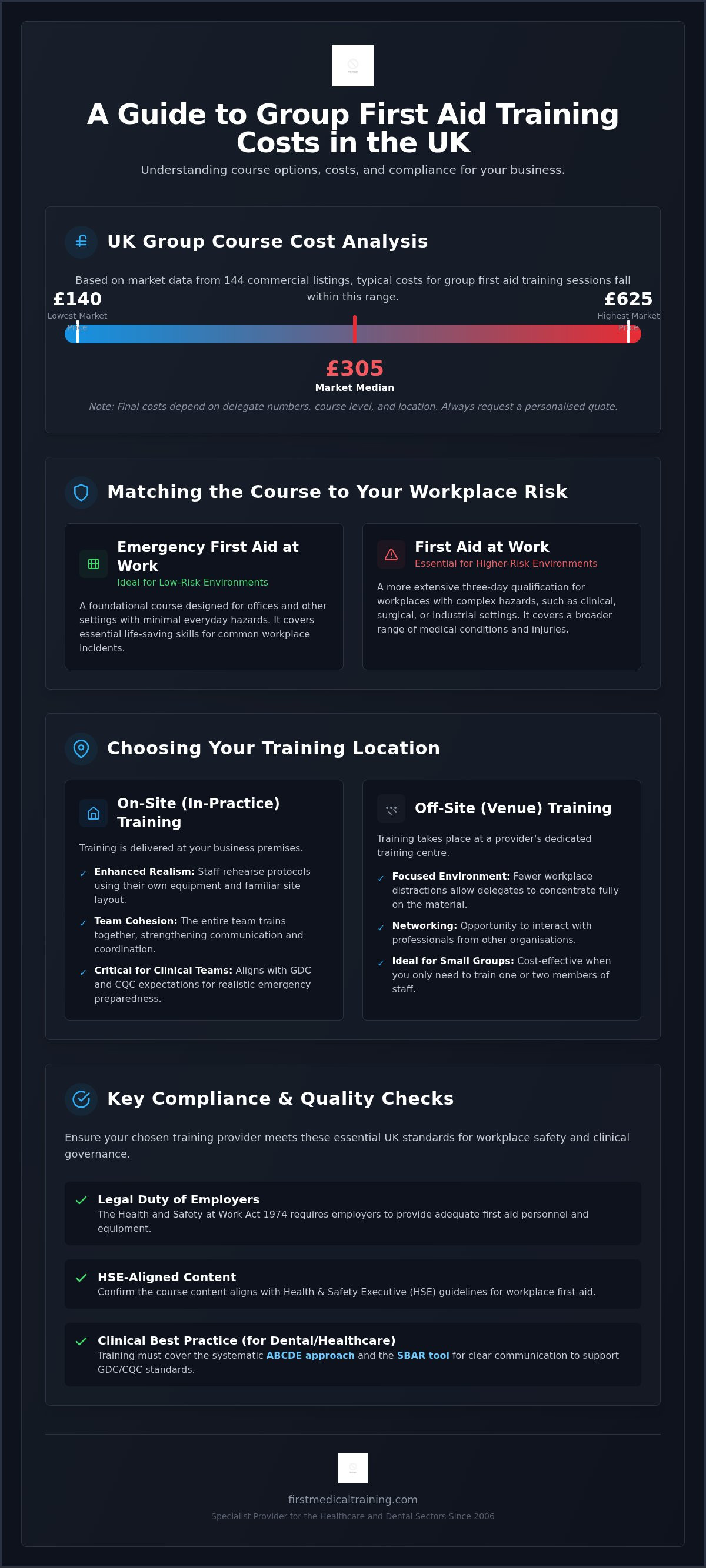
The cost of group first aid training uk sits between £140 and £625 per course across 144 commercial listings, with a market median of £305. Your exact outlay depends on delegate numbers, course level and location logistics, so a personalised quote is the reliable way to pin down figures for your team. The decisions that follow (which qualification fits your risk profile, whether you train on-site, and how you confirm HSE-aligned content) determine both compliance and value.
Key Takeaways: Group first aid training in the UK typically costs between £140 and £625, with a market median of £305 per booking.
- Market data shows 144 listings range from £140 to £625 for group sessions.
- Except when booking low-risk office teams, choose comprehensive First Aid at Work over emergency-only.
- Best for clinical teams to train onsite to rehearse protocols using their own equipment.
- The market median cost for a group booking is £305 according to market listings.
Match your course to the risks you actually face
Before you compare fees, map the course to how your facility actually works. Three common patterns guide that choice:
- Low-risk office teams: take standard Emergency First Aid at Work so cover stays proportionate to everyday hazards.
- High-risk surgical or clinical rooms: choose specialised clinical modules that rehearse the emergencies you are most likely to meet.
- Mixed dental or healthcare teams under GDC and CQC scrutiny: prioritise in-practice delivery so staff rehearse on their own floor plan, then confirm the provider teaches the ABCDE approach and SBAR communication.
Based on market listings, standard UK course fees fall between the published band above, with a market median of £305. With clients, tailored modules improve emergency response times, and practice audits confirm that custom scenarios prepare staff better for real medical crises. Assess team size early so you can judge whether an off-site course or training held in your own rooms offers clearer value.
For clinical practices, group training for dental staff supports GDC standards and CQC inspection requirements. Confirm your provider covers the systematic ABCDE approach (Airway, Breathing, Circulation, Disability, Exposure) and the SBAR tool framework for clear emergency Communications. Review your clinical risk assessment each year, then lock in the course that matches it.
What shapes the cost of group first aid training uk
Fees for shared workplace sessions sit in a wide published band (market median £305) according to market listings, and the headline figure is rarely the whole story.
Calculate the final total with care. Administrative fees or candidate assessment charges often apply and can shift your expected outlay. Knowing exact group size up front limits budget surprises.
Compare standard market options so you can control spend:
| Booking Type | Standard Inclusions | Potential Extra Costs |
|---|---|---|
| Standard Group Booking | Instructor delivery, core course materials | Assessment fees, travel expenses |
| Comprehensive Package | Assessment costs, physical workbooks, certification | Extra candidate fees beyond set limit |
Ask providers for an all-inclusive quote so budget control stays tight. For transparent pricing, explore First Medical Training options for your organisation.
Reviewing individual experiences helps set expectations for professional instruction.
"Great training experience. Comprehensive and informative, yet neatly structured and taught in an easygoing way. I would certainly suggest their services."
Tip: Always ask your provider if candidate assessment fees and physical workbooks are included in the initial quote.
Feedback of this kind shows how clear, engaging delivery keeps compliance training accessible and practical for learners.
First aid training is a legal duty for UK employers
UK law requires employers to provide adequate first aid equipment and trained personnel for workplace safety. Published market fees for group courses sit around a median of £305 according to market listings.
Run a thorough risk assessment to fix your precise staffing needs. The Health and Safety at Work Act 1974 obliges businesses to protect staff health, and related rules mandate appropriate cover. High-risk environments need full First Aid at Work cover, whereas low-risk settings need smaller provisions.
One practical advantage of training inside your own rooms is that staff learn against their familiar site layout, which strengthens real-world emergency execution. Choosing the right path supports workplace safety compliance. Explore tailored options through Courses, First Medical Training so your team lines up with recognised first aid rules (HSE standards).
Pick Emergency First Aid or full First Aid at Work with intent
Select Emergency First Aid at Work for low-risk sites, or comprehensive First Aid at Work (a three-day qualification for higher-risk workplaces covering a broader range of medical conditions and injuries) when hazards are complex.
When teams train together, instructors often see delegates confuse basic CPR steps with broader clinical management. Checking the applicable HSE expectations helps you assign the right certification to your workplace risk assessment.
Standard courses cover routine incidents, whereas emergency modules focus on rapid life support. Immediate care can reduce how severe an injury becomes, which is why the match between course depth and operational risk matters.
Emergency training fits small, low-hazard offices. Comprehensive options suit industrial environments. Match course content directly to the risks you have already identified, and keep Resuscitation Council UK guidelines in view. Explore CPD Courses, First Medical Training when you are ready to raise your team’s skill level.
Confirm HSE-aligned content and AED skills before you buy
Inspect provider credentials so the curriculum meets national expectations for workplace first aid. Course pricing varies by provider within the published market band (median £305) according to market listings.
You may be comparing two group options during procurement. Confirm whether the provider covers essential life-saving skills such as real-time CPR feedback and automatic external defibrillator operation.
Verify that equipment matches legal safety requirements. The LifeVac device is registered as a Class I Medical Device in the UK and carries UKCA and CE marks, confirming compliance with British medical standards. Those markings indicate conformity with UK medical device regulations and give you a clear compliance signal for the workplace.
Include practical modules such as the CPR and AED awareness with anaphylaxis course so severe emergencies are covered. First Medical Training Ltd has been trusted by UK dental professionals since 2006 to deliver these accredited modules. Choose an accredited course that protects your staff.
Why off-premises training weakens clinical team response
Off-site venues fall short when clinical teams must practise emergency protocols on their own layout and equipment. External rooms supply generic setups, while group bookings (in-practice training) let staff rehearse real scenarios inside the working environment they will use in a crisis.
A practical pattern from client work runs like this: a clinical team sent to an external classroom loses familiarity with its own space constraints and equipment locations, which slows genuine emergency response. Moving the same drills back into the practice, using the practice’s emergency drug kit and portable suction unit, surfaces missing items before a real event and restores coordination that breaks down away from the floor.
Off-premises instruction can still suit solo learners. Team coordination, though, depends on practising where you work. Review emergency drug kit compliance so the practice stays prepared.
Choose onsite or venue delivery around your group size
Onsite training cuts staff travel cost, while external venues suit businesses that lack dedicated practical space. Group prices follow the published UK market band according to market listings. Host at your own premises when you want staff to run scenarios with their own emergency drug kit. Pick an offsite location when remote workers must train together without stopping daily operations.
Split-shift scheduling, used in client work, keeps clinical coverage intact during sessions and avoids practice closures while you work toward CQC inspection readiness. Assess room dimensions so there is enough space for practical CPR. Keep a ratio of one instructor to twelve delegates so session quality holds. First Medical Training Ltd provides flexible delivery options across the UK to help you manage those session limits safely. Ask for dates that fit your rota when you are ready to proceed.
Book your workplace group session in 4 steps
You can arrange a shared workplace session quickly and still stay aligned with HSE expectations. According to market listings, group training across UK providers clusters around a median of £305. Early preparation simplifies scheduling for busy clinical teams and secures preferred dates faster.
- Conduct a risk assessment: Evaluate your workplace hazards and determine staff delegate numbers.
- Select your qualification: Choose a relevant course such as Emergency First Aid or Kids' First Aid (paediatric first aid).
- Submit your request: Contact First Medical Training Ltd with your location and preferred dates.
- Confirm the booking: Finalise your schedule to receive course materials and trainer details.
Once those four steps are complete, course materials and trainer details follow without delay.
Frequently asked questions
What first aid courses are offered?
We deliver specialised education including the Medical Emergencies in a Dental Practice CPD Course and Emergency First Aid Course for Scuba Divers. Our portfolio also features Mental Health First Aid for Dental Practices, Sedation Awareness for Dental Teams (CPD-Accredited), and Paediatric Immediate Life Support (ILS) Training for Healthcare Professionals.
How many people can attend a group session?
Shared workplace sessions typically accommodate up to 12 delegates per instructor so practical practice stays adequate. According to market listings, UK group course fees fall into a published price band with a market median of £305. Pricing varies by location, team size and specific course requirements, so request a personalised quote for exact figures.
Where are the training venues?
Courses can be delivered directly at your business premises anywhere across the United Kingdom for maximum convenience. Alternatively, delegates can attend our dedicated training venues located in Bradford and Leeds.
Do you provide courses for workplace compliance?
Yes, our educational programmes align with official standards set by the General Dental Council (GDC) and Resuscitation Council UK. We assist clinical teams with CQC inspection readiness by providing fully accredited CPD training.
Is first aid training a legal requirement for employers?
Yes, employers must meet HSE expectations by undertaking a workplace risk assessment. You must ensure adequate equipment, facilities and trained personnel are available to render immediate assistance to injured workers.
Secure Your Team's First Aid Readiness
According to market listings, UK group first aid options typically sit in a published fee band with a market median of £305.
Your team still needs compliant preparation, and the same choices you weighed at the start (course level, onsite practice, and verified emergency content) decide whether that preparation holds under pressure. Inspect emergency drug kit compliance on a routine cycle. Advisers recommend practising emergency responses directly in your clinical environment so staff master protocols on their own equipment.
From client work, scenario drills in familiar surroundings speed up emergency reaction times and cut confusion during real cardiac or respiratory crises.
When you plan the 2026 training calendar, explore our course packages and request a tailored quote for your dental practice. More on this: Your Shopping Cart.