

CPR Training for Dental Receptionists: A Practical UK Guide

What happens when a patient collapses in the waiting room and the clinical team is elsewhere? Reception staff can help start a coordinated response, but uncertainty about what to do can make those first moments harder. CPR training for dental receptionists should clarify the front-desk role and help staff practise the actions they may need to take in a dental setting.
Receptionists do not necessarily need the same training as clinicians. The right learning depends on their duties and the practice’s emergency procedures. GDC standards expect dental team members to understand their role in a medical emergency, while Resuscitation Council UK guidance informs the response practices should rehearse. That does not mean every receptionist has the same clinical responsibilities.
This guide explains how reception staff can raise the alarm, call 999 and help direct responders. It also compares training formats and sets out how to choose learning that reflects the receptionist’s role. The Medical Emergencies in a Dental Practice Course can support shared team preparation, helping staff practise communication and understand how their roles fit together.
Key Takeaways
- Learn how reception staff can recognise a possible emergency, raise the alarm and pass on essential information.
- Understand what cpr training for dental receptionists should cover and how it differs from advanced clinical training.
- Compare online, classroom and in-practice learning against your team’s duties and rehearsal needs.
- Review roles, identify learning needs, organise training and revisit your practice’s readiness.
- Explore how the Medical Emergencies in a Dental Practice Course can support coordinated team preparation.
Why CPR training for dental receptionists matters in a practice
CPR training is instruction and practice in cardiopulmonary resuscitation, often combined with awareness of how an automated external defibrillator (AED) is used. A general overview of Cardiopulmonary resuscitation (CPR) explains its purpose and basic techniques. Practice-based learning helps staff understand how their response fits the dental setting. For receptionists, training should focus on actions they can safely take as part of the practice team.
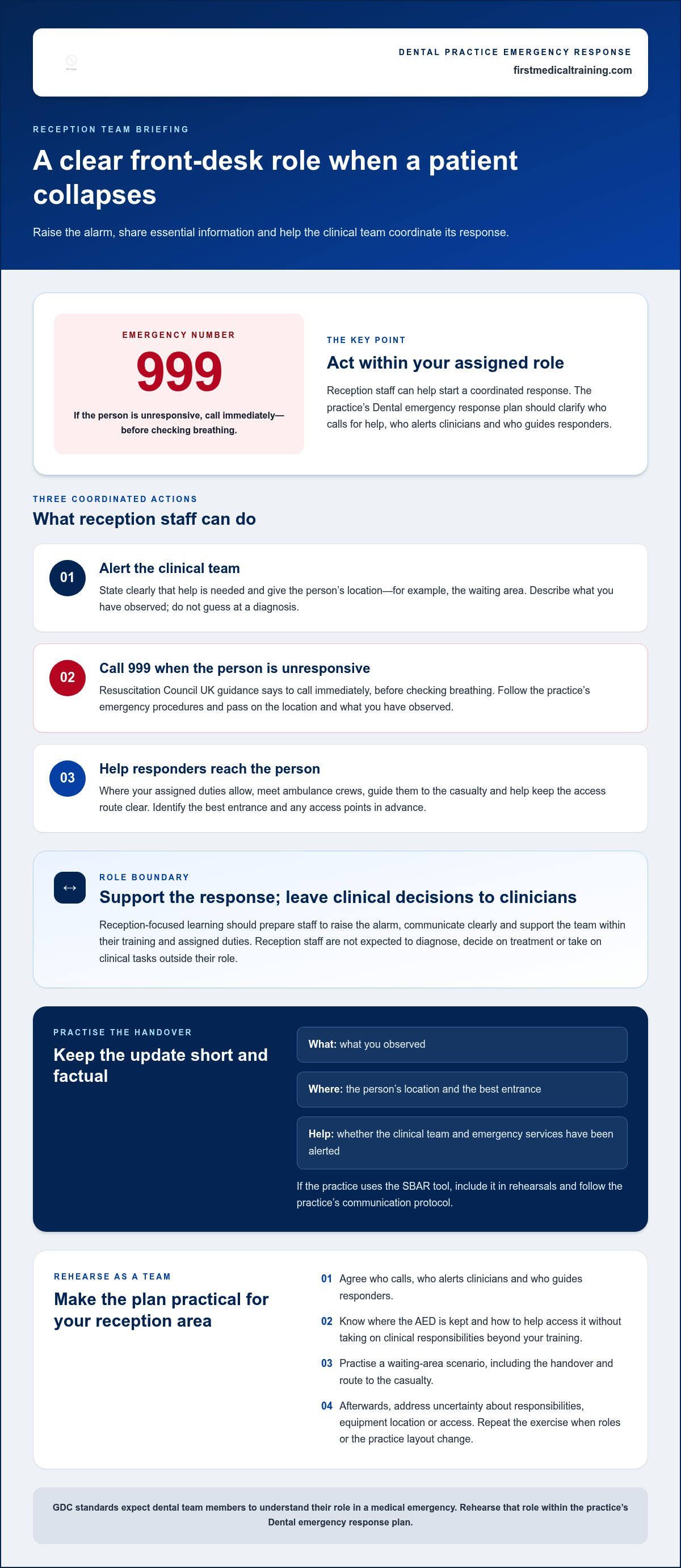
Reception staff may be among the first to notice that a patient or visitor in the waiting area is distressed, unresponsive or suddenly unwell. They can alert the clinical team promptly, give the location and describe what they have observed. They are not expected to diagnose a condition, decide on treatment or take on clinical tasks outside their training and assigned role.
GDC standards expect dental team members to know their role in a medical emergency, and Resuscitation Council UK guidance informs how practices prepare and rehearse their response. Training helps turn that role into a clear sequence of actions. Role-appropriate CPR training prepares dental reception teams to raise the alarm, communicate clearly and support the clinical response without taking on clinical decisions.
What can a dental receptionist contribute during an emergency?
Follow the Dental emergency response plan and the duties assigned to you. Alert the clinical team immediately and state where help is needed. For example, say that a person has collapsed in the waiting area and identify the nearest entrance or room. If the person is unresponsive, current Resuscitation Council UK guidance is to call 999 immediately, before checking breathing.
A colleague may need to meet ambulance crews, guide them to the casualty and keep the route clear. Reception staff can help by directing responders and, where their assigned duties allow, moving waiting patients away from the access route. Agree in advance who makes the call, who alerts the clinicians and who guides responders in. Rehearse the sequence so tasks are not duplicated or missed.
How does dental reception differ from a general workplace setting?
A dental reception area is a patient-facing space where someone may become unwell before or after treatment. The response still depends on the practice’s plan and the clinical team’s assessment. Reception staff do not need to interpret symptoms. Their task is to pass on what they have observed clearly and promptly.
Knowing the practice layout makes that information more useful. Identify the waiting area, the best entrance and any access points responders need to reach. Rehearse these details with the wider team so front-desk actions connect with the clinical response. A guide to medical emergencies in a dental practice can provide further context on how a practice prepares its people, procedures and equipment.
What CPR training for dental receptionists should cover
Useful learning gives reception staff clear boundaries as well as practical confidence. It should help you recognise when someone may need urgent assistance, activate the practice’s response and pass accurate information to colleagues. It should also make clear where front-desk support ends and clinical assessment or treatment begins.
CPR and AED awareness is different from advanced clinical skills or Dental Immediate Life Support (ILS). ILS is intended for clinical response; reception-focused learning should prepare you to support the team within your assigned role. The Resuscitation Council UK provides guidance that informs resuscitation practice, while the practice’s Dental emergency response plan explains how your team applies its procedures.
Core CPR and AED awareness for front-desk staff
Learn when to raise the alarm, where the AED is kept and how to summon colleagues trained to use it. Course instruction should cover CPR skills at the level set by its learning objectives, with practical technique taught and supervised by the course provider. Reception staff should know how to help access the device without assuming clinical responsibilities beyond their training.
Some AEDs provide real-time CPR feedback, using prompts or performance information during use. This is a device feature, not a receptionist’s training outcome or a replacement for instruction. For clinical response detail, use the published cardiac arrest management guide alongside the practice’s training and protocols.
Communication and team coordination skills
Practise giving a short, factual update: what you observed, where the person is and whether help has been called. Avoid guessing at a diagnosis. Clear information helps the clinical team understand the situation without losing time clarifying basic details.
If your practice uses the SBAR tool, include it in rehearsals. It structures a handover around Situation, Background, Assessment and Recommendation. Use it in line with the practice’s communication protocol. Rehearse how reception staff alert clinicians, allocate tasks and pass on information under the Dental emergency response plan.
Use a short scenario to test the plan. For example, practise what happens when a patient becomes unwell in the waiting area: alert the right colleague, locate the AED and give a concise handover. Afterwards, identify any uncertainty about responsibilities, equipment location or access, then update the team briefing or procedure. Repeat the exercise when roles or the practice layout change.
For shared team learning, the Medical Emergencies in a Dental Practice Course provides a setting to build familiarity with coordinated emergency response. Keep learning role-aware: reception staff need to know how they can contribute, while clinical assessment and treatment remain with appropriately trained team members.
Online, classroom or in-practice CPR training: what suits a dental reception team?
The right format depends on what your team needs to learn and practise. Online learning can help staff revisit theory around varied rotas. Classroom sessions allow direct interaction and practical activities. In-practice training brings rehearsal into the actual clinical environment, where the team can work through roles and communication using its own layout. Choose a format by matching it to the learning outcomes, rather than assuming one approach suits every practice.
Compare the options against the tasks reception staff may need to perform. Consider whether learning checks understanding and gives the team a chance to practise the handovers and procedures in the Dental emergency response plan.
| Format | What it can offer | Points to consider |
|---|---|---|
| Online | Flexible access to learning and theory refreshers. | Check how understanding is assessed and whether practical outcomes need a separate rehearsal. |
| Classroom | Trainer interaction and opportunities for group discussion and practice. | Consider how well the activities reflect reception duties and team communication. |
| In-practice | Rehearsal in the practice layout, with team roles and routes in view. | Use the session to test local procedures and identify unclear responsibilities. |
When can online CPR training be a useful option?
Online learning may suit a team that needs flexibility around different shifts or wants to refresh underpinning knowledge between practical sessions. Its suitability depends on the learning outcomes. Check that assessment tests understanding rather than only recording course completion, and decide whether staff also need supervised skills practice or a team exercise. Do not assume online study alone addresses every learning need identified by the practice.
What can in-practice training add?
In-practice training lets staff rehearse how the plan works in their own setting. Practise who alerts the clinical team, who meets responders and how colleagues communicate if the waiting area is busy. This can reveal an unclear handover or a task without an assigned owner. Discuss what happened and update the team’s understanding of the procedure.
Use the published dental practice emergency preparedness checklist alongside training to review roles, equipment locations and access routes. A checklist can prompt discussion; rehearsal shows whether each person understands what to do. For cpr training for dental receptionists, combine individual learning with opportunities for the whole team to practise coordination.
How to choose and organise CPR training for dental receptionists
Start with your practice’s response arrangements, then match the learning to the receptionist’s role. A Risk assessment helps you consider workplace first-aid provision; it does not replace the practice’s clinical emergency procedures. Keep legal duties, professional standards and clinical guidance distinct: the Health and Safety (First-Aid) Regulations 1981 concern adequate and appropriate workplace first-aid provision, while GDC standards and Resuscitation Council UK guidance inform dental team preparedness.
Map receptionist responsibilities before selecting a course
Review your Dental emergency response plan and list the actions assigned to reception staff. Clarify who alerts the clinical team, how the location is communicated and who supports access for responders. Consider how reception staff contact clinical colleagues, including across different shifts. Record individual learning needs instead of assuming every receptionist has the same duties or needs the same level of clinical training.
Check course fit, standards and team follow-up
Compare the course outcomes with the tasks reception staff are expected to perform and the practice’s wider emergency arrangements. Check what learning is assessed, whether practical rehearsal is included and how the session fits staff availability. CPD accreditation and alignment with GDC or Resuscitation Council UK guidance are distinct from legal compliance. Choose learning that addresses the needs and responsibilities you have identified.
Use this sequence to organise cpr training for dental receptionists:
- Review roles. Read the Dental emergency response plan and clarify the receptionist’s assigned actions.
- Identify learning needs. Note gaps in emergency awareness, communication, AED location knowledge or confidence, without assigning clinical duties beyond the role.
- Compare formats. Match online, classroom or in-practice learning to the outcomes needed, including whether staff need practical rehearsal together.
- Schedule learning. Plan training so reception and clinical colleagues can take part and staff across shifts understand their roles.
- Review readiness. Revisit the plan, rehearse communication and role allocation, and maintain relevant training records in line with practice processes.
After training, check whether each person can explain their role and pass on essential information clearly. Record follow-up needs, update staff when procedures change and arrange further practice if a handover or responsibility remains unclear. Keep records factual: note the learning completed and any actions still needed, rather than treating attendance alone as proof of readiness.
To support coordinated learning across reception and clinical roles, explore the Medical Emergencies in a Dental Practice Course.
How First Medical Training supports CPR learning for dental reception teams
Reception staff are part of the practice’s emergency response, and their learning should be considered alongside the clinical team’s. First Medical Training delivers the Medical Emergencies in a Dental Practice Course to support shared team preparation. It gives practices a setting to consider how team members work together while keeping clinical responsibilities distinct from front-desk duties.
First Medical Training has provided specialist education for the dental and healthcare sectors since 2006. It is an accredited CPD provider following Resuscitation Council UK guidelines, with training aligned with General Dental Council expectations. This training can support your team’s preparation, alongside the practice’s own roles, procedures and learning needs.
Connect receptionist learning with whole-team readiness
Shared learning helps reception and clinical colleagues build a common understanding of how the practice coordinates its response. A receptionist may need to alert the team, describe what they have observed or support the flow of information, while clinicians assess the patient and lead clinical care. The course is designed for dental team training, so keep individual responsibilities clear rather than assuming every participant has the same clinical role.
Apply the learning to your Dental emergency response plan. Reception and clinical colleagues can discuss how they pass information between them and how their roles fit together during an emergency. First Medical Training delivers courses at your business premises, allowing the team to learn together in its practice setting. Use the session to discuss local arrangements, while continuing to follow the plan and the clinical instruction relevant to each role.
Take the next step towards practice-relevant training
Before arranging training, define what your team wants to achieve. You may want reception and clinical staff to strengthen their shared understanding or review how their communication supports the practice’s response. Keep those aims specific. Then consider how the Medical Emergencies in a Dental Practice Course fits your team’s preparation, alongside any role-specific learning or practice sessions identified in your arrangements.
First Medical Training has delivered specialist dental and healthcare education since 2006. Its dental emergency course offers team learning with CPD accreditation and an approach that follows Resuscitation Council UK guidelines. cpr training for dental receptionists is most useful when reception learning connects with the team’s wider readiness, rather than being treated as an isolated task.
Explore the Medical Emergencies in a Dental Practice Course and discuss training options for your practice team.
Make your next practice rehearsal count
Confidence grows when everyone understands how their actions connect. At your next team meeting, choose one part of the Dental emergency response plan to walk through together. Check that reception and clinical colleagues know how to pass information, who takes each action and where any uncertainty needs to be resolved. Agree when you will practise again.
Keep the aim practical. CPR training for dental receptionists should help your front-desk team contribute calmly and clearly while respecting the boundaries between support and clinical care. A shared training plan helps build readiness into everyday practice, rather than waiting for an emergency to expose a gap.
Explore a team-focused option and consider how it fits your practice’s learning needs. Explore medical emergencies training for your dental practice and take the next step towards a more coordinated response. Clear roles and regular practice help your team understand its responsibilities.
Frequently Asked Questions
Do dental receptionists need CPR training?
Not every receptionist is automatically required to hold a CPR qualification. The employer should assess the practice’s first-aid needs and consider what reception staff are expected to do. Keep that workplace assessment separate from professional expectations for dental registrants: GDC standards address the dental team’s preparedness, while the Health and Safety (First-Aid) Regulations 1981 concern workplace first-aid provision. Document the reasoning behind the practice’s decision and review it if roles or arrangements change.
Can a dental receptionist perform CPR?
A receptionist may provide CPR if it is appropriate to the situation and within their training, but the immediate response should follow the practice’s procedure and current emergency guidance. If you are unsure, call 999 and follow the call handler’s instructions. Do not try to identify the cause of a collapse before getting help. Training should make clear which actions you are prepared to take and when to hand over to a clinical colleague.
Is online CPR training enough for dental receptionists?
It depends on the learning outcomes and what the practice has identified as necessary. Before selecting an online course, check how it tests understanding, what evidence of completion it provides and whether the intended skills require practical instruction. Compare the course outcomes with the receptionist’s assigned duties, then record any learning that still needs to be addressed. Do not treat an online completion record as proof of practical competence.
How often should dental receptionists refresh CPR training?
There is no single refresh interval that applies to every receptionist. Follow current guidance and your practice’s training policy, and review learning needs when a staff member’s duties change or an emergency exercise identifies uncertainty. Keep a record of training dates, course outcomes and follow-up actions. This gives the practice a clear basis for planning refreshers, rather than relying on memory or applying a schedule designed for a different role.
Does CPR training for dental receptionists include AED awareness?
It can, but course content varies, so review the stated outcomes. AED awareness might cover recognising the device, knowing how to access it and understanding how to summon someone trained in its use. Practical AED instruction focuses on operating the device in a training setting; advanced clinical courses cover a different level of response. Record which staff have received which learning so the team can identify any further instruction needed.
Can reception staff attend medical emergency training with the rest of the dental team?
Yes. Joint sessions can help staff understand how their tasks connect, particularly when reception and clinical colleagues work different shifts. Include the people who handle calls and visitors, not only those present during clinical sessions. If someone cannot attend, brief them on relevant changes to procedures and responsibilities. The Medical Emergencies in a Dental Practice Course provides a team-training context without assuming every attendee has the same clinical role.
What should a receptionist do first when a patient collapses in a dental practice?
Follow the practice’s emergency procedure and summon the clinical team without delay. If the person is unresponsive, current Resuscitation Council UK guidance says to call 999 immediately, before checking breathing. Give the call handler the practice address and the patient’s location, then follow their instructions. Report what you can see or hear, rather than guessing at a diagnosis or cause.