

CQC Medical Emergency Requirements for Dental Practices in 2026

What would an inspector see if a patient collapsed in your dental practice today: a team ready to respond, or certificates that do not show how people act under pressure? For practices in England, understanding the cqc medical emergencies requirements dental teams need to meet means looking beyond training records to a working emergency response system.
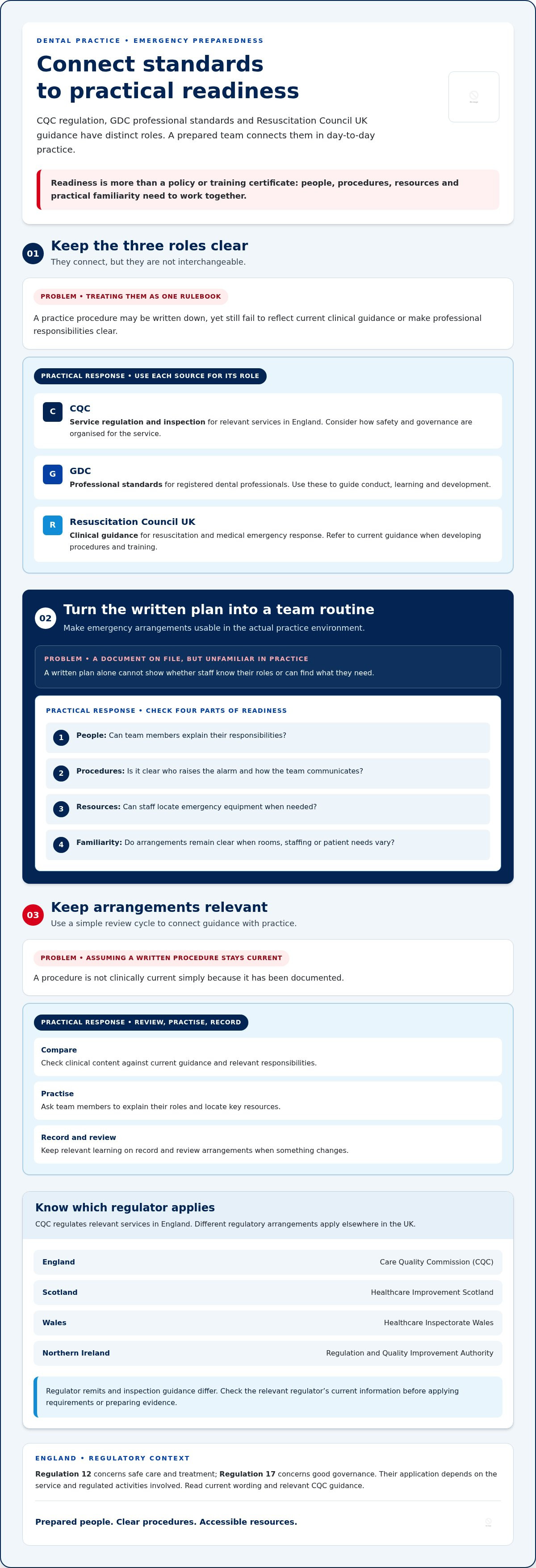
It is understandable to be unsure how CQC expectations differ from GDC professional standards and Resuscitation Council UK guidance. Each has a distinct role. CQC regulates relevant dental services in England, while different regulatory arrangements apply elsewhere in the UK.
This guide explains how those expectations translate into day-to-day preparedness. You will learn what practical evidence can help demonstrate readiness, from clear team roles and accessible emergency equipment to up-to-date records and rehearsed procedures. It also explains how suitable training can help your team build confidence and apply learning in practice. The aim is not simply to hold a certificate, but to develop and evidence a coordinated approach to medical emergencies.
- Understand how cqc medical emergencies requirements dental teams need to consider apply to regulated services in England, and how CQC’s role differs from GDC standards and Resuscitation Council UK guidance.
- Organise useful evidence of preparedness across practice policies, staff learning records, equipment checks and team familiarity with emergency arrangements.
- Turn written plans into practical routines by reviewing roles, mapping the patient journey, practising communication and recording learning.
- Use specialist dental CPD to strengthen knowledge and rehearse responses as part of a wider preparedness plan, not as a guarantee of compliance.
- Consider how your team can apply course learning in its clinical environment and identify practical follow-up actions.
What do CQC medical emergency requirements mean for dental practices?
The Care Quality Commission (CQC) regulates relevant health and care services in England. It does not regulate dental practices across the whole UK. In England, CQC expectations sit within the regulations and regulated activities that apply to a service. For dental practices, emergency preparedness forms part of providing safe care and maintaining effective governance. The phrase cqc medical emergencies requirements dental teams need to understand refers to this wider expectation, not to a single, standalone emergency rulebook.
In practical terms: CQC emergency preparedness means having people, procedures and resources organised so your team can respond safely and explain how those arrangements work. It involves more than keeping a policy or training certificate on file.
In England, Regulation 12 concerns safe care and treatment, while Regulation 17 concerns good governance. Their application depends on the service and regulated activities involved. Read the current wording and relevant CQC guidance rather than relying on a general summary. CQC’s regulatory framework sets expectations for the service. GDC standards address the professional conduct and development of registered dental professionals, while Resuscitation Council UK guidance informs clinical practice. These sources are connected, but they are not interchangeable. The Care Quality Commission (CQC) Wikipedia overview provides background on the regulator. Use current official guidance when interpreting requirements.
Which regulator applies to a dental practice in each UK nation?
Start by identifying where your practice operates and its registration context. CQC regulates relevant services in England. In Scotland, the relevant healthcare improvement and inspection body is Healthcare Improvement Scotland; in Wales, it is Healthcare Inspectorate Wales; and in Northern Ireland, it is the Regulation and Quality Improvement Authority. Their remits and inspection guidance differ. Read the relevant regulator’s current information before applying requirements or preparing evidence.
What does emergency readiness mean in a dental setting?
Readiness brings together coordinated people, documented procedures, suitable resources and practical familiarity. Your written plan should set out who raises the alarm, where emergency equipment is kept and how the team communicates. A document alone, however, cannot show whether staff understand their roles or can find what they need in the practice.
Make the arrangements usable in day-to-day work. Ask team members to explain their responsibilities and locate key resources. Consider whether procedures remain clear when rooms, staffing or patient needs vary. Record relevant learning and review arrangements when something changes. The aim is not to impose one named course or identical response model on every practice. It is to ensure your approach reflects applicable requirements and current clinical guidance, and that the team can put it into practice.
How do CQC expectations connect with GDC and resuscitation guidance?
The cqc medical emergencies requirements dental teams need to consider are easier to interpret when you separate three functions: service regulation, professional standards and clinical guidance. They work together, but none replaces the others. CQC regulates relevant health and care services in England; the General Dental Council (GDC) sets standards for registered dental professionals; and Resuscitation Council UK (RCUK) publishes clinical guidance relevant to emergency response.
| Source | What it covers | How to use it |
|---|---|---|
| CQC | Regulation and inspection of relevant services in England. | Understand the service’s regulatory responsibilities and how safety and governance are assessed. |
| GDC | Professional standards for registered dental professionals. | Use its expectations to guide professional conduct, learning and development. |
| RCUK | Clinical guidance for resuscitation and medical emergency response. | Refer to current guidance when developing clinical procedures and training. |
CQC, GDC and Resuscitation Council UK: distinct roles
Think of the three sources as connected layers. CQC considers whether the service is organised to provide safe care and maintain suitable governance. GDC standards apply to registered professionals and inform their responsibilities and development. RCUK guidance supports the clinical approach teams use. A sound practice process connects these layers: use current clinical guidance, ensure professional learning supports staff roles, and keep arrangements consistent with the regulatory framework that applies to your service.
A practice procedure is not clinically current simply because it is written down. Compare its clinical content with current guidance and make sure relevant team members understand how it relates to their responsibilities. CQC’s guidance on medical emergency equipment for dental practices is a useful reference for its position on this topic. Read the live guidance and applicable regulatory wording before relying on a summary or making a compliance claim.
Does CQC require one specific medical emergencies course?
Do not assume that CQC requires every practice to use one named course, provider or certificate. The key question is whether your arrangements support safe care and whether staff can carry out the responsibilities relevant to their roles. A certificate can help evidence learning, but it cannot by itself show how well the team understands local procedures or works together.
Choose learning by reviewing staff responsibilities, practice needs and applicable professional and clinical guidance. Check current authoritative sources before stating that a particular course, accreditation or training interval is mandatory. Record what the training covers and how it relates to the team’s work. A dental medical emergencies CPD course can support that learning. First Medical Training’s specialist dental emergency CPD training supports dental teams as part of wider practice preparation.
What evidence can show a dental practice is ready for a medical emergency?
Evidence is most useful when it shows how your arrangements work, not simply that documents exist. Organise it so you can explain the connection between written procedures, staff learning, available resources and what the team can locate or describe in practice. These are practical ways to demonstrate preparedness, not a guaranteed CQC checklist or a universal list of legal requirements.
A Dental emergency response plan is a documented protocol that sets out who does what, how the team responds and where emergency resources are kept. Keep it clear enough to guide the team and specific enough to reflect how your practice operates. Evidence relevant to cqc medical emergencies requirements dental teams are preparing for may include:
- Policies and procedures: the current response plan, role allocation, communication arrangements and escalation route for summoning emergency assistance.
- Staff learning records: relevant course or learning details, attendance and outcomes, with a clear link to team members’ responsibilities.
- Equipment checks: dated records showing what was checked, when, by whom and what action followed if an issue was found.
- Practical familiarity: evidence that staff know where resources are kept and understand how to follow the practice’s arrangements.
Use the dental practice emergency preparedness checklist to organise your review. Apply it alongside current authoritative guidance and the requirements relevant to your service. A checklist alone does not prove compliance.
Document the response plan, roles and escalation route
Record who takes each role, how team members communicate and how emergency assistance is summoned. Include the location of relevant equipment and make the procedure easy to find. Then check that staff can explain their responsibilities without needing to read from the document. Review the plan after relevant changes, such as altered room layouts, equipment locations or team arrangements.
Keep the plan aligned with current clinical guidance and your practice’s procedures. Avoid adding treatment instructions from memory. Use authoritative guidance for clinical content and ensure the team knows where to access the approved procedure. Clear, consistent wording helps staff follow the same agreed arrangements.
Keep training and equipment records clear
Record learning in an accessible format. Include who took part, the subject covered and any relevant outcomes or follow-up needs. For equipment, use a log that clearly identifies the item, date, checker and action taken. Where applicable, document emergency drug kit compliance, including storage and expiry checks, in line with relevant guidance and local procedures.
Make records easy to retrieve and review them when roles, resources or procedures change. A log is most helpful when it reflects checks actually completed and actions taken, rather than an unexplained tick. Together, these records help you explain how preparation is maintained. Practical familiarity also shows whether the arrangements make sense to the people expected to use them.
How can dental teams turn written requirements into reliable practice?
A written procedure becomes useful when each person knows how to apply it in the setting where care is delivered. Use a short, structured exercise to test how the team shares tasks, communicates and finds the resources it needs. Keep clinical response instructions aligned with current authoritative guidance. Use practice exercises to rehearse those instructions, not to create a separate treatment protocol.
Follow this sequence:
- Review roles. Agree who leads, who communicates and who carries out other assigned tasks. Make sure responsibilities reflect staff roles and the practice’s procedures.
- Map the patient journey. Consider where an emergency could arise, from the waiting area to the treatment room, and how the team would coordinate across those spaces.
- Practise communication. Rehearse raising the alarm, sharing relevant information and arranging the handover to emergency responders, in line with your current procedures.
- Record learning. Note what worked, where staff were uncertain and what follow-up action the practice has agreed.
For more context on planning and team confidence, use this medical emergency response course guide alongside the guidance that applies to your practice. It can help you consider how learning fits into wider preparation, without treating a course as a substitute for workable local arrangements.
Use training to practise team roles and communication
Rehearse realistic situations that allow the team to practise role allocation, escalation and handover. Keep the exercise relevant to the staff present and the practice environment. The SBAR tool is a structured communication framework: Situation, Background, Assessment, Recommendation. It can help staff organise critical information when communicating, but follow current clinical guidance and local procedures for the response itself.
In-practice training takes place in the actual clinical environment, so the team can practise with its own layout and equipment. For example, staff can rehearse how to communicate across rooms and locate resources before they need to do so in an emergency. Choose exercises that build familiarity and confidence while staying within each person’s responsibilities.
Review learning without assuming a fixed interval
After an exercise, invite the team to identify any unclear role, communication gap or difficulty finding equipment. Agree practical follow-up actions, assign responsibility and record completion. This is a sensible way to guide workplace learning. Distinguish it from a claimed regulator or professional training interval, and verify any mandatory frequency against current authoritative sources. The GDC medical emergencies CPD guidance can help you review professional development expectations. For structured learning that supports team practice, explore First Medical Training’s dental medical emergencies CPD training.
How can specialist dental CPD support CQC readiness?
Specialist dental CPD can help your team develop emergency knowledge and rehearse how to work together. It supports preparedness, but attending a course does not guarantee compliance or replace your practice’s own procedures, equipment checks and review of applicable guidance. Use learning to strengthen your arrangements, then consider how staff will apply it in their roles.
First Medical Training Ltd provides a Medical Emergencies in a Dental Practice CPD course. Its dental training follows Resuscitation Council UK guidance and aligns with General Dental Council expectations. Founded in 2006, the organisation specialises in education for dental and healthcare professionals. Meeting cqc medical emergencies requirements dental practices need to address depends on combining relevant learning with arrangements that work in the clinical setting.
What can a Medical Emergencies in a Dental Practice course cover?
Relevant learning can develop understanding of how to recognise a medical emergency, coordinate team roles and communicate during a response. It can also give staff an opportunity to build confidence within their professional scope. The aim is not to extend anyone’s responsibilities beyond their role, but to help the team understand how its agreed arrangements fit together.
Use course learning alongside current clinical guidance and your own response procedures. A CPD certificate records participation, but cannot by itself demonstrate how your team will respond in your practice. Discuss what staff have learned, relate it to their responsibilities and identify any local procedures or resources they need to become familiar with. Keep clinical instructions consistent with authoritative guidance.
Choose a learning format that fits the practice
Training can take place at your business premises or at First Medical Training Ltd’s training venues. Learning at your premises can help the team relate course discussions to its own environment, layout and equipment. Whichever setting you choose, consider how staff will apply the learning afterwards and how it connects with your existing plans.
Make the next step practical. Identify the team’s learning needs, select relevant specialist CPD, then plan how to discuss and apply the learning in the practice. Treat course attendance as one part of preparedness, not a substitute for maintaining suitable resources or ensuring staff know the agreed procedures. This connects professional development with day-to-day readiness without implying that one course meets every regulatory or clinical expectation.
Explore Medical Emergencies in a Dental Practice training and choose a learning option that supports your team’s next step.
Turn your next review into a practical step
Understanding the cqc medical emergencies requirements dental practices need to address is a starting point, not the end of preparedness. Choose one useful next step for your team: review a procedure together, practise communicating responsibilities or identify a learning need. A focused action can turn your review into a clear plan for continued improvement.
Set a date to revisit the action and decide what would show it has helped. This keeps emergency preparation connected to everyday practice and gives your team a clear way to build confidence over time.
For support with your team’s learning, explore First Medical Training’s Medical Emergencies in a Dental Practice course and choose a next step that fits your needs. Continue developing your team’s readiness through clear plans, relevant learning and regular reflection.
Frequently Asked Questions
Does CQC inspect dental practices across the whole UK?
No. CQC regulates relevant health and care services in England, not dental services throughout the UK. Scotland, Wales and Northern Ireland have separate regulatory arrangements, including Healthcare Improvement Scotland, Healthcare Inspectorate Wales and the Regulation and Quality Improvement Authority. The cqc medical emergencies requirements dental teams need to consider depend on the nation and registration framework that apply to their service. Read the relevant regulator’s current dental guidance before using CQC information.
Can locum and temporary dental staff be included in emergency preparation?
Yes. Include locum and temporary staff in local orientation before they take part in patient care. Show them how to raise the alarm, where to find the practice’s emergency procedures and how responsibilities are allocated during an incident. Ask them to confirm they understand the arrangements, and record the orientation. This helps prevent temporary team members from relying on assumptions based on procedures used at another practice.
Can a dental practice use online learning for medical emergency CPD?
Online learning can support knowledge development, but consider whether the format lets staff practise the skills relevant to their roles. For example, an online module may explain emergency procedures, while a separate practical session can let the team rehearse communication and become familiar with equipment. Match the learning method to its intended outcomes and current guidance. Record what each staff member completed and identify any practical learning that still needs attention.
What should a practice do when an inspection identifies an emergency preparedness concern?
Read the inspection finding carefully and identify the specific issue the regulator has raised. Compare it with applicable guidance, decide what action will address the concern, assign responsibility and record progress. If the finding indicates an immediate risk to patient safety, act promptly to manage that risk and follow any directions in the regulator’s report. Keep evidence of changes and review whether they have resolved the stated concern.
Should emergency arrangements cover patients with additional communication needs?
Yes. Consider how your team will communicate with a patient who may need information presented differently during a stressful situation. For example, identify whether an interpreter, written prompts or another communication aid may be helpful, and make relevant information accessible to staff who need it. Avoid relying on assumptions about a person’s needs. Include communication arrangements in planning while protecting the patient’s privacy and dignity.
How can a dental practice show that emergency equipment checks are being completed?
Keep a clear, dated record for each check, noting the equipment reviewed, who completed it and any issue or follow-up action. If a check identifies a problem, record how it was addressed and when the item was ready for use again. Use a consistent log that staff can retrieve easily, whether paper-based or digital, and ensure entries reflect checks actually completed.