

De-escalation Training for Difficult Patients in UK Dental Practices

In a 2025 British Dental Association survey, 96% of community dentists said they had dealt with demanding or aggressive behaviour in the previous year. When a patient becomes distressed or confrontational, staff need more than good intentions: they need a calm, agreed response. For UK dental teams, mental health first aid for dental practices uk should reflect the realities of the clinical setting, not rely on generic advice.
It is understandable to feel unsure what to say, how to set boundaries or when to seek further help. Dental professionals must also treat patients with dignity and respect, as set out in the General Dental Council’s Standards for the Dental Team. These responsibilities can sit alongside clear steps to protect staff and other patients.
This article explains how to assess de-escalation training for your practice, what dental-specific mental health education can contribute and how to respond when an interaction becomes challenging. You will also learn how clear communication, agreed team roles and practical escalation procedures can support a consistent approach. The aim is to build confidence while keeping patient care and staff safety in view.
Key Takeaways
- Distinguish a tense interaction from a mental health diagnosis or medical emergency, and respond within your role.
- Use attentive listening, measured speech and clear language to acknowledge concerns while maintaining professional boundaries.
- Compare training by its relevance to dentistry, opportunities to practise communication, team involvement and support for applying learning afterwards.
- Build learning into routine practice by identifying team needs, agreeing roles and reviewing relevant policies and your Dental emergency response plan.
- Consider how mental health first aid for dental practices uk can support a dental-focused approach to team development.
What does de-escalation mean in a UK dental practice?
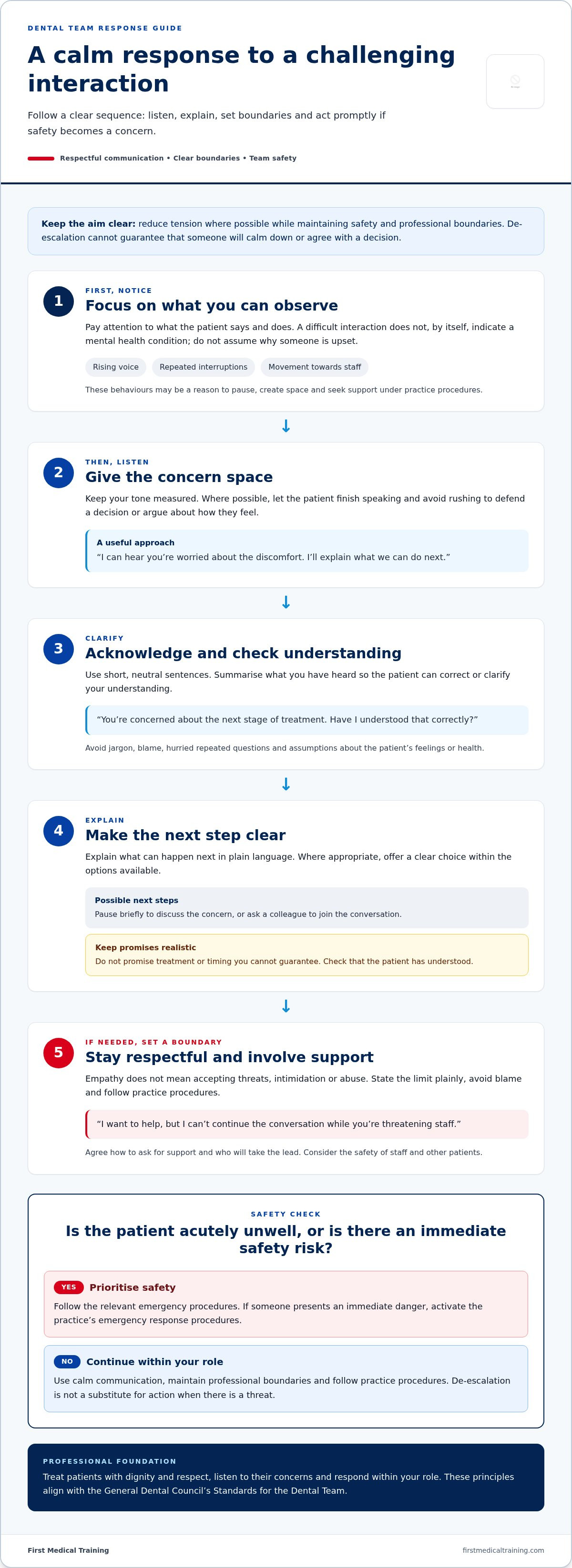
De-escalation is calm, respectful communication intended to reduce tension while maintaining safety and professional boundaries. It can help keep a conversation manageable, but it cannot guarantee that a patient will calm down or agree with a decision. The aim is to respond thoughtfully, not to control someone else’s behaviour.
In a dental practice, de-escalation might mean pausing treatment to listen, explaining the next step in plain language or setting a clear limit on unacceptable conduct. The wider principles behind de-escalation techniques can inform your approach. Apply them in a way that fits your role, the clinical situation and practice procedures.
A difficult interaction does not, by itself, indicate a mental health condition. Equally, do not assume that an upset patient is being deliberately difficult. Focus on what you can observe and what the person says. If the patient appears acutely unwell or there is an immediate safety risk, follow the relevant emergency procedures rather than treating the situation as a communication challenge alone.
Why can dental appointments become emotionally difficult?
Patients may feel worried about pain, treatment, what they have been told or what will happen next. Discomfort, waiting and uncertainty can also affect a conversation. For example, a patient who asks the same question several times may need clearer information. The behaviour alone does not tell you why they are asking.
Listen without interrupting, acknowledge the concern and explain the next step. You might say, “I can hear you’re worried about the discomfort. I’ll explain what we can do next.” Check that the patient has understood, and avoid assumptions about their feelings or health. Respectful listening and clear information can help prevent misunderstandings from adding to tension.
The General Dental Council’s Standards for the Dental Team emphasise treating patients with dignity and respect and listening to their concerns. These principles support professional communication, including during difficult conversations.
Where do communication and safety boundaries meet?
Empathy does not mean accepting threats, intimidation or abuse. Keep your language measured and respectful, but state the boundary plainly: “I want to help, but I can’t continue the conversation while you’re threatening staff.” Avoid arguing, blaming or making promises you cannot keep. Where appropriate, explain the next step, such as pausing the discussion or involving a colleague, in line with practice procedures.
Agree how the team will ask for support and who will take the lead if a conversation becomes difficult. Consider the safety of other patients and staff, and follow practice policies. If someone presents an immediate danger, prioritise safety and activate the practice’s emergency response procedures. De-escalation is one part of a safe response, not a substitute for action when there is a threat.
Dental-focused learning, including mental health first aid for dental practices uk, can support team development. It should build awareness and communication skills without asking staff to diagnose patients or work beyond their professional role.
Which de-escalation skills help dental teams respond calmly?
No single phrase suits every patient or situation. Treat de-escalation as a set of adaptable communication principles, not a guaranteed script or clinical intervention. Listen, speak at a measured pace, use straightforward language and acknowledge the concern raised. Adapt your response to the clinical context and your role.
Where it is safe and practical, give the patient time to explain the immediate concern. Avoid rushing to defend a decision or correct how they feel. A calm, brief response can keep attention on what needs addressing now, rather than turning the exchange into an argument about who is right.
How can staff listen and speak without increasing tension?
Keep your posture and tone calm, and allow the patient to finish speaking where possible. Use neutral, short sentences, then summarise what you have heard: “You’re concerned about the next stage of treatment. Have I understood that correctly?” This gives the patient a chance to clarify and helps the team respond to the actual concern rather than an assumption.
Explain what can happen next in simple language. Avoid jargon, blame and repeated questions delivered in a hurried tone. If the patient seems unsure, check their understanding with an open prompt such as, “What would you like me to explain again?” Respectful listening does not mean agreeing with every statement. It shows that you have heard the concern and are responding professionally.
Where appropriate, offer a clear choice within the options available. For example, explain whether you can pause briefly to discuss a concern or ask a colleague to join the conversation. Be specific about the next step and do not promise treatment or timing you cannot guarantee. Realistic choices help the patient understand what is within their control.
When should a team set boundaries or escalate?
Notice observable changes, such as a rising voice, repeated interruptions, movement towards staff or refusal to let a conversation continue. These behaviours do not explain why a person is upset, but they may be a reason to pause, create space and seek support under practice procedures. Involve a colleague early rather than waiting for the situation to become unsafe.
State boundaries calmly and consistently. For instance: “I want to discuss your concern, but I need you to stop shouting so we can continue.” Focus on the behaviour and the practical next step, not on labelling the patient. If the boundary is not respected, follow the practice’s agreed process for ending or moving the interaction.
Supportive communication is not diagnosis, treatment or crisis care.
Distinguish routine distress from immediate risk. If there is an immediate threat to anyone’s safety, stop relying on conversation alone and follow the practice’s emergency procedures. Team learning can help staff agree how to communicate and seek support. Mental Health First Aid for Dental Practices is a dental-focused option for team development.
How should you compare de-escalation training for dental practices?
Choose training by matching its content to the interactions your team needs to manage, not by relying on broad claims about confidence or results. First identify the roles involved, the situations that cause uncertainty and how your practice expects staff to seek support. Then compare the training’s relevance to dentistry, opportunities to practise communication and plans for applying learning afterwards.
What makes training relevant to a dental team?
Look for examples grounded in patient-facing dental work and relevant to reception, clinical and management staff. Shared principles can help colleagues respond consistently, while role-based discussion lets each person consider what they can appropriately do. Check that the course information explains its learning outcomes clearly and does not promise a particular response from patients.
| What to compare | General awareness | Role-specific learning | Practice-based discussion |
|---|---|---|---|
| Dental relevance | Introduces broad concepts; check how clearly dental situations are addressed. | Connects discussion to reception, clinical or leadership responsibilities. | Uses familiar workflows and practice scenarios to explore team responses. |
| Communication practice | May explain principles; look for examples staff can apply. | Can consider language suited to different patient-facing roles. | Can give the team time to discuss responses to realistic scenarios. |
| Team participation | Can build shared awareness across attendees. | Can focus on the responsibilities of particular roles. | Can help colleagues discuss handovers and when to seek support. |
| Applying learning | Check whether the course explains how to put learning into practice. | Consider how role-specific learning fits existing procedures. | Discuss how learning relates to practice policies and review. |
Use the table to identify what best fits your needs, rather than assuming one format is always superior. A team seeking shared language may value general awareness. A practice reviewing how concerns pass between reception and the clinical team may benefit from role-specific or practice-based discussion. The key is a clear connection between learning and day-to-day work.
How does mental health first aid differ from de-escalation instruction?
Mental health first aid is supportive learning. It can help staff recognise when someone may need support and consider an appropriate response, but it is not diagnosis or therapy. De-escalation focuses on communication and boundaries during a difficult interaction. The subjects can complement each other in team development, but they address different learning needs.
Emergency response training has a separate purpose: preparing a team to respond to a medical emergency under relevant procedures. Do not treat communication training as a substitute for emergency training, or assume either course covers the other. First Medical Training Ltd is an accredited CPD provider, and its training is aligned with General Dental Council expectations. Its Mental Health First Aid for Dental Practices supports dental-focused team learning.
How can a dental practice put de-escalation learning into practice?
Training is most useful when the team connects it to everyday procedures, agreed responsibilities and opportunities to review how those arrangements work. Build that connection in stages. Focus on practical learning, staff support and patient safety, rather than expecting a course to resolve every difficult interaction.
How can a practice prepare before training?
Start with a team conversation and your existing Risk assessment processes. Identify situations that leave staff unsure how to respond, such as rising frustration at reception or uncertainty about who should join a conversation. Include appropriate patient-facing, clinical and management roles so the discussion reflects how information and support move through the practice.
Before training, agree a straightforward route for requesting help. For example, decide how a receptionist can discreetly alert a colleague and who should take the lead when support is needed. Use your dental practice emergency preparedness checklist alongside relevant practice procedures to review emergency arrangements. Keep medical emergencies distinct: the Dental emergency response plan should guide the team’s response to those events.
How can managers reinforce learning afterwards?
After training, make time for short team discussions. Review what staff found useful, where roles or procedures remain unclear, and what support may help the team apply the learning. Keep discussion focused on improving arrangements, not criticising an individual’s response.
- Identify team needs. Discuss recurring communication challenges and relevant findings from existing Risk assessment processes.
- Include the right roles. Bring together staff whose responsibilities overlap during patient interactions, including reception, clinical and management colleagues.
- Agree roles and support routes. Set out who can step in, how colleagues can request support and what to do if the situation presents immediate danger.
- Connect learning to procedures. Review relevant practice policies and the Dental emergency response plan. Keep emergency response arrangements distinct from routine communication support.
- Review learning in practice. Use brief, routine discussions to check whether agreed arrangements are clear and whether any procedure needs review.
Record incidents or concerns confidentially, following practice procedures and limiting access to appropriate staff. When reviewing an incident, focus on what the practice can learn and whether its arrangements were clear. Protect patient and staff confidentiality, and do not include identifying details in general team discussions.
The GDC CPD requirements guide can provide context when you plan professional development. Treat de-escalation learning as part of ongoing team development, and review how it fits your practice’s wider needs. For dental-focused learning, Mental Health First Aid for Dental Practices can support a considered approach to team development alongside your existing procedures.
How can Mental Health First Aid for Dental Practices support your team?
Dental-focused learning helps your team consider mental health support in the context of practice life, where patient-facing and clinical responsibilities meet. First Medical Training Ltd provides Mental Health First Aid for Dental Practices for dental teams. Consider how it fits your development priorities and existing procedures. Training supports learning, but it cannot guarantee a particular response during a difficult interaction.
What should a dental team expect from relevant mental health training?
Training designed for dental practices can make the subject relevant to your setting. Assess the course information by checking whether it explains its dental context, identifies its intended participants and sets out clear learning aims. This helps you judge whether the learning fits the people and situations you want to address.
Keep expectations within the course’s stated aims and outcomes. Attendance does not give staff a clinical qualification, the ability to diagnose a condition or authority to provide treatment. Mental health first aid learning can support awareness and a considered response, but it does not replace practice policy, clinical judgement or emergency procedures.
Consider how the learning could sit alongside existing arrangements. For example, your team might discuss how staff can respond consistently when a patient raises a concern, while following practice procedures for further support. This makes training one part of team development, rather than a stand-alone solution to every challenging situation.
What are practical next steps for practice leaders?
Take a structured approach before choosing learning for your team:
- Identify priorities. Discuss where staff need more understanding or confidence, drawing on relevant team feedback and practice needs.
- Choose participants thoughtfully. Consider which patient-facing, clinical and management colleagues would benefit from a shared understanding.
- Review the course information. Compare its stated aims and outcomes with your priorities. Keep the distinction between mental health first aid and de-escalation clear.
- Plan how to apply learning. Decide how the team will relate it to existing policies and review it through routine discussion.
This approach helps you assess mental health first aid for dental practices uk by its relevance to dentistry, value for team learning and practical application. It also keeps clear that training does not replace established procedures. Use your priorities to decide how the learning fits your team’s development, without treating course participation as a promise of a particular de-escalation result.
Review the course information against your team’s needs and explore Mental Health First Aid for Dental Practices.
Make your next team-development step purposeful
Choose one practical priority for your next staff development discussion, such as agreeing how colleagues can request support or deciding how to review learning after a challenging interaction. A clear objective gives your team a useful starting point and connects training with the way your practice works.
For practices considering mental health first aid for dental practices uk, look for learning that fits your team’s responsibilities and supports thoughtful, respectful patient communication. First Medical Training Ltd has delivered specialised education since 2006, with experience in professional learning for healthcare and dental teams.
Set aside time to review the course information, identify who should take part and consider how the learning could sit alongside your existing procedures. A consistent team approach develops through clear expectations and ongoing reflection, not a single conversation.
Explore Mental Health First Aid for Dental Practices and take a considered next step in your team’s development.
Frequently Asked Questions
Is de-escalation training mandatory for dental practices?
There is no blanket requirement for every UK dental practice to provide de-escalation training. Practices should still consider relevant legal requirements and professional expectations, including safe working arrangements and GDC standards for patient care. What is appropriate may depend on the practice’s circumstances. Check current GDC and CQC guidance, then consider your policies and Risk assessment. Course attendance alone does not show that every relevant responsibility has been met.
Can mental health first aid training teach dental staff to diagnose a mental health condition?
No. Training in mental health first aid for dental practices uk is supportive learning, not a diagnostic or therapeutic qualification. It does not authorise staff to identify a condition or provide treatment for one. Listen to the person, respond within your professional role and follow practice procedures if further support may be needed. If you are unsure what action is appropriate, involve the relevant colleague or lead under your practice arrangements.
What should dental staff do if a patient becomes threatening?
Prioritise immediate safety and follow your practice’s escalation procedures. Use calm communication only if it is safe to do so, and seek colleague support early. Do not try to manage immediate danger alone or remain in a situation that puts anyone at risk. Know how to alert the appropriate team members and what steps your practice expects you to take if a threat develops.
How can a dental practice document a difficult patient interaction?
Make a timely, factual record in line with practice policy. Describe what you observed and heard, such as the words used or actions taken, and separate those details from assumptions about the person’s motives or health. Follow your practice’s confidentiality arrangements and restrict access to appropriate staff. Check current guidance and local procedures for record-keeping requirements; do not rely on a general article for legal or retention instructions.
Does de-escalation training replace a dental practice emergency plan?
No. Communication learning does not replace emergency procedures, agreed roles or relevant clinical training. Align it with your Dental emergency response plan so staff can distinguish a difficult conversation from a medical emergency and know which process applies. Review the plan and related learning against current professional guidance. Make sure relevant team members know where to find the procedures and how their responsibilities fit together.
How often should dental staff refresh de-escalation skills?
There is no single refresh interval that applies to every dental team. Practice leaders can review learning needs in light of staff roles, incidents, Risk assessment and current guidance. A change in team responsibilities or a review of an interaction, for example, may identify topics to revisit. Record development priorities, decide who needs further learning and schedule a review that fits the practice.
Can de-escalation training guarantee that a difficult interaction will become safe?
No training can guarantee that an interaction will become safe or that a patient will respond in a particular way. Learning can help staff prepare, communicate thoughtfully and recognise when they need support, but it cannot remove every risk. Follow practice procedures, stay within your role and prioritise safety if the situation escalates. Treat training as preparation that informs judgement, not as a substitute for action when danger is immediate.