

Dental Emergency Training Scenarios: A Practical Guide

What if a dental emergency drill tested more than clinical recall? A realistic scenario should also show whether your team can communicate clearly, assign roles and act in a coordinated way. Choosing dental emergency scenario examples for training can feel difficult if you’re unsure which situations suit your practice or how to keep an exercise useful rather than confusing.
This guide covers practical scenarios for dental teams, including patient collapse, suspected anaphylaxis and cardiac arrest. You’ll see what each exercise can help your team practise, how to set safe boundaries and how to assess role allocation, communication and use of a structured approach such as the ABCED assessment. Use these learning points to identify gaps and plan relevant follow-up training. Scenario practice can connect individual knowledge with team readiness, in line with guidance from the General Dental Council and Resuscitation Council UK. The focus is on choosing exercises that reflect your setting and leave every team member clearer about what to do next.
Key Takeaways
- Choose dental emergency scenario examples for training that match your team’s learning needs, from role allocation to clear communication.
- Build each exercise around a defined objective, a clear context, assigned roles and a debrief guided by your dental emergency response plan.
- Use scenarios such as syncope, hypoglycaemia, anaphylaxis, choking and suspected cardiac arrest to practise different aspects of the team response.
- Keep practice realistic but psychologically safe. Ask what went well, what was unclear and what the team would change next time.
- Use debrief findings and staff learning priorities to decide whether the next step is a refresher, focused skills practice or medical emergency CPD.
Why use dental emergency scenario examples for training?
A training scenario is a structured rehearsal of a possible emergency and the team’s response. It lets staff practise coordinating in a familiar dental setting, rather than only discussing what might happen. For example, a patient could become unwell during treatment. The exercise can help your team consider who raises the alarm, who stays with the patient and who brings the required equipment, in line with your practice procedures.
Dental settings and staffing arrangements differ, so adapt each scenario to your rooms, equipment and team roles. A receptionist, dental nurse and clinician may have distinct responsibilities, but the exercise should reflect your own dental emergency response plan. A patient-focused overview of a dental emergency can provide useful context. Staff training should then focus on the response expected in your practice. Scenario practice supports role awareness, communication and reflection, but it doesn’t replace current clinical guidance or formal training.
What makes an emergency scenario useful for a dental team?
Start with one clear learning objective, such as allocating responsibilities promptly or giving a concise handover. Set a plausible context, but don’t script every action or imply there’s only one correct way for the team to organise itself. Before the exercise, explain who is taking part, the expected level of knowledge and what observers will record. Keep notes focused on actions and communication that relate to the objective.
Which skills can a practice exercise reveal?
Observe how the team raises the alarm and agrees immediate responsibilities. Notice whether staff use the agreed ABCED approach to assess the patient and communicate relevant observations clearly. An observer can also note questions that arise: Is equipment easy to locate? Is it clear who will share information with responding services? Treat these as prompts for discussion and follow-up, not proof of non-compliance.
Use the debrief to turn observations into practical next steps. Clarify uncertainty against current guidance and the practice’s agreed procedures, then decide whether roles, communication or equipment arrangements need further review. For wider course and compliance context, read the Medical Emergencies in a Dental Practice course guide. Choosing dental emergency scenario examples for training around a real learning need makes each exercise more relevant to the people and setting involved.
How to structure dental emergency scenario examples around learning objectives
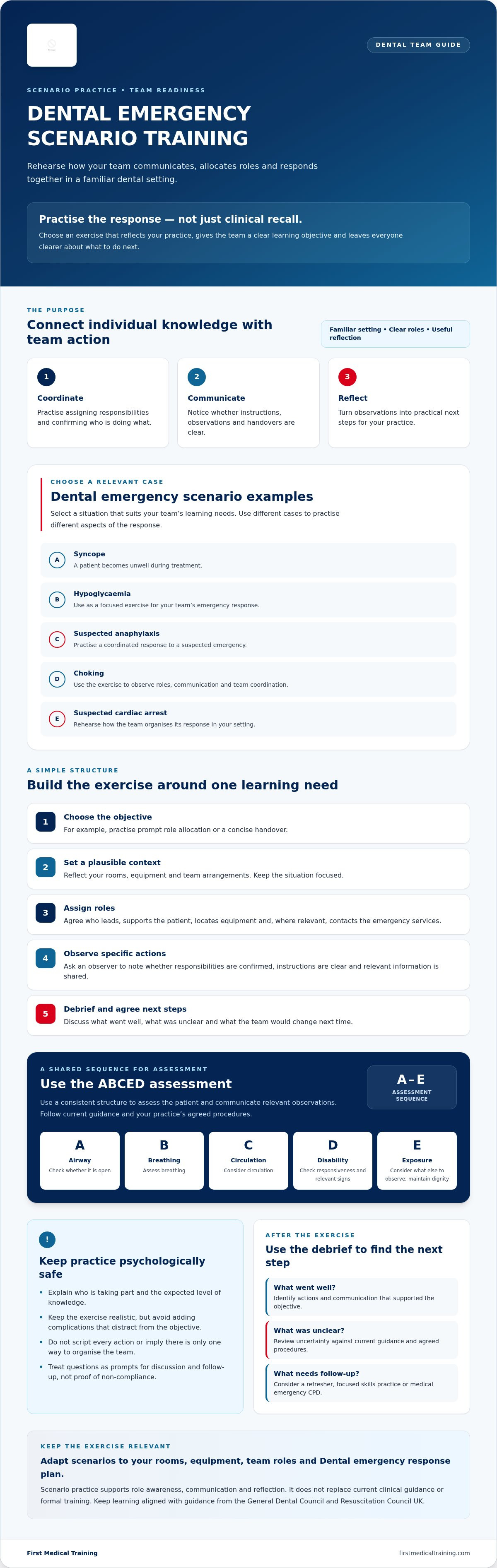
A clear structure keeps an exercise focused and gives the team something useful to discuss afterwards. Build dental emergency scenario examples for training around one learning need, then follow a simple sequence: choose the objective, set the context, assign roles, run the exercise and debrief. Before you begin, check that the scenario follows current clinical guidance and your practice’s dental emergency response plan.
Set the scenario, roles and observable actions
Choose a concise starting situation that feels plausible in your practice, such as a patient becoming unwell during an appointment. Keep the exercise focused. If the objective is role allocation, avoid adding unrelated complications that distract from the learning point.
Assign roles based on your team and setting. Decide who leads, who supports the patient, who locates equipment and, where relevant, who contacts the emergency services. You can also appoint an observer to record specific actions. Agree in advance what they’ll look for, such as whether instructions are clear, responsibilities are confirmed and relevant information is shared. This makes feedback more useful than a general impression of how the exercise went.
Use a consistent assessment and communication framework
Use the ABCED assessment as a shared structure: Airway means checking whether the airway is open; Breathing means assessing breathing; Circulation means considering circulation; Disability means checking the patient’s level of responsiveness and other relevant signs; Exposure means considering what else needs to be observed while maintaining the patient’s dignity. Follow current guidance when applying the framework, and use your practice’s agreed procedures.
A structured assessment gives the team a common sequence for noticing and communicating relevant information. Where a handover is needed, the SBAR tool can help organise it: Situation, Background, Assessment and Recommendation. Practise concise updates rather than relying on lengthy explanations. The facilitator should assess whether information is passed clearly, not just whether a framework is named.
After the exercise, compare observations with the learning objective. Ask which actions were clear, where responsibilities became uncertain and what should be practised next. Record follow-up points for the team, then check whether they call for a refresher, a focused skills session or broader CPD. If your learning needs point to structured support, explore dental medical emergency CPD training and consider whether it fits your team’s priorities.
Dental emergency scenario examples: choose cases that test different team skills
Choose cases that match your team’s learning priorities. These dental emergency scenario examples for training are prompts for practising recognition, team roles, communication and escalation. They are not stand-alone clinical instructions or a substitute for current guidance and your practice’s dental emergency response plan. Keep each exercise focused on what the team should notice and how it should coordinate its response.
Scenarios for recognition and early team coordination
Use a short, realistic starting point, then observe what the team identifies, communicates and escalates. The aim is to reveal learning points, not to test staff with unexpected complications.
| Scenario | Practice objective | Debrief prompt |
|---|---|---|
| Syncope during an appointment | Notice a change in the patient’s condition and coordinate who leads, supports the patient and communicates observations. | How quickly did the team recognise the change, and were responsibilities clear? |
| Suspected hypoglycaemia | Practise sharing relevant information and clarifying who is responsible for each response task. | What information was communicated, and did anyone have to guess their role? |
| Possible anaphylaxis | Explore recognition, prompt escalation and whether staff know where to check the practice’s agreed procedures. | What signs prompted concern, and what further training or clarification would help? |
For these cases, keep the debrief centred on what the team observed and how it communicated. Discuss uncertainties against current guidance rather than turning the exercise into a treatment lesson.
Scenarios for airway concerns and life-support response
Airway and life-support exercises can test whether people raise the alarm, coordinate tasks and communicate clearly under pressure. Set boundaries before starting, especially if participants will rehearse physical skills, and follow relevant training guidance.
| Scenario | Practice objective | Debrief prompt |
|---|---|---|
| Choking | Rehearse summoning help, allocating immediate responsibilities and keeping communication clear. | Did the team make it clear who was doing what, and how was information shared? |
| Suspected cardiac arrest | Assess team coordination and CPR and AED awareness in line with current guidance. | Could team members locate the relevant equipment and coordinate their roles? |
Use the answers to choose a focused follow-up, not to make assumptions about compliance. For clinical context on the latter scenario, read the cardiac arrest management guide for dental practice.
How to run and debrief a dental emergency training scenario
A useful exercise should feel realistic enough to prompt teamwork, but safe enough for participants to learn without feeling judged. Before you begin, explain the learning objective, the boundaries of the simulation and each person’s role. Make clear that the purpose is to identify learning points, not to catch someone out. Choose dental emergency scenario examples for training that reflect your practice, and adapt the exercise to staff experience and the skills you want to practise.
Facilitate the exercise without turning it into a test
Use the practice environment and equipment only if they’re suitable for the exercise. Tell participants what is simulated, which actions they must not carry out on a real patient or operational equipment, and how they can pause if they have a safety or wellbeing concern. During the scenario, observe actions and communication against the agreed objective. Avoid interrupting to correct routine decisions, but step in if safety or wellbeing requires it.
Keep the exercise manageable. If the aim is to practise role allocation, for example, observe who takes the lead, how tasks are confirmed and whether information is passed clearly. Don’t add extra complications unless they support the learning objective. This helps keep feedback specific and the session psychologically safe.
Debrief the team and capture learning
After the exercise, give each participant space to describe their role and what information they needed. Use open questions to guide reflection:
- What went well?
- What was unclear, or harder than expected?
- What would you change next time?
Compare what you observed with the objective and current practice guidance. Record learning points, assign follow-up actions and review the dental emergency response plan if the exercise raised questions about roles, communication or equipment arrangements. Check relevant guidance from the General Dental Council, Care Quality Commission and Resuscitation Council UK. A practice drill can support learning, but completing a scenario doesn’t by itself establish compliance.
For wider preparation prompts, use the dental practice emergency preparedness checklist. If your debrief identifies a need for structured team learning, explore medical emergency training for dental teams as a possible next step.
When should a dental team choose facilitated emergency training?
Choose the next step based on what your team needs to practise, not simply on whether an exercise has been completed. A short refresher may suit a team that understands its procedures but needs to revisit responsibilities. Focused skills training may be more appropriate if a debrief highlighted uncertainty in a particular area. If learning needs span several types of emergency or involve the whole team, consider broader medical emergency CPD.
Match the learning need to the training format
Decide whether your priority is another scenario rehearsal, a structured course or a combination of both. Use debrief notes to identify the skill or knowledge area, then consider which team members need to take part. Check that the course content suits their roles and your practice’s learning objectives. Before recommending a course, verify its current details, CPD accreditation and available delivery options directly with the provider.
In-practice training may be useful when your team needs to work in its clinical environment and consider its own layout and equipment. Confirm that this format is suitable for the learning objective and available for the course you’re considering. It should complement, not replace, your practice’s procedures or current clinical guidance.
Turn scenario findings into a practical next step
Prioritise one or two actions from the debrief rather than treating every observation as a failure. For example, you might clarify who is responsible for a particular task or arrange further practice in an identified skill area. Assign someone to each action, set a review point and decide how you’ll check whether the team’s learning need has been addressed.
If your findings point to broader learning across the team, First Medical Training’s Medical Emergencies in a Dental Practice course may be relevant to explore. First Medical Training offers accredited medical emergency training and Dental Immediate Life Support training. Check the current course details and accreditation wording before deciding whether either fits your objectives.
Once you’ve identified your priorities, you can ask about medical emergency training for your dental team. Share the learning needs you’ve identified and confirm course content and delivery options before making a decision.
Turn your team’s learning into confident action
Useful dental emergency scenario examples for training begin with a clear learning objective and finish with an honest debrief. Focus on how your team shares information, understands its roles and identifies practical follow-up. Then choose a refresher, focused skills training or broader CPD to match those needs.
Facilitated training can help your team explore learning priorities in a structured setting. First Medical Training was founded in 2006 and provides accredited training courses, including Medical Emergencies in a Dental Practice and Dental Immediate Life Support. Check current course details and accreditation before deciding what suits your practice.
Use your debrief findings to guide the next step, and keep the focus on learning rather than blame. To discuss relevant training for your team, ask about medical emergency CPD training for your dental team.
Frequently Asked Questions
What are examples of medical emergency scenarios for dental team training?
Useful examples include a patient fainting, suspected hypoglycaemia, possible anaphylaxis, choking and suspected cardiac arrest. Choose each case to practise a defined team skill, such as recognising a change, assigning roles, communicating observations or locating equipment. Keep the exercise consistent with current clinical guidance and your dental emergency response plan. The scenario should prompt discussion and teamwork, not act as a stand-alone treatment guide.
How do you create a realistic dental emergency training scenario?
Start with one learning objective and a short situation that could plausibly arise in your practice. Assign participant and observer roles, then agree which actions or communication behaviours the observer will note. Use a familiar setting where appropriate, but make clear what is simulated and set safe boundaries before starting. After the exercise, discuss what went well, what was unclear and what the team would change next time.
Can dental teams practise emergency scenarios in their own practice?
Yes, a practice can arrange scenario rehearsal in its own setting if the exercise is suitable and safe. Using the clinical environment may help the team consider its layout, roles and equipment locations. Agree beforehand which equipment can be used and what must remain untouched or simulated. Facilitated in-practice training may also be an option, but check the provider’s current delivery arrangements and confirm that the format suits your learning objectives.
Which emergency scenarios should a dental practice include in training?
Select cases according to your team’s learning priorities and the emergencies covered by current guidance. Syncope, hypoglycaemia, anaphylaxis, choking and suspected cardiac arrest offer different opportunities to practise recognition, role allocation, communication and escalation. You don’t need to cover every case in one exercise. Start with a relevant learning need, then use debrief findings to decide which scenario or skill to practise next.
What should a dental team discuss during a scenario debrief?
Ask each participant what their role was and what information they needed. Discuss what went well, what felt unclear and what the team would change in another exercise. Compare observed actions with the learning objective and current practice guidance, without treating a question or pause as proof of non-compliance. Record useful learning points, assign follow-up actions and review the dental emergency response plan if the exercise raises relevant questions.
Is scenario-based training enough for medical emergency CPD?
Scenario practice is a useful way to rehearse team responses, but it shouldn’t automatically be treated as a substitute for structured CPD or clinical guidance. Check current General Dental Council requirements and ensure any CPD activity meets the relevant criteria for your role. Consider whether your team also needs a structured course, focused skills training or documented reflection. Choose a format that addresses the learning needs identified during practice and debrief.
How often should dental staff practise medical emergency scenarios?
Resuscitation Council UK guidance advises regular simulation-based practice and annual updates to emergency training. Check the current guidance and your practice’s training arrangements to confirm what applies to your team. Use changes in staff roles, debrief findings and learning needs to inform practice between formal updates. Keep a record of training and agreed follow-up, and make sure scenario exercises reflect current procedures rather than relying on memory alone.