

Dental Nurse ILS Training: The 2026 Guide to Immediate Life Support and GDC Compliance

If a patient collapsed in your chair right now, would you feel like a capable responder or a panicked bystander? It's a question that keeps many dental professionals awake, especially when the line between "highly recommended" and "required" training feels blurred. You likely recognise that basic life support is no longer the ceiling for clinical excellence in a modern surgery. You want to move beyond simple chest compressions and feel truly prepared to handle complex equipment like manual defibrillators without a moment of hesitation.
Mastering dental nurse ils training is the most effective way to bridge the gap between basic aid and professional resuscitation leadership. We understand the weight of responsibility you carry; that's why this 2026 guide is designed to replace anxiety with clinical confidence. You'll gain a clear understanding of the latest GDC medical emergency standards and the practical skills needed to manage those critical first five minutes of a cardiac arrest. We'll explore current regulatory expectations, demystify airway management equipment, and outline exactly how to secure your essential verifiable CPD hours for the year ahead.
Key Takeaways
- Understand why dental nurse ils training has become the modern standard for clinical excellence, acting as the essential bridge between basic aid and advanced resuscitation leadership.
- Learn how to apply the systematic ABCDE approach to identify deteriorating patients before a crisis occurs, ensuring your response is both methodical and calm.
- Clarify the 2026 GDC requirements for medical emergency training, including the updated enrolment deadlines for trainee dental nurses and the mandate for annual skills updates.
- Discover the practical steps for managing a cardiac arrest whilst a patient is in the supine position, including the effective use of airway management equipment and AEDs.
- Identify how bespoke in-practice training can enhance team behaviour and ensure your practice remains fully compliant with Resuscitation Council UK quality standards.
Why Dental Nurse ILS Training is Essential in 2026
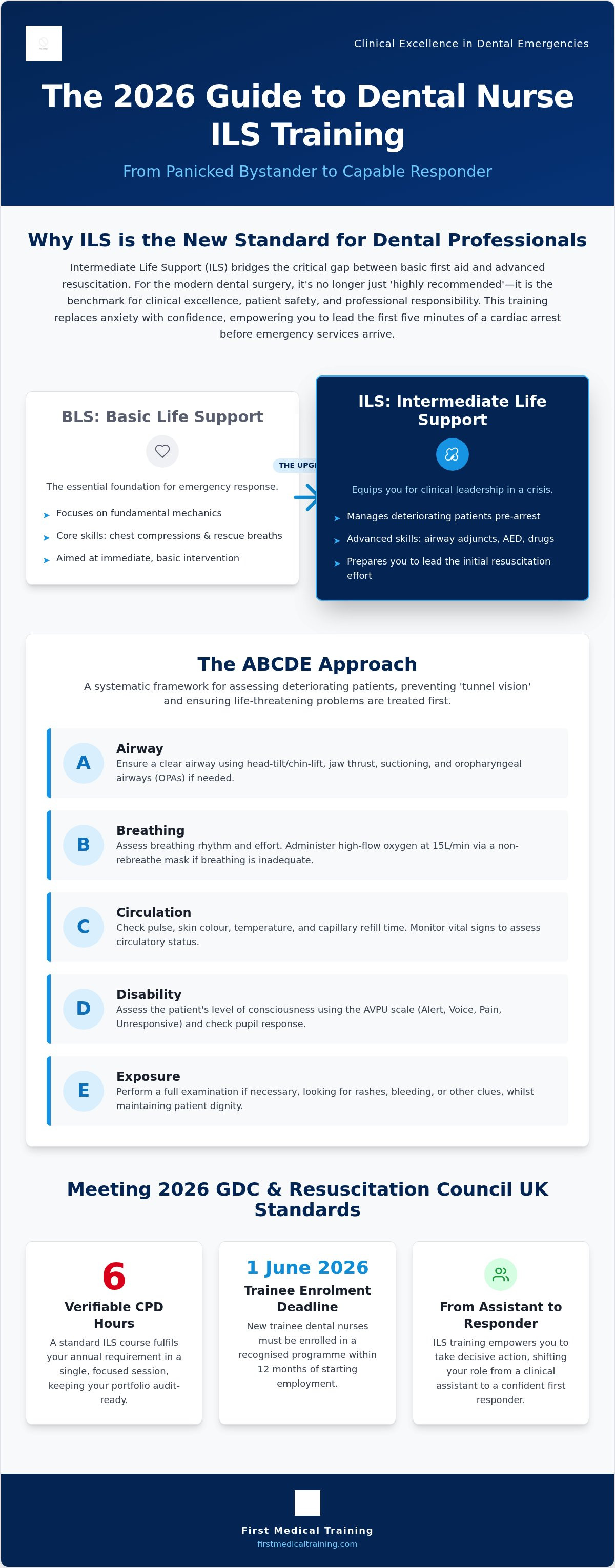
Dental ILS training is more than a box-ticking exercise for your professional portfolio. It is a one-day intensive programme specifically designed for healthcare professionals who need to bridge the gap between basic aid and advanced resuscitation. Whilst Basic Life Support (BLS) focuses on the fundamental mechanics of chest compressions and rescue breaths, Intermediate Life Support equips you with the skills to manage a deteriorating patient or a cardiac arrest for those critical first few minutes before an ambulance arrives. The GDC categorises medical emergencies as a "highly recommended" CPD topic. This means that failing to maintain these skills isn't just a clinical oversight; it's a direct risk to your professional registration and the safety of everyone in your practice.
The shift from BLS to ILS represents a move towards clinical leadership. In a modern surgery, simply calling 999 is not enough. You are expected to handle airway adjuncts, use an AED with precision, and understand the pharmacology of emergency drugs. Relying on outdated training creates a significant legal and professional liability. If a patient experiences a crisis in your chair, the subsequent audit will look for evidence that your dental nurse ils training was current, relevant, and met the standards set by the Resuscitation Council UK.
Meeting GDC CPD Requirements for 2026
The GDC is clear: all registrants must stay up to date with medical emergencies. A standard ILS course typically provides 6 hours of verifiable CPD, fulfilling your annual requirement in a single, focused session. From 1 June 2026, new trainee dental nurses must be enrolled in a recognised training programme within 12 months of starting employment. This highlights a regulatory push for earlier clinical competence. Maintaining an up-to-date CPD portfolio is your best defence during a GDC audit. It proves you have the contemporary knowledge required to practise safely.
The Role of the Dental Nurse in Resuscitation
In a crisis, the dental nurse often transitions from a clinical assistant to an active responder. You are frequently the first person to notice a patient "going off" or showing subtle signs of distress whilst in the supine position. Dental nurse ils training empowers you to take decisive action rather than waiting for instructions. This shift in responsibility has a profound psychological benefit. When you understand the protocols, the fear of the unknown disappears. You stop feeling anxious about a potential collapse and start feeling prepared to lead the first five minutes of the rescue effort.
The ABCDE approach is the gold standard for clinical assessment in all medical emergencies. This systematic framework allows you to assess a patient's condition logically, ensuring that life-threatening problems are prioritised and treated in order. In the high-pressure environment of a dental surgery, having a memorised structure prevents the "tunnel vision" that often occurs during a crisis. For those undergoing dental nurse ils training, mastering this sequence is the difference between a chaotic response and a controlled, life-saving intervention.Recognising a patient who is "going off" in the chair requires keen observation. You might notice subtle changes in skin colour, a change in breathing rhythm, or a sudden lack of response to verbal prompts. By following the BDA guidance on medical emergencies, you can ensure your practice meets the highest safety standards. Effective communication is the backbone of this framework. Using structured tools ensures that when you call for help or brief the dentist, every piece of critical information is delivered clearly and without ambiguity.
Airway and Breathing Management in the Surgery
Maintaining a clear airway is your first priority. In a dental setting, this often involves simple manoeuvres like the head-tilt chin-lift or jaw thrust to prevent the tongue from obstructing the throat. If the patient is unconscious, you may need to utilise adjuncts such as oropharyngeal airways (OPAs). Proper suctioning is equally vital to clear any secretions or dental debris that could lead to aspiration. When breathing is inadequate, administering high-flow oxygen at 15 litres per minute via a non-rebreathe mask is essential. This is a core skill taught in our Medical Emergencies in a Dental Practice Course, which focuses on practical, hands-on application.
Circulation and Disability: Monitoring Vital Signs
Once the airway and breathing are stabilised, you must assess the circulation. This involves checking the pulse, skin temperature, and capillary refill time. A pulse oximeter is a valuable tool here, providing real-time data on oxygen saturation and heart rate. It's crucial to distinguish between simple syncope (faint) and a cardiac-related collapse. Whilst a faint usually resolves quickly with leg elevation, a cardiac event requires immediate escalation. Assessing "Disability" involves checking the patient's level of consciousness using the AVPU scale (Alert, Voice, Pain, Unresponsive). If a patient remains unconscious, they must be managed carefully to protect their airway until the emergency services arrive, a process made much smoother by the comprehensive skills developed through dental nurse ils training.
BLS vs ILS: Which Training Level Does Your Practice Need?
Distinguishing between Basic Life Support (BLS) and Immediate Life Support (ILS) is vital for practice managers and clinical staff alike. Whilst BLS provides the essential foundation of chest compressions and the use of an Automated External Defibrillator (AED), ILS introduces a higher level of clinical intervention. This includes advanced airway management and the ability to work effectively as part of a resuscitation team. For many, dental nurse ils training is the logical progression that ensures a practice isn't just compliant, but genuinely prepared for high-stakes scenarios.
One of the most significant differences lies in "non-technical skills". ILS training places a heavy emphasis on team leadership and structured communication during a crisis. It moves the dental nurse away from simply following AED voice prompts and towards understanding the "why" behind every action. This level of training is particularly crucial in environments where the risk profile is higher, such as oral surgery centres or clinics treating medically compromised patients.
When is ILS Mandatory for Dental Nurses?
For practices providing conscious sedation, the choice between BLS and ILS is often made for you. The Intercollegiate Advisory Committee on Sedation in Dentistry (IACSD) explicitly states that all members of the primary dental care team involved in the delivery of sedation must have up-to-date ILS training. This applies to both intravenous (IV) and inhalation sedation. Even if your practice doesn't offer these services, having at least one ILS-trained member in every team provides a safety net. It ensures there is a designated lead who can manage the scene until paramedics arrive.
Advanced Skills: Defibrillation and Drugs
ILS training takes you deeper into the mechanics of cardiac arrest. You'll move beyond the basic "shock advised" message of an AED to gain a fundamental understanding of heart rhythms. This knowledge helps you anticipate the next steps in the resuscitation algorithm. A critical part of the nurse's role in an ILS context is the preparation of emergency drugs. You'll learn the correct protocols for handling Adrenaline; ensuring the right dose is ready the moment the dentist or lead clinician calls for it. Safety is paramount amongst the dental team; therefore, ILS also covers the strict "all clear" protocols required to prevent accidental injury during defibrillation. By integrating these advanced skills, dental nurse ils training ensures your response is both rapid and safe.
Practical Scenarios: Managing Patient Collapse in the Chair
Most resuscitation training occurs on an open floor, yet the reality of a dental emergency is often confined to the surgery chair. When a patient collapses whilst in the supine position, your first instinct might be to move them. However, modern protocols suggest that keeping the patient in the chair, reclined fully flat, is often the safest and most efficient way to begin chest compressions. This approach is a cornerstone of effective dental nurse ils training, as it focuses on the physical constraints of your specific clinical environment. You should ensure the headrest is removed or adjusted to provide a firm surface for airway management and that the chair's height is set to allow for effective, high-quality compressions.
Preparation is the best antidote to panic. Your surgery should be organised so that the AED and the emergency "Grab Bag" are accessible within seconds, not minutes. When calling 999, you must clearly state you are in a dental surgery, provide the exact address, and confirm that you have a patient in cardiac arrest who requires an immediate emergency response. Having a pre-planned route for the paramedics to enter the building can save vital seconds during the handover process. If you want to practice these scenarios in your own surgery environment, our Dental Immediate Life Support (ILS) Training provides the hands-on experience your team needs to remain calm under pressure.
Team Dynamics and Crisis Resource Management
Resuscitation is a team effort that relies on clear role allocation. In a crisis, the dentist typically leads, whilst the nurse manages the airway or operates the AED. A third team member should act as the "recorder," noting the timings of shocks delivered and any drugs administered. To avoid errors, use "closed-loop" communication; if the leader asks for the oxygen to be turned on, the responder should verbally confirm once the task is complete. Recognising the impact of adrenaline is also vital. Your heart rate will rise, and your field of vision may narrow, but the structured skills refined during dental nurse ils training will help you maintain focus on the protocol.
Post-Emergency Care and Debriefing
The crisis doesn't end when the ambulance arrives. A professional handover using the SBAR tool ensures the paramedics have all the necessary information regarding the Situation, Background, Assessment, and Recommendation. Once the patient is in the care of the hospital team, your practice should conduct a formal debrief. This isn't about assigning blame; it's about discussing what went well and identifying areas for improvement. Finally, ensure the entire event is documented accurately in the patient's clinical records, as this is a critical requirement for GDC compliance and professional accountability.
Professional ILS Training with First Medical Training
Choosing a training provider is a decision rooted in trust. At First Medical Training, we've spent two decades acting as a seasoned mentor to the dental profession. Since our founding in 2006, our mission has been to bridge the gap between abstract clinical theory and the practical realities of a busy surgery. Our dental nurse ils training is not a generic healthcare programme; it's a bespoke experience designed by industry veterans who understand the physical constraints of the dental chair and the unique pressures of the primary care environment.
We believe that true confidence comes from hands-on familiarity with the tools of the trade. Our courses provide direct access to specialised equipment, including the latest AEDs and LifeVac anti-choking devices. We don't just show you how they work; we ensure every member of the team feels comfortable operating them under pressure. This steady, reliable approach demystifies complex protocols, transforming "highly recommended" guidelines into a set of sharp, instinctive skills that save lives.
Tailored Solutions for Dental Teams
The most effective training happens in the environment where you actually work. By conducting sessions within your own practice, we can customise scenarios to suit your specific surgery layout and equipment storage. This in-practice approach is essential for building cohesive team behaviour, ensuring that everyone knows exactly where the grab bag is kept and how to navigate the space during a crisis. We also recognise that emergency response isn't purely physical. We integrate Mental Health First Aid awareness into our sessions, helping teams manage the psychological impact of a medical emergency. This comprehensive strategy ensures your team meets the gdc cpd requirements medical emergencies with absolute ease.
Booking Your 2026 ILS Certification
Organising your annual training shouldn't be a source of stress. We've streamlined the booking process to make it as efficient as possible for practice managers. Once you've scheduled your training day, you can expect a methodical and purposeful session that respects your team's time. The day is structured around high-impact workshops and practical assessments that move at a steady pace. There's no unnecessary fluff; just clear, functional instruction that leads your staff from curiosity to professional readiness. Don't leave your compliance to chance. Enrol your team in a Dental ILS course today and gain the peace of mind that comes from being prepared by the experts.
Securing Your Clinical Excellence for 2026
Elevating your professional skills from basic support to immediate life support is a transformative step for your career. By mastering the ABCDE framework and understanding the nuances of resuscitation within the dental chair, you aren't just meeting regulatory standards; you're becoming a vital leader in your clinical team. We've explored how dental nurse ils training serves as the essential bridge between theory and the high-pressure reality of a patient collapse in the surgery.
Since 2006, First Medical Training has acted as a trusted mentor to the profession, training over 15,000 dental practices worldwide. Our accredited programmes ensure full compliance with Resuscitation Council UK and GDC guidelines. We specialise in the medical emergencies in dental practice course, providing the steady reliability and hands-on expertise your team deserves. You have the capability to act decisively in a crisis, and with the right preparation, you'll replace surgery anxiety with clinical confidence.
Book Your Dental ILS Training with First Medical Training today and ensure your team is ready for whatever the year ahead brings.
Frequently Asked Questions
Is ILS training mandatory for all dental nurses in the UK?
ILS training is mandatory for all dental nurses involved in the delivery of conscious sedation, as specified by the Intercollegiate Advisory Committee on Sedation in Dentistry (IACSD). For those in general practice, the GDC categorises medical emergencies as a "highly recommended" CPD topic. Whilst Basic Life Support is the minimum requirement, many modern practices adopt ILS as their clinical standard to ensure the highest level of patient safety and professional preparedness.
How often do dental nurses need to update their ILS certification?
You must update your certification annually to remain compliant with Resuscitation Council UK and GDC standards. Medical emergency skills are perishable; therefore, yearly refresher training is essential to maintain clinical competence and confidence. Most certificates are valid for 12 months from the date of issue. Keeping your skills current ensures you can act decisively during a crisis whilst also protecting your professional registration during a GDC audit.
Can I do my dental nurse ILS training online or must it be in person?
Effective dental nurse ils training requires a practical, hands-on component to be valid and recognised by regulatory bodies. Whilst some providers offer blended learning with an online theory module, you must complete an in-person assessment for airway management and AED use. We believe that physical practice in a surgery environment is the only way to build genuine muscle memory. It allows you to use equipment like the LifeVac in a realistic setting.
What is the difference between BLS and ILS for dental professionals?
BLS focuses on the basics of CPR and AED use, whilst ILS introduces advanced airway management, team leadership, and the use of emergency drugs. ILS training prepares you to lead the first five minutes of a resuscitation effort before paramedics arrive. It moves beyond simple life-saving mechanics to a more comprehensive clinical assessment using the ABCDE approach. This higher level of training is essential for high-risk environments like oral surgery centres.
Does the ILS course cover medical emergencies like anaphylaxis and asthma?
Yes, a comprehensive ILS course covers the immediate management of all common medical emergencies encountered in the surgery. This includes the response to anaphylaxis, asthma, seizures, and hypoglycaemia. You'll learn the correct protocols for administering emergency medication and using airway adjuncts effectively. Our training ensures you can recognise the early signs of deterioration, allowing you to intervene before a situation escalates into a full cardiac arrest or other life-threatening event.
How many CPD hours does a Dental ILS course provide?
A standard Dental ILS course typically provides 6 hours of verifiable CPD. This allows you to meet your annual GDC requirement for medical emergencies in a single day of focused training. We ensure that all hours are fully documented with a certificate that clearly states the learning outcomes. This makes it easy to maintain your professional portfolio and demonstrate your commitment to clinical excellence during your five-year CPD cycle for GDC audits.
What happens if I fail the practical assessment of the ILS course?
Our instructors take a supportive, mentor-led approach to assessment; therefore, if you struggle with a specific skill, we'll provide additional coaching on the day. The goal is to build your confidence, not to catch you out. Most participants successfully complete the practical elements after a few attempts. If you cannot meet the required standard, we'll discuss the next steps to ensure you receive the further training needed to achieve your certification safely.
Do I need to be a qualified nurse to take the ILS course?
No, you don't need to be fully qualified to undertake dental nurse ils training. Trainee dental nurses are encouraged to participate, especially given the 2026 GDC regulations requiring earlier enrolment in formal training programmes. The course is designed to be accessible for all members of the clinical team. It provides a structured environment where both veterans and newcomers can refine their skills and learn to work together effectively during a medical emergency.