

Emergency First Aid at Work Course UK: The Definitive Guide for Dental Practices in 2026

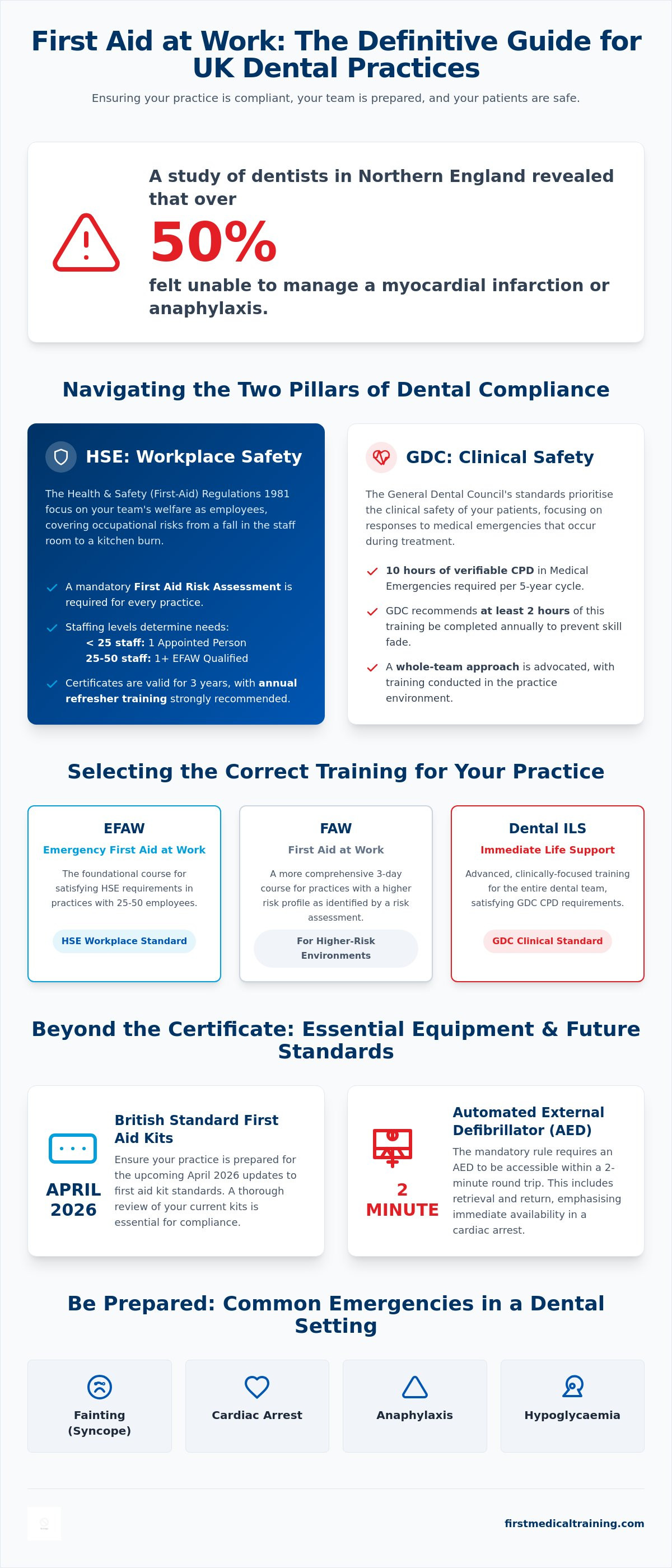
Did you know that whilst a dental professional may encounter a medical emergency every one to two years, a study of dentists in Northern England revealed that over 50% felt unable to manage a myocardial infarction or anaphylaxis? It is a sobering statistic that highlights the common gap between clinical knowledge and real-world emergency readiness. You likely find it challenging to balance the Health and Safety Executive (HSE) workplace regulations with the rigorous clinical standards set by the General Dental Council (GDC). It's often frustrating to manage expiring certificates across a large team or find training that supports both your reception staff and your clinical clinicians.
This definitive guide simplifies the process of implementing first aid at work for dental practices, helping you bridge that gap with professional confidence. We'll break down the April 2026 British Standard updates, explain the mandatory two-minute AED rule, and provide a clear roadmap for securing verifiable CPD hours for your entire team. By the end of this article, you'll have a structured plan to ensure your practice is fully compliant and your staff are empowered to act decisively in any crisis, whether it occurs in the waiting room or the dental chair.
Key Takeaways
- Align HSE workplace regulations with GDC core CPD requirements to satisfy both legal and professional standards simultaneously.
- Explore how specialised first aid at work for dental practices addresses unique clinical challenges, including managing emergencies whilst a patient is positioned in the dental chair.
- Determine whether your team requires EFAW, FAW, or Dental Immediate Life Support (ILS) based on your practice size and specific risk assessment.
- Update your emergency readiness with the latest 2026 standards for first aid kits and Automated External Defibrillator (AED) accessibility.
- Build a more resilient team capable of handling everything from fainting and hypoglycaemia to cardiac arrest with structured, professional training.
Understanding Compliance: HSE Regulations and GDC Standards for Dental Practices
Compliance in a dental setting isn't a single-path journey. You're managing two distinct sets of standards that occasionally overlap but serve different masters. The Health and Safety (First-Aid) Regulations 1981 focus on your team's welfare as employees, whilst the General Dental Council (GDC) prioritises the clinical safety of your patients. This dual-track requirement is where many practice managers feel the most pressure. It's a common misconception that a clinical "Medical Emergencies" update automatically satisfies the HSE. In reality, your workplace first aider needs to know how to handle a fall in the staff room or a kitchen burn, not just a syncopal attack in surgery. Successfully managing first aid at work for dental practices requires a clear understanding of where these regulations diverge and how to document them correctly.
The legal weight of these requirements falls squarely on the Practice Manager to conduct a thorough first aid risk assessment. This document must justify your chosen level of cover, taking into account the nature of the work and the physical layout of the surgery. You shouldn't view this as a bureaucratic hurdle, but as the foundational layer of a safe working environment. When an inspector from the HSE or the CQC visits, they'll look for evidence that you've considered both the staff's occupational risks and the patients' clinical needs. This combined approach ensures that no member of the team is left vulnerable during an incident.
The HSE Requirement: Workplace Safety for Staff
The HSE mandates that every employer provides adequate equipment and personnel to deal with workplace injuries. For most dental practices, a formal first aid risk assessment is the starting point. This isn't just a box-ticking exercise; it's a legal obligation. You must consider the specific layout of your building and the total staff count, including part-time workers. If you have fewer than 25 employees, you must have at least one "Appointed Person" to take charge of first aid arrangements. Once your team grows to between 25 and 50 members, the requirement shifts. You'll need at least one person qualified in Emergency First Aid at Work. Whilst certificates are valid for three years, the HSE strongly recommends annual refresher training. This prevents skill fade and ensures your receptionists and administrators are just as protected as your clinical staff.
The GDC Requirement: Clinical Safety for Patients
Patient safety falls under GDC jurisdiction, where "Medical Emergencies" is a highly recommended core subject. All registered dental professionals must complete at least 10 hours of verifiable CPD in this area every five-year cycle. The GDC recommends at least two hours of this training are completed annually. They advocate for a whole-team approach, meaning everyone from the principal dentist to the trainee dental nurse should train together in the practice environment. This training specifically links to Development Outcome C, which focuses on the maintenance and development of clinical skills. It's about ensuring that when a patient collapses in the chair, the response is immediate, professional, and coordinated. Integrating first aid at work for dental practices into your annual schedule ensures you meet these clinical standards without neglecting your statutory workplace duties.
What to Expect: Syllabus of a Tailored Emergency First Aid at Work Course UK
A standard syllabus provides the foundation, but first aid at work for dental practices requires a more nuanced approach. In a clinical environment, scene assessment goes beyond checking for external dangers; it involves managing sharp instruments, aerosols, and the physical constraints of a dental surgery. Your training should focus on the primary survey and secondary assessment through a professional lens. You'll learn to manage an unconscious casualty whilst they're still in the dental chair, a scenario that requires specific positioning techniques to maintain an open airway. Effective communication is the thread that holds an emergency response together. A tailored course teaches your receptionist how to relay vital information to emergency services whilst the dental nurse and dentist initiate life-saving protocols at the chairside.
Life-Saving Skills: CPR and AED Usage
Cardiopulmonary Resuscitation (CPR) remains the cornerstone of emergency response. Your training will cover the distinct protocols for both adult and paediatric Basic Life Support (BLS), ensuring you're prepared for any patient demographic. Under the updated BS 8599-1:2019+A1:2026 standard, the "two-minute AED rule" is now a critical benchmark. This means your team must be able to retrieve and deploy an Automated External Defibrillator within 120 seconds. Understanding the AED's role in the "Chain of Survival" is vital, as it significantly increases the chances of survival during a cardiac arrest. You'll also practice managing airway obstructions and choking, developing the muscle memory needed to act when a patient's breathing is compromised. For those looking to refresh these skills, our Emergency First Aid at Work Course (EFAW) – 1 Day provides the focused, hands-on practice your team needs.
Common Clinical Emergencies in the Dental Surgery
Statistics show that syncope (fainting) is the most frequent emergency in UK practices, occurring roughly every 1.59 years per dentist. Whilst common, it requires a calm and methodical response to prevent further complications. Your syllabus will also cover hypoglycaemia, which occurs on average every 8.26 years, and the initial management of seizures or suspected cardiac events. Identifying anaphylaxis early is another priority. You'll learn the immediate steps to take, including the administration of adrenaline if required, before the ambulance arrives. Integrating these scenarios into your Professional Training Solutions ensures that your team isn't just following a checklist, but is genuinely capable of diagnosing and treating the most likely crises they'll face in daily practice. This practical confidence is what ultimately protects your patients and your professional reputation.
Selecting the Correct Training: EFAW, FAW, or Dental ILS?
Choosing the right level of training is a critical decision for any Practice Manager. You need to satisfy the HSE guidance on first aid at work whilst also meeting the GDC's clinical expectations. A common mistake is opting for a brief three-hour session that only covers basic life support. Whilst this might tick a GDC box, it frequently leaves the practice non-compliant with workplace regulations. A comprehensive approach to first aid at work for dental practices typically involves the one-day Emergency First Aid at Work (EFAW) course, which provides a broader safety net for both staff and patients. It ensures that your non-clinical team members are just as prepared as your dentists.
For larger or multi-site practices, the three-day First Aid at Work (FAW) course might be necessary if your risk assessment identifies specific hazards or if you have more than 50 employees. However, for most high-street surgeries, the EFAW is the efficient, professional standard. We're also seeing a significant shift towards blended learning. This model allows your team to complete the theoretical modules online at their own pace, followed by a focused practical session. It's a pragmatic solution that respects your surgery's time whilst ensuring skill retention remains high. Always ensure your provider is accredited; otherwise, those verifiable CPD hours won't count toward your professional registration.
The 1-Day EFAW: The Baseline for Dental Teams
The one-day EFAW course has become the preferred baseline because it balances depth with efficiency. It covers the essential life-saving skills required for a workplace setting without the three-day commitment of a full FAW. Many practices now organise these sessions as part of a dedicated "Training Day." By closing the surgery for a single day, you can get the entire team certified simultaneously, from the clinicians to the front-of-house staff. This fosters a unified response culture where everyone knows their role. For a deeper look at these requirements, see our First Aid Certification for Dental Professionals UK guide.
ILS vs EFAW: Understanding the Clinical Depth
Whilst EFAW is the workplace standard, some environments require more clinical depth. Dental Immediate Life Support (ILS) is specifically designed for practices performing conscious sedation or those wanting a higher level of readiness. The equipment distinguishes the two. EFAW focuses on pocket masks and AED usage, whereas ILS introduces airway adjuncts like oropharyngeal airways and more advanced suction techniques. If you're unsure which level your specific practice requires, our EFAW 1 Day Course UK FAQ clarifies the common points of confusion regarding first aid at work for dental practices and clinical depth. Selecting the right course ensures you're not just compliant, but truly prepared.
Beyond the Certificate: Essential First Aid Kits and Life-Saving Equipment
Holding a valid certificate is only half of the compliance equation. To effectively implement first aid at work for dental practices, your physical resources must match your team's training. The Health and Safety (First-Aid) Regulations 1981 require that equipment is "adequate and appropriate," which currently means adhering to the BS 8599-1:2019+A1:2026 standard. This updated framework moves away from simple headcounts and instead demands a risk-based approach to your supplies. Your workplace first aid kit should be clearly marked and easily accessible to all staff, containing the staples for common injuries like cuts or minor burns sustained in the decontamination room or staff kitchen.
However, a standard workplace kit isn't designed for clinical crises. You must maintain a dedicated emergency drugs kit alongside your first aid supplies to satisfy GDC requirements. This kit should include the specific medications and delivery systems required for treating anaphylaxis, asthma, and cardiac distress. Organisation is paramount here. Many practices now use colour-coded "grab bags" that can be rushed to a casualty within seconds. Your receptionist plays a vital role in this system, acting as the designated person for monthly equipment audits. They should meticulously track expiry dates for both drugs and AED pads, ensuring that everything is "fit for purpose" when it's needed most.
Advanced Protection: AEDs and Anti-Choking Devices
The 2026 amendment to the British Standard reinforces the "two-minute AED rule," making on-site defibrillators a non-negotiable asset. Even if your practice is located near a hospital, the time saved by having a functional device on-site is the difference between life and death. We also recommend incorporating the LifeVac anti-choking device into your surgery's toolkit. This non-invasive suction device provides an additional layer of protection for airway emergencies where traditional abdominal thrusts might be difficult or contraindicated. Training your team to deploy this specialised equipment with speed and confidence ensures that your emergency response is truly comprehensive. To ensure your practice is fully equipped, you can browse our range of emergency equipment today.
Mental Health First Aid: A New Standard for 2026
Modern first aid at work for dental practices now extends beyond physical trauma. By July 2026, the industry has recognised the significant psychological pressures faced by dental teams. High-stress environments can lead to burnout or mental health crises amongst staff, which directly impacts patient safety. Incorporating Mental Health First Aid into your strategy helps you identify early signs of distress and provide appropriate support. This holistic approach doesn't just improve staff retention; it builds a more resilient, compassionate practice culture. Integrating wellbeing into your overall first aid strategy demonstrates a commitment to the "human element" of care that defines the best modern dental practices.
Professional Training Solutions: Why Dental Teams Trust First Medical Training
Confidence in a crisis is built on the foundation of high-quality, relevant instruction. Since our founding in 2006, First Medical Training has established itself as a trusted partner for healthcare professionals across the UK. With over two decades of experience, we've developed a deep understanding of the unique operational and clinical challenges faced by modern surgeries. We don't believe in a one-size-fits-all approach to first aid at work for dental practices. Instead, our training is delivered by seasoned professionals who understand the rhythm of a dental environment, from the decontamination room to the chairside. This specialised insight ensures that the scenarios we practice are realistic and directly applicable to your daily work.
Our commitment to in-practice training is a cornerstone of our service. By conducting sessions within your own surgery, your team can practice emergency protocols using your actual equipment and within your specific layout. This eliminates the guesswork of where the AED is stored or how to manage a casualty in a confined space. We provide comprehensive support that extends beyond the standard certificate, offering everything from the core EFAW course to Mental Health First Aid and the supply of essential emergency equipment. This holistic approach ensures that your practice remains a safe environment for both your staff and your patients.
Bespoke Training for the Whole Team
We tailor our 1-day EFAW course to bridge the gap between workplace safety and clinical excellence, incorporating specific dental emergency scenarios that general providers often overlook. This inclusive approach ensures that every member of your team, from trainee dental nurses to senior partners and administrative staff, receives instruction that is both engaging and relevant to their specific role. We are dedicated to providing training that seamlessly integrates GDC standards with HSE compliance, ensuring your practice meets every regulatory benchmark with ease.
Booking Your 2026 Training
Organising your team's professional development shouldn't be a logistical burden. We offer national coverage, bringing our expert trainers directly to your practice anywhere in the UK to minimise travel time and disruption. By booking a group session, you can align your surgery's schedule with your training needs, ensuring the entire team is certified simultaneously. This creates a unified and capable response team ready for any eventuality. Enquire about our Emergency First Aid at Work Course for Dental Practices today and secure your team's compliance and confidence for the year ahead.
Securing Your Practice's Future with Professional Emergency Readiness
Mastering the intersection of HSE workplace safety and GDC clinical standards is the hallmark of a well-run surgery. We've explored how a risk-based approach to your equipment and a tailored syllabus can transform your team's response from reactive to professional. Implementing robust first aid at work for dental practices ensures that whether an incident occurs in the waiting room or the surgery chair, your staff have the muscle memory to act with speed and precision. This structured readiness protects your patients, your employees, and your professional reputation.
First Medical Training was established in 2006 and brings over 20 years of dental training expertise to surgeries across the UK. We don't just provide instruction; we're specialist suppliers of LifeVac anti-choking devices and AEDs, ensuring your equipment meets the rigorous 2026 standards. Every clinical staff member receives GDC-aligned verifiable CPD certificates, giving you total peace of mind during regulatory inspections. It's time to move beyond simple compliance and build a culture of genuine safety and confidence within your practice.
Book Your National Dental EFAW Training with First Medical Training today. Your team's readiness is the greatest investment you can make in patient care and staff wellbeing. We look forward to supporting your journey toward professional excellence.
Frequently Asked Questions
Is Emergency First Aid at Work (EFAW) mandatory for dental practices?
Yes, EFAW training is a statutory requirement under the Health and Safety (First-Aid) Regulations 1981 for many surgeries. Whilst smaller practices with fewer than 25 employees might only require an "Appointed Person" to manage first aid arrangements, any practice with 25 to 50 staff must have at least one person trained in EFAW. Conducting a thorough risk assessment is the only way to determine your specific legal obligations for providing first aid at work for dental practices.
How often do dental staff need to renew their EFAW certificate?
An EFAW certificate is valid for three years from the date of issue. However, the Health and Safety Executive (HSE) strongly recommends that first aiders attend an annual refresher course to prevent skill fade. Given that the GDC also recommends annual updates for medical emergencies, many practices find it more efficient to organise team-wide training every twelve months to ensure both workplace and clinical standards remain current.
Does EFAW count towards GDC verifiable CPD requirements?
Yes, our EFAW course provides verifiable CPD hours that count towards your professional development cycle. For the training to be valid for your GDC records, it must include clear learning outcomes and a certificate of completion. All clinical staff must complete 10 hours of medical emergencies training per five-year cycle, and a tailored EFAW course is an excellent way to secure a significant portion of those hours whilst meeting workplace safety laws.
What is the difference between EFAW and annual Medical Emergencies training?
EFAW focuses on workplace safety and general injuries, whilst Medical Emergencies training is a clinical requirement focused on patient care. EFAW covers incidents like falls, burns, or fainting amongst staff and visitors. Medical Emergencies training deals with specific clinical crises like anaphylaxis or cardiac arrest in the dental chair. Combining these ensures your strategy for first aid at work for dental practices is comprehensive and covers every person on the premises.
Can a dental receptionist be the designated first aider for the practice?
Absolutely, and it is often a highly practical choice for the team. Whilst clinicians are focused on the patient during a crisis, a trained receptionist can take control of the wider environment. They are perfectly positioned to call emergency services, meet the ambulance, and retrieve life-saving equipment like the AED. Training your front-of-house staff ensures that the clinical team is never left without administrative and logistical support during a medical event; additionally, using a platform like TurnUp World can help your reception team manage their daily capacity more effectively, ensuring they always have the bandwidth to handle these critical responsibilities.
Does our practice need an AED to comply with UK first aid regulations?
Yes, all clinical dental practices in the UK must have immediate access to an Automated External Defibrillator (AED). This is a mandatory requirement from both the GDC and the Resuscitation Council UK. Furthermore, the 2026 British Standard (BS 8599-1) update emphasises the "two-minute rule," meaning the device must be retrievable and ready for use within 120 seconds of a suspected cardiac arrest occurring anywhere on the site.
What should be included in a dental practice first aid kit?
Your workplace first aid kit must comply with the BS 8599-1:2019+A1:2026 standard. This includes sterile dressings, bandages, eye pads, and nitrile gloves. It is important to remember that this kit is for workplace injuries and is separate from your GDC-mandated emergency drugs kit. You should also consider including specialised items like a LifeVac anti-choking device to provide a more robust response to airway obstructions in the surgery or waiting room.
How many staff members should be trained in EFAW in a typical dental surgery?
The minimum requirement is one trained person for practices with 25 to 50 employees, but this doesn't account for holidays or sickness. To ensure constant cover, most surgeries aim to have at least two staff members certified in EFAW. Many modern practices now choose to train the entire team together. This creates a more resilient environment where every member of staff, regardless of their role, feels confident and capable of acting in an emergency.