

First Aid Certification for Dental Professionals: The 2026 Compliance and Buying Guide

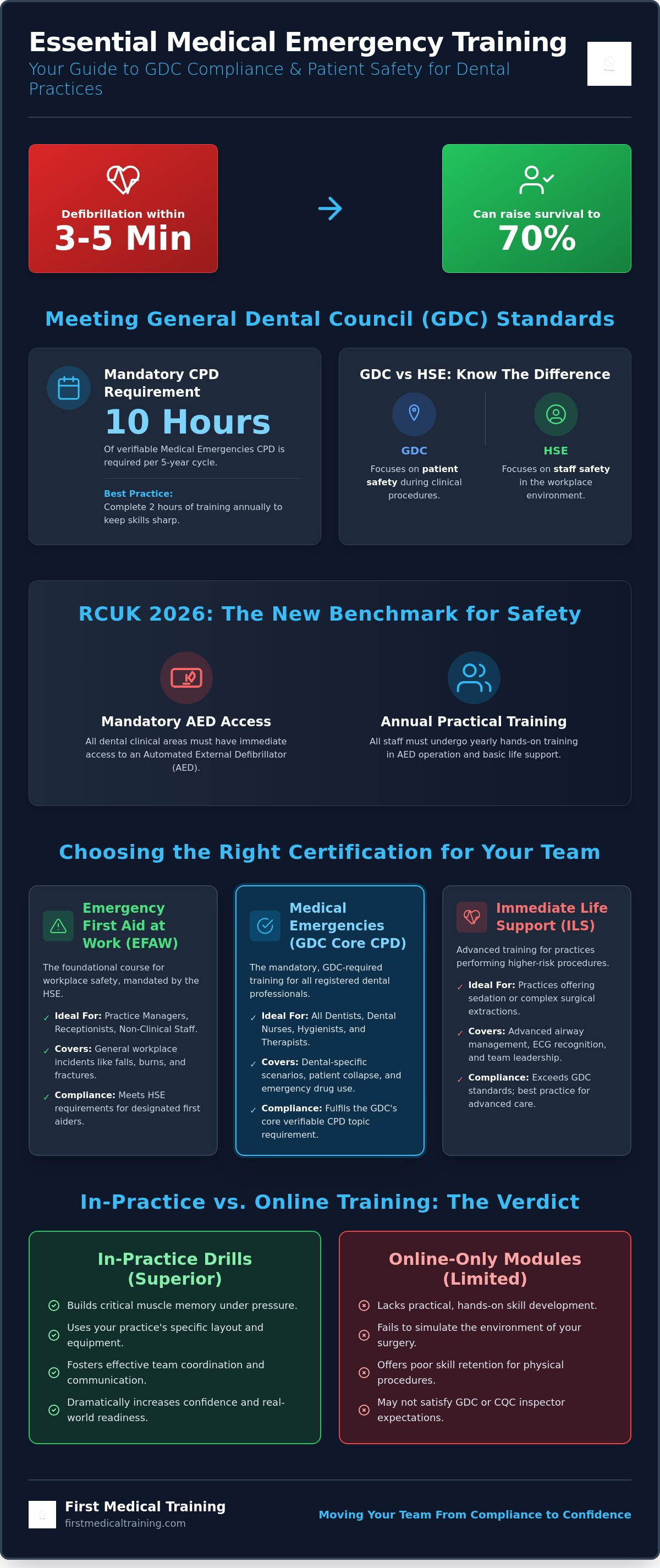
Did you know that defibrillation within three to five minutes of a collapse can produce survival rates as high as 70%? In a busy dental surgery, where fainting is common but cardiac arrest remains a critical threat, these seconds are the difference between a tragedy and a life saved. It's understandable if you feel a sense of dread when considering a real-life medical emergency or selecting the specific first aid certification dental professionals need to stay safe. Balancing the General Dental Council's core CPD requirements with the practical need for HSE-compliant first aid can feel like a bureaucratic maze, especially when you're organising training for an entire clinical team.
This guide simplifies that process, ensuring your practice meets every regulatory standard whilst building genuine clinical confidence. You'll find a comprehensive breakdown of the 2026 GDC requirements and a clear comparison of training options available for your staff. We'll also explore how to choose the right course format and equipment, moving your team from "tick-box" compliance to a state of total professional readiness.
Key Takeaways
- Master the 2026 GDC standards for medical emergencies CPD to ensure your team meets the mandatory 10-hour cycle requirement with confidence.
- Identify the most effective first aid certification dental professionals should hold by comparing the specific benefits of EFAW and ILS training.
- Understand why hands-on, in-practice drills are superior to online-only modules for managing a patient collapse within your own surgery environment.
- Define clear emergency roles for every staff member and learn how to integrate life-saving equipment like AEDs and anti-choking devices into your annual training.
Understanding GDC Requirements for First Aid and Medical Emergencies
The General Dental Council (GDC) is clear about its expectations for patient safety. Within their regulatory framework, Medical Emergencies is a "highly recommended" core CPD topic. This isn't a suggestion; it's a mandatory requirement that directly impacts your professional registration. Every registered professional must document at least 10 hours of verifiable CPD in medical emergencies within each five-year cycle. We recommend spreading this out as two hours of training every year to ensure your skills remain sharp and your knowledge stays current with evolving protocols.
Confusing Health and Safety Executive (HSE) workplace regulations with GDC clinical standards is a frequent pitfall for practice managers. While the HSE requires you to have a designated first aider for staff safety, the GDC requires you to be prepared for clinical crises involving patients. Annual training has become the gold standard because it fosters the muscle memory needed to act under pressure. With over 30,000 out-of-hospital cardiac arrests occurring in the UK every year, the ability to respond instantly is vital. Precision saves lives.
GDC Verifiable CPD vs General First Aid
Verifiable CPD requires more than just a signature on an attendance sheet. It demands a structured learning environment with clear outcomes and a certificate from a recognised provider. While a basic community course offers the first and immediate assistance needed for general injuries, it often fails to address the unique challenges of a dental surgery. An audit-ready first aid certification dental professionals can rely on must include specific dental scenarios, such as managing a collapse in a dental chair or using the practice's emergency drug kit. Without this context, your training may not satisfy a GDC or CQC inspector.
The Role of the Resuscitation Council UK (RCUK) Standards
The Resuscitation Council UK (RCUK) sets the clinical benchmarks that define modern emergency response. Their guidelines are the foundation of our curriculum, ensuring that your team's skills are based on the most recent medical evidence. For clinical staff, there's an increasing emphasis on Dental Immediate Life Support (ILS), which provides a more advanced level of training than standard CPR. This level of expertise ensures you're prepared for high-risk procedures and complex patient needs.
The 2026 RCUK standard stipulates that all dental clinical areas must have immediate access to an Automated External Defibrillator (AED) and that all staff must undergo annual practical training in its operation and basic life support.
Comparing Core Certifications: EFAW, ILS, and Medical Emergencies
Selecting the correct first aid certification dental professionals require involves more than just checking a regulatory box. It's about matching the level of training to the specific clinical risks present in your surgery. While every staff member needs basic life support skills, the depth of training varies between administrative staff and clinical practitioners performing invasive procedures. Choosing the wrong course can leave gaps in your practice's safety net or lead to non-compliance during a CQC inspection.
In 2026, the industry standard has shifted towards integrated training that combines theoretical knowledge with practical, hands-on drills. Every certification, whether it's a foundation course or advanced life support, must now include Automated External Defibrillator (AED) training. This ensures that if a patient collapses, your team isn't just waiting for an ambulance; they're actively managing the situation with the best tools available.
Emergency First Aid at Work (EFAW) for Dental Practices
The Health and Safety Executive (HSE) mandates that any workplace with five or more employees must have at least one person trained in Emergency First Aid at Work. In a dental setting, this role often falls to the practice manager or lead receptionist. Unlike clinical-only modules, the EFAW 1 Day Course covers general workplace incidents that occur outside the surgery chair. This includes managing fractures, severe burns, or accidental injuries amongst the team. It provides a broad safety net for the entire building, ensuring that non-clinical emergencies are handled with the same precision as medical ones.
Dental ILS: When Basic Life Support Isn’t Enough
For practices offering conscious sedation or complex surgical extractions, standard basic life support is insufficient. Immediate Life Support (ILS) is the preferred standard for private and high-risk clinics because it bridges the gap between basic CPR and advanced medical intervention. This training focuses heavily on airway management using adjuncts and the correct administration of emergency drugs from your practice kit. According to the Resuscitation Council UK standards, clinical staff must be proficient in these advanced techniques to manage a deteriorating patient effectively. If your practice handles high-risk cases, ensuring your clinicians hold a current ILS certificate is a vital part of your risk management strategy.
For a team-wide approach that covers all GDC requirements in a single session, our Medical Emergencies in a Dental Practice Course offers a streamlined way to get the whole surgery up to speed.
Online vs In-Practice Training: Which Delivery Method Wins?
Choosing how to deliver the first aid certification dental professionals need often comes down to a choice between the convenience of a screen and the reality of a surgery floor. While e-learning modules offer a quick way to tick a compliance box, they often lead to a "compliance trap". In a real patient collapse, theoretical knowledge doesn't automatically translate into physical action. You can't learn the exact pressure required for chest compressions or the tactile feel of an airway adjunct through a laptop speaker. Precision matters in a crisis.
In-practice training provides a significant psychological advantage. It allows your team to rehearse life-saving protocols in the very environment where they'll be used. We've seen that teams who train together in their own surgeries show much lower anxiety levels during actual emergencies. They aren't just learning first aid; they're learning how to navigate their specific workspace, where the AED is kept, and how to move around a dental chair in a crisis. This familiarity is a vital component of a successful response.
The Limitations of E-Learning in Clinical Settings
Passive learning is a genuine risk with online-only courses. Without an instructor to physically assess a student's technique, it's impossible to guarantee that skills like CPR or choking protocols are being performed correctly. Many practitioners worry that in-house training is too disruptive to the daily diary. However, the cost of a three-hour closure is far lower than the professional and emotional price of being unprepared. When you weigh individual e-learning fees against group in-house rates, the value of a single, focused session for the whole team usually wins on both a financial and educational level.
Maximising Value with In-House Medical Emergency Courses
Customisation is the key to effective training. An in-house session allows us to integrate your specific practice protocols and equipment into the drills. For example, practicing the recovery position is entirely different when you're managing a patient in a narrow dental surgery compared to an open classroom. This practical application is supported by the British Dental Association's guidance for dental practices, which emphasises the importance of clear team roles and regular risk assessments.
By training as a unit, you build a culture of safety. Every member, from the lead dentist to the trainee nurse, knows exactly where to stand and what to do. This coordinated response is what ultimately saves lives and ensures your practice remains a trusted environment for every patient who walks through the door.
A Role-Based Selection Guide for Your Dental Team
Efficiency in an emergency doesn't happen by accident; it's the result of clear roles and targeted training. When selecting the first aid certification dental professionals require, a "one size fits all" approach often overlooks the specific duties of different team members. A dentist leads the clinical response, but they can't do that effectively if the receptionist isn't trained to clear the waiting room or the nurse isn't proficient in airway management. Precision saves lives. Dividing your training strategy by role ensures that every individual knows exactly where they fit into the practice's emergency protocol.
Clinical Staff: Dentists, Nurses, and Hygienists
Clinical practitioners are the primary responders in the surgery. For these roles, the focus must remain on the "Big 6" medical emergencies: fainting, asthma, anaphylaxis, cardiac problems, epilepsy, and hypoglycaemia. Dentists and dental therapists carry a heavy professional responsibility to manage these crises until paramedics arrive. This requires a deep understanding of the practice's emergency drug kit and advanced life support techniques. Confidence is built through practice.
Dental nurses and hygienists also have mandatory requirements. They must be able to assist the dentist seamlessly, preparing equipment and monitoring vital signs under pressure. For all clinical staff, maintaining annual verifiable CPD is non-negotiable to stay compliant with current standards. You can find a detailed breakdown of these obligations in our GDC CPD Requirements for Medical Emergencies: The 2026 Compliance Guide. This ensures that everyone in the treatment room remains audit-ready and clinically sharp.
Non-Clinical Staff: The First Line of Defence
Receptionists and administrative staff are often the first to spot a deteriorating patient in the waiting room. They are your first line of defence. Whilst they may not be administering adrenaline, they must be trained in basic life support and AED operation. They also play a vital role in communication, such as liaising with emergency services and managing other patients during a crisis. Their calm response sets the tone for the entire practice.
Many forward-thinking practices now include mental health awareness in their front-of-house training to help staff manage anxious patients or colleagues under stress. Organising a whole-team training day is the most efficient way to ensure these roles interlock perfectly. It builds a shared language of safety that protects your patients and your professional reputation. Teamwork is the foundation of patient safety.
Ready to align your whole team with expert instruction? Book your practice-wide first aid training to ensure total compliance and clinical readiness.
Future-Proofing Your Practice: Equipment and Advanced Training
Staying ahead of regulatory curves requires a proactive approach to both skills and hardware. In 2026, the first aid certification dental professionals choose must reflect the technological advancements found in a modern surgery. It's no longer sufficient to simply own a defibrillator; your entire team must be proficient in its use, regardless of their clinical grade. Integrating Automated External Defibrillator (AED) training into your annual certification ensures that when seconds count, no one is hesitant to deploy this life-saving technology. Precision in equipment operation is just as vital as the clinical knowledge behind it.
Beyond traditional resuscitation, mental health first aid has emerged as a vital component of team wellbeing and patient care. Recognising the signs of acute stress or panic amongst colleagues and patients is the next frontier for dental leadership. A truly future-proofed practice treats psychological safety with the same gravity as physical emergency response, creating a resilient workplace culture that can handle any crisis with steady reliability. This holistic approach ensures your team is prepared for the human element of care, not just the clinical protocols.
Supporting the physical health of your staff is another pillar of a resilient practice. For professionals based in Dorset, seeking expert care from Fit & Healthy Chiropractic can help manage the physical strain often associated with long hours in the surgery.
Essential Life-Saving Equipment for 2026
Compliance is tied to the specific equipment you keep on-site. It's essential that your training is tailored to the exact AED model in your surgery, as subtle differences in operation can cause delays during a high-pressure event. We are also seeing a significant rise in the adoption of the LifeVac anti-choking device within UK dental surgeries. Whilst traditional suction is standard, the LifeVac provides a non-invasive solution for airway obstructions that may not respond to standard protocols. For a deeper look at how these tools integrate into your legal obligations, read our Medical Emergencies in a Dental Practice Course: The Definitive Guide.
Why First Medical Training is the Professional Choice
With over 20 years of experience specialising in dental-specific emergency education, we understand the practical realities of your field. We act as a bridge between rigorous GDC requirements and real-world application. Our unique advantage lies in being both a trusted supplier of emergency equipment and a premier provider of first aid courses. This dual expertise ensures that your training is always aligned with the latest hardware and clinical standards. We don't just teach the theory; we provide the tools and the confidence to use them.
When choosing a provider in 2026, use this final checklist to ensure they meet the professional standard:
- Do they provide GDC-verifiable CPD hours for all staff roles?
- Is the training conducted in-practice using your own emergency kit?
- Is the curriculum based on the latest Resuscitation Council UK standards?
- Do they have a proven track record of delivering national sessions to dental teams?
Securing the future of your practice starts with a single, organised step. You can book a national in-practice session for your entire team today, ensuring you remain compliant, confident, and ready for any emergency that arises.
Securing Your Practice's Clinical Readiness
Navigating the complex landscape of GDC compliance and patient safety requires a methodical approach. You've seen that the right first aid certification dental professionals choose is one that balances rigorous standards with the practical realities of a working surgery. By moving beyond "tick-box" exercises and embracing role-specific, in-practice drills, you ensure your team is prepared for any eventuality, from a minor faint to a critical cardiac arrest. Precision in training leads to precision in care.
First Medical Training has been a trusted partner in professional development since 2006. With 20 years of dental expertise, we are accredited providers of Dental ILS and EFAW courses, and specialist suppliers of life-saving equipment like the LifeVac anti-choking device. We bridge the gap between regulatory requirements and real-world application, giving your team the confidence to act when it matters most. Our structured, supportive approach demystifies complex protocols, making them accessible to every staff member.
Don't leave your practice's readiness to chance. Book Your In-Practice Medical Emergencies Course Today and join the thousands of dental professionals who trust us to keep their surgeries safe and compliant. We're ready to help your team become a capable, coordinated response unit.
Frequently Asked Questions
What is the GDC recommended annual training for medical emergencies?
The GDC expects all registered dental professionals to complete at least ten hours of verifiable CPD in medical emergencies per five-year cycle. We recommend conducting at least two hours of this training annually to stay compliant and keep skills sharp. This core CPD topic must cover cardiopulmonary resuscitation (CPR), basic life support (BLS), and the use of an automated external defibrillator (AED) to meet national standards.
Do dental receptionists need first aid certification?
Yes, receptionists should hold a valid first aid certification to act as a reliable first line of defence in the waiting room. Whilst they aren't clinical staff, they are often the first to identify a deteriorating patient or a visitor in distress. Training your administrative team in basic life support and AED operation ensures a coordinated, practice-wide response that protects everyone on the premises.
Is online first aid training valid for GDC verifiable CPD?
Online training can count towards verifiable CPD hours, but it shouldn't be the only method you use for life-saving skills. The GDC and Resuscitation Council UK emphasise the importance of practical, hands-on assessment for physical procedures like chest compressions. We suggest a blended approach where theory is covered online, but the essential first aid certification dental professionals need is finalised with an in-person, instructor-led session.
How often should a dental team practice medical emergency drills?
You should ideally conduct medical emergency drills every three months to ensure protocols remain fresh in everyone's mind. Whilst formal certification is an annual requirement, these quarterly rehearsals help your team maintain the muscle memory needed for a high-pressure collapse. Practicing in your own surgery layout allows staff to locate emergency drugs and equipment instantly, reducing response times when it truly matters.
What emergency drugs must be present during first aid training?
Your practice must have a fully stocked emergency drugs kit, including adrenaline, aspirin, glucagon, glucose, glyceryl trinitrate spray, midazolam, medical oxygen, and salbutamol. During our training sessions, we review these specific medications to ensure all staff understand their indications and dosages. It's vital that every team member knows where the kit is stored and how to prepare the contents for the clinician's use.
Can one person in the practice be the designated first aider?
HSE regulations require at least one designated first aider for small teams, but GDC standards imply that all registered professionals must be capable of responding to an emergency. Relying on a single person creates a dangerous bottleneck if that individual is unavailable or occupied with a patient. A whole-team approach to first aid certification dental professionals is the only way to guarantee a safe clinical environment.
What is the difference between BLS and ILS for dental professionals?
Basic Life Support (BLS) covers the essentials of CPR and AED use, whereas Immediate Life Support (ILS) includes advanced techniques like airway adjuncts and emergency drug administration. ILS is the preferred standard for clinicians performing conscious sedation or complex surgical procedures. It provides a more advanced framework for stabilising a patient during the critical minutes before an ambulance arrives at the practice.
Does first aid certification for dental staff include AED training?
Yes, every modern first aid course for dental teams must include practical training on an automated external defibrillator. The Resuscitation Council UK guidelines are clear that all clinical dental areas must have immediate access to an AED. Annual training ensures that all staff members, including non-clinical personnel, feel confident and competent when deploying the device during a suspected cardiac arrest.