

First aid for remote workers and home offices

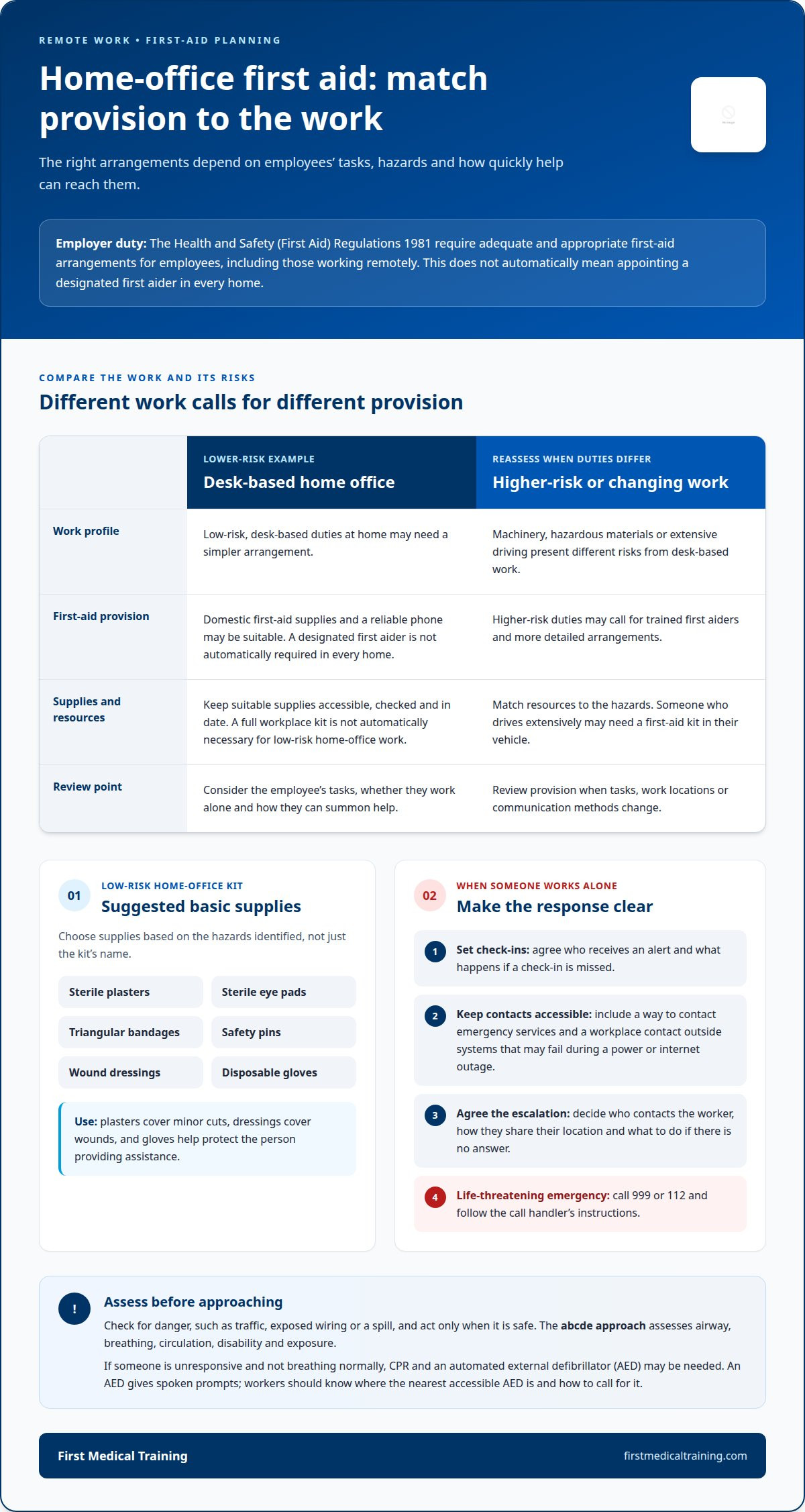
A home office doesn’t remove an employer’s first-aid responsibility. Under the Health and Safety (First Aid) Regulations 1981, employers must provide adequate and appropriate first-aid arrangements for all employees, according to UK legislation. For low-risk, desk-based work at home, simple domestic first-aid supplies and a reliable phone for emergency services may be more suitable than appointing a designated first aider.
That distinction matters: remote work can reduce everyday workplace hazards, but working alone may delay access to help. First aid for remote workers should reflect their tasks and risks, as well as isolation, communication and wellbeing.
This article explains how to assess first-aider needs, prepare a suitable home-office first-aid kit and reduce common risks. It also covers check-ins, emergency communication and mental health support, helping you make arrangements that fit how your team works.
Key Takeaways
- Match first-aid arrangements to the work, its risks and whether employees work alone, rather than assuming every home worker needs a designated first aider.
- Assess hazards in the home-office set-up and keep suitable first-aid supplies accessible, with contents checked and in date.
- Plan how remote employees can raise the alarm and receive support if they become unwell or are injured while alone.
- Use regular communication and practical wellbeing measures to help reduce isolation and spot when someone may need support.
- Choose training that fits the work and the emergencies employees may realistically face.
Do remote workers need first aiders?
Not every home worker needs a designated first aider, but employers must assess their first-aid arrangements. The right provision depends on the work, its hazards and how quickly help can reach someone.
UK employers have a legal duty to provide adequate and appropriate first aid arrangements for all employees under the Health and Safety (First Aid) Regulations 1981, according to UK legislation. This duty applies when employees work remotely. It does not automatically mean appointing a first aider in every home. For low-risk, desk-based work, domestic first-aid supplies and a working phone may be suitable.
Start with a first-aid needs assessment. Record employees’ tasks, whether they work alone and how they can summon help. Someone using office equipment at home faces different risks from a person operating machinery, handling hazardous materials or driving extensively. Higher-risk duties may call for trained first aiders and more detailed arrangements.
A lone worker cannot serve as their own designated first aider. Plan how someone else will respond if they become ill or injured without colleagues nearby. Specify who receives an alert, how they will contact the worker and what to do if there is no answer. Regular check-ins can help identify when someone needs assistance.
At an emergency scene, check for danger before approaching. Look for hazards such as traffic, exposed wiring or a spill, and act only when it is safe. Use the ABCDE approach to assess airway, breathing, circulation, disability and exposure. If the person can respond, ask what happened and where they feel pain. A follow-up check may reveal injuries that were not immediately apparent.
Workers are more confident when they know what to do before an emergency. Practise describing a location, summoning help and explaining what has happened. Discuss scenarios such as a colleague fainting during a video call or reporting chest pain by phone. Clear roles reduce hesitation, especially when no one else is nearby to take over.
CPR, AED Use and Life-Threatening Emergencies
For a life-threatening emergency, call 999 or 112 and follow the call handler’s instructions. If someone is unresponsive and not breathing normally, CPR and an automated external defibrillator (AED) may be needed. An AED gives spoken prompts to guide its use. Check that workers know where the nearest accessible AED is, how to call for it and who can meet emergency services.
Training lets people practise these actions instead of relying on memory alone. Cover how to recognise an emergency, raise the alarm and take appropriate action within the scope of their training. Make the plan practical for someone working alone at home, rather than assuming a colleague is close by.
Emergency Contacts and Incident Procedures
Give every remote worker a straightforward procedure for contacting emergency services and their workplace contact. Explain how to share their location, describe the incident and report immediate hazards. Keep emergency contact details accessible, not only in a work system that may be unavailable during a power or internet failure.
Set a clear check-in process for lone workers, including what happens when a check-in is missed. Record incidents and near misses, then review whether the response worked. For instance, if a worker reports feeling unwell and then stops replying, the agreed escalation steps should start without uncertainty about who acts next.
First Aid Kits and Emergency Resources
Keep suitable first-aid supplies accessible and check that they remain adequate and in date. For low-risk home-office work, ordinary domestic supplies may be enough; a full workplace kit is not automatically necessary. Workers should also know how to contact emergency services and find relevant local medical facilities.
Match resources to the hazards identified. Someone who drives extensively may need a first-aid kit in their vehicle, while a desk-based employee may need only basic supplies and a reliable phone. Review the arrangements when tasks, work locations or communication methods change.
First aid risks in home and remote work settings
At home, the boundary between a work-related incident and an ordinary domestic accident can be less clear. An injury while carrying out assigned work at a home workstation has a different context from an incident during a personal break. Explain how to describe what they were doing when an incident occurred so the employer can assess its connection to work.
Consider more than the desk when reviewing work-related hazards. Employees may move equipment between rooms, take work calls while doing household tasks or use a separate space for occasional duties. Ask what tasks they do and where they do them. Understanding the set-up helps distinguish a one-off domestic hazard from a risk linked to work arrangements.
For a low-risk home office, suggested first-aid kit contents include sterile plasters, sterile eye pads, triangular bandages, safety pins, wound dressings and disposable gloves. Each item serves a practical purpose: plasters cover minor cuts, dressings cover wounds, and gloves help protect the person providing assistance. Choose supplies based on the hazards identified, not just the kit’s name.
A full BS 8599-1 workplace first-aid kit is not usually required for a UK home office. The standard refers to workplace kits, but a home office used for low-risk, desk-based duties has different requirements from a shared or higher-risk site. Where an employee’s tasks change, reconsider whether the home-office provision still fits those duties.
Accident reports should capture the work context as well as the injury. If an employee cuts a finger while preparing equipment for a work task, they should explain what they were doing and whether the equipment contributed. Reporting a faulty item can help prevent the same problem affecting someone else. Explain how to report incidents internally and who reviews them for follow-up.
Use incident reports to identify issues that need attention, rather than treating every event in isolation. Repeated reports involving the same equipment, for example, may point to a maintenance or replacement issue. Near misses can also reveal hazards before anyone is injured. Give employees a clear route for reporting these events, even when no treatment was needed.
When reviewing first-aid arrangements for a home worker, consider:
- Whether their work is desk-based or includes tasks with different hazards.
- Whether a reported event happened during assigned work or a personal activity.
- Whether equipment or work methods contributed to an injury or near miss.
- Whether incident reports call for a change to the work set-up or procedures.
Keep the reporting process straightforward. Explain what details employees should share, who receives the report and how the employer follows up. Practical first aid courses can also help staff understand how to respond to incidents and communicate what happened.
Mental health, isolation and wellbeing
Remote work can reduce everyday contact with colleagues, making it harder to notice when someone is struggling. A worker who stops joining team discussions, misses regular check-ins or seems unusually withdrawn may benefit from a supportive conversation. These changes do not establish a mental health condition, but they are a reason for managers to check in privately and ask how work is going.
Build regular contact into the working week. A brief one-to-one meeting gives employees space to raise concerns they may not mention in a group call. Ask specific, open questions such as, “Are your workload and deadlines manageable?” or “Have you been able to take breaks?” Listen without interrupting, agree on a practical next step and set a follow-up date.
Address isolation through purposeful team connection, not constant monitoring. Offer regular meetings with a clear purpose, optional informal conversations and accessible ways to ask for help. For example, a new starter working from home could have a named colleague for work questions and a scheduled discussion with their manager. Make participation inclusive for employees who cannot join every live call.
Protect the boundary between work and personal time. Agree on expected working hours, encourage proper breaks and avoid treating an immediate reply as proof of commitment. Someone who regularly stays online late may have an excessive workload or unclear priorities. Review tasks and deadlines with them, then record any changes so expectations stay consistent.
Give employees a clear route to support before concerns become urgent. Explain whom they can approach, how confidential conversations are handled and what happens if they need further help. Managers should not try to diagnose or provide clinical treatment. They can listen, take concerns seriously, discuss suitable workplace adjustments and direct employees to appropriate professional support.
Use a simple response when someone shares a wellbeing concern:
- Choose a private setting and give the employee time to explain.
- Acknowledge what they have said without judgement or quick assumptions.
- Ask what practical change or support would help at work.
- Agree who will act next and when you will review the situation.
Training can help managers and colleagues recognise distress, listen safely and understand the limits of their role. Mental health first-aid training should complement a wider workplace approach, not replace professional care or ordinary management responsibilities. Practise realistic conversations, such as responding when a colleague says deadlines feel overwhelming or they feel disconnected from the team.
Keep wellbeing discussions respectful and proportionate. Share personal information only with those who need it to provide agreed support, and explain any limits to confidentiality before a conversation becomes sensitive. Record practical workplace actions, such as revised priorities or more frequent check-ins, without turning routine notes into an unsupported medical assessment.
Review your approach when team arrangements change. A new manager, changed workload or move from office-based to fully remote work can affect how people connect and seek help. Ask employees which contact methods work for them, then adjust meeting patterns and support routes. Regular follow-up makes wellbeing part of everyday team practice, rather than something addressed only in a crisis.
Remote working
Hybrid work changes where employees do their jobs, so first-aid arrangements should reflect the locations they use. Review and document the needs assessment when work patterns or team composition change. For example, if a team starts using a shared workspace, review its arrangements alongside existing home and office provision. Keep the record current so managers can see which locations and groups it covers.
Display screen equipment (DSE) is an important part of home-working safety. Employers should provide remote workers with training and equipment to address DSE hazards. Explain how to position screens and input devices, adjust the workstation and report discomfort. A laptop at a kitchen table, for example, may create a different set-up from a dedicated desk with separate equipment. Tailor guidance to the equipment employees actually use.
Make DSE support practical, rather than treating it as a one-off instruction. Ask employees to describe their workstation and identify equipment that makes comfortable working difficult. Provide relevant guidance and equipment to address hazards, then review the set-up if they change location or equipment. Record the action taken so follow-up does not depend on memory.
Co-working spaces need clear agreements between occupiers. Self-employed people working in a UK co-working space are responsible for their own first-aid provision, but can make joint arrangements with other occupiers. Where employers share premises, it is helpful to agree clearly who will provide first aid for workers on site. Put the responsibility in writing and make sure each occupier understands what it covers.
Do not assume a shared workspace has settled every occupier’s arrangements. Review the written agreement when organisations join or leave, or when the space changes how it is used. A new occupier, for example, may bring different activities and hazards. Record who is covered by the shared provision and how each organisation’s responsibilities fit alongside it.
Pregnancy is another reason to review an employee’s work arrangements individually. UK employers should assess risks for pregnant employees and may need to adjust working conditions. Discuss the employee’s duties and work environment, then consider whether tasks or the set-up should change. Record agreed adjustments and review them if duties or circumstances change.
Use a location-based review to keep hybrid arrangements aligned:
- List the places where employees regularly work, including shared premises.
- Update the documented assessment when team membership or work patterns change.
- Review DSE training and equipment against employees’ actual workstation set-ups.
- Record shared-space responsibilities and any agreed individual adjustments.
Remote-working arrangements are more reliable when records reflect day-to-day practice. A documented review helps managers identify which provisions apply at home, in a shared workspace or at the employer’s premises, and what needs updating as arrangements evolve.
First Medical Training Ltd: Medical Emergencies in a Dental Practice Course
First Medical Training Ltd offers the Medical Emergencies in a Dental Practice Course for dental teams preparing to respond to emergencies in clinical settings. It is designed for staff who need to practise recognising and managing medical emergencies as part of their dental role. First aid for remote workers requires a separate assessment of their tasks and risks; dental emergency training does not replace that process.
For general workplace first-aid needs, the Emergency First Aid at Work Course (EFAW) - 1 Day may be a closer fit. Dental Immediate Life Support (ILS) Training and the Automated External Defibrillator (AED) Training Course address other role-specific needs. Select training based on employees’ responsibilities and the emergencies they may encounter, including when planning first aid for remote workers.
Make your next step a practical one
Turn your arrangements into a routine the team can follow. Set a date to review responsibilities and practise how employees raise an alarm. Use the discussion to identify gaps between written procedures and the realities of home or hybrid work.
For first aid for remote workers, match preparation to the risks and responsibilities identified in your assessment. Consider the skills employees need to respond appropriately in their specific roles, then plan training around those needs.
Contact First Medical Training Ltd today to discuss training for your team. Clear preparation helps people respond with purpose when an emergency happens.
Frequently Asked Questions
What first aid training do UK employers need to provide for remote workers?
Training should match the hazards and first-aid needs identified for each role. A desk-based employee working from home may need clear emergency instructions, while someone who drives extensively or works with machinery may need more formal training. Consider whether employees work alone and how quickly assistance could reach them. Explain how to report an incident, contact emergency services and follow the agreed response procedure.
Do UK first aid at work regulations apply to employees working from home?
Yes. The Health and Safety (First Aid) Regulations 1981 apply to employees working remotely, and UK employers must make adequate and appropriate first-aid arrangements for all employees, according to UK legislation. The required arrangements depend on the work and its risks. This does not automatically mean appointing a first aider for every home office. Employers should include remote duties in their assessment and decide what provision is suitable.
How should employers assess first aid needs for remote and lone workers?
Assess employees’ tasks, work locations, hazards, communication options and access to emergency help. Include health risks that may affect their arrangements, and consider whether they work without close or direct supervision. For example, compare a home-based administrator with someone travelling between isolated sites. Record decisions on raising an alarm, who responds and what happens if a lone worker misses an agreed check-in.
What first aid kit should a UK remote worker keep at home?
For low-risk home-office work, ordinary domestic first-aid supplies may be sufficient. HSE guidelines suggest sterile plasters, sterile eye pads, triangular bandages, safety pins, wound dressings and disposable gloves for a low-risk kit. Keep supplies accessible, replace used items and check expiry dates. If a role involves additional hazards, use the employer’s assessment to decide whether other equipment or arrangements are needed.
Who should remote workers contact in a medical emergency in the UK?
Call 999 or 112 for an emergency. Give the call handler the full address, including any access details that could help responders find the property, then describe what has happened and follow their instructions. If you are supporting a colleague, tell them to call while you stay in contact, where possible. Notify the agreed workplace contact once emergency services have been called, without delaying urgent assistance.
What should a remote worker do if a colleague has a medical emergency during a video call?
Ask the colleague for their exact location and whether they can respond. If the situation appears urgent, tell them to call 999 or 112, or arrange the call if they cannot. Keep the video or phone connection open if practical, and alert the workplace contact using the agreed procedure. Don’t attempt to assess or treat beyond your training. Share clear observations with the emergency call handler.
How can employers arrange first aid cover for remote and hybrid teams?
Start by mapping where employees work and when they attend shared premises. Specify who is responsible for first aid at each location, how staff raise an alarm and how lone workers receive follow-up. In co-working spaces, self-employed occupiers can make joint arrangements, while a written agreement usually assigns one employer responsibility for first aid on the premises. Review the plan when roles or working patterns change.
What are the risks of providing first aid while working alone at home?
A lone worker may have no nearby colleague to summon help, manage another task or take over if the situation changes. The scene may also contain hazards, such as an electrical fault or spill. Check for danger before approaching and act only when it is safe. If the person needs urgent care, contact emergency services and follow the call handler’s directions rather than taking unnecessary risks.