

First aid needs assessment for office risks and provision

An office may seem low-risk, but it still needs first-aid cover that works across shifts and absences. A first aid needs assessment for an office environment should consider the work, hazards, number of people on site, working patterns, and where staff and visitors are located. It also helps determine who should respond and what equipment should be available.
It’s understandable to start with the number of people who work in the office. Headcount matters, but it is only one factor. The layout, incident history, lone or mobile workers, and times when first-aiders are unavailable can all affect whether arrangements are adequate.
This guide explains how to assess office risks, plan cover across shifts and absences, and choose suitable first-aid equipment. You’ll also learn when to review arrangements and how to make sure staff know where to find help and supplies. Use the findings of a first aid needs assessment for an office environment to make practical decisions about provision and help people receive prompt assistance at work.
Key Takeaways
- Base first-aid provision on workplace hazards, staffing patterns, site layout and accident history, not headcount alone.
- Plan trained cover for every shift and account for annual leave and other absences.
- Consider staff, visitors and contractors, as well as lone or mobile workers, when assessing who may need help.
- Match first-aid equipment to the risks, keep it accessible and replenish supplies promptly after use.
- Review your arrangements when work or staffing changes, or when an incident highlights a gap.
Appointed persons and trained first-aiders
A workplace needs first-aid arrangements matched to its risks, staffing and working patterns. The Health and Safety (First-Aid) Regulations 1981 are relevant UK workplace legislation, according to the UK legislation register.
First-Aider Ratios by Hazard Level
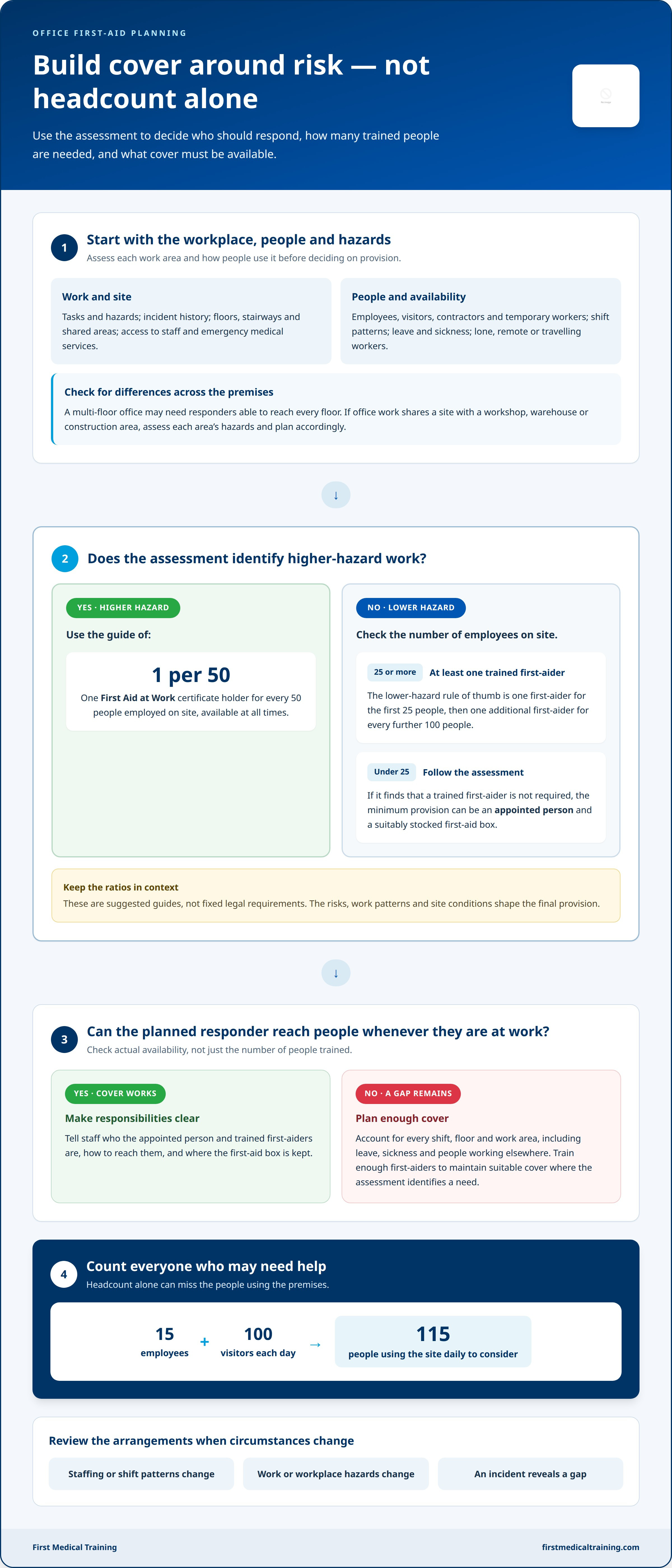
First-aider ratios are suggested numbers of trained responders based on workplace hazard levels and staffing. They help you estimate cover, but should not replace a risk assessment. For lower-hazard workplaces, the rule of thumb is one first aider for the first 25 people employed on site, then one additional first aider for every 100 people after that. For higher-hazard workplaces, the guide is one First Aid at Work certificate holder for every 50 people employed on site at all times.
Factors Affecting First-Aider Numbers
The number of first-aiders needed depends on the workforce, hazards, working patterns, workplace layout, and access to staff. One responder may not be reachable across different floors, shifts, or work areas. Include remote, travelling, and lone workers in the assessment, along with known accident history. For example, a multi-floor office may need arrangements that ensure a responder can reach every floor.
If the assessment finds that a trained first-aider is not required, an appointed person takes charge of first-aid arrangements. This role is different from providing trained first-aid cover: the appointed person coordinates arrangements, while a trained first-aider provides care within their training. In a low-hazard workplace, the minimum provision can be an appointed person and a suitably stocked first-aid box.
Use the assessment to decide whether trained first-aiders are needed, and how many must be available. Workplaces with 25 or more employees should provide at least one trained first-aider, including low-hazard workplaces. For higher-risk work, consider whether First Aid at Work training is appropriate; Emergency First Aid at Work is a separate qualification. The suggested ratios are guidance, not fixed legal requirements, so hazards and work patterns shape the final provision.
Plan cover for every period when people are at work. One trained first-aider cannot reliably cover every shift if they are on leave, off sick, or working elsewhere. In a multi-floor office, identify who can respond on each floor and make responsibilities clear to staff and managers. If the assessment identifies a need for first-aiders, train enough people to maintain suitable cover.
Connect people, responsibilities, and equipment in the workplace plan. The appointed person should know where the first-aid box is kept and how staff can access it. Staff should know who the appointed person and trained first-aiders are, and how to reach them during work. Review arrangements when staffing, hazards, or work patterns change, so planned cover continues to match actual conditions.
Assessing workplace, workforce and hazard-related first-aid needs
Assess provision against the work, hazards, workforce, and site rather than relying on headcount alone. Inadequate arrangements can leave people without timely help and put an employer’s workplace first-aid responsibilities at risk. The assessment should identify and address any gaps.
Assessing Workplace Hazards and Risks
A workplace risk assessment identifies hazards, considers how they could cause harm, and informs suitable first-aid provision. Start with the tasks people perform, then consider the likelihood and seriousness of accidents or injuries. Include incident history, work patterns, site layout, and access to emergency medical services. This helps distinguish office needs from those of construction work, where activities create different hazards.
Assessing Risks in Offices
An office assessment considers the activities and conditions that could lead to injury or illness. Review shared areas, stairways, kitchens, equipment, lone-working arrangements and any tasks outside routine desk work. Also account for staff with known health needs, young workers, trainees and pregnant workers. For example, an office employing 40 people may have different risks from a warehouse with the same workforce, so identical headcounts do not establish identical provision.
Workplace Hazard and Risk Levels
Risk levels depend on the type of work, the hazards present, and their potential consequences, not just the workplace label. A quiet office may be lower risk overall, but a site combining office work with a workshop or warehouse has different needs across its operations. Assess each area separately, then plan provision for its specific risks. This prevents a low-risk area from determining cover for higher-risk work elsewhere.
Workforce numbers still matter because more people on site can mean more people who may need assistance. Include non-employees in the picture: visitors, contractors, temporary workers and members of the public may also be present. A premises with 15 employees and 100 visitors each day should consider provision for 115 people using the site daily, rather than counting employees alone.
At a mixed-use site, map where each activity takes place and the hazards it creates. A reception area, office floor, and adjoining construction or maintenance zone may need different arrangements. For temporary works or short-term maintenance projects, securing appropriate safety gear through providers like coloradosafetysupply.com helps manage physical site hazards alongside first-aid planning. Share relevant hazard information between organisations on the same site, agree who provides cover, and make sure workers know how to summon assistance. Coordination matters when responsibilities or equipment are shared.
Use the findings to identify practical gaps, such as a recurring incident pattern, a work area far from assistance, or visitors unfamiliar with the building. Record the reasons for the arrangements, even though findings do not have to be written down. A clear record helps explain why provision suits the workplace and supports reviews when operations change.
Coverage for shift patterns and periods of absence
First-aid provision must remain adequate whenever people are at work, including during shifts and out-of-hours work. A rota showing trained cover during standard office hours is not enough if staff also work evenings, weekends, or staggered shifts. Map when each team is present, then identify who can respond during every working period.
Staff numbers change throughout the day, as can the people available to provide first aid. Include part-time members, temporary workers, and teams working remotely from the main office. For each shift, record the trained first-aider on duty, their work location, and a suitable alternative. This makes gaps visible before they affect workplace health and safety arrangements.
- Compare planned first-aider cover with each shift and work location.
- Mark annual leave, sickness and other expected periods of absence.
- Arrange alternative cover when a trained responder is unavailable.
Build absence cover into the plan instead of relying on one responsible colleague. If the only trained first-aider works a late shift, for example, daytime staff may have no trained cover. The assessment should establish how many trained people are needed across actual working patterns. It should also account for their availability, not just the number of certificates held by the workforce.
Keep a current record of cover arrangements, responsibilities, and relevant certificate dates. Certificates for suitable first-aid qualifications are valid for three years unless stated otherwise. UK HSE guidance recommends annual refresher training during the certificate period, although this refresher is not mandatory. Tracking training dates helps managers plan renewals and avoid relying on expired certificates.
Check cover whenever the rota or staffing changes. A new evening shift, extended opening hours, or a team moving to another floor can leave a responder too far away. Include planned leave and known training absences in rota reviews. For unexpected sickness, identify who is responsible for arranging replacement cover and how staff will be told about the change.
Make arrangements clear to all employees, including those who rarely work on site. Explain who is covering each shift, how to reach them, and where first-aid equipment is kept. If teams share premises, agree which organisation provides cover during overlapping hours. Review the record after a change or incident, then update the rota and staff communications to reflect current cover.
First-aid planning for offices and other workplaces
A workplace assessment turns hazards, staffing, and site conditions into practical first-aid arrangements. It helps an employer decide what provision is adequate for employees and others using the premises.
Purpose of a Workplace Assessment
A workplace first-aid needs assessment identifies the facilities, people and equipment needed for the risks present. Its purpose is to make arrangements suitable for the actual work, rather than relying on a standard plan. UK workplaces with fewer than five employees are still covered by the Health and Safety (First-Aid) Regulations 1981, according to the UK legislation register. Assess the needs of every workplace, whatever its size.
Map the building before deciding where help and supplies should be available. Note floors, entrances, work areas, and the distance between teams. In a multi-storey office, a first-aid box on the ground floor may not be readily accessible to someone working above. Consider whether staff can summon assistance promptly and whether visitors know where to go.
Workforce distribution matters as much as the total number of employees. Identify teams based at the office, people who work remotely, lone workers, and staff who travel between sites. Include visitors, contractors, and temporary workers in the arrangements. If several organisations share a site, agree who provides first-aid cover and how workers can contact that person.
Consider access to emergency medical services alongside the building layout. At a remote workplace, employees may need a clear way to summon help, such as access to a phone, and suitable transport arrangements. Make the location and access route clear to responders. Account for practical delays caused by distance, locked entrances, or an unfamiliar site layout.
Reviewing Plans After Workplace Changes
Reviewing an assessment means checking whether existing arrangements still match current hazards and working conditions. A significant workforce change, a new activity or piece of equipment, or an incident that reveals an overlooked risk can make an earlier plan unsuitable. Review the assessment at least annually and sooner when circumstances change. This keeps facilities and cover aligned with how the workplace operates.
Record the assessment’s findings and the reasons for the chosen arrangements, even though findings do not have to be written down. A record helps an employer explain decisions and identify actions after a change. If a department moves floors, for example, reconsider access to assistance, equipment locations, and staff distribution. Update staff communications so people know the current arrangements.
Monitor accidents and ill health, then use that information when reviewing provision. A repeated incident in one area may point to a hazard that needs attention, while a new working pattern may create a gap in cover. Include workers’ known health needs when planning suitable facilities. Clear, current arrangements help staff understand how to summon help and where to find assistance.
First-aid equipment and kit provision
First-aid equipment is useful only when it suits workplace risks, is accessible, and remains sufficiently stocked. Use the assessment findings to match supplies and locations to likely emergencies, rather than choosing a kit solely by office size.
Employers in Great Britain should provide at least one first-aid kit for each workplace. This is a starting point, not proof that provision is adequate and appropriate for every site. A large office, multiple floors, or separate work areas may need additional kits so staff can reach supplies promptly. Consider where people work, how they move around the building, and whether visitors can find equipment.
For kit contents, the Health and Safety Executive points to British Standard BS 8599. HSE’s suggested contents for a low-hazard workplace include 20 individually wrapped sterile plasters in assorted sizes and at least three pairs of disposable gloves. These examples can guide planning, but the assessment should also consider the hazards and likely injuries at your site.
An office with routine desk work may have different first-aid needs from a workplace that also includes a workshop or storage area. Identify the activities in each area and consider whether their hazards call for particular supplies. Where risks differ across a site, do not assume one standard kit will suit every work area. Choose equipment suited to the tasks people actually perform.
Make access part of the first-aid arrangements. Place kits where staff can reach them promptly, and tell employees where they are kept. A kit behind a locked door or in an area unfamiliar to visitors may be difficult to find during an emergency. In a multi-floor office, clear signs and staff awareness help people locate supplies across the building.
Set a routine for checking kit contents and replenishing supplies soon after use. A simple record of checks and replacements can help those responsible spot repeated shortages, while sourcing replenishment stock from medical distributors such as OmniMedSource ensures boxes remain fully provisioned. After an incident, check the kit promptly and replace used supplies; otherwise, the next response may begin with missing items. Keep the checking process clear enough for the appointed person or responsible staff member to follow.
Review equipment when the assessment changes, such as after introducing new work activities or moving teams. Reconsider both kit contents and locations when staff move floors or a workplace adds a separate operational area. For broader provision, explore emergency equipment suited to the needs identified in your assessment.
First Medical Training
First Medical Training Ltd offers first-aid and emergency-response courses covering workplace needs. Courses include Emergency First Aid at Work and the Automated External Defibrillator (AED) Training Course, alongside courses for dental teams. Their content includes practical training in first-aid skills and AED awareness.
Choose training that fits your team’s responsibilities and the risks identified in your assessment. To discuss suitable training for your workplace, contact First Medical Training Ltd.
Put your assessment into practice
A first aid needs assessment for an office environment is most valuable when it informs everyday decisions, not just a written record. Decide who will keep arrangements current and how staff can raise concerns about practical obstacles. Their feedback can help reveal issues that a document alone may not show.
Use the findings to choose your next priority, whether that means clarifying responsibilities, improving staff awareness, or developing emergency response skills. Focus on what your team needs to act confidently within its role.
Contact First Medical Training Ltd to discuss training for your team and agree which skills your assessment shows need attention.
Frequently Asked Questions
What is a first aid needs assessment and why do I need one?
It is a review of your workplace’s likely first-aid needs, used to shape suitable arrangements. It helps you decide what support people may need after an injury or sudden illness and whether existing provision has gaps. A new public-facing area, for example, may change who could need assistance. Keep a record of your reasoning so managers can understand how the arrangements were chosen.
How many first-aiders do I need?
The number depends on hazards, people on site, work patterns and layout. As a guide, a lower-hazard workplace should have one first-aider for the first 25 people employed on site, then one additional first-aider for every 100 people after that. For higher-hazard workplaces, the guide is one First Aid at Work certificate holder for every 50 people employed on site at all times. These are guidance figures, not fixed legal requirements.
Does every business need one?
Every UK employer should consider workplace first-aid needs, whatever the organisation’s size. Workplaces with fewer than five employees are still covered by the Health and Safety (First-Aid) Regulations 1981, according to the UK legislation register. The resulting arrangements depend on the assessment. A small office may need different provision from a business with machinery, public access or several work areas.
How often should it be reviewed?
Review the assessment at least annually and sooner if circumstances change. A new shift, an incident that exposes an overlooked hazard, or a move to different premises can make existing arrangements unsuitable. A team relocating to another floor, for example, may have different access to first-aid supplies. Update the record and staff information so both reflect the revised arrangements.
What is a workplace first aid needs assessment in the UK?
It is a practical evaluation of the first-aid arrangements appropriate to a particular workplace. It considers the work taking place, who uses the site, and how help can be reached. The assessment guides decisions about trained responders, appointed-person responsibilities, equipment, and facilities. It helps an employer establish how workplace arrangements will address foreseeable injuries or illness.
What does UK HSE guidance require employers to consider in a first aid needs assessment?
HSE guidance says employers should assess first-aid needs in relation to workplace hazards and risks. Consider work activities, workforce size, working patterns, and known accident history, alongside site layout and access to emergency medical services. Include relevant needs of workers with disabilities or particular health problems, and consider visitors and contractors. These factors help show whether existing arrangements suit the people and activities on site.
How do office size and number of employees affect first aid provision?
Employee numbers help estimate demand, but floor area and layout affect how quickly assistance can reach someone. A compact office and a multi-floor building with teams in separate areas may need different arrangements, even with similar staffing. Account for who is present at different times and where first-aid supplies are located. If members of the public visit, include their presence in planning.
How should an office assess risks from work activities, layout, and lone working?
List the activities performed in each area, then consider how they could lead to injury or illness. Map floors, shared spaces, and routes between teams, and identify where lone workers operate without nearby colleagues. For example, assess how a lone worker in a separate office would summon help and where responders could meet them. Use incident records to identify risks that routine observation may miss.