

GDC CPD for Dental Professionals: 2026 Compliance Guide

Missing a single annual CPD statement doesn't just invite a letter from the GDC; it risks your entire professional registration and your right to practise in the UK. We understand why many dental teams feel a sense of dread as the July 31st deadline approaches. Between managing complex patient cases and navigating the nuances of "verifiable" versus "general" hours, staying on top of gdc cpd requirements for dental professionals often feels like an exhausting administrative burden.
You deserve to feel confident that your training isn't just ticking a box, but is actually preparing your team for real-world clinical crises. This guide will demystify the Enhanced CPD (ECPD) framework for the 2026 cycle, helping you master your five-year cycle with ease. We'll break down the specific hour requirements for every team role, clarify the strict "10 in 2" rule, and provide a clear roadmap for meeting the essential 10-hour medical emergency recommendation. By the end of this article, you'll have a structured plan to ensure every member of your practice remains compliant, capable, and ready to act.
Key Takeaways
- Understand why the General Dental Council prioritises the quality of your learning over simply counting hours through the Enhanced CPD framework.
- Identify the specific gdc cpd requirements for dental professionals based on your role, including the critical 10 in 2 rule for maintaining registration.
- Master the Highly Recommended medical emergency topics by completing at least 10 hours per cycle with annual refresher training.
- Learn how to write effective reflective statements that satisfy GDC standards and demonstrate genuine clinical growth.
- Discover how in-practice group training can streamline compliance for your entire team whilst focusing on your surgery's specific equipment.
Understanding the GDC Enhanced CPD (ECPD) Framework
The General Dental Council transitioned all registrants to the Enhanced CPD (ECPD) framework to ensure that professional development remains relevant, rigorous, and patient-focused. This scheme represents a fundamental shift for the UK dental workforce. It moves away from the old system of passive hour-counting toward a model of active, reflective learning. By 2026, the GDC expects every dental professional to demonstrate how their training directly improves patient outcomes and maintains high clinical standards. Compliance isn't just about meeting a quota; it is about proving your ongoing fitness to practise.
The core philosophy of ECPD centres on the "quality of learning." Instead of a last-minute scramble to log hours at the end of a cycle, you must now maintain a Personal Development Plan (PDP). This document acts as a roadmap for your professional growth. You are required to identify your specific learning needs based on your daily role and the needs of your patients. This structured approach ensures that gdc cpd requirements for dental professionals are met with clear intention. It ensures that when a crisis occurs in your surgery, your team has the genuine clinical readiness to respond rather than just a certificate on the wall.
The Four GDC Development Outcomes
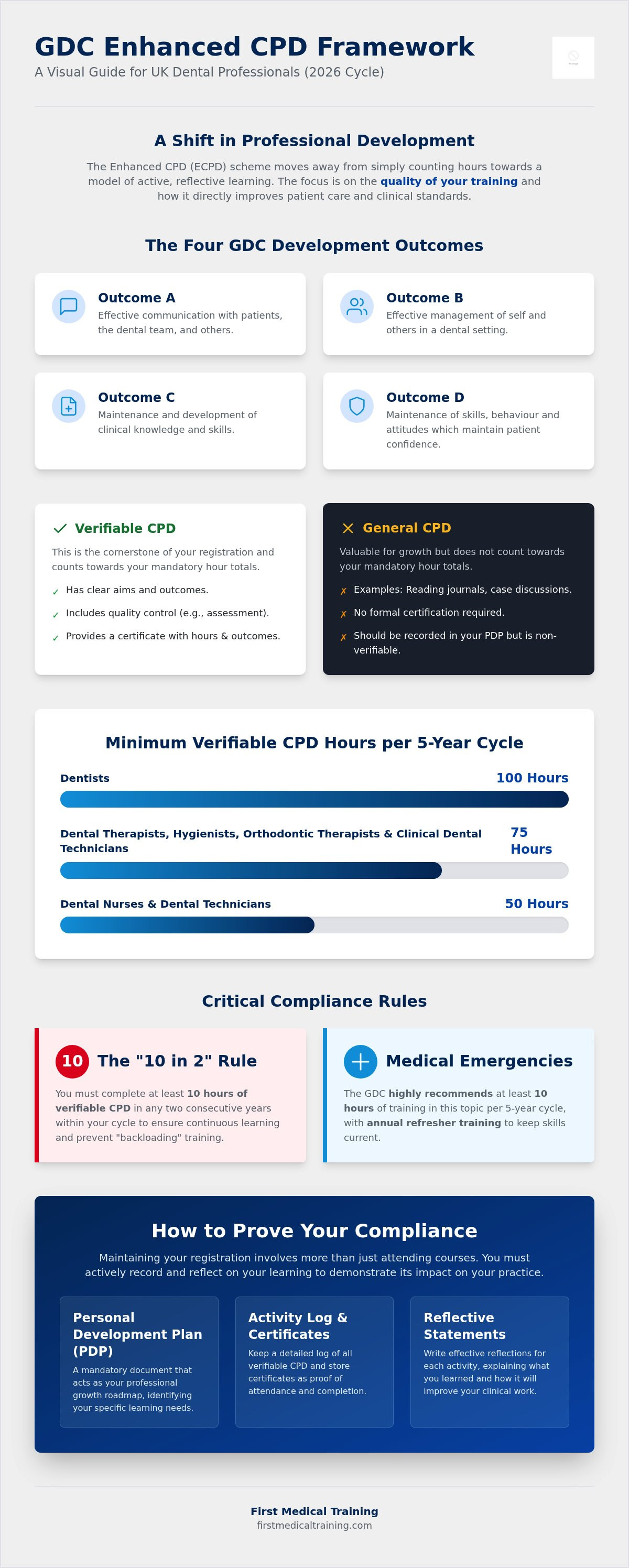
To make your CPD verifiable, every activity must be linked to at least one of the GDC's four development outcomes. These categories ensure your learning covers the full spectrum of professional life and patient care. Most high-quality courses, such as Dental ILS or Medical Emergencies training, will cover multiple outcomes simultaneously.
- Outcome A: Effective communication with patients and the dental team.
- Outcome B: Effective management of self and others, including leadership and business skills.
- Outcome C: Maintenance and development of clinical knowledge and skills within your field of practice.
- Outcome D: Maintenance of ethical and professional behaviour, including following GDC guidance and standards.
Verifiable vs General CPD: What is the Difference?
Understanding the distinction between these two categories is vital for your 2026 portfolio. Verifiable CPD is the cornerstone of your registration. To count as verifiable, the activity must have clear learning aims and anticipated outcomes. There must also be a robust quality control process, such as an evaluation form or an assessment. Most importantly, you must receive a certificate of attendance that includes the date, the number of hours, and the specific development outcomes met.
General CPD refers to non-verifiable learning. This might include reading dental journals, discussing complex cases with colleagues, or self-directed study. Whilst these activities are valuable for your personal growth and clinical knowledge, they don't count towards your mandatory hour totals. You should still record these activities in your PDP to show a well-rounded approach to learning, but they don't require the formal certification necessary for your core gdc cpd requirements for dental professionals.
GDC CPD Hours: Requirements for Every Dental Role
Every member of the dental team plays a distinct part in patient care, and the General Dental Council reflects this through tiered hour requirements. Understanding your specific obligations is the first step toward maintaining your professional registration. Whilst the five-year cycle provides a long-term window, the GDC's Enhanced CPD (ECPD) Framework introduces a crucial "10 in 2" rule. This mandate requires all registrants to complete at least 10 hours of verifiable CPD in any two consecutive years, even if you are at the beginning of your cycle. This prevents the risks associated with "backloading" training and ensures your skills remain current.
The consequences of failing to meet these gdc cpd requirements for dental professionals are severe. If you do not submit your annual statement or fail to reach your hour targets, the GDC can remove you from the register. This makes it illegal for you to practise in the UK. Re-entry to the register is a complex, time-consuming process that often involves additional fees and proof of compliance. Maintaining a steady pace of learning is the most reliable way to protect your career and your livelihood.
Hours by Professional Title
Your registration title dictates the minimum number of verifiable hours you must log every five years. It is important to note that if you hold multiple titles, you must meet the requirements for the role with the highest hour count.
- Dentists: 100 hours of verifiable CPD.
- Dental Hygienists, Dental Therapists, Orthodontic Therapists, and Clinical Dental Technicians: 75 hours of verifiable CPD.
- Dental Nurses and Dental Technicians: 50 hours of verifiable CPD.
If you joined the register mid-cycle, your hours are calculated on a pro-rata basis. You should check your online GDC account to confirm your exact target and deadline to avoid any administrative errors.
Starting Your Cycle: The Personal Development Plan (PDP)
A Personal Development Plan (PDP) is no longer optional; it is a mandatory requirement for all UK dental professionals. Your PDP should identify your specific learning needs based on your daily clinical tasks and the patient demographic you serve. For instance, a nurse working in a specialist oral surgery practice will have different training priorities than one in a general community clinic. You must link every planned activity to at least one of the GDC development outcomes (A, B, C, or D) to ensure a balanced approach to your professional growth.
Your PDP must be a living document that evolves annually to reflect changes in your role or new clinical interests. Regularly reviewing this plan ensures you stay on track with your gdc cpd requirements for dental professionals whilst identifying gaps in your knowledge. If your team needs to refresh their core skills together, booking a Medical Emergencies in a Dental Practice Course is an efficient way to satisfy multiple PDP goals in a single session.
Highly Recommended Topics: The Medical Emergencies Mandate
The GDC classifies Medical Emergencies as a "Highly Recommended" topic, placing it at the very top of the professional development hierarchy. This prioritisation exists because, unlike elective clinical skills, emergency response is a critical safety requirement that applies to every registrant regardless of their daily duties. The GDC recommends that you complete at least 10 hours of verifiable CPD in this subject per five-year cycle. To maintain a high level of preparedness, they specifically suggest that at least two of these hours are completed every single year. This annual cadence ensures that life-saving protocols remain fresh in your mind and that your team can act instinctively when every second counts.
Compliance is a collective effort. From the receptionist who may be the first to spot a patient in distress to the dentist administering treatment, everyone must understand their role in the practice's emergency plan. First Medical Training aligns directly with these recommendations by providing accredited sessions that satisfy these gdc cpd requirements for dental professionals whilst building genuine confidence. We focus on the practical application of skills within your specific surgery environment, ensuring that your team isn't just watching a video but actively practising with the equipment they would use in a real crisis.
Medical Emergencies vs Dental ILS
There is often confusion regarding the difference between Basic Life Support (BLS) and Immediate Life Support (ILS). BLS covers the fundamental skills of CPR and the use of an AED. However, for many dental professionals, particularly those involved in sedation or complex procedures, Dental Immediate Life Support (ILS) is the appropriate standard. ILS includes airway management and the administration of emergency drugs, providing a higher level of intervention. Choosing our medical emergencies in dental practice course ensures your team meets the specific resuscitation standards required for clinical safety and GDC compliance.
Other GDC Recommended Subjects
Whilst medical emergencies take precedence, the GDC also identifies several other "Recommended" topics that are essential for a well-rounded portfolio. These subjects support the broader gdc cpd requirements for dental professionals and ensure patient safety across all aspects of the practice. You should aim to complete 5 hours per cycle in Disinfection and Decontamination, and a further 5 hours in Radiography and Radiation Protection. Other vital areas include legal and ethical issues, complaints handling, and safeguarding. For those in technical roles, reviewing the CPD requirements for dental technicians can help clarify how these topics apply to laboratory settings versus clinical environments.
Recording and Reflecting: How to Prove Your Compliance
The GDC has moved beyond the era of passive hour-counting. Today, the focus is firmly on reflective practice. This shift means that the regulator isn't just interested in the fact that you attended a course; they want to see evidence of what you actually learned and how it will impact your patient care. Meeting the gdc cpd requirements for dental professionals involves more than just collecting certificates. You must demonstrate a cycle of planning, doing, reflecting, and then applying that knowledge to your clinical environment. This process ensures that your professional development is a meaningful investment in patient safety rather than a mere administrative hurdle.
Maintaining an organised CPD folder is your best defence against the GDC audit process. The GDC can randomly sample your records at any time during your five-year cycle and for up to five years after it concludes. If you are selected for an audit, you'll need to produce your Personal Development Plan (PDP), a log of all verifiable activities, and the corresponding certificates of attendance. Your folder must clearly demonstrate how you are meeting gdc cpd requirements for dental professionals through structured evidence. If your records are incomplete or lack reflection, you risk your registration status.
The Art of Reflective Learning
Reflection shouldn't be a complex essay. It should be a concise, honest appraisal of your training. Ask yourself what went well, what could be improved in a real-life emergency, and how your clinical behaviour will change. For example, after a session on fainting, your reflection might state: "Following the syncope management dental training, I recognised that our practice's emergency drugs were stored in an area that was difficult to access quickly; we have now relocated the kit to the central corridor to ensure immediate availability during a patient collapse." This shows the GDC that the training led to a tangible improvement in clinical safety.
Annual Statement Requirements
Submitting your annual CPD statement is a non-negotiable part of your registration. For Dental Care Professionals (DCPs), the deadline to submit this statement is 28 August 2026. Even if you have completed zero hours in a particular year, you must still submit a statement confirming this. Your submission must include the total number of verifiable hours completed and a confirmation that each activity was linked to the correct GDC development outcomes. A common mistake is failing to match the hours on your certificates with the hours declared on your statement, which can trigger an investigation.
To ensure your team's certificates and reflections meet the highest regulatory standards, book your next Medical Emergencies in a Dental Practice Course with First Medical Training today.
Streamlining Your Dental Team Training with First Medical Training
Meeting the various gdc cpd requirements for dental professionals is significantly easier when the entire team works in unison. Whilst individual learning is a core part of professional growth, emergency response is a team sport. It requires a level of coordination that online modules simply cannot provide. First Medical Training has spent two decades helping practices transform their annual compliance into a powerful team-building exercise. By training together in your own clinical environment, you move from individual hour-counting to a collective culture of safety that protects both your patients and your registration.
Every dental surgery is unique. A specialist orthodontic centre faces different risks than a general practice with a high proportion of elderly patients. Our trainers customise every session to your specific equipment and patient demographic. This bespoke approach ensures your gdc cpd requirements medical emergencies training isn't just a generic lecture, but a practical rehearsal for the scenarios you're most likely to encounter. We ensure that every team member, from the principal dentist to the newest receptionist, understands their specific duties during a crisis.
Why In-Practice Training Beats Online-Only Modules
Digital modules are excellent for theoretical knowledge, but they cannot replicate the physical reality of a medical crisis. In-practice training allows your team to gain hands-on experience with your actual Automated External Defibrillator (AED) and emergency drug kits. Building team cohesion during high-pressure scenario rehearsals is vital. It allows staff to find their voice and understand their specific duties in a crisis. This practical application of dental practice emergency preparedness protocols ensures that if a patient collapses, the response is methodical and calm. You'll leave the session with the confidence that your equipment is functional and your team is ready.
Beyond Compliance: Mental Health and Wellbeing
Modern dental practice involves more than just physical safety. The GDC's Development Outcome B focuses on effective management and leadership, which includes supporting the mental wellbeing of your team. We offer specialised Mental Health First Aid for dental practices to help staff manage the unique stresses of the clinical environment. Integrating wellbeing into your training calendar demonstrates a commitment to a supportive workplace culture that goes far beyond basic regulatory requirements. As you plan your 2026 training calendar, consider a holistic approach that protects the mental health of your colleagues whilst fulfilling your statutory obligations. A resilient team is a compliant team.
Secure Your Professional Standing for 2026
Meeting the gdc cpd requirements for dental professionals requires a proactive approach that prioritises patient safety over simple administrative box-ticking. By integrating reflective learning into your Personal Development Plan and committing to the annual medical emergency recommendations, you protect both your registration and your clinical reputation. This commitment to safety also applies to the sterile processing of instruments; for those seeking specialised certification in this area, click here to find out more about the training provided by Mbawine Consultant Services. A well-prepared team is the foundation of a safe practice; structured, hands-on training remains the most effective way to ensure everyone is ready to act in a crisis.
First Medical Training has been a dependable mentor to the dental sector since 2006. We offer accredited Medical Emergencies and ILS courses designed to demystify complex protocols and build genuine confidence amongst your staff. Our expert-led sessions provide the practical experience that online modules simply cannot match. Book Your GDC-Compliant Medical Emergencies Training Today to ensure your surgery meets every regulatory standard with ease. Take the final step in your compliance journey and empower your team to provide the highest standard of emergency care.
Frequently Asked Questions
How many hours of CPD do I need for the GDC in 2026?
Your total hour requirement depends on your specific registration title. Dentists must complete 100 hours of verifiable CPD per five-year cycle, whilst Dental Hygienists, Therapists, and Clinical Technicians require 75 hours. Dental Nurses and Technicians must complete 50 hours. Regardless of your role, you must also adhere to the "10 in 2" rule, which mandates at least 10 hours of verifiable CPD in any two consecutive years.
Is medical emergency training mandatory for the GDC every year?
The GDC highly recommends that you complete at least 10 hours of medical emergency training per five-year cycle. To maintain clinical readiness, they specifically suggest completing at least two hours of this training every year. Whilst "highly recommended" topics are not strictly mandatory in the same way as the total hour count, failing to meet these standards can be viewed unfavourably during an audit or fitness to practise investigation.
What counts as verifiable CPD for dental professionals?
Verifiable CPD must meet four specific criteria to be accepted by the regulator. The activity must have clear learning aims and anticipated outcomes, include a process for quality control, and provide you with a certificate of attendance. This certificate must include the date, the number of hours, and the development outcomes met. Ensuring your training meets these gdc cpd requirements for dental professionals is essential for a valid portfolio.
Do dental nurses have different CPD requirements than dentists?
Yes, dental nurses have a lower total hour requirement than dentists. Nurses must complete a minimum of 50 hours of verifiable CPD every five years, whereas dentists are required to complete 100 hours. However, the expectations for "highly recommended" topics, such as medical emergencies and disinfection, remain similar across the entire dental team to ensure practice-wide patient safety and consistent standards of care; this often involves staying informed about infection screening through resources like mrsatest.co.uk.
What are the four GDC development outcomes (A, B, C, D)?
The GDC development outcomes categorise the impact of your learning on your professional practice. Outcome A focuses on communication and effective teamwork. Outcome B covers management and leadership in the dental environment. Outcome C involves the maintenance and development of your clinical knowledge. Finally, Outcome D relates to ethical and professional behaviour. Every piece of verifiable CPD in your portfolio must be linked to at least one of these four categories.
What happens if I do not meet my GDC CPD requirements?
Failure to comply with gdc cpd requirements for dental professionals can result in your removal from the GDC register. If you don't submit your annual statement or meet your hour targets, you'll lose your legal right to practise in the UK. Restoring your name to the register is a difficult and costly process that often requires you to prove you have caught up on all missing professional development before you can return to work.
Can I carry over CPD hours from one five-year cycle to the next?
No, you cannot carry over surplus CPD hours from one five-year cycle into the next. Each cycle is a distinct period; your hour count resets to zero once a new cycle begins. This rule ensures that your learning is distributed evenly throughout your career rather than being front-loaded. It's important to plan your training so you meet your targets within each specific five-year window to maintain continuous compliance.
How do I link my medical emergency training to my PDP?
You link your training by first identifying "medical emergencies" as a learning need in your Personal Development Plan at the start of your cycle. When you complete a course, record the date and hours and map it to GDC Development Outcome C. You must then write a brief reflection explaining how the session has improved your ability to handle a crisis in the surgery. This creates a clear audit trail from your initial plan to your clinical application.