

How Often Should Dental Staff Update Medical Emergency Training?

Your GDC CPD cycle may span five years, but emergency skills should not wait that long for a refresher. If you’re asking how often should dental staff update medical emergency training, Resuscitation Council UK guidance points to an annual update in resuscitation skills, including CPR and AED use.
It can be difficult to fit that recommendation around GDC CPD requirements and the practical demands of releasing a whole team for training. Treat annual skills updates and CPD record-keeping as related but separate parts of your plan. This article explains what the guidance says, how to distinguish professional recommendations from fixed legal duties, and how to organise useful training for registered and non-registered staff. It also explains how practising together in your clinical environment can help staff understand their roles, equipment and emergency response plan. A clear schedule and accurate records make training easier to manage and help you keep your team prepared.
Key Takeaways
- For how often should dental staff update medical emergency training, use annual resuscitation refreshers as your planning baseline, while distinguishing this guidance from GDC CPD requirements and applicable legal duties.
- Check current GDC and Resuscitation Council UK guidance, and identify the regulator and inspection expectations that apply where your practice operates.
- Choose a refresher format that supports practical skills and whole-team participation. In-practice rehearsal lets staff practise with the practice’s own layout and equipment.
- Review your Risk assessment when staffing, services, equipment or practice arrangements change. Then schedule training and keep clear completion records.
- Use your practice review to set learning objectives and consider a Medical Emergencies in a Dental Practice CPD Course as a relevant refresher option.
How often should dental staff update medical emergency training?
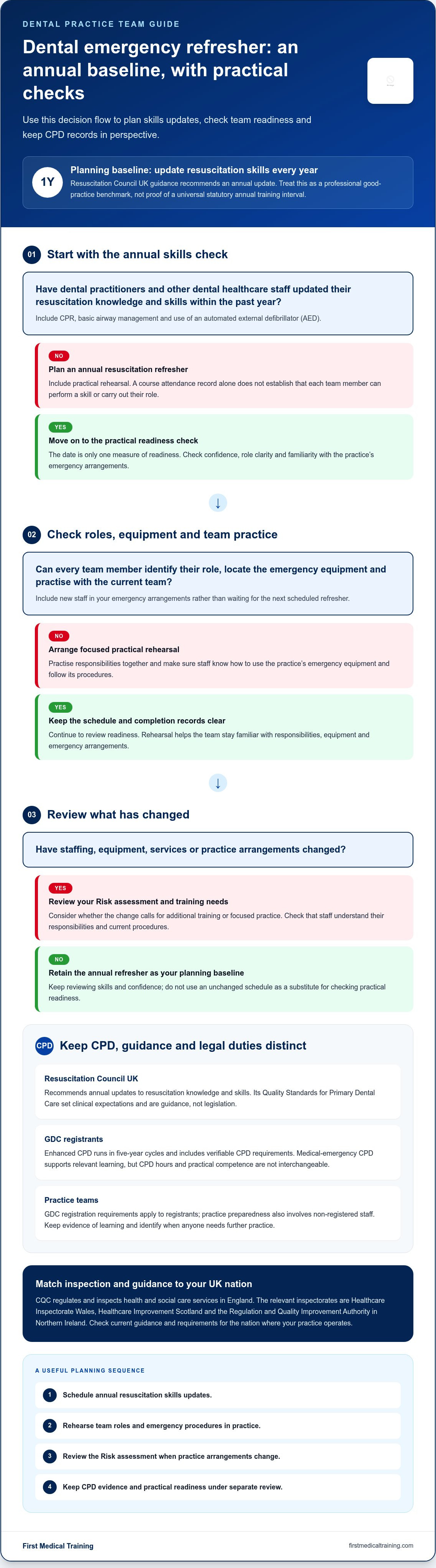
Plan for a refresher at least annually. Resuscitation Council UK guidance recommends that dental practitioners and other dental healthcare staff update their resuscitation knowledge and skills every year. This includes CPR, basic airway management and using an automated external defibrillator (AED). Use this as a practical benchmark, then review whether changes to your team, equipment or services call for additional training.
The purpose is to maintain capability, not simply renew a certificate. Attending a course does not necessarily mean someone can perform a skill, use the equipment confidently or understand their role within the team. Include practical rehearsal, and make sure new staff understand your emergency arrangements rather than waiting for the next scheduled refresher.
Is annual medical emergency training a legal requirement?
Keep professional guidance, GDC CPD expectations and legal duties distinct. Resuscitation Council UK recommends annual skills updates. The GDC’s Enhanced CPD scheme operates across a five-year cycle and sets requirements for verifiable CPD. Its recommendation on medical-emergency CPD is not the same as a universal statutory rule requiring every dental practice to run a particular course every year. Check current GDC and Resuscitation Council UK guidance when setting your policy, and consider any relevant accreditation conditions or employer requirements.
An annual refresher is a professional good-practice benchmark, not, by itself, proof of a universal statutory annual training interval. Meeting CPD recording requirements does not automatically show that practical emergency skills have been refreshed. Likewise, a course attendance record alone does not establish that every team member can carry out their role.
Why does a regular refresher matter in a dental practice?
Medical emergencies may be infrequent in a practice, but skills and confidence can fade when staff have little opportunity to use them. A general Medical emergency can demand a prompt, coordinated response. In a dental setting, staff need to know the practice’s procedures and work together. Regular rehearsal keeps responsibilities familiar, particularly when colleagues change or new team members join.
Use the annual update to identify where your team needs support, rather than treating the date as the only measure of readiness. Ask whether everyone knows their role, can locate and use the practice’s emergency equipment, and has practised with the current team. If confidence or role clarity is uncertain, arrange focused practice instead of assuming past attendance is enough. This gives you a clearer picture of preparedness than a training certificate alone.
What do UK dental guidance and standards say about refresher training?
Use guidance and standards for their distinct purposes. The Resuscitation Council UK Quality Standards for Primary Dental Care set out clinical expectations for resuscitation in dental settings, including staff training. They are guidance, not legislation. The GDC sets professional standards and CPD requirements for its registrants, while the relevant regulatory body in each UK nation oversees inspection and regulation.
For GDC registrants, Enhanced CPD is organised in five-year cycles, with verifiable CPD requirements and development outcomes to guide relevant learning. GDC guidance recommends medical-emergency CPD within that framework. This is separate from practical skills refreshers. For more detail on the professional CPD framework, read the GDC CPD requirements for medical emergencies.
How should practices interpret GDC CPD expectations?
Choose learning that develops knowledge and skills relevant to your role and practice. The GDC’s development outcomes help registrants connect CPD to professional practice, including maintaining and developing knowledge and skills in their field. Medical-emergency learning can support that aim, but CPD hours and practical competence are not interchangeable. One records learning; the other concerns whether a person can apply relevant skills.
Keep evidence of completed learning and consider how it meets each registrant’s development needs. Course attendance alone does not prove competence or automatic compliance. Check that learning is relevant, record it appropriately and identify whether staff need further practice. GDC registration requirements apply to registrants, while practice preparedness also involves non-registered staff.
How do clinical guidance and inspection expectations fit together?
Match your approach to the nation where the practice operates. The Care Quality Commission (CQC) regulates and inspects health and social care services in England. In Wales, the relevant inspectorate is Healthcare Inspectorate Wales; in Scotland, Healthcare Improvement Scotland; and in Northern Ireland, the Regulation and Quality Improvement Authority. These bodies operate under different national frameworks, so CQC requirements do not apply throughout the UK.
In Scotland, the Scottish Dental Clinical Effectiveness Programme (SDCEP) provides resources for dental practice teams; it is not a UK-wide regulator. Use relevant national guidance alongside professional standards and your practice policies. Resuscitation Council UK provides clinical resuscitation guidance, the GDC sets professional standards and CPD expectations for registrants, and national regulators oversee services within their jurisdictions. This distinction helps you set a clear training plan without confusing guidance, professional expectations and regulation.
First Medical Training Ltd provides a Medical Emergencies in a Dental Practice CPD Course for dental teams to include in their refresher planning.
Which refresher approach best maintains dental emergency skills?
The right format depends on what your team needs to learn and practise. When deciding how often should dental staff update medical emergency training, consider how staff will demonstrate and rehearse practical skills, not just how they will access information. CPR and AED use involve physical actions that benefit from practical rehearsal and feedback. Online learning can support knowledge updates, but it should not be assumed to replace supervised practice or practical assessment.
Compare the options with your learning objectives, staffing arrangements and practice needs:
- In-practice training brings learning into your clinical environment, where staff can rehearse roles and procedures using the practice’s layout and equipment.
- Venue-based training takes the team away from the practice and may include practical activities. Consider travel and whether the chosen date allows staff to attend.
- Online learning can make knowledge updates easier to schedule around clinical work. Check whether the course includes practical assessment; online theory alone cannot demonstrate physical skills.
Do not choose a format on convenience alone. Compare the course content with the skills and knowledge your practice has identified as priorities, including which skills need hands-on rehearsal. A clear course description should explain what learners will cover and how their learning will be assessed.
When can in-practice training suit a dental team?
In-practice training lets your team work through a scenario in the rooms where an emergency could occur. Staff can rehearse moving through the space, locating equipment and communicating across clinical and non-clinical roles. This can bring practical questions to light, such as who will call for help or where equipment is kept. The benefit is rehearsal that reflects your setting, not an assumption that this format suits every practice.
It also gives colleagues a chance to practise together rather than learning separately. A clinician, receptionist and other team members may have different responsibilities, so a shared exercise can help clarify handovers and coordination. Use the session to identify uncertainties and agree on any follow-up learning.
What can online or venue-based refreshers contribute?
Online study can suit knowledge-based learning when coordinating a shared session is difficult. It may let team members complete learning at different times, but flexibility does not provide observation or feedback on practical performance. Use online learning as part of your approach where appropriate, and arrange hands-on practice for skills that need it.
Venue-based learning may suit teams able to attend a scheduled session away from the practice. Its practical value depends on the activities included, so match the format to your objectives rather than assuming every session offers the same rehearsal. First Medical Training Ltd’s medical emergencies in a dental practice course guide can help you consider how dental-specific learning relates to your team’s needs. Choose a format that provides access to the learning and practice your staff need.
How can a dental practice set and review its refresher schedule?
Turn guidance into a schedule your team can follow and maintain. Use annual resuscitation refreshers as your planning baseline, then adjust the plan when needs change. A clear cycle helps you organise training, identify gaps and connect learning to the way the practice operates. When deciding how often should dental staff update medical emergency training, account for both the recommended refresher rhythm and regular reviews of team capability.
Use this sequence to create a workable plan:
- Review current guidance. Check relevant professional and clinical guidance, along with applicable regulator, accreditation or employer expectations.
- Assess team needs. Use your Risk assessment to consider staffing, services, equipment and practice arrangements. Identify who needs which learning instead of assuming every role requires identical training.
- Schedule refreshers. Set dates in advance, plan how staff can take part and arrange a catch-up for anyone unable to attend the main session.
- Record completion and follow-up. Document participation, learning covered and any further action. Set a review date and assign a named practice role to keep the schedule current.
Use the dental practice emergency preparedness checklist to review practice arrangements alongside your training plan. Keep training records with other evidence of emergency preparedness so you can see what has been completed and what remains outstanding.
What events should prompt an earlier refresher?
Do not wait for the next planned date if a change or learning need suggests an earlier review would help. Consider a new starter, changed staff responsibilities, new emergency equipment, a change to the clinical layout or an adjustment to the services your practice provides. A long absence may also mean a team member needs support before returning to their usual role.
Review learning from drills, incidents and staff feedback. If an exercise shows that people are unsure about a procedure or responsibility, record the gap and decide how to address it. These are sensible review triggers, not separate statutory retraining deadlines. Let the identified need guide your follow-up.
What should the practice record and review?
Keep records clear enough to show who took part, when training occurred and what it covered. Note actions arising from the session, such as arranging further practice or updating the team about equipment or procedure changes. Track absences and outstanding learning so gaps remain visible.
Assign responsibility to a named practice role, such as the practice manager or another designated lead, and set the next review date. At that review, compare the plan with current staffing, services, equipment and arrangements. If you identify a need for dental-specific refresher learning, arrange medical emergency CPD training for your dental team.
How can dental teams arrange a relevant medical emergency refresher?
Start with your practice review, not a generic course checklist. Identify what the team needs to strengthen, who needs the learning and whether any skills require practical rehearsal. Then compare those objectives with the course content and delivery format. This helps you choose a refresher that fits your practice arrangements and gives staff learning they can apply in their roles.
First Medical Training Ltd provides a Medical Emergencies in a Dental Practice CPD Course for dental teams. Its courses are accredited, follow Resuscitation Council UK guidelines and align with GDC expectations. Compare the course information with your practice objectives to understand how the learning supports your team’s needs and CPD planning.
Depending on your review, useful learning objectives might include:
- Recognising a medical emergency and knowing when to raise concern.
- Using a systematic initial assessment, such as the abcde approach, where it fits the learning objectives.
- Communicating clearly and coordinating responsibilities across clinical and non-clinical roles.
- Identifying where further practice or follow-up learning would help staff apply their knowledge.
Keep objectives proportionate to staff roles. A shared foundation helps the whole team understand how to contribute, while role-specific learning can address the different tasks staff may be expected to perform. Do not assume that one course or attendance record meets every individual learning need.
What should the practice aim to refresh in a dental CPD course?
Set objectives around the capabilities your review has identified, such as recognition, initial assessment, communication and role coordination. If using the abcde approach is an objective, check that the course information supports it. Focus on refreshing knowledge and skills relevant to your team. Use clinical guidance for detailed emergency procedures rather than treating a course description as a substitute for protocols.
What is a practical next step for your team?
Review your training record, identify the next refresher due and note any gaps arising from staff changes, feedback or previous practice reviews. Select learning that fits your team’s roles and current needs, then record how it contributes to your plan. This connects the training you arrange with the preparedness you want to maintain.
Explore dental medical emergency CPD training to consider a refresher for your practice team and its learning objectives.
Make your next refresher part of a prepared team culture
Keep training active beyond the session. At your next team meeting, invite staff to share one part of emergency response they feel confident about and one area where clearer communication would help. Use their feedback to shape future learning and encourage discussion across clinical and non-clinical roles.
A prepared team depends on shared understanding and reflection, not paperwork alone. Give colleagues a clear way to raise questions, and make learning part of how your practice supports its staff.
First Medical Training Ltd provides dental medical emergency CPD training for practice teams. Explore medical emergency CPD training for your dental team and plan your next refresher.
Frequently Asked Questions
Can dental staff complete medical emergency refresher training online?
Yes. Online learning can support medical emergency knowledge updates, but it may not assess practical performance. If staff need to refresh physical skills such as CPR, include suitable hands-on practice and feedback in the training plan. Before booking an online course, compare its learning and assessment methods with your objectives. A course completion record shows participation, but does not by itself confirm practical competence.
What should a practice do if a team member misses the annual refresher?
Arrange a catch-up as soon as practicable and record the planned date and any interim learning support. Ask the team member and practice lead to identify whether particular knowledge or skills need attention before the refresher. To keep track of how often staff update medical emergency training, record each person’s completion date rather than relying on a single team calendar entry.
Do new dental staff need medical emergency training before treating patients?
Give new starters a practice-specific induction before they take on their usual duties. Explain the practice’s emergency arrangements, who to alert and how their role fits into the team response. Tailor the induction to their responsibilities and experience, and do not treat it as a substitute for relevant refresher learning. Review their previous training and identify any gaps to address as part of their development.
Does medical emergency training count towards GDC CPD?
It can count towards a GDC registrant’s CPD when the learning meets GDC requirements, including relevance to professional development and appropriate recording. Keep evidence of the learning and consider how it relates to the registrant’s role. Do not assume every course automatically qualifies as verifiable CPD, or that CPD hours alone demonstrate practical competence. Check current GDC guidance when recording activity.
Should all members of a dental team receive the same refresher training?
Not necessarily. Everyone should understand their part in the practice’s emergency arrangements, but learning can be tailored to different responsibilities and existing skills. A receptionist, for example, may need clarity on raising the alarm and directing help, while clinical staff may need relevant practical skills. Build shared team understanding, then identify role-specific learning needs rather than assuming one identical course meets everyone’s requirements.
What should be reviewed after a medical emergency drill or incident?
Review how clearly staff understood their roles, how communication worked and whether relevant equipment and procedures were accessible. Ask the team to identify confusion or delays, then agree practical follow-up actions. For example, if staff were unsure who should make a call, clarify that responsibility and include it in the next briefing or practice exercise. Record lessons and update relevant training or arrangements.
How can a dental practice show that emergency training is up to date?
Keep a training record showing each person’s attendance date, the learning covered and relevant completion evidence, such as a course certificate. Note outstanding training and follow-up actions, then review the record as staff join or change roles. A clear, current record helps you explain your training plan and identify gaps. Pair it with evidence that you review practice arrangements and learning needs.