

How to Create a Culture of Safety in a Dental Practice: A Practical Guide

What if the weakness in your safety procedures isn’t the policy, but the gap between what’s written down and what happens each day? Learning how to create a culture of safety in a dental practice means making safe behaviour part of routine work, not leaving procedures in a folder or revisiting them only after an incident.
You may already have procedures in place, yet staff can still feel unsure about raising concerns, reporting near misses or applying training under pressure. A stronger culture starts with clear leadership and open communication, then turns those principles into practical team habits.
This guide sets out a step-by-step approach: clarify responsibilities, make it easier to speak up, rehearse responses together and review what the team learns. It also explains how to connect training with daily systems, so improvements are put into practice and kept under review. A consistent approach supports patient and staff safety while helping your practice meet the expectations of bodies such as the General Dental Council and, in England, the Care Quality Commission.
Key Takeaways
- See safety culture as the shared habits and systems that protect patients and staff, not simply a set of written procedures.
- Invite staff to raise concerns during briefings, and respond in a way that supports open discussion and learning.
- Use a Dental emergency response plan and regular Risk assessment to clarify actions and help the team spot hazards.
- Build a practical learning cycle: identify a need, rehearse together, record actions and review progress. In-practice training lets the team practise in its own clinical environment.
- Use a manageable review cycle that brings together staff feedback, observations and practice records to strengthen your safety culture.
What does a culture of safety mean in a dental practice?
Written procedures provide direction, but they don’t guarantee that everyone will follow them consistently. Understanding how to create a culture of safety in a dental practice starts with looking beyond the policy folder. Consider what happens during a busy clinic, how colleagues communicate and whether concerns are treated as useful information.
A safety culture is the shared values, habits and systems that guide a team to protect patients and staff in everyday work. You can see it in routine decisions: staff follow agreed processes, pause when a situation changes and ask for help when they need it. This connects with the wider idea of patient safety, which considers how care systems and the actions of people within them affect safety.
A policy sets out what should happen. Training can explain or refresh a skill. Neither, on its own, shows whether the team can apply that guidance consistently across roles and circumstances. A positive culture depends on repeated practice, clear expectations and constructive conversations. It also gives staff a way to raise concerns without being dismissed or blamed for speaking up in good faith.
How does a positive safety culture appear in daily practice?
Look for consistent behaviours, especially when the schedule is full. Team members follow agreed processes rather than skipping steps to save time, and they know how to flag a concern if something feels unclear or unsafe. When a colleague raises an issue, listen calmly, clarify what happened and agree what to do next. Brief, clear communication helps everyone understand relevant changes, regardless of their role.
Make these behaviours observable, not just stated as values. For example, ask a team member to explain a change to a routine and check that colleagues understand it. Encourage staff to ask for clarification before proceeding when an instruction is unclear. Leaders reinforce expectations by responding constructively and following up, so staff know what happened after they raised a concern.
Why do shared safety behaviours matter?
Predictable teamwork gives colleagues a common starting point when a hazard appears or circumstances change. Each person should know what they need to do, who needs to know and when to pause and reassess. This doesn’t remove uncertainty from clinical work. It helps the team communicate clearly while responding to it.
Include patients and colleagues in safety discussions. Invite patients to share relevant concerns, and make it acceptable for staff to point out hazards, ask questions or suggest reviewing an existing process. Keep discussions practical by making space to:
- Share observations about processes that are unclear or difficult to follow.
- Identify who needs to know about a concern and what action is required.
- Agree how the team will communicate any change in practice.
Shared behaviours turn safety from an individual expectation into a team commitment. They also give leaders a practical foundation for the next steps: making speaking up routine, connecting procedures to daily work and reviewing whether agreed actions are followed.
How can dental leaders help staff speak up about safety?
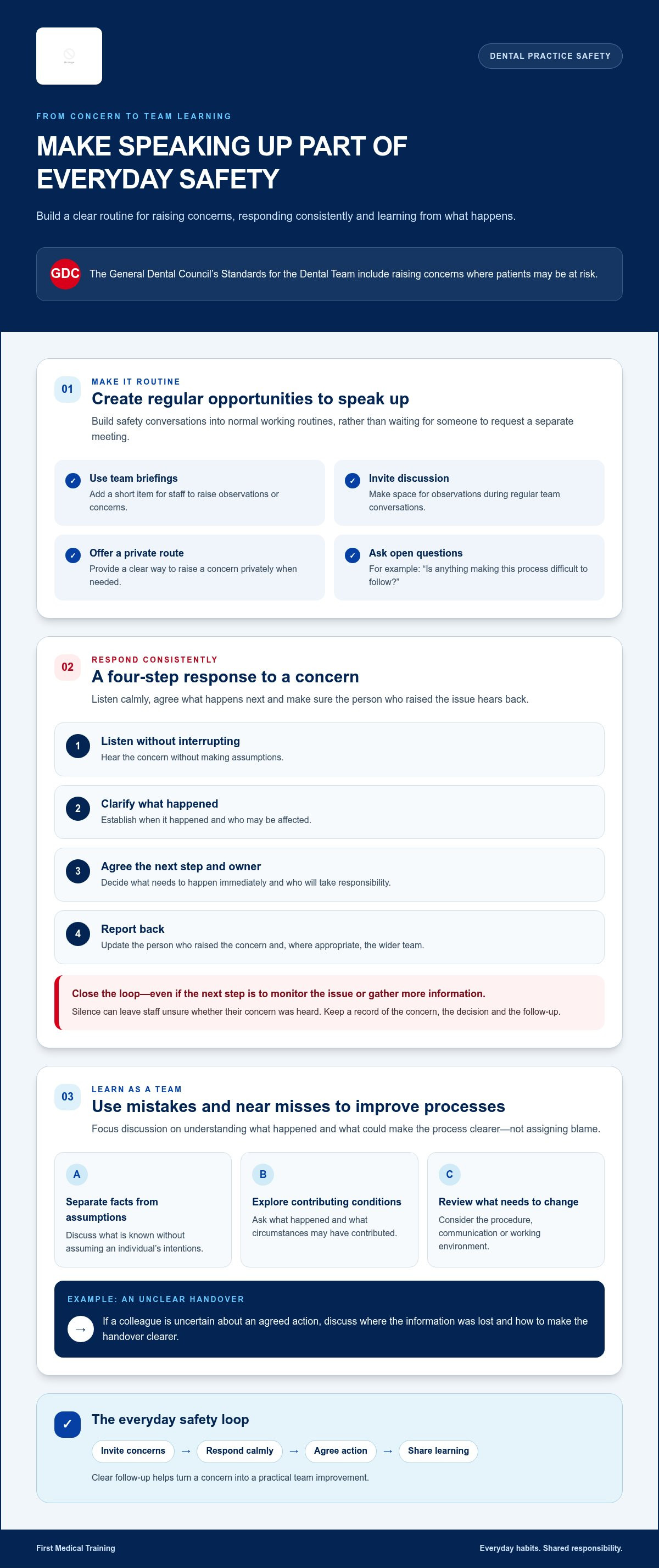
Staff are more likely to raise a concern when leaders show that speaking up is expected and taken seriously. Listen without interrupting, respond calmly and explain what happens next. The General Dental Council’s Standards for the Dental Team include raising concerns where patients may be at risk, so make sure staff know how to do this within your practice.
When staff feel confident to speak up, the team can surface concerns while there is still time to consider a response. It doesn’t mean every concern will have a simple solution. It means staff know their observations will be heard and considered.
How can practice managers make it easier to raise concerns?
Build opportunities into normal working routines instead of relying on staff to request a separate meeting. Add a short item to team briefings, invite observations during regular discussions and provide a clear route for raising a concern privately when needed. Ask neutral, open questions such as, “Is anything making this process difficult to follow?” or “What should we review before the next session?”
Explain how concerns will be handled. A practical response is to:
- Listen without interrupting or making assumptions.
- Clarify what happened, when it happened and who may be affected.
- Agree the immediate next step and who will take responsibility.
- Report back to the person who raised the concern and, where appropriate, the wider team.
Close the loop, even if the decision is to monitor the issue or gather more information before acting. Silence can leave staff unsure whether their concern was heard. Keep records focused on the concern, the decision and the follow-up, so the team can see how it was considered.
How should a team learn from mistakes and near misses?
Focus discussion on understanding what happened and improving the process, not assigning blame. Separate known facts from assumptions about an individual’s intentions. Ask what happened, what conditions may have contributed and whether the current procedure, communication or working environment needs review.
For example, if a handover leaves a colleague uncertain about an agreed action, discuss where the information was lost and how to make the handover clearer. Record the agreed action, assign responsibility and set a review point. Some events need further investigation, and not every concern has one obvious fix. Be honest about that, and share progress rather than promising an outcome you can’t guarantee.
Apply the same approach to medical-emergency learning. A Medical Emergencies in a Dental Practice Course can support staff development alongside open communication and routine review. Make raising and following up concerns a consistent part of how you create a culture of safety in a dental practice.
How can daily systems make safety part of dental practice routines?
Safety is easier to put into practice when procedures connect to specific actions, named responsibilities and a clear way to flag problems. A Dental emergency response plan sets out how the team manages a medical emergency, including who does what and where relevant equipment is kept. Make the plan easy to access, keep its instructions clear and ensure staff know where to find it.
A Risk assessment helps the practice identify hazards and consider whether existing controls remain suitable. Treat it as a working process, not a document to complete and file away. For example, if a room layout or equipment location changes, check whether the current instructions and responsibilities still make sense.
Make key information visible where it supports the work. Display responsibility lists in an appropriate staff area, keep equipment-check records in an agreed location and tell the team how to report a hazard or near miss. In England, the Care Quality Commission assesses whether dental services are safe and well-led. Organised records can help you explain how your systems operate and how concerns are followed up.
How can a practice connect policies with everyday work?
Translate each written instruction into an observable action. If a procedure says emergency equipment must be accessible, staff should know where it is and how access is maintained. If a policy sets out a reporting route, staff should be able to describe how to use it. These checks can reveal unclear wording or steps that don’t fit the way work happens.
Assign someone to review each relevant procedure, communicate updates and ensure the current version is available to staff. Keep records concise and useful. Capture the decision, responsible person and follow-up point, rather than recording a discussion without showing what happens next. Review how your emergency plans and daily routines fit together.
How should teams turn safety observations into improvements?
Use the practice’s agreed process to record hazards, near misses and recurring barriers. Then review the information with the people who carry out the relevant work. They can help clarify whether a problem relates to unclear instructions, the working environment, equipment access or another factor. Look for repeated themes as well as individual events.
For each agreed change, record what will happen, who owns the action and when it will be reviewed. For example, if staff report that a reporting form is difficult to locate, make the reporting route clearer and ask the team whether it is easier to use. Share the outcome with relevant colleagues, including when an action remains under review.
This cycle turns observations into follow-through: capture the issue, consider it with the people involved, assign an action and revisit the result. It gives leaders a repeatable way to connect policy, daily behaviour and review, and provides a practical foundation for how to create a culture of safety in a dental practice.
How can dental teams build safety through practice and training?
Training is most useful when it addresses a clear need in the practice and gives staff a chance to apply agreed procedures together. Use a simple cycle: identify what the team needs to learn, practise it, discuss what happened, record actions and review whether they’ve been completed. This connects learning to daily work instead of treating attendance at a session as the final step.
In-practice training lets staff rehearse in their actual clinical environment, using the practice layout and the equipment they would access. Rehearsal can reveal practical questions that are easy to miss elsewhere, such as whether a route is clear, responsibilities are understood or colleagues know where to find relevant equipment. Keep practice focused on team readiness and your agreed clinical protocols. Training supports those protocols; it doesn’t replace them.
What should a dental team rehearse together?
Choose a scenario that reflects a learning need or an aspect of the team’s response that needs clarification. Agree the learning aims before starting, then practise the roles, communication routes and equipment access set out in your Dental emergency response plan. Keep the scenario realistic for your setting, and stay within approved protocols and the training objectives.
Include non-clinical colleagues when their responsibilities form part of the response. For instance, they may need to understand how to alert relevant team members or support communication, according to practice procedures. Make each person’s role clear and observe how information passes between colleagues. This lets the team examine coordination as well as individual tasks.
After the rehearsal, ask what was clear, where anyone felt uncertain and whether the plan was workable in the practice environment. Focus on what the team can learn, not on scoring individual performance. A calm debrief helps staff identify useful adjustments and areas where further practice may be needed.
How can teams make training useful after the session?
Turn learning into follow-up. Record agreed changes, name an action owner and set a point to review progress. If a rehearsal shows that staff aren’t sure where to find a piece of equipment, for example, confirm its correct location, update relevant information if needed and tell the team about the change. Bring unresolved questions into the next team discussion or training plan.
Set learning objectives with current General Dental Council expectations and relevant Resuscitation Council UK guidance in mind. Keep records proportionate and useful: note the session’s focus, participation, learning points and follow-up actions. Use these records to identify patterns over time, such as roles or communication steps that need more rehearsal. This connects training with practice review, rather than leaving learning in a certificate or attendance record.
Build emergency-response learning into your wider approach to how to create a culture of safety in a dental practice, alongside clear procedures, communication and follow-up. Explore the medical emergencies in a dental practice course to support your team’s learning and rehearsal.
How can a dental practice sustain and review its culture of safety?
A safety culture needs regular attention. Use a manageable review cycle: gather feedback, choose a priority, agree and carry out an action, communicate what changed, then revisit the issue. The aim isn’t to create more paperwork. It’s to check whether the practice’s approach works in daily conditions and adjust it when it doesn’t.
Consider several sources of information together. Staff feedback can reveal where people feel uncertain; observations can show how a process works in practice; records can highlight concerns or actions that need follow-up. No single measure tells the whole story. Comparing them gives you a more useful basis for deciding what to review next.
For practices in England, clear, current processes and relevant records can also support preparation for Care Quality Commission (CQC) inspection. Keep documentation organised so you can explain how the practice identifies concerns, assigns actions and checks progress. Focus on how the system operates, rather than collecting documents without considering whether they reflect everyday work.
Which signs can help a practice review progress?
Ask practical questions. Do staff know how to raise a concern and where to record it? Can they see who is responsible for agreed actions and whether those actions have been followed up? After a change, ask the people affected whether it has made their work clearer or safer. Their answers can help you decide whether an improvement is working or needs adjustment.
Set a review point for each priority. At that point, consider feedback alongside observations and practice records. If an action remains incomplete, clarify what is preventing progress, agree the next step and update the team. If the action is complete, check whether it addressed the original concern before closing the review.
How can a practice keep improvements going?
Keep the workload realistic. Select a small number of practical priorities rather than introducing several changes at once and making follow-up difficult. Share what the team has learned, recognise staff who report concerns constructively and explain what will happen next. Acknowledging a report doesn’t require promising a particular outcome; it shows that raising issues is valued.
Use relevant continuing professional development (CPD) to address learning needs identified through review. Link the learning to a clear objective, then consider how it should inform team practice. Training can support improvement, but it works best alongside clear procedures, staff communication and follow-up. Focus on what the team needs to understand or practise, not training as a stand-alone answer.
Repeat the cycle and record decisions, action owners and review points. This steady approach makes how to create a culture of safety in a dental practice an ongoing part of leadership and team learning. If medical-emergency readiness is a priority, explore First Medical Training Ltd’s dental CPD support to inform your team’s development.
Make your next safety improvement count
Choose one practical step your team can take next, such as setting a date to review an emergency procedure or making time to discuss a learning need. Keep the action clear, assign responsibility and agree when you’ll check progress. Consistent follow-through gives safety work direction beyond the next meeting or training session.
Knowing how to create a culture of safety in a dental practice is an ongoing part of professional development. First Medical Training Ltd has operated since 2006 and is an accredited CPD provider following Resuscitation Council UK guidelines, with training aligned with General Dental Council expectations. Use relevant learning to support your team’s development and strengthen the systems you put into practice.
Explore dental medical emergency CPD training and take a considered next step towards a safer, more confident team.
Frequently Asked Questions
Can a small dental practice create a strong culture of safety?
Yes. Learning how to create a culture of safety in a dental practice can start with a short staff check-in, even in a small team. Ask each person to name one part of the working day that creates uncertainty, such as a handover or access to a shared item. Choose one issue to address, agree who will take it forward, then ask staff at a later meeting whether the change is workable.
Is a safety culture the same as having policies and procedures?
No. A policy describes the intended process; it cannot show by itself whether staff can apply it in a real situation. For example, a written handover procedure may be clear, yet team members may interpret a key instruction differently. Ask staff to explain the relevant step in their own words and compare it with the current procedure. If there’s a gap, clarify the wording or arrange suitable guidance, using current UK requirements as a reference.
How can dental staff raise a safety concern without creating conflict?
Use the practice’s reporting route and describe the issue in neutral, specific terms: what you noticed, where or when it occurred, and what may need attention. For example, say, “The instruction on this form is unclear during handover; could we review it?” This keeps the discussion focused on the work rather than a colleague’s character. If the concern involves immediate risk, follow the relevant practice escalation procedure promptly.
Can safety training improve teamwork in a dental practice?
Training can give colleagues a shared opportunity to practise communication and compare how they understand their roles. It can also reveal where a procedure and the working environment don’t align, such as an instruction that assumes equipment is stored elsewhere. After a session, turn that observation into a process review or further learning objective. Keep clinical decisions within approved protocols, and ensure training supports rather than replaces them.
Does the GDC prescribe one specific safety-culture model for every dental practice?
No. The GDC sets professional standards for dental teams, but does not prescribe one named safety-culture model for every practice. Use the current Standards for the Dental Team to guide professional conduct, including collaboration and raising concerns, then select review methods that suit your practice. For a specific compliance question, consult the latest official GDC guidance rather than relying on a general article or a model used elsewhere.