

HSE First Aid Regulations for UK Businesses: Employer Duties

First-aid training isn’t automatically mandatory for every employee, but employers must provide adequate and appropriate first-aid arrangements. According to The National Archives, Regulation 3 of the Health and Safety (First-Aid) Regulations 1981 requires employers to provide suitable people, equipment and facilities, and to inform employees about the arrangements. In practice, HSE first-aid regulations for businesses in the UK require you to assess workplace needs rather than follow a single set ratio of trained first aiders.
It can be difficult to know whether an appointed person is enough or whether your workplace needs trained first aiders. The answer depends on your hazards, work activities, workforce and arrangements for providing cover.
This article explains how to assess your needs, what the regulations require and how to choose suitable training and equipment. You’ll also learn how to communicate first-aid arrangements so staff know what to do and where to find help in a workplace emergency.
Key Takeaways
- Employers must provide adequate first-aid arrangements, but the right provision depends on workplace needs rather than a fixed staffing ratio.
- Use workplace hazards, staffing levels and who may be affected to assess how many trained first aiders are needed.
- Understand when an appointed person may be suitable and when a trained first aider is indicated for your workplace.
- Choose and maintain first-aid equipment to suit the risks; BS 8599-1 is a useful kit standard, not a legal requirement.
- Consider Emergency First Aid at Work training when your assessment identifies a need for staff to respond to workplace emergencies.
Employer duties under workplace first aid regulations
The HSE first-aid regulations for businesses in the UK set out employers’ workplace duties. The Health and Safety (First-Aid) Regulations 1981 are UK regulations requiring employers to provide adequate first-aid provisions in the workplace, according to The National Archives. These HSE first-aid regulations for businesses in the UK make provision a workplace responsibility, not simply a matter of choice.
Core first-aid duties
According to The National Archives, under Regulation 3 of the Health and Safety (First-Aid) Regulations 1981, employers must provide adequate and appropriate first-aid equipment, facilities and suitable persons, and inform employees of the arrangements. This means provision should fit the workplace and its activities. A construction site, for example, may need different equipment and access arrangements from an office.
Employers should ensure employees can access help if they become ill or injured at work. Consider whether suitable people and equipment are available wherever work takes place, including away from a main site. Make clear who takes charge and how staff can find first-aid support.
Reporting workplace injuries
First-aid arrangements and accident reporting are separate responsibilities. According to the Health and Safety Executive, where any person at work is incapacitated for routine work for more than seven consecutive days, excluding the day of the accident, because of an injury resulting from an accident arising out of or in connection with that work, the responsible person must send a report to the relevant enforcing authority in an approved manner as soon as practicable and in any event within 15 days of the accident.
The Health and Safety Executive also states that over-seven-day incapacitation injuries must be reported to the HSE within 15 days of the incident. Failing to provide the required first-aid arrangements means an employer has not met the statutory duty. Employers should ensure suitable provision is in place and communicated to employees.
Communicating first-aid arrangements
Tell employees how to access first aid and where to find equipment and trained people. Clear instructions help staff act promptly during an incident.
Explain the arrangements during induction and whenever they change. Identify who is appointed to take charge, where the first-aid kit is kept and how to summon assistance. Displaying this information in a shared workplace can help employees find it quickly.
Provision across work locations
Arrangements across work locations should explain how employees access first aid at each workplace, including when working from home or across multiple sites. Equipment and suitable people may differ between locations, so account for each setting.
For home workers, make the route to first-aid support clear. For employees moving between sites, explain the arrangements at each location, including where to find equipment and suitable people. Review the arrangements when locations or activities change, so they continue to reflect the work being done.
What Are the HSE First Aid Requirements 2026?
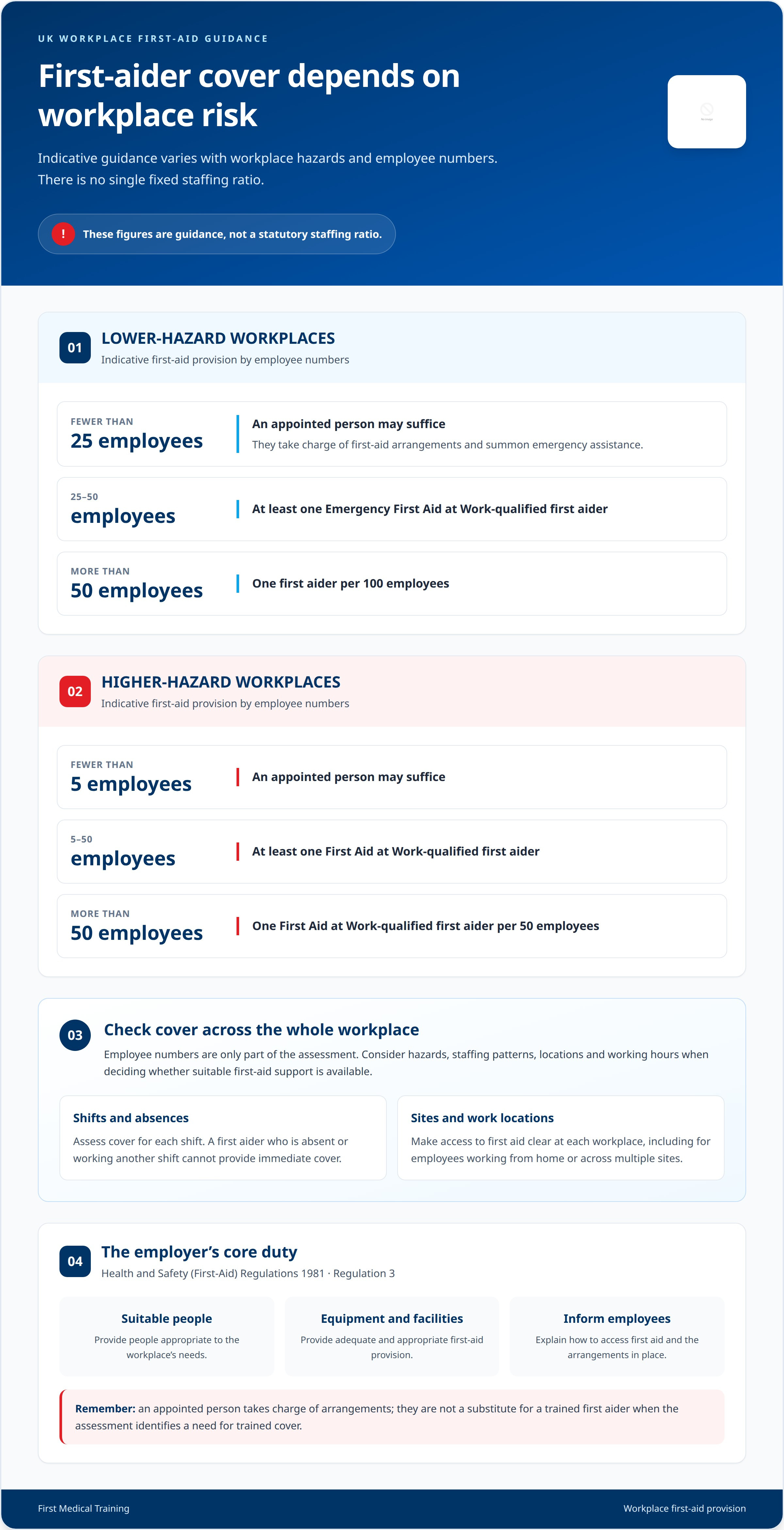
First-aid provision should reflect the needs of each workplace rather than follow a fixed headcount formula. Each workplace needs an appointed person or trained first aider according to its hazards, staffing and first-aid needs assessment.
Appointed persons and trained first-aiders
An appointed person takes charge of first-aid arrangements; a trained first aider has completed a relevant course. An appointed person is not a substitute for a trained first aider when the assessment identifies a need for trained cover.
For a low-hazard workplace with fewer than 25 employees, an appointed person may be sufficient. They can look after the arrangements and summon emergency assistance, but should not be treated as a qualified responder. Match the role to the actual risks and likely incidents at work.
Assessing first-aider numbers
The number of first aiders depends on workplace hazards and employee numbers, with different indicative figures for lower- and higher-risk settings. For low-hazard workplaces, guidance indicates:
- Fewer than 25 employees: an appointed person may suffice.
- 25-50 employees: at least one EFAW-qualified first aider.
- More than 50 employees: one first aider per 100 employees.
For higher-hazard workplaces, guidance indicates:
- Fewer than five employees: an appointed person may suffice.
- 5-50 employees: at least one First Aid at Work-qualified first aider.
- More than 50 employees: one First Aid at Work-qualified first aider per 50 employees.
These figures are guidance, not a statutory staffing ratio. A construction workplace, for example, should consider its specific hazards as well as employee numbers when deciding what provision is suitable. In specialist fields such as industrial surface preparation and coatings, platforms like dangleacademy.com provide trade-specific training that supports broader site safety and risk mitigation alongside first-aid compliance.
Coverage across shifts
Shift coverage means keeping first-aid arrangements available whenever employees are working. A trained first aider who is absent, on leave or working another shift cannot provide immediate cover.
Consider staffing patterns, locations and working hours when deciding how many first aiders are needed. If a workplace runs separate shifts, assess cover for each shift rather than counting only the total number of trained staff. Check that employees can reach an aider and equipment during every working period.
Review the arrangements when staffing, hazards or working patterns change. If your assessment identifies a need for trained workplace responders, an Emergency First Aid at Work course may help meet that training need.
First aid needs assessments
A first-aid needs assessment identifies the provision required for a workplace’s risks, people and working arrangements. Review it when conditions change instead of relying on employee numbers alone.
Assessing workplace first-aid needs
A workplace first-aid needs assessment considers hazards, activities, the workforce and access to facilities. A desk-based office and a site with higher-risk tasks may need different arrangements.
Start with health and safety risks, then consider how accidents or illness could occur. Include the work environment, number of people present, work patterns and location of first-aid equipment. Consider whether employees work alone or across several sites, and whether visitors or members of the public could be affected. Make suitable provision for them as well.
There is no set legal review interval. An annual review is commonly used as a minimum routine interval, but update the assessment sooner if work activities, staffing, premises or incidents change. Record why the current provision is suitable and what needs to change. This helps managers show how arrangements address identified risks.
Mental health belongs in the assessment alongside physical hazards. The UK first-aid-at-work guidance was updated with minor amendments in 2024 to emphasise employers’ responsibilities to consider employees’ mental health. Consider how employees can access appropriate support, and whether the existing arrangements address the needs identified. This does not replace assessment of physical injuries or emergency response.
Provision for remote and mobile workers
Assess how remote and mobile workers can access first aid away from a main workplace. A home office, a lone visit and a mobile work task each raise different access considerations.
Include remote, mobile and lone workers in the assessment. Consider what they do, where they work and how they would summon help if injured or unwell. For a home worker, identify how to reach first-aid support; for a mobile employee, consider changing locations and activities.
Set out practical arrangements for each work pattern. For example, a worker visiting customer sites may need clear instructions for contacting a responsible person and accessing first-aid arrangements at the location. A lone worker needs a defined way to report an incident and request help. Check whether equipment and facilities are accessible where the work actually takes place, not just at a central office.
Revisit these decisions when a role changes or new locations are added. A useful assessment describes specific risks, identifies the provision that addresses them and records when an update is needed.
First-aid training and the 2013 amendment
Training should match the first-aid provision identified by your workplace assessment. The 2013 amendment changed how providers are approved, so employers need to consider competence and suitable course content.
Choosing a competent training provider
A competent provider delivers training that prepares staff for the duties identified in the assessment. The course should support adequate first-aid provision, not simply increase the number of employees holding certificates.
The 2013 amendment to regulation 3(2) ended HSE approval of first-aid training providers. Employers therefore need to select a provider based on the course’s relevance, training delivery and assessment of learners. Check that the course content fits the workplace hazards and the role expected of each trained person.
For example, a workplace with higher-risk activities may need staff to complete the broader First Aid at Work qualification. The HSE describes First Aid at Work as a three-day course, which may be delivered over a maximum of ten weeks. Match the course to the needs identified, rather than choosing solely by employee numbers.
Blended learning combines online study with face-to-face practical training. It can let employees complete theory before practising relevant skills with an instructor. Check that learning and assessment cover the practical response expected at work, such as managing a casualty and using available equipment.
Training and certificate renewals
Training and certificate renewal help keep first-aid knowledge current and maintain workplace cover. Workplace first-aid qualifications are valid for three years and must be renewed before expiry.
Plan renewals around certificate expiry dates so trained staff retain their qualification without a gap. Record each employee’s course and renewal date. This helps managers identify when replacement cover may be needed during training or absence.
Workplace first-aid qualifications follow a three-year requalification cycle, with a one-day annual update recommended between requalifications. The update gives first aiders an opportunity to refresh their skills before the next full course, but it does not replace qualification renewal.
Training should reflect each person’s responsibilities. An appointed person who takes charge of arrangements has a different role from a trained first aider expected to provide first aid. Use the workplace assessment to identify the role required, then select training accordingly. Review the decision if activities or risks change, and schedule renewal before certificates expire.
What First Aid Equipment Is Required?
The Health and Safety (First-Aid) Regulations 1981 require first-aid equipment and facilities to be adequate and appropriate to workplace circumstances. The right contents depend on the risks identified in your assessment.
A low-hazard workplace kit may include individually wrapped sterile plasters, sterile eye pads, triangular bandages, safety pins, wound dressings, disposable gloves and guidance leaflets. Other equipment may be appropriate where workplace hazards or tasks create different needs. Mark the kit clearly with a white cross on a green background so employees can find it promptly in an emergency.
BS 8599-1 is the British Standard for workplace first-aid kits, but buying a kit to that standard is not a regulatory requirement. Use it as a reference when selecting equipment, then consider whether the contents suit your workplace. A kit intended for a low-hazard office may not address the needs of a workplace with different risks.
Eye irrigation is another practical consideration. If mains tap water is not readily available, HSE guidance advises providing at least one litre of sterile water or sterile normal saline in sealed disposable containers. Choose provision that suits the workplace and its access to suitable water.
Make kit maintenance part of workplace readiness. Replace sterile items by their expiry dates and replenish used supplies so equipment is ready when needed. Assign responsibility for routine checks and tell employees where the kit is kept. A clearly marked kit is of little use if staff cannot find it or its supplies have expired.
An accident book can help record incidents and support an internal review of workplace readiness. Keep records in line with your organisation’s procedures, and use incident patterns to identify whether equipment or arrangements need attention. For example, repeated minor cuts in one work area may prompt a review of hazards and suitable protective measures.
UK health and safety legislation does not require an automated external defibrillator (AED). Consider one as part of wider first-aid planning, based on workplace circumstances and identified needs. If you provide an AED, tell staff where it is and how to access it in an emergency.
Choose each item for a practical purpose: dressings for wounds, gloves for protection and sterile water for eye irrigation where needed. This keeps equipment appropriate, accessible and ready to use, rather than relying on a generic kit to meet every workplace’s needs.
First Medical Training
First Medical Training Ltd helps you develop workplace response skills through training suited to the needs identified in your assessment. Choose an Emergency First Aid at Work Course (EFAW) - 1 Day for general workplace first-aid skills, or an Automated External Defibrillator (AED) Training Course when your arrangements include an AED. Dental teams can consider the Medical Emergencies in a Dental Practice Course or Dental Immediate Life Support (ILS) Training for clinical emergency scenarios.
These courses support staff development; your first-aid needs assessment should guide which training is appropriate and who needs it. Match course selection to the hazards, roles and emergency procedures at your workplace, rather than choosing by headcount alone.
For guidance on training options for your workplace, contact First Medical Training Ltd.
Put your workplace response plan into practice
Understanding HSE first-aid regulations for businesses in the UK is a starting point; the next step is making sure arrangements work in practice. Assign responsibility for keeping your response plan current, and include first-aid awareness in staff induction and updates when the workplace changes. A new task, site or working pattern can affect access to help, so build reviews into your health and safety processes.
Think beyond written procedures. Staff should know how to act, where to find equipment and how to raise the alarm. Clear communication and suitable training turn a documented plan into a practical response, while regular review keeps arrangements aligned with your workplace.
If you’re ready to discuss training that fits your workplace needs, contact First Medical Training. A considered next step can help your team feel more prepared to respond calmly and appropriately when an emergency occurs.
Frequently Asked Questions
Is First Aid Training a Legal Requirement for Employers?
Employers must provide suitable first-aid arrangements, but the law does not require every employee to complete first-aid training. Your needs assessment determines whether trained first aiders are needed or an appointed person is sufficient. A small, low-hazard office may need different provision from a site with higher-risk work. The requirement is to provide the right level of workplace cover, not to train every employee.
What are the Health and Safety (First-Aid) Regulations 1981?
They are UK regulations requiring employers to provide adequate first-aid provisions in the workplace. According to The National Archives, Regulation 3 covers suitable people, equipment and facilities, as well as informing employees about arrangements. In practical terms, a business needs provision suited to its circumstances, rather than a standard package for every workplace. The regulations support prompt help when someone becomes ill or injured at work.
First Aid Kits: What Must They Contain?
No single kit list suits every workplace; contents should reflect the risks identified in your assessment. For a low-hazard setting, HSE guidance recommends items such as sterile dressings, eye pads, triangular bandages, gloves and guidance leaflets. Tasks involving eye hazards may call for suitable eye-irrigation provision. Keep sterile supplies within their expiry dates and replenish items after use.
What Is a 'Suitable Person'?
Depending on workplace needs, a suitable person may be designated to take responsibility for first-aid arrangements or be a trained first aider selected to provide first aid. An appointed person can oversee arrangements and summon help, but does not hold the same role as a qualified first aider. If your assessment identifies a need for a trained responder, appointing someone only to manage the kit does not meet that need.
What Is a First Aid Needs Assessment?
A first-aid needs assessment reviews workplace hazards, activities, people and working patterns to determine suitable provision. Consider who may be affected, including visitors, and how workers access help at different locations. A mobile employee working alone, for example, has different access needs from a colleague based at a staffed office. Revisit the assessment when tasks, premises or staffing arrangements change.
What Is the Difference Between EFAW and FAW?
Emergency First Aid at Work (EFAW) provides basic emergency-response training, while First Aid at Work (FAW) covers a broader range of injuries and medical conditions. EFAW includes topics such as CPR, AED use, choking and bleeding. FAW covers those topics as well as further conditions and injuries, including fractures, burns and major bleeding. The appropriate course depends on your workplace risks and the level of provision identified.
What first aid equipment must UK businesses provide, including first aid kits?
Businesses must provide first-aid equipment and facilities that are adequate and appropriate to their circumstances. A kit is only one part of provision: consider whether employees can access it promptly and whether its contents suit workplace risks. If mains tap water is not readily available for eye irrigation, HSE guidance advises sealed containers holding sterile water or sterile normal saline. UK legislation does not require every workplace to have an AED.
What are the differences between Emergency First Aid at Work and First Aid at Work training?
EFAW is a shorter course focused on immediate response to common emergencies; FAW provides broader training for workplace first aiders. The HSE describes FAW as a three-day course, which may be delivered over a maximum of ten weeks. FAW includes EFAW subjects as well as additional illnesses, medical conditions and injuries. Use your assessment to choose the qualification that matches workplace hazards, not simply the course length.