

LifeVac vs Heimlich Manoeuvre Effectiveness: What the Evidence Can Tell You

Could a suction device outperform the Heimlich manoeuvre in a real choking emergency? The question behind LifeVac vs Heimlich manoeuvre effectiveness is understandable: when seconds matter, conflicting claims can make it hard to know which approach to trust. But these are not interchangeable options, and the evidence does not support using a device as a substitute for recognised first aid.
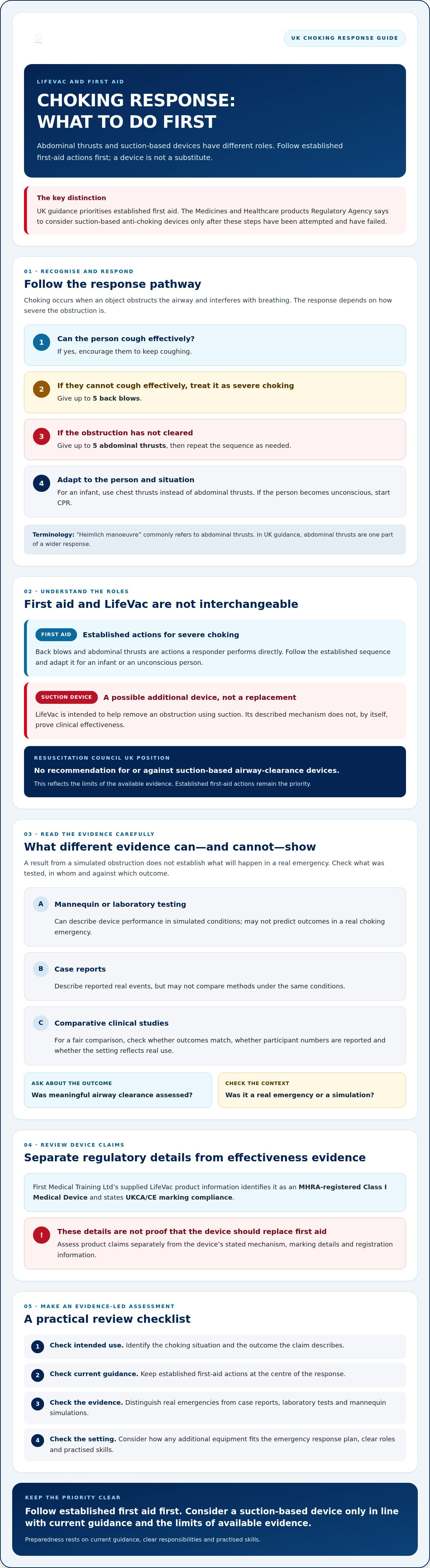
UK guidance prioritises encouraging the person to cough, then giving back blows and, if needed, abdominal thrusts. The Medicines and Healthcare products Regulatory Agency says suction-based anti-choking devices should be considered only after these established steps have been attempted and have failed. Resuscitation Council UK makes no recommendation for or against these devices, reflecting the limits of the available evidence.
This article explains how the approaches differ and what studies can, and cannot, tell you about their effectiveness. You’ll learn why mannequin results and case reports do not provide the same certainty as high-quality clinical evidence, how to assess product claims, and why training and a prompt emergency response should remain central to preparedness. This context can help you make an informed decision about equipment without losing sight of what to do first.
Key Takeaways
- Understand why the Heimlich manoeuvre, usually referring to abdominal thrusts, is one part of a wider choking response rather than the whole protocol.
- Assess LifeVac vs Heimlich manoeuvre effectiveness by checking the type and quality of evidence, not relying on promotional claims or isolated reports.
- Recognise that Resuscitation Council UK guidance prioritises established first-aid actions and makes no recommendation for or against suction-based airway-clearance devices.
- Use a practical checklist to review intended use, current guidance, evidence and how a device would fit your setting’s emergency response plan.
- Build preparedness around current guidance, clear roles and practised skills, then assess whether additional equipment is appropriate for your circumstances.
LifeVac vs the Heimlich manoeuvre: what exactly are you comparing?
Choking occurs when an object obstructs the airway and interferes with breathing. The response depends on the severity of the obstruction. If the person can cough effectively, encourage them to keep coughing. If they cannot cough effectively, the obstruction may be severe and needs immediate first aid. If the person becomes unconscious, start CPR.
In brief: first-aid manoeuvres are actions a responder performs directly, while LifeVac is a mechanical device intended to clear an airway using suction. They have different roles, so a fair comparison of LifeVac vs Heimlich manoeuvre effectiveness must consider the situation and outcome being assessed. A result from a simulated obstruction, for example, cannot establish what will happen in a real emergency.
What does the term Heimlich manoeuvre mean in UK guidance?
“Heimlich manoeuvre” commonly means abdominal thrusts. UK guidance describes a broader sequence for a conscious person with severe choking: give up to five back blows, then up to five abdominal thrusts if the back blows have not cleared the obstruction. Repeat the sequence as needed. For an infant, use chest thrusts instead of abdominal thrusts. If the person becomes unconscious, start CPR.
The Heimlich manoeuvre article outlines the familiar term and its history, but use current Resuscitation Council UK guidance to direct your actions. Abdominal thrusts are one part of a response, not a standalone treatment for every choking emergency.
What is LifeVac designed to do?
LifeVac is a suction-based anti-choking device. Its intended function is to help remove an obstruction by suction, but that description does not prove clinical effectiveness. Assess evidence for the device separately from its mechanism, including whether findings come from real emergencies, clinical research or simulated conditions.
First Medical Training Ltd offers the LifeVac Anti-Choking Device. Its supplied product information identifies it as an MHRA-registered Class I Medical Device and states UKCA/CE marking compliance. These are regulatory and marking details, not evidence that it should replace established first aid. Resuscitation Council UK makes no recommendation for or against suction-based airway-clearance devices, and established actions should be prioritised.
Keep the comparison practical: ask whether a study assessed the same type of choking emergency, the same point in the response and a meaningful outcome, such as clearing an obstruction. Without those details, a headline claim cannot show which approach is more effective in real-world use.
How should you judge evidence on LifeVac vs Heimlich manoeuvre effectiveness?
To judge LifeVac vs Heimlich manoeuvre effectiveness, look beyond a headline result and ask what was tested, in whom and against which outcome. Resuscitation Council UK guidance establishes the recommended first-aid sequence; research into a device addresses a separate question. Neither a product claim nor a study in a controlled setting automatically shows which approach performs better in a real choking emergency.
Use this table to distinguish what different types of evidence can tell you:
| Intervention or source | Intended role | Evidence type | Measured outcome | Key limitation |
|---|---|---|---|---|
| Back blows and abdominal thrusts | Established first-aid actions for severe choking | Clinical guidance and reports from real events | Whether an obstruction is cleared; reported complications | Case data may not compare methods under the same conditions |
| LifeVac | Suction-based device considered as an adjunct | Case reports, laboratory or mannequin testing, and any clinical studies | Device performance or reported airway clearance | Simulated results may not predict outcomes in real emergencies; reports may lack a comparison group |
| LifeVac compared directly with first aid | Assess relative outcomes in defined scenarios | Comparative clinical studies | Matching outcomes, such as obstruction clearance and adverse events | Conclusions depend on study quality, participant numbers and whether the setting reflects real use |
Studies with different designs cannot establish a simple head-to-head winner, because they may test different people, situations and outcomes. A mannequin study can assess performance under controlled conditions, but cannot by itself establish clinical effectiveness. A case report records what happened in one instance. It cannot show how often the same outcome occurs or prove that the device caused it.
What evidence would support a fair comparison?
Look for studies that compare the interventions in similar choking scenarios and patient groups, using clearly defined outcomes and follow-up periods. Check whether authors report unsuccessful attempts, adverse events and study limitations. Confirm findings in the original publication rather than relying on a promotional summary. For first-aid context, consult current Resuscitation Council UK guidance. The Mayo Clinic's choking first-aid guide offers an additional overview, but UK guidance should inform UK practice.
Why can testimonials and isolated cases mislead?
A successful individual case can describe an experience, but it cannot establish comparative effectiveness or estimate risk. Testimonials may omit unsuccessful uses, the total number of attempts or other actions taken at the same time. This can create selection and publication bias: successful or striking stories may be more likely to be shared than routine or unsuccessful outcomes. Treat them as reports, not proof.
For practical preparedness, pair evidence review with training and a rehearsed response. Explore first aid courses as one way to support confident, practised action.
LifeVac and abdominal thrusts compared: roles, limits and risks
These approaches have different places in an emergency response. Abdominal thrusts are an established first-aid action within a wider sequence. According to Medicines and Healthcare products Regulatory Agency (MHRA) guidance, LifeVac is a suction-based device that may be considered only after standard first-aid protocols have been attempted and have failed. Resuscitation Council UK prioritises established actions that can be started without equipment.
For LifeVac vs Heimlich manoeuvre effectiveness, compare each option in context rather than treating a device and one manoeuvre as direct substitutes.
| Consideration | Abdominal thrusts | LifeVac |
|---|---|---|
| Role in response | An established first-aid action for severe choking, used as part of the recommended response. | An adjunct device, not a replacement for established first-aid actions. |
| What the responder does | Uses a taught physical first-aid technique, following current guidance for the person and situation. | Uses a mechanical suction device according to its current manufacturer instructions. |
| Preparation | Learn and practise choking first aid so you can act promptly. | Check intended use and instructions, and consider how the device fits the response plan. |
| Evidence limits | Guidance supports its place in the response, but does not provide a direct comparison with a device. | Evidence from cases or simulations cannot, on its own, establish real-world comparative effectiveness. |
| Guidance alignment | Part of established choking first aid. | Not recommended for or against by Resuscitation Council UK; do not let it displace first-line actions. |
Can a suction device replace recognised choking first aid?
No. Resuscitation Council UK’s current choking guidance prioritises established first-aid actions and makes no recommendation for or against suction-based airway-clearance devices. The MHRA positions devices such as LifeVac for use only after established Basic Life Support protocols have been attempted and have failed. Don’t pause to find or prepare a device before starting the recommended response.
What limitations should you consider before relying on a device?
Check the manufacturer’s current instructions, including who the device is intended for, and make sure it is accessible and ready if you choose to include it in your plans. Don’t assume that owning a device prepares everyone to respond. Agree who will act, how the device fits the setting’s emergency response plan and how staff will keep their first-aid skills current. Be cautious of claims that are not supported by evidence relevant to the situation.
A device can create false reassurance if people expect it to replace training or delay established care while they locate it. Keep roles clear, practise the recognised response and assess any additional equipment as part of preparedness, not as a reason to change the order of care.
How to make a safe, evidence-led decision about LifeVac
Decide whether an anti-choking device belongs in your setting only after reviewing current first-aid guidance, the evidence and your team’s response plan. Resuscitation Council UK prioritises established choking first aid; a device should not distract from those actions or delay them. Use this checklist to guide your assessment.
- Confirm current guidance. Check Resuscitation Council UK recommendations and the Medicines and Healthcare products Regulatory Agency’s guidance on anti-choking devices. Make sure your approach follows the established response before considering additional equipment.
- Check the exact device and intended use. Read the manufacturer’s current instructions and confirm that they apply to the device you’re considering. Don’t rely on a product description alone.
- Review evidence and regulatory information. Look for original research, note its limitations and distinguish regulatory status from evidence of clinical effectiveness. Verify any registration or marking details against current authoritative records before purchase or use.
- Plan training and access. Decide who would respond, where equipment is kept and how staff would access it without delaying first aid. Practise the established response and make sure the device’s role is clear to the team.
For a dental practice, ask whether the device fits the Dental emergency response plan, including staff roles, escalation and access to emergency equipment. If staff are not clear about what to do first, purchasing another device will not resolve that gap. Use the dental practice emergency preparedness checklist to review wider readiness, then check that your procedures and staff preparation work together.
Prepare your team as well as your equipment
Set out who leads the response, who contacts emergency services and who retrieves equipment, while keeping first aid as the priority. Rehearse the plan so staff know how to act under pressure. A medical emergencies in a dental practice course can support your team’s preparation and help connect learning with the clinical setting.
Equipment and training do not need to be competing choices. Assess both against current guidance, the quality of available evidence and your practice’s needs. If you have reviewed these points and want to assess the device itself, explore the LifeVac anti-choking device alongside your established emergency response arrangements.
LifeVac vs Heimlich manoeuvre: training and next steps
Turn your emergency plan into a routine the whole team can follow. Assign roles, make sure everyone knows where equipment is kept and schedule practice so staff can work through their responsibilities together. A clear process helps your team move from written guidance to coordinated action.
What does effective preparation look like in practice?
Use team discussions and practice sessions to check that staff understand the agreed response and can find the equipment they may need. Review the plan when the practice layout, equipment or team changes. Keep it grounded in current professional guidance, and give any device a defined place in the plan rather than leaving staff to decide how to use it during an emergency.
Where can dental teams build emergency response confidence?
First Medical Training Ltd provides medical emergency and dental CPD training. Its training offer includes the Medical Emergencies in a Dental Practice Course and Dental Immediate Life Support (ILS) Training. Consider how relevant training can support your team’s learning and rehearsal, without treating course attendance as a guarantee of a particular outcome.
If you’re reviewing equipment as part of that preparation, explore the LifeVac anti-choking device. Assess it alongside your team’s training and emergency arrangements, so staff understand its intended place in the plan.
Make preparedness your next step
The LifeVac vs Heimlich manoeuvre effectiveness question cannot be answered by comparing isolated claims or unlike study results. The evidence has limits, so do not treat a device as a proven replacement for recognised choking first aid. Base your response on current guidance, clear responsibilities and skills your team has practised.
If you’re considering LifeVac, assess its intended role alongside your emergency plan, check the manufacturer’s current instructions and verify current regulatory and marking details. First Medical Training Ltd lists the LifeVac Anti-Choking Device among its offerings. Its supplied product information identifies it as an MHRA-registered Class I Medical Device and states UKCA/CE marking compliance; check current details before purchase or use.
First Medical Training Ltd provides specialised training, including courses for dental teams. Take a measured next step: explore First Medical Training Ltd’s LifeVac anti-choking device as part of a wider, well-practised emergency response. With preparation and clear roles, your team can approach an emergency with greater confidence.
Frequently Asked Questions
Is LifeVac more effective than the Heimlich manoeuvre?
Current evidence does not establish that LifeVac is more effective than abdominal thrusts in real choking emergencies. Resuscitation Council UK makes no recommendation for or against suction-based airway-clearance devices, reflecting limitations in the evidence. LifeVac and first-aid actions also have different roles, so a fair comparison needs similar scenarios and outcomes. Follow current UK choking guidance first, and assess device claims against the quality and relevance of the evidence.
Can LifeVac replace abdominal thrusts during a choking emergency?
No. Resuscitation Council UK guidance prioritises established first-aid actions, including back blows and, when needed, abdominal thrusts for severe choking in adults and children. The Medicines and Healthcare products Regulatory Agency states that anti-choking devices should be used only after established Basic Life Support protocols have been attempted and failed. Don’t delay first aid to locate or prepare a device. Follow current guidance and the manufacturer’s instructions.
What does the evidence say about LifeVac?
Evidence includes reports of individual cases and simulated or laboratory testing, but these study types have limits. A successful case cannot establish how often a device works, while a mannequin test cannot by itself show what will happen in a real emergency. Check whether a study is independent, peer-reviewed and relevant to the situation being considered. Treat promotional summaries and testimonials cautiously, and verify claims against original research and current clinical guidance.
Is the Heimlich manoeuvre the same as abdominal thrusts?
The term “Heimlich manoeuvre” commonly refers to abdominal thrusts, but UK guidance describes a wider response to severe choking. For a conscious adult or child, encourage coughing first if effective; if not, give up to five back blows, followed by up to five abdominal thrusts if needed. For an infant, use chest thrusts instead of abdominal thrusts. If the person becomes unconscious, start CPR and follow emergency guidance.
Should a dental practice keep an anti-choking device?
A dental practice can assess whether an anti-choking device fits its setting and documented emergency response plan, but it should not treat the device as a substitute for first-aid training or established procedures. Resuscitation Council UK makes no recommendation for or against suction-based devices. Consider whether staff can access and understand it, and review current manufacturer instructions and relevant guidance. Keep the team’s roles, equipment access and first-aid response clear.
Is LifeVac an MHRA-registered medical device?
First Medical Training Ltd’s supplied product information identifies LifeVac as an MHRA-registered Class I Medical Device and states UKCA/CE marking compliance. Regulatory status and marking details can change, so verify the current information for the exact device against authoritative records before purchase or use. Registration or marking does not, by itself, establish comparative clinical effectiveness. Follow the manufacturer’s current instructions and keep established choking first aid as the priority.
What should I do if someone is choking?
If the person can cough effectively, encourage them to keep coughing and watch for worsening symptoms. If coughing is ineffective, give up to five back blows. If these do not clear the obstruction, give up to five abdominal thrusts for an adult or child, repeating the sequence as needed. Use chest thrusts for an infant. If the person becomes unconscious, call 999 and start CPR. Follow current Resuscitation Council UK guidance and your training.