

Managing Patient Collapse: A Guide to Dental Surgery Training and ILS Protocols

Imagine the clinical silence of your surgery is suddenly broken by the sound of a patient slipping from the chair; do you know exactly who reaches for the oxygen and who retrieves the AED without a single word being exchanged? Most dental professionals admit that while they've read the guidelines, the thought of a real-life emergency still triggers a spike of adrenaline and a moment of role confusion. It's a significant pressure, especially when you consider that the GDC expects every team member to be a capable responder. Investing in high-quality patient collapse dental surgery training isn't just about ticking a regulatory box; it's about replacing that initial panic with rehearsed, clinical precision.
We understand that the balance between administering emergency drugs and deploying an AED can feel daunting when every second counts. This guide will help you master the clinical protocols and team-based responses required to manage a patient collapse safely within a dental surgery environment. We'll break down the latest Resuscitation Council UK standards, clarify specific team roles during a medical crisis, and outline how you can achieve your required verifiable CPD with confidence. You'll move from uncertainty to being a seasoned mentor for your team, ensuring patient safety remains at the heart of your practice.
Key Takeaways
- Master the ABCDE assessment to quickly differentiate between simple syncope and life-threatening cardiac arrest.
- Learn how structured patient collapse dental surgery training transforms individual knowledge into a coordinated team response using the "pit-crew" model.
- Discover why "closed-loop" communication is the gold standard for preventing clinical errors during high-pressure emergencies.
- Gain clarity on the immediate use of emergency oxygen and suction as part of a structured airway management protocol.
- Understand the latest GDC requirements for verifiable CPD and why Immediate Life Support (ILS) is the benchmark for dental clinicians.
Understanding Patient Collapse in the Dental Surgery Environment
In a clinical dental context, a patient collapse is defined as a sudden loss of consciousness accompanied by a loss of postural tone. It's a high-stakes moment that demands immediate, structured action. While major life-threatening events are relatively infrequent, medical emergencies occur with enough regularity in UK practices that preparedness is a core requirement of modern dentistry. You aren't just managing a clinical event; you're managing a crisis in a confined, high-pressure space.
The dental surgery presents unique challenges for emergency response. You're often working with a patient in a supine position, surrounded by specialised equipment and sharp instruments. This physical layout can complicate access for resuscitation and the deployment of an AED. Beyond the logistics, the psychological impact on the team is intense. Without regular patient collapse dental surgery training, the natural human response is often one of hesitation. A calm, organised approach doesn't just save the patient; it protects the professional confidence of every staff member involved.
Common Triggers for Collapse During Treatment
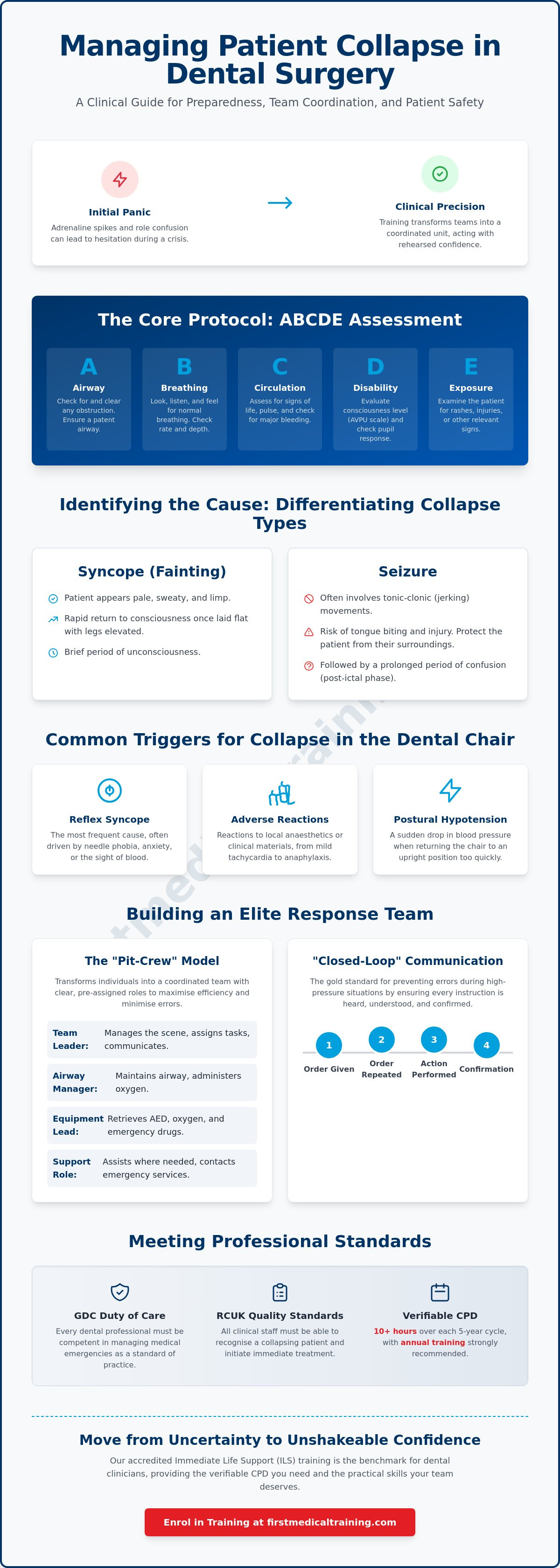
Most incidents in the chair are triggered by the physiological stress of dental procedures. Reflex syncope, commonly known as fainting, is the most frequent cause. This is often driven by needle phobia, intense anxiety, or even the sight of blood. Other triggers include adverse reactions to local anaesthetics or clinical materials, which can range from mild tachycardia to full anaphylaxis. Additionally, postural hypotension is a common risk, especially in elderly patients or those on certain medications, when the dental chair is returned to an upright position too quickly after a long procedure.
The Legal and Professional Duty of Care
The General Dental Council (GDC) is clear: every registered dental professional has a duty to be competent in managing medical emergencies. This isn't a suggestion; it's a standard of practice. The Resuscitation Council UK (RCUK) provides the clinical framework through their Quality Standards for Primary Dental Care, last updated in May 2020. These guidelines state that all clinical staff must be able to recognise and initiate treatment for a collapsing patient. To maintain your registration and meet your professional obligations, you must complete at least 10 hours of verifiable CPD in medical emergencies over each five-year cycle. However, the RCUK and GDC strongly advocate for annual patient collapse dental surgery training to keep skills sharp and responses instinctive.
Identifying the Cause: Differentiating Types of Collapse
When a patient loses consciousness, the first ten seconds are the most critical for your diagnostic accuracy. You must resist the urge to act on impulse and instead follow the "Look, Listen, Feel" approach. By looking for chest movement, listening for breath sounds, and feeling for expired air against your cheek, you can immediately determine if the patient is in respiratory or cardiac arrest. Whilst syncope is the most frequent event in the chair, assuming every collapse is a simple faint is a dangerous clinical oversight. This level of diagnostic clarity is exactly what we focus on during our patient collapse dental surgery training sessions.
A comprehensive review of Dental Emergencies highlights that many incidents are predictable if the medical history is scrutinised before treatment begins. For example, a patient with poorly controlled diabetes is at a higher risk of a "silent" hypoglycaemic collapse, which can mimic syncope but requires entirely different intervention. Your ability to cross-reference the patient's current symptoms with their known medical history can mean the difference between a controlled recovery and a worsening crisis.
Syncope vs. Seizures: Key Clinical Indicators
Differentiating between a faint and an epileptic fit requires a keen eye for detail. A patient experiencing syncope will typically be pale, sweaty, and limp, with a rapid return to consciousness once placed in the supine position with legs elevated. In contrast, a seizure often involves tonic-clonic movements, possible tongue biting, and a prolonged period of confusion known as the post-ictal phase. Your immediate management for a seizure involves protecting the patient from injury by clearing equipment away and monitoring their airway, only transitioning to active intervention with buccal midazolam if the seizure is prolonged or repeated.
Cardiac and Respiratory Emergencies
Cardiac events often present with acute chest pain, but a full collapse indicates the situation has escalated to a myocardial infarction or cardiac arrest. You must also be vigilant for the rapid onset of anaphylaxis, where the window for identifying skin changes, stridor, or a wheeze is incredibly narrow. Recognising these signs early allows for the prompt administration of adrenaline, which is life-saving in this context. Refining these diagnostic skills is a core component of our Medical Emergencies in a Dental Practice Course, ensuring your team can act with certainty.
Effective identification also means knowing when to call for help. If a patient doesn't respond to initial syncope management or shows signs of respiratory distress, your protocol must trigger an immediate call for an ambulance. Every second you spend second-guessing the cause is a second lost in the chain of survival.
The ABCDE Assessment: Immediate Life Support Protocol
Once you've identified that a collapse has occurred, the ABCDE assessment becomes your operational roadmap. This systematic approach ensures that life-threatening conditions are treated in order of priority, preventing the team from being distracted by less critical symptoms. In the context of patient collapse dental surgery training, the ABCDE protocol is adapted to the specific environment of the clinic, where high-volume suction and specialised seating play a role in the initial response.
- Airway (A): Ensure the airway is patent using the head-tilt, chin-lift manoeuvre. In a dental setting, you must immediately clear any foreign bodies, such as cotton wool rolls or debris, using high-volume suction if necessary.
- Breathing (B): Look, listen, and feel for no more than ten seconds. If breathing is absent or abnormal, such as agonal gasps, start CPR immediately. If the patient is breathing, assess the rate and depth to identify respiratory distress.
- Circulation (C): Check the pulse and capillary refill time. Cold extremities or a weak, thready pulse may indicate shock or severe syncope.
- Disability (D): Assess consciousness levels using the AVPU scale (Alert, Voice, Pain, Unresponsive). A declining score indicates a worsening clinical state.
- Exposure (E): Check for visible rashes, which might suggest anaphylaxis, or medical alert jewellery that provides vital clues to underlying conditions like epilepsy or diabetes.
Managing the Patient in the Dental Chair
The physical management of a patient depends entirely on the diagnosis. For simple syncope, the "head down, feet up" position is standard. Modern dental chairs usually have a Trendelenburg feature specifically for this purpose. However, if the patient is in cardiac arrest, you must move them to the floor immediately. Performing chest compressions on a dental chair is ineffective because the upholstery and the chair's suspension absorb the force of the compressions. Your team should rehearse the transition from chair to floor to ensure it's done safely and without delay. Ergonomically, the person performing compressions should be positioned at the patient's side, with shoulders directly over their hands to maintain high-quality CPR without premature fatigue.
Oxygen Administration and Monitoring
In almost every medical emergency, high-flow oxygen is essential. The standard flow rate for a collapsing patient is 15 litres per minute using a non-rebreather mask with a reservoir bag. If the patient isn't breathing effectively, a bag-valve-mask (BVM) should be used. This is ideally a two-person technique where one member maintains the airway seal whilst the other provides ventilations. Whilst pulse oximetry is a useful tool, it has limitations in a crisis. During a collapse, peripheral perfusion may be poor, leading to inaccurate or delayed readings. Never delay clinical action whilst waiting for a digital reading; always treat the patient based on your clinical observations.
Team Dynamics and Emergency Equipment Coordination
Managing a patient in crisis is a team sport. Even the most skilled clinician cannot effectively manage an airway, perform chest compressions, and prepare emergency drugs simultaneously. This is why patient collapse dental surgery training emphasises the "Pit-Crew" model. In this framework, every member of the practice has a pre-assigned station. The Team Leader, typically the dentist, oversees the ABCDE assessment and directs the response. The Airway person manages oxygen and suction, whilst the Circulation person handles chest compressions or AED pad placement. Finally, the Runner retrieves equipment and communicates with emergency services.
Effective communication is the glue that holds this model together. During a collapse, verbal instructions should follow a "closed-loop" pattern. When the leader says, "Call an ambulance and request an AED," the responder repeats back, "Calling an ambulance and fetching the AED now." This simple repetition confirms the instruction was heard and prevents critical tasks from being missed in the noise of the surgery. Clear Standard Operating Procedures (SOPs) should be displayed near every phone, detailing the practice's postcode and specific instructions for guiding the ambulance crew to the correct entrance.
The Role of the Dental Nurse and Receptionist
The contribution of the non-clinical team is often the difference between a chaotic response and a controlled one. Whilst the clinical team focuses on the patient, the receptionist takes on the vital role of managing the environment. They must reassure other patients in the waiting room and clear the path for paramedics. Within the surgery, the dental nurse often acts as the scribe, recording the exact times drugs were administered or shocks delivered. This accurate record is essential for the handover to the ambulance crew, ensuring continuity of care.
Utilising Emergency Equipment
Immediate access to an AED is a GDC requirement, but its effectiveness depends on the team's speed. The AED should be retrieved at the first sign of unresponsiveness. Once the pads are applied, the device provides clear voice prompts, but the team must ensure the environment is safe before a shock is delivered. Your ability to select the correct intervention comes from the medical emergencies in dental practice course, which teaches you to distinguish between drug-led interventions and mechanical ones. For instance, if a collapse is caused by a complete airway obstruction, an anti-choking device like the LifeVac may be required when standard thrusts fail.
To ensure your team is fully prepared for these high-pressure scenarios, consider booking our Dental Immediate Life Support (ILS) Training to rehearse these roles in your own clinical environment.
Meeting GDC Standards through Accredited Dental ILS Training
Whilst Basic Life Support (BLS) provides the fundamental skills for resuscitation, it often falls short of the clinical requirements for a modern dental practice. Immediate Life Support (ILS) is the professional benchmark, incorporating advanced airway management, the use of emergency drugs, and team-based coordination. Choosing the right patient collapse dental surgery training ensures that your team isn't just following a generic first aid manual but is applying protocols specifically designed for the clinical environment. This distinction is vital when managing a casualty in the unique physical constraints of a dental chair.
Verifiable CPD is a cornerstone of professional registration. The GDC is clear that medical emergency training must be updated annually, and all registrants must complete a minimum of 10 hours of verifiable CPD in this area over each five-year cycle. When selecting a provider, you must ensure their curriculum aligns with the Resuscitation Council UK (RCUK) Quality Standards, which were last updated in May 2020. A certificate is only as valuable as the training it represents; it must prove that your team has engaged in practical, scenario-based learning that meets these rigorous standards.
Training within your own practice offers a distinct advantage over external centres. It allows you to identify specific logistical challenges, such as the narrowness of a particular hallway or the exact location of the emergency kit in a crisis. Developing a culture of preparedness involves more than an annual visit from a trainer. It requires regular "mock drills" where the team can practise their "pit-crew" roles without the pressure of a real casualty. These rehearsals ensure that when a real collapse occurs, the response is instinctive rather than reactive.
Why First Medical Training is the Professional Choice
With a 20-year history of specialising in dental emergency education, we understand the unique pressures of your field. Our courses don't just meet GDC and RCUK standards; they exceed them by providing hands-on, pragmatic instruction delivered by experienced medical professionals. We bridge the gap between theoretical knowledge and clinical confidence, ensuring your team is ready to act when it matters most. We don't just teach the protocols; we help you embed them into your daily practice culture.
Next Steps for Your Practice
The first step toward total readiness is a thorough audit of your current equipment. Check the expiry dates on your emergency drug kit and ensure your AED is fully functional with fresh pads. Once your hardware is in order, the next priority is your software: the skills of your team. Booking an annual patient collapse dental surgery training session ensures that every staff member, from the lead clinician to the newest receptionist, knows exactly how to respond. Contact our team today at First Medical Training to develop a bespoke training plan that fits the specific needs of your practice.
Elevating Your Clinical Response
Mastering the response to a medical crisis is about more than personal competence; it's about the seamless coordination of your entire team. By adopting the systematic ABCDE approach and the "pit-crew" model, you ensure that every second is used effectively when it matters most. Moving beyond basic first aid to structured ILS protocols allows you to lead with the quiet confidence of a seasoned professional. Regular patient collapse dental surgery training is the most effective way to bridge the gap between theoretical guidelines and real-world clinical action.
Since 2006, we've focused exclusively on dental emergency education, providing accredited courses trusted by thousands of healthcare professionals nationwide. Our training is designed to exceed GDC and RCUK standards, focusing on the practical realities of your surgery. Don't leave your team's readiness to chance. Book Your Dental Immediate Life Support (ILS) Training Today and secure the verifiable CPD and peace of mind that comes from being truly prepared. Your patients' safety is your priority, and we're here to support you in protecting it.
Frequently Asked Questions
What are the GDC requirements for medical emergency training?
All dental registrants must complete at least 10 hours of verifiable CPD in medical emergencies and resuscitation over each five-year registration cycle. The GDC expects you to keep up-to-date evidence of your capability, which is why annual updates are considered best practice. This ensures your skills remain current and your practice stays compliant with the Standards for the Dental Team.
Should a collapsed patient always be removed from the dental chair?
No, you shouldn't always remove a patient from the chair. For a simple faint, keeping the patient in the chair and using the Trendelenburg position is usually sufficient. However, if the patient is in cardiac arrest, they must be moved to a hard, flat floor immediately. Performing chest compressions on a cushioned dental chair is ineffective because the chair's upholstery absorbs the force of the compressions.
How often should a dental team practice their emergency response?
Formal patient collapse dental surgery training must be refreshed at least once a year to meet GDC expectations. Beyond this annual requirement, your team should conduct regular mock drills to ensure role clarity and equipment familiarity. These internal rehearsals help maintain the "pit-crew" efficiency required during a real-life crisis, making the formal annual training even more effective.
What is the difference between BLS and ILS training for dentists?
Basic Life Support (BLS) focuses on the core skills of chest compressions and AED use. In contrast, Immediate Life Support (ILS) is specifically tailored for healthcare professionals and includes advanced airway management, the use of emergency drugs, and team leadership skills. For dentists and clinical staff, ILS is the preferred level of training as it reflects the equipment and responsibilities present in a surgery.
Which emergency drugs are mandatory in a UK dental surgery?
The British National Formulary (BNF) specifies a mandatory list of drugs that every UK dental practice must stock. This includes Adrenaline (1:1000), Aspirin (300mg), Glucagon, Glyceryl Trinitrate (GTN) spray, Midazolam (buccal), Oral Glucose, and a Salbutamol inhaler. You must also have the appropriate delivery systems, such as spacers for inhalers and syringes for Glucagon, readily available and within their expiry dates.
Can a dental receptionist take part in medical emergency training?
Absolutely, and it's highly recommended that they do. Whilst receptionists don't perform clinical interventions, they are vital as "Runners" who fetch the AED or manage the arrival of emergency services. Including them in your patient collapse dental surgery training ensures the entire practice operates as a single, coordinated unit during an emergency, which significantly improves patient outcomes.
How do I record a medical emergency for GDC compliance?
You should document every detail of the event in the patient's clinical records, including the time of collapse and the specific actions taken. Record the exact dosages and times for any drugs administered, as well as the patient's vital signs throughout the incident. Following the event, conduct a formal team debrief and record the outcomes; this audit trail is essential for demonstrating GDC compliance and improving future responses.
Is an AED mandatory for all dental practices in the UK?
Yes, an AED is mandatory. The GDC endorses the Resuscitation Council UK's quality standards, which state that all clinical areas in a dental practice must have immediate access to an Automated External Defibrillator. This requirement applies to all practices, regardless of their size or the types of procedures they perform, to ensure the highest level of patient safety in the event of cardiac arrest.