

Mental Health Awareness: A Guide for UK Practice Managers

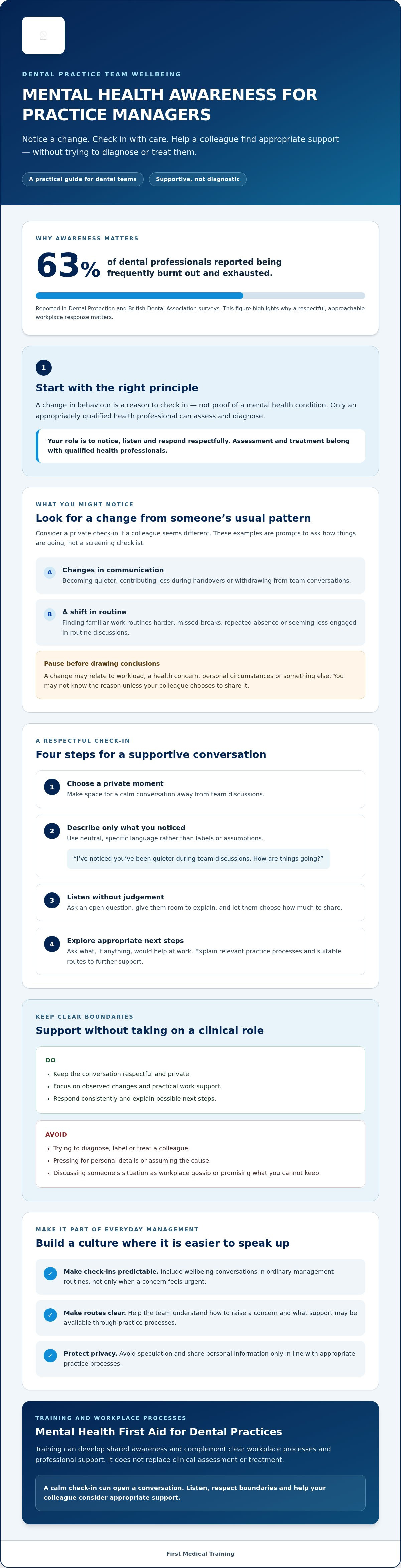
What if a colleague’s missed breaks, irritability or repeated absence is a sign of distress, not simply a difficult week? Dental Protection and British Dental Association surveys from 2024-25 found that 63% of dental professionals reported being frequently burnt out and exhausted. For practice managers, mental health awareness means noticing possible changes without jumping to conclusions, then responding with care while staying within your role.
It’s understandable to feel unsure about starting a sensitive conversation or worry about saying the wrong thing. You don’t need to diagnose a condition. A calm, private check-in and a willingness to listen can help you understand what support may be appropriate.
This guide explains how to notice possible concerns, approach a conversation respectfully and signpost a team member to suitable support. It also covers practical ways to make wellbeing conversations part of everyday management, and how training such as Mental Health First Aid for Dental Practices can complement clear workplace processes and professional support.
Key Takeaways
- Use mental health awareness for practice managers to support a healthier team culture without taking on the role of a clinician.
- Look for changes in behaviour as a reason to check in, not as proof of a particular mental health condition.
- Plan a private, respectful conversation: describe what you’ve noticed, listen without judgement and ask what support may help.
- Build predictable check-ins and clear routes for raising concerns into everyday practice routines.
- Consider Mental Health First Aid for Dental Practices to develop shared awareness alongside workplace processes and professional care.
Mental health awareness for practice managers: why it matters in a dental team
Mental health awareness at work means noticing when someone may be struggling, listening without judgement and responding respectfully, without trying to diagnose or treat them. As a practice manager, you can make space for an early conversation and help a colleague consider appropriate next steps. Assessment and treatment belong with appropriately qualified health professionals.
Mental health awareness for practice managers has a practical role in a dental setting. Patient-facing responsibilities, busy schedules and close team coordination all shape the working day. These pressures may provide context when a colleague seems different, but they don’t prove that the person has a mental health condition. An accessible overview of mental health in the UK offers wider context, but it cannot tell you what an individual colleague is experiencing.
What does mental health awareness mean at work?
Awareness begins with noticing a change, such as someone becoming quieter than usual or seeming to find routine communication difficult. Treat it as a reason to check in, not evidence of a diagnosis. Stress may be temporary or linked to a particular situation; a diagnosable condition is for an appropriate health professional to assess. Don’t label a colleague or assume the cause. Ask an open question, then give them room to explain or choose not to share.
Why does the dental practice setting need a practical approach?
Clinical duties, patient needs and staff coordination can leave little room for an unplanned conversation. A practical approach makes support part of ordinary management rather than something raised only when a concern feels urgent. Set a respectful tone, make it clear how team members can raise concerns, and respond consistently. These steps don’t reveal what someone is experiencing, but they can make it easier to discuss a difficulty early.
Managers influence team culture through communication, work organisation and their response when someone asks for help. Keep personal conversations private, avoid promises you can’t keep, and explain what support or next steps may be available through your practice’s processes. Your role isn’t to remove every workplace pressure or take responsibility for a colleague’s health. It is to make a thoughtful response possible and help the team understand where to turn for further support.
Signs a practice manager may notice, and how to interpret them carefully
A change in someone’s usual behaviour can prompt a supportive check-in, but it can’t tell you what is causing the change. A colleague may become less communicative, withdraw from team conversations or alter their usual routine. These observations aren’t diagnostic criteria and don’t confirm that a person has a mental health condition.
Observation alone cannot diagnose a mental health condition; only an appropriately qualified health professional can assess and diagnose one. A change might relate to workload, a health concern, personal circumstances or something else entirely. You may not know the reason unless your colleague chooses to share it.
What changes might prompt a supportive check-in?
Notice a shift from the individual’s usual pattern rather than treating one incident as a warning sign. For example, a team member may contribute less during handovers, seem less engaged in routine discussions or find it harder to keep to familiar work routines. These examples are prompts to check in, not a screening checklist. Don’t use them to label someone or draw conclusions about their health.
Consider the context and whether the change is continuing or was a one-off. Is there a practical work issue you can discuss, such as competing demands or unclear responsibilities? Ask privately and describe only what you’ve observed. Avoid speculating with other team members or turning personal information into workplace gossip.
How can managers avoid assumptions or stigma?
Use neutral, specific language. You could say, “I’ve noticed you’ve been quieter during team discussions this week. How are things going?” Then listen. Ask what, if anything, would help at work, and let the colleague decide how much personal information to share. Don’t press for details, suggest a diagnosis or assume that someone who appears well has no concerns.
People respond to pressure differently, and a change in behaviour may have a cause unrelated to mental health. Keep the conversation respectful and focused on the person’s experience and any work support they want to discuss. If the concern relates to work-related stress, the Health and Safety Executive (HSE) sets out employers’ legal responsibility to help their employees. Use this guidance to inform workplace processes, not to assess an individual.
Mental health awareness for practice managers means noticing carefully, asking rather than assuming, and respecting boundaries. To develop a shared approach across your dental team, consider whether Mental Health First Aid for Dental Practices could complement your existing workplace processes and routes to professional support.
How to respond without diagnosing: a safe conversation and clear boundaries
You don’t need to know the cause of a colleague’s difficulties to offer a supportive check-in. Your role is to listen, understand whether there’s a practical workplace concern and help them consider suitable next steps. Mental health awareness for practice managers means offering support without taking on the role of a clinician or therapist.
What should a manager say when checking in?
Choose a private moment when you can listen without interruption. Be specific and non-judgemental. For example: “I’ve noticed you’ve seemed quieter than usual in team discussions. How are things going? There’s no pressure to share more than you want to.”
Give the person time to answer. Don’t rush to solve the problem, ask for personal details they don’t want to share or suggest what you think is wrong. An open question such as “Is there anything at work that would help right now?” can keep the conversation focused on practical support. If they identify a workplace issue, discuss what can reasonably be explored through your practice’s usual processes. Agree whether a follow-up conversation would be helpful.
Be clear about confidentiality. Don’t promise that everything will remain private, particularly if information raises a safety concern or needs to be handled under workplace procedures. Explain calmly what you may need to do and who may need to be involved. Follow your practice’s relevant policies and seek appropriate advice if you’re unsure. The Acas framework for positive mental health offers guidance on the roles of employers, managers and individuals at work.
When should a manager signpost or escalate a concern?
If a colleague wants help beyond what you can provide, encourage them to speak with an appropriate health professional or support service. You can ask whether they already have support and whether they’d like help identifying a suitable next step, without insisting that they disclose details to you.
If they raise an immediate safety concern, stay calm and follow your practice’s established procedures. Don’t try to assess the level of risk yourself or manage a serious concern alone. Seek the appropriate advice or assistance set out in your workplace process, and record or share information in line with that process.
Keep your role clear throughout: you can listen, respond respectfully and signpost, but you aren’t responsible for diagnosing a condition or providing therapy. A calm, consistent approach helps you act supportively while keeping decisions within your remit.
Build mental health awareness into everyday practice management
Make wellbeing part of ordinary practice management, not a conversation reserved for a crisis. Predictable routines help team members understand when and how they can raise a concern, while giving managers regular opportunities to review practical workplace issues. They don’t guarantee that everyone will speak up, but they make the process clearer and more consistent.
Which routines can support a more open team culture?
Build these steps into existing management routines:
- Schedule regular one-to-ones. Set aside time to discuss workload, communication and work-related concerns. Keep the conversation consistent, even when there’s no immediate issue to address.
- Explain how to ask for support. Make the relevant contact person, process and route for raising concerns clear to the whole team. Repeat this information during induction and team updates, and check that staff know where to find it.
- Review practical pressures. Ask whether responsibilities, schedules or communication arrangements need attention. Some pressures may be outside your control, but you can still consider what can be clarified, prioritised or referred through existing processes.
Document processes so managers and staff can find the right information when needed. A dental practice emergency preparedness checklist concerns emergency readiness, not staff wellbeing, but it can prompt you to consider how your practice records procedures, responsibilities and review points. Keep wellbeing guidance separate and specific to your workplace.
How should practice managers review guidance and training needs?
Review your wellbeing procedures periodically. Check that staff know how to raise a concern, who receives it and what happens next. Confirm that managers understand their role and know where to seek appropriate advice if a situation falls outside it. If you refer to GDC or CQC expectations, check the relevant current guidance directly before describing any formal requirement. Don’t present general wellbeing recommendations as regulatory rules.
Consider whether mental health awareness for practice managers is supported by both clear workplace processes and suitable learning. Training can build shared awareness, but it doesn’t replace professional care or your practice’s procedures. For wider team CPD planning, consult the GDC CPD requirements for medical emergencies guide, keeping emergency CPD distinct from mental health learning.
To explore structured learning for your dental team, consider Mental Health First Aid for Dental Practices alongside clear routes for support and regular process reviews.
When mental health training can help a dental practice team
Training may be useful when your team needs more than a general reminder to look after wellbeing. Match the response to the need: an informal awareness activity can prompt discussion, workplace procedures explain how to raise concerns and find support, and structured training gives managers and staff a shared learning opportunity. None of these replaces clinical care or a clear workplace process.
First Medical Training Ltd offers Mental Health First Aid for Dental Practices. Before choosing a course, check its current content and how it fits your team’s responsibilities. A course alone won’t resolve workplace pressures or provide clinical support.
What should practice managers look for in mental health training?
Start with relevance. Check whether the examples relate to dental teams and whether the learning addresses a manager’s supportive role, professional boundaries and routes for signposting. Confirm the current syllabus, format, accreditation and learning outcomes directly with the provider before comparing options. Look for clear information about what participants will cover and whether it connects with your practice’s existing procedures.
Use mental health awareness for practice managers as one part of a wider plan, not a substitute for practical routines. Staff should still know how to raise a concern and where to seek appropriate help. Training can sit alongside these arrangements, but it doesn’t replace professional care, workplace action or your practice’s own processes.
How can managers choose the next practical step?
Identify the gap before selecting an intervention. Do managers need guidance on supportive conversations, or are staff unclear about how to raise concerns? Discuss the need with the team without requiring anyone to disclose personal information. Then explain what the selected training or activity can address, and what remains the responsibility of workplace procedures or health professionals.
Keep wider learning plans organised too. If you’re reviewing dental-team CPD across different subjects, the medical emergencies in a dental practice course guide covers a separate area of practice learning. Keep that distinct from mental health training when identifying team needs.
To review the relevant course information, explore First Medical Training Ltd. Check the current details directly and consider how the course could complement your practice’s wellbeing processes and routes to professional support.
Make supportive conversations part of your practice
Effective mental health awareness for practice managers starts with careful observation, not assumptions. Notice changes in context, invite a private conversation and listen without trying to diagnose or take on a clinician’s role. Clear boundaries and appropriate signposting help you respond with care.
Make wellbeing part of everyday management through predictable check-ins, respectful communication and clear routes for raising concerns. Review your practice’s processes and consider whether team training could address a specific knowledge gap. Training can build shared awareness, but it works alongside workplace procedures and professional support, not instead of them.
Founded in 2006, First Medical Training Ltd specialises in training that includes Mental Health First Aid for Dental Practices. Check the current course information to see whether it fits your team’s needs. Explore mental health training with First Medical Training Ltd and take a practical next step towards a more supportive team culture. Every respectful conversation can help make it easier for colleagues to ask for support.
Frequently Asked Questions
What does mental health awareness mean for a practice manager?
Mental health awareness for practice managers means noticing possible changes, listening without judgement and knowing how to signpost a colleague to suitable support. It doesn’t mean diagnosing a condition or providing treatment. In a dental team, use a respectful conversation to ask how someone is and whether there’s a work-related issue they’d like to discuss. Follow your practice’s established processes and respect that they may choose not to share private circumstances.
Can a practice manager diagnose a mental health condition?
No. A practice manager shouldn’t diagnose a colleague or treat a change in behaviour as proof of a condition. Describe what you’ve observed, ask an open question and listen to the response. If the colleague wants help, encourage them to contact an appropriate health professional or support route. If they raise a safety concern, follow your practice’s procedures and check current professional guidance before making decisions about any formal obligations.
What signs of poor mental health might a manager notice at work?
Changes in communication, routine, engagement or interaction with colleagues may prompt a supportive check-in. They aren’t diagnostic signs and can have many explanations, including personal circumstances or other health concerns. Avoid using a checklist to label someone or infer what they’re experiencing. Focus on a specific change you’ve noticed, ask how they are in a private and respectful way, and let them decide what they want to share.
How should a practice manager support a colleague who seems distressed?
Choose a private, appropriate moment, describe what you’ve noticed without judgement and ask an open question. Listen without pressing for personal details. Ask what support would be useful, explain relevant workplace routes and agree a follow-up if appropriate. Don’t promise absolute confidentiality if practice policy or safety procedures may require information to be shared. If there’s an immediate safety concern, remain calm and follow your practice’s procedures and current professional guidance.
Are practice managers required to provide mental health training?
Don’t assume that a specific mental health training course is a legal or professional requirement. Requirements can depend on applicable guidance, your practice’s circumstances and its policies. Check current information directly from authoritative sources, including relevant General Dental Council (GDC) or Care Quality Commission (CQC) material. Distinguish a useful staff development option from a confirmed requirement, and remember that awareness training doesn’t replace workplace processes or professional support.
What should mental health awareness training for a dental team cover?
Look for learning that’s relevant to dental teams and helps staff understand supportive conversations, role boundaries and routes to further support. Check the course’s current syllabus and learning outcomes directly with the provider, and confirm its format and accreditation before comparing options. Don’t assume particular content is included without checking. Training can complement your practice’s procedures, but it isn’t a replacement for clinical care or established workplace support routes.
How can a manager discuss mental health while respecting confidentiality?
Speak privately and ask permission to discuss what you’ve noticed. Let the colleague choose what to share, and explain confidentiality accurately, including any limits in your practice’s policies or safety procedures. Don’t promise secrecy if you can’t guarantee it. Follow workplace processes for handling information, and check current guidance before describing specific legal or record-keeping duties. Keep the conversation focused on the colleague’s needs and any practical support they wish to discuss.