

Online vs in-person ILS courses: compare costs and time

The most convenient ILS format isn’t automatically the best fit for your team. An online-versus-in-person ILS course comparison should start with the learning outcomes: online study can offer flexible access to theory, while face-to-face sessions allow practical guidance. The right choice depends on the skills learners need to practise and how training can fit into work.
Weigh convenience against the practical demands of life support training. Choose a format that supports engagement, helps learners build relevant skills and works with your team’s schedule. This comparison outlines what to consider without assuming one delivery method suits every workplace or learner.
Compare online and in-person ILS training by looking at flexibility, workplace planning, engagement and technology needs. Consider delivery and assessment, then use the decision guide to match the format to your team’s learning aims. These practical factors can help you plan training that supports staff development and readiness.
Key Takeaways
- Choose a format around the practical skills your ILS training needs to develop, not convenience alone.
- Compare scheduling with the time your team will spend away from normal workplace duties.
- Consider how direct instructor feedback and hands-on practice may support engagement and skill development.
- For online learning, account for reliable internet, a compatible device and learners’ confidence using the platform.
- Use the Resuscitation Council UK guidance section to understand why delivery and assessment standards matter when selecting ILS training.
Flexibility and scheduling
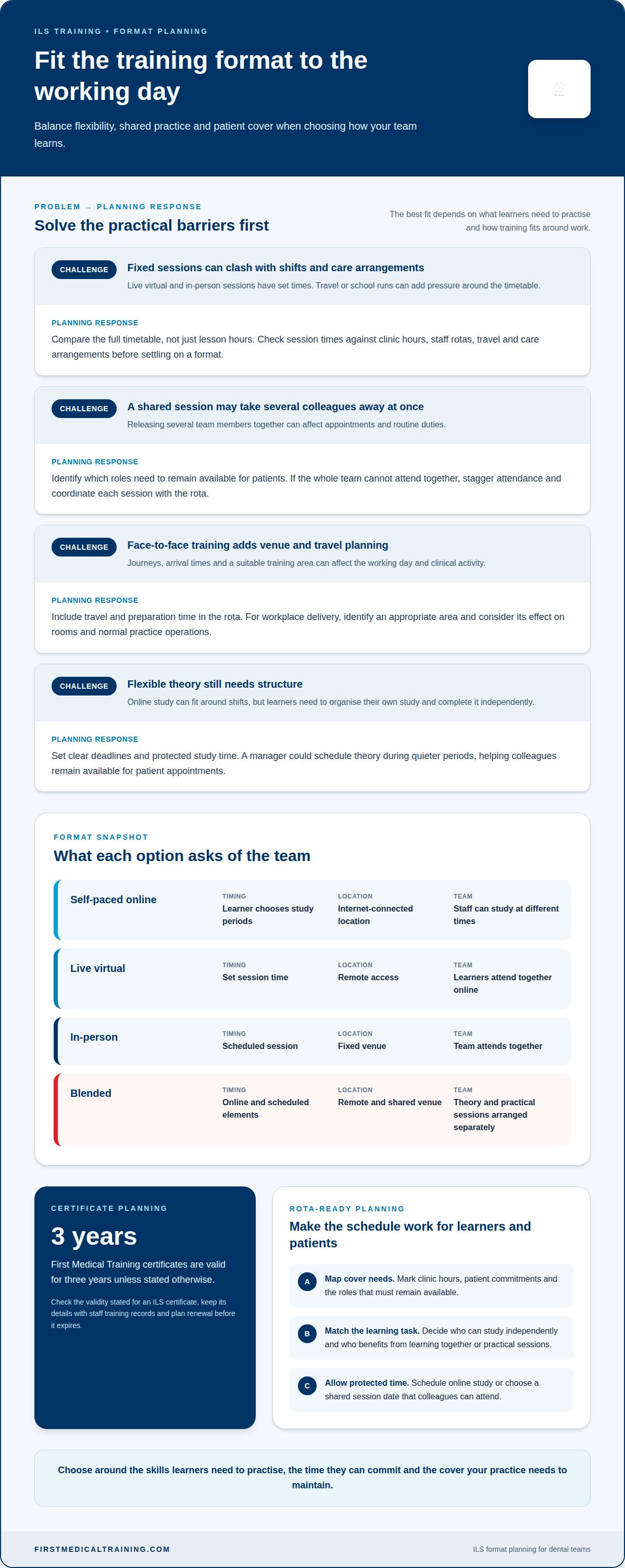
Online learning can make ILS theory easier to fit around shifts, travel and family commitments. Learners can study from different locations, while in-person training generally requires attendance at a set time and place. The key distinction is whether flexibility means choosing when to study or learning together with an instructor.
For example, a dental team member with childcare responsibilities might complete an online theory module after a child’s bedtime. A live virtual session still has a fixed start time, so childcare may be needed during the session. In-person attendance can add travel around school collection or a partner’s shifts. Compare the full timetable, not just the lesson hours.
Online learning can also help a practice plan around staff rotas. A manager might schedule theory study during protected periods on quieter days, rather than release the whole team at once. This can help keep colleagues available for patient appointments. Staff still need to organise their study and complete it independently, so set clear deadlines and protected time.
Virtual learning lets staff join from different locations with an internet connection. For instance, team members working across two practices could attend the same live session remotely. In-person training brings learners together at one venue, supporting discussion and shared activities, but everyone must travel and attend at the scheduled time. Each format can suit different learning styles and workplace arrangements.
The table compares common formats by their scheduling demands:
| Option | Timing | Location | Team coordination |
|---|---|---|---|
| Self-paced online | Learner chooses study periods | Internet-connected location | Staff can study at different times |
| Live virtual | Set session time | Remote access | Learners attend together online |
| In-person | Scheduled session | Fixed venue | Team attends together |
| Blended | Online and scheduled elements | Remote and shared venue | Theory and practical sessions are arranged separately |
Use a simple planning sequence. First, mark clinic hours and cover needs on the rota. Next, identify who can study independently and who benefits from a shared session. Schedule online modules during protected work time, or choose an in-person date when the required colleagues can attend. For childcare, compare the session time with school runs and care arrangements.
A blended plan can put flexible theory study before a scheduled practical session. This separates independent learning from the time learners need to be together, but still requires shared availability for the practical element. Match each learning task to its timing needs and the team’s actual schedule.
In-person training costs and operational disruption
In-person ILS training requires more planning than choosing a session date. Decide who will attend, how the practice will maintain patient cover and where training will take place. Releasing several team members together may affect appointments and routine duties. Staggering attendance can preserve cover, but requires coordination across separate groups or sessions.
Travel is another planning consideration. Allow time for the journey to and from the venue, and consider how start times affect staff travelling from different locations. For workplace training, set aside a suitable area and account for any impact on rooms and normal clinical activity. These details shape the operational impact of face-to-face training.
First Medical Training’s certificates are valid for three years unless stated otherwise. Use the validity stated for an ILS certificate to plan renewal, and keep the certificate details with your staff training records.
Before arranging attendance, map the session against the practice rota. Identify which roles must remain available for patients, then decide whether the team can attend together or needs staggered attendance. Include travel and preparation time in the rota, not just the hours in the training room. This gives managers a clearer view of how long colleagues will be away from normal duties.
Use this planning checklist:
- Choose a session date that fits staff availability and patient commitments.
- Arrange cover for clinical and administrative duties during training.
- Plan journeys and arrival times for everyone attending.
- For workplace delivery, identify an appropriate training area and its effect on practice operations.
- Record certificate validity and schedule renewal before it expires.
Compare how each format affects the working day. Online learning may spread study across individual periods, while in-person training concentrates attendance in a shared session. Both require staff time to be planned. Face-to-face training may suit learners who need supervised activities, but the team still needs a workable plan for appointments, cover and travel.
For a dental team, arrange attendance around the roles needed to keep the practice functioning. Where colleagues cannot all leave at once, stagger participation and coordinate the sessions with the rota. If your team is considering practical ILS training, explore the ILS training options that suit your workplace arrangements.
Online engagement and technical barriers
Online sessions remove the shared classroom, so participation needs deliberate structure. A Harvard Business Review study found that 52% of online-course learners felt less engaged than learners in in-person training. For an ILS session, this can matter when learners need to discuss a scenario, ask questions or practise a response together. Clear prompts and scheduled interaction help keep attention on the learning task.
Feedback is another consideration. A study by the Journal of Online Learning and Teaching found that 60% of online learners missed the immediacy of feedback in in-person learning. For example, a learner practising a response to a simulated emergency may need timely guidance to understand what to adjust. A live instructor can respond during a session, while independent modules may rely on quizzes or written feedback.
Practical ILS learning also raises the question of equipment. In a live online session, learners use their own equipment for hands-on practice. Someone studying at home may not have the same training equipment or space as a group in a dedicated room. This can affect what the session demonstrates and how an instructor observes each participant. Online activities should match the equipment learners can access.
Technology affects access and interaction. Online training requires a reliable internet connection, a compatible device and basic digital skills. A dropped connection during a live session can interrupt an explanation or prevent a learner from responding. Small screens can make demonstrations harder to follow, particularly when several people share a device. Plan for these practical barriers, not just minor inconveniences.
Set up each online session with a short technical routine:
- Use a computer or tablet with a screen large enough to follow demonstrations.
- Test the internet connection, sound and camera before the session begins.
- Choose a quiet space where learners can focus and speak without interruption.
- Arrange any practice equipment in reach before the instructor starts the activity.
- Agree how learners will rejoin and receive missed instructions if their connection drops.
Plan for the technology needed to participate, including suitable devices, internet access and any equipment used in practical activities. Requirements vary by learner and session design, so include them alongside staff time when planning. For example, if a team shares one computer, learners may need separate sessions or additional devices.
Choose online delivery when the team can meet its technology and engagement needs. If a key learning task depends on close observation, immediate feedback or shared equipment, prioritise a format that supports that interaction.
Online versus in-person course comparison
The right ILS format depends on what learners must do, not convenience alone. Online learning can give staff access to theory from different locations. In-person learning brings them together for practical activities and direct instructor feedback. An online vs in-person ils course comparison should therefore start with the skills learners need to develop and demonstrate.
Compare the options across five criteria: access, interaction, practical work, feedback and workplace fit. Self-paced learning lets learners choose when to study. Live virtual sessions allow questions, but participants join remotely. Classroom training supports face-to-face practice, while blended learning combines remote study with scheduled practical work.
| Option | Access and timing | Interaction and feedback | Practical learning | Best fit |
|---|---|---|---|---|
| Self-paced online | Study at chosen times, from different locations | Independent, with feedback shaped by course activities | Limited by what learners can practise alone | Flexible theory study |
| Live virtual | Attend remotely at a scheduled time | Questions and instructor contact during sessions | Uses learners’ own equipment | Remote, instructor-led discussion |
| In-person | Attend at a set time and venue | Direct communication and immediate feedback | Practical exercises with instructor guidance | Skills that need coached practice |
| Blended | Combine remote study with scheduled attendance | Online and face-to-face interaction | Practical work can take place in person | Theory plus supervised practice |
Consider a team learning to respond to a simulated emergency. Online modules can introduce key concepts, but learners may need an instructor to observe their practice, answer questions and correct technique. In-person sessions allow practical exercises with direct guidance. If observation and coaching are central learning needs, face-to-face delivery may be more suitable.
Convenience still matters. An employee working across locations may attend a live virtual session without travelling to a venue. A fixed classroom date can bring colleagues together for discussion and shared practice. However, staff need to be available at the same time, and the workplace must plan for their absence. Compare scheduling trade-offs as well as learning activities.
Use this decision sequence:
- List the ILS tasks learners must understand and practise.
- Identify which tasks need direct observation or immediate correction.
- Choose online study for suitable theory and in-person sessions for coached practical work.
- Match the timetable to staff availability and workplace cover.
Choose the format that lets learners practise and receive feedback on the skills the course aims to develop. Use online delivery when remote access suits the learning task; prioritise in-person learning when practical guidance is essential.
What are the Resuscitation Council UK requirements for ILS course delivery and assessment?
Resuscitation Council UK guidelines provide a reference for resuscitation training, but delivery format alone doesn’t establish course quality. First Medical Training Ltd states that it is an accredited provider following Resuscitation Council UK guidelines. For an ILS course, consider how its learning activities and assessment address the practical skills learners need.
Separate three questions when reviewing course information: what guidance shapes the content, what learners practise and how their performance is assessed. A course may cover recognised resuscitation principles, but learners still need a clear way to practise applying them. For example, a scenario can ask a learner to recognise deterioration, communicate their findings and take an appropriate response role.
Assessment should make expected performance clear. Look for knowledge checks and practical observation when the learning outcomes include practical skills. A written quiz can test recall, while an instructor observing a simulated emergency can assess how learners apply a sequence, communicate with colleagues and respond to feedback. These are examples of useful assessment methods, not a claim that Resuscitation Council UK mandates one universal format.
Delivery format affects what instructors can observe. In-person training allows direct observation of practical exercises and correction during practice. A live online session can support questions and discussion, but practical observation depends on the activity, equipment and camera view. Self-paced learning may focus on knowledge unless practical skills are assessed separately. Match the assessment method to each learning outcome.
Use this checklist to assess whether course delivery and assessment are clear:
- Identify the resuscitation guidance the course follows.
- Review the practical learning outcomes, not just the theory topics.
- Check how learners demonstrate each skill and receive feedback.
- Confirm how successful completion is recorded and evidenced.
- Match online or in-person activities to the skills being assessed.
For a dental team, a scenario might involve allocating roles, communicating clearly and following a structured response. The assessment should explain which actions learners must demonstrate and how instructors evaluate them. This helps managers connect the course to staff development and workplace readiness without treating a certificate alone as proof of every practical ability.
Choose training that explains its guideline alignment, learning outcomes and assessment approach in plain terms. To explore ILS training options with Resuscitation Council UK alignment, consider your team’s practical learning needs.
First Medical Training Ltd: Medical Emergencies in a Dental Practice Course
First Medical Training offers the Medical Emergencies in a Dental Practice - CPD Training course for dental teams seeking training focused on emergencies in a clinical setting. Choose it when your priority is preparing the team to respond to medical emergencies that may arise during practice.
If your learning need centres on immediate life support, Dental Immediate Life Support (ILS) Training is the closer fit. The distinction is practical: select the dental emergencies course for broader practice-based emergency preparation, or ILS training when immediate life support is the specific focus. First Medical Training Ltd also offers an Emergency First Aid at Work Course (EFAW) - 1 Day and an Automated External Defibrillator (AED) Training Course for different workplace learning needs.
Contact First Medical Training Ltd to discuss which course best matches your team’s training aims.
Turn your course choice into a practical plan
Use your online-versus-in-person ILS course comparison to set a clear training objective for your team. Identify the response skills staff need to practise, then choose a delivery format that lets them develop and demonstrate those skills. A useful course decision leads to a plan for applying the learning in the workplace.
Before arranging training, consider which colleagues need to take part and how learning will fit into your practice’s schedule. Give staff time to engage with the course, then consider how their learning connects with your dental emergency response plan. This makes training part of a considered approach to emergency readiness, rather than an isolated event.
For support matching your team’s aims with suitable training, contact First Medical Training. Take the next step towards a team that feels better prepared to respond calmly and work together during a medical emergency.
Frequently Asked Questions
Is an online ILS course recognised or accredited in the UK?
An online ILS course’s recognition depends on its accreditation and certificate, not the online format alone. First Medical Training’s courses are approved and monitored by the First Aid Industry Body (FAIB), and successful learners receive UK-recognised certificates, valid for three years unless stated otherwise. This does not mean every online ILS course has the same approval or recognition. Match the specific course’s accreditation and certificate details to your professional needs.
How does online ILS training compare with in-person ILS training?
Online ILS training can make course material accessible remotely, while in-person training lets an instructor observe learners directly. An online lesson, for example, may suit reviewing response principles before a team discussion. In a classroom, learners can practise a scenario together and receive guidance as they work through it. Compare learning activities and assessment, not just the delivery label, to judge which format supports your team’s intended outcomes.
Which ILS skills require hands-on practice and assessment?
Practical skills such as CPR and AED use benefit from physical practice and instructor feedback. Reading about compressions or watching a demonstration cannot show how a learner performs the actions. Scenario-based assessment can also let instructors observe communication, role allocation and responses to new information. Consider how the course assesses each practical outcome, especially when learners must demonstrate a skill rather than answer a knowledge question.
How long does an ILS course take online versus in person?
Course duration depends on the learning design and what the course includes, so online and in-person formats have no universal comparison time. Online study may separate independent learning from scheduled teaching, while an in-person timetable brings activities together in a set session. Include any required preparation, practical work and assessment when planning staff time. The timetable should make clear which activities require attendance.
Do employers or NHS trusts accept online ILS certificates?
Employers and NHS trusts set training requirements for particular roles, so online certificates are not automatically accepted in every workplace. First Medical Training issues UK-recognised certificates to successful learners, valid for three years unless stated otherwise. Before allocating training, match the certificate and course outcomes to the employee’s duties and local training criteria. This distinguishes general recognition from whether an organisation accepts a course for its own requirements.
What equipment and technology are needed for an online ILS course?
You need a reliable internet connection, a compatible device and basic digital skills to use the online platform. A computer or tablet can make written material and demonstrations easier to follow than a small phone screen. For a live session, choose a quiet space and test the connection before joining. If practical activities are included, arrange the specified equipment in advance so you can participate as instructed.
What are the limitations and risks of learning ILS online?
Online learning can make it harder for an instructor to observe practical performance, correct technique immediately or assess how a learner responds during a scenario. A poor connection may also interrupt live explanations or questions. For example, a learner may understand a CPR demonstration but still need supervised practice to develop the physical skill. Treat online theory as one part of learning when practical demonstration and assessment are required.