

Onsite First Aid Training for Healthcare Providers

Onsite first aid training for healthcare providers in the UK should reflect the employer’s first-aid needs assessment under the Health and Safety (First-Aid) Regulations 1981. Depending on the setting and identified risks, suitable options can include Emergency First Aid at Work, AED training and clinical emergency courses such as Dental Immediate Life Support. Practical work matters: the trainer should be able to observe and supervise learners as they practise.
Choosing a course is about more than fitting training into the working day. Healthcare teams need practical learning that builds confidence and reflects the emergencies they may face. This guide explains which courses can be delivered onsite, how to prepare your venue and what to consider when choosing training for your team.
You’ll also learn why active trainer supervision matters during practical sessions and how to match a course to your workplace needs. With a clear plan, your team can build skills in a familiar setting and understand how to respond calmly when an emergency occurs.
Key Takeaways
- Match the course to your workplace risks and the first-aid needs identified for your team.
- Consider Emergency First Aid at Work for basic workplace response training; the course lasts one day.
- Prepare a clean, well-lit room with enough space for learners and practical activities.
- Plan practical sessions so the trainer can observe and supervise each learner’s work.
- Use onsite training to practise procedures in a familiar setting and consider how staff shifts affect attendance.
What First Aid Courses Can Be Delivered Onsite?
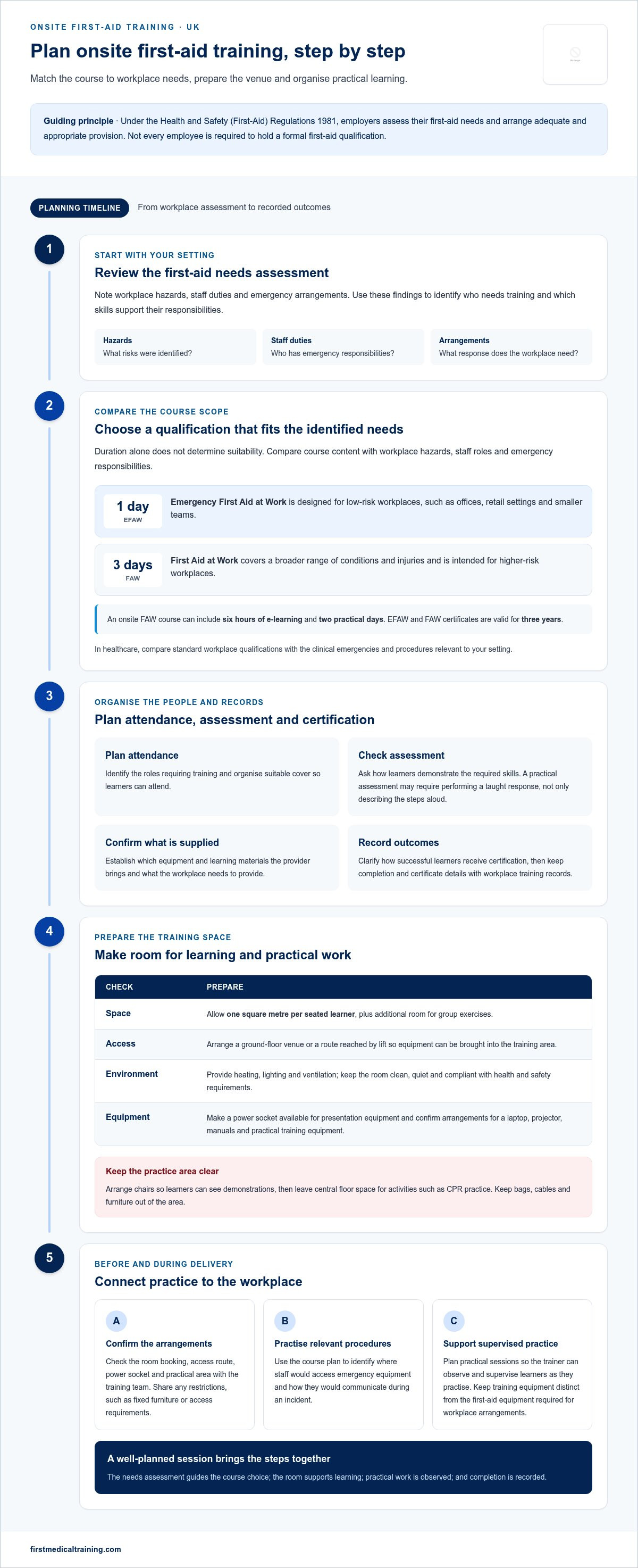
UK training providers can deliver first-aid courses at workplaces; some also use training venues. No single qualification is required for every healthcare employee. Employers assess their needs under the Health and Safety (First-Aid) Regulations 1981, then select provision that reflects workplace hazards and staff responsibilities.
Course Duration and Suitability
Emergency First Aid at Work (EFAW) is a one-day course designed for low-risk workplaces, such as offices, retail settings and smaller teams. First Aid at Work (FAW) is a three-day qualification covering a broader range of conditions and injuries, and is intended for higher-risk workplaces. Healthcare employers should use a needs assessment to decide whether either qualification suits their setting.
An onsite FAW course can include six hours of e-learning and two practical days. EFAW and FAW certificates are valid for three years. These formats can help managers plan attendance, but duration alone doesn’t determine suitability. Consider the hazards, staff roles and emergency responsibilities identified in your workplace assessment.
Delivery, Equipment and Certification
Onsite delivery brings instruction and assessment to your workplace, while some providers also teach at separate venues. Ask what the course’s assessment involves and how learners demonstrate the required skills. For example, a practical assessment may require participants to perform a taught response, rather than only describe the steps aloud.
Before arranging a course, establish what equipment and learning materials are supplied and what your workplace needs to provide. Clarify how successful learners receive certification and how completion is recorded. This helps you plan attendance and maintain accurate training records without confusing participation with assessed performance.
To select a qualification, follow these steps:
- Review the needs assessment: note hazards, staff duties and emergency arrangements.
- Compare course scope: check whether EFAW or FAW matches those identified needs.
- Plan attendance: identify the roles requiring training and organise suitable cover.
- Record outcomes: keep completion and certificate details with workplace training records.
The Health and Safety (First-Aid) Regulations 1981 require employers to arrange adequate and appropriate first-aid provision based on a needs assessment. They do not require every employee to hold a formal first-aid qualification. Use the assessment to identify who needs training and which course best supports their responsibilities.
In healthcare, standard workplace qualifications may not cover every clinical emergency. Compare the course content with the risks and procedures relevant to your setting, then choose learning aims and assessment that match the need. This keeps onsite training focused on appropriate skills, rather than choosing a qualification simply because it fits the timetable.
Venue and equipment requirements
Course topics depend on the qualification. Emergency first aid courses can include CPR and AED skills, while broader workplace training covers more medical conditions and injuries. Match the learning objectives to your team’s responsibilities and the emergencies identified in its workplace assessment.
Set up the room before the trainer arrives. Provide enough space for every learner to sit comfortably, plus clear floor space for practical activities such as CPR. Allow one square metre per seated learner and additional room for group exercises. A crowded layout can restrict movement and make practice harder for everyone.
Check access as well as room size. A ground-floor venue or one reached by lift makes it easier to bring equipment into the training area. Provide heating, lighting and ventilation, and keep the room clean, quiet and compliant with health and safety requirements. These details help learners focus on demonstrations.
- Room: provide seating and practical floor space for the full group.
- Access: arrange a ground-floor room or a route using a lift.
- Environment: ensure suitable lighting, heating and ventilation.
- Power: make a power socket available for presentation equipment.
Ask which training materials and equipment the provider will bring, then prepare anything your venue needs to supply. Onsite arrangements may include a laptop, projector, manuals and practical training equipment. Provide a power socket for presentation facilities and keep the floor uncluttered so the trainer can demonstrate and learners can practise.
Practical exercises need more than a clear patch of floor. Arrange chairs so learners can see demonstrations, then leave a central area for activities such as CPR practice. Keep bags, cables and furniture out of the area. This layout helps participants move between instruction, practice and feedback without disrupting the session.
Use the course plan to connect exercises with your workplace. For example, identify where staff would access emergency equipment and how they would communicate during an incident. Training equipment supports practice; it doesn’t replace the first-aid equipment required for workplace arrangements. Keep these purposes distinct when preparing the room.
Before delivery, confirm the room booking, access route, power socket and practical area with the training team. Share any restrictions, such as fixed furniture or a room that must remain accessible to staff. If you’re planning onsite first aid course delivery, include these venue details in the arrangements so the session can be organised around the space available.
Why Choose In House/Onsite First Aid Training?
Onsite training lets healthcare teams practise in the workplace where they may need to respond. For a GP surgery, dental practice or care team, use a workplace risk assessment to identify relevant hazards and select suitable training.
Clinical risks such as needlestick injuries, choking and cardiac emergencies call for different response considerations. Match an aid training course to the situations staff may face, their roles and the equipment available. Include basic life support where cardiac emergencies are part of the identified need.
For dental practices, practical sessions can help staff understand how to communicate and work together during a medical emergency. A GP surgery or care setting can also use scenario-based practice relevant to its staff and environment. Keep scenarios within the course learning objectives, and ensure participants understand the limits of their roles.
Flooring affects practical exercises. Choose a clear, stable area where learners can kneel and practise CPR without furniture obstructing movement. If you use mats, position them securely and check they don’t slide during practice. Remove loose cables and bags from the exercise area before the session.
Online learning can cover theory and awareness, while some roles require in-person practical training and assessment. A blended approach can help staff prepare before a practical session, but online study alone won’t provide hands-on practice when that is needed. Consider the course aims, learners’ duties and how competence will be assessed.
To make an onsite session useful for your team, take these steps:
- Identify workplace risks: consider examples such as needlestick injuries, choking and cardiac emergencies.
- Set learning aims: decide which staff need basic life support or other first-aid skills.
- Prepare practice space: clear a stable area for kneeling, CPR exercises and trainer observation.
- Choose the format: compare online theory with the practical instruction and assessment required for the role.
Accreditation and course guidance also matter. For a dental team, select training that reflects relevant professional expectations, including General Dental Council development outcomes where applicable. Ask how practical skills are assessed, and plan for designated first aiders to keep their training current. These steps connect learning with workplace responsibilities.
Onsite delivery can bring colleagues together to practise shared procedures in their working environment. Use the session to practise clear role allocation and communication, then note any gaps for follow-up. This makes training more relevant by grounding it in the risks and responsibilities identified for your workplace.
Flexible scheduling around business operations and shift patterns
Plan first-aid training around patient appointments, staff rotas and essential duties. List the roles that need an aid qualification, then identify when those staff members can be released. For example, a dental practice can compare clinical sessions with administrative cover before choosing a training date.
Next, map shift patterns across the organisation. Include part-time colleagues, staff who work across different sites and teams with different start times. This helps you identify who can attend together and whether separate groups are needed. Learners should be able to participate fully without leaving essential work uncovered.
Onsite delivery at your business premises can reduce travel away from the usual workplace. If a separate venue is more practical, consider staff travel, access and the effect on daily operations. Think about where colleagues are based and whether a central location would make attendance easier.
Match the timetable to the course format. For a one-day qualification, choose a day when required learners can attend the full course. Avoid scheduling practical learning during handovers or the busiest part of a service. If your rota can’t release everyone at once, plan separate groups and ensure each has suitable cover.
Use this planning sequence:
- List learners: identify the roles and teams that need training.
- Review rotas: note clinical sessions, handovers and essential duties.
- Compare delivery options: weigh workplace training against travel to a suitable venue.
- Set attendance groups: organise cohorts around the course format and available cover.
Consider which skills each group needs to practise. A dental team may need colleagues from different roles to work through a shared emergency scenario. An organisation supporting children may need relevant staff included in paediatric training. Scheduling those colleagues together makes it easier to practise communication and role allocation as a team.
Prepare arrangements before confirming the date. Share shift patterns, room access and any restrictions on releasing staff with the training organiser. Decide who will maintain service cover while learners attend, and record the agreed attendance plan. This helps prevent clashes with appointments, handovers or other scheduled responsibilities.
Once the date is set, brief learners and managers on the timetable, location and attendance expectations. Record completion and certificate details, then use the rota to plan future renewal and refresher activity. This makes a single training date part of organised staff development while keeping daily operations in view.
Trainer supervision of practical work
Practical assessment matters because learners must demonstrate skills, not just describe them. During onsite first-aid training, the trainer should be able to watch and supervise all practical work for assessment and health and safety reasons. That means observing each learner’s technique and addressing unsafe practice as it happens.
During CPR practice, supervision lets the trainer observe a learner’s positioning and how they follow the taught sequence. In a defibrillator exercise, the trainer can see whether participants follow the demonstration and communicate clearly. These examples distinguish active, observed practice from a session where learners only watch.
Before exercises begin, agree how the trainer will manage the practice area. Keep the floor clear, position learners so they can see demonstrations and allow room for individual practice. If learners practise in pairs, the trainer still needs a clear view of each activity. Arrange seating and equipment to avoid obstructed sightlines.
A useful practical session follows a clear cycle:
- Demonstrate: the trainer explains and models the skill being taught.
- Practise: each learner performs the skill in the designated area.
- Observe: the trainer watches technique and safe handling of equipment.
- Give feedback: learners receive direction on what to repeat or improve.
This cycle makes performance visible for assessment and gives learners a chance to correct technique before moving to another exercise. For first aid at work, use the course’s practical objectives to guide observation. Don’t treat attendance or confidence speaking in a group as proof of practical competence.
Healthcare settings add workplace context to practice. A dental team might rehearse communication during a medical emergency, while a school team may practise an appropriate response for its setting. Keep any defibrillator exercise and device use under the trainer’s direction. Mental health first aid has different learning aims, so don’t confuse it with physical emergency-response practice.
When reviewing a course, ask how practical assessment is conducted, how feedback is given and how each learner gets an opportunity to practise. These questions focus on observable learning and safe delivery, not presentation alone. Use the answers to judge whether the session supports the skills your workplace needs.
For a course with supervised practice, explore first-aid training options that include practical learning and assessment.
First Medical Training: Medical Emergencies in a Dental Practice Course
First Medical Training Ltd delivers Medical Emergencies in a Dental Practice - CPD Training to help dental teams prepare for emergencies in the clinical setting. It’s a relevant next step when your team needs focused practice beyond general workplace first aid, including recognising an emergency, coordinating a response and using the practice’s emergency procedures.
For teams seeking further practical development, Dental Immediate Life Support (ILS) Training and the Automated External Defibrillator (AED) Training Course address specific response skills. The Emergency First Aid at Work Course (EFAW) is another option for workplace first-aid provision. Choose according to your team’s roles and identified training needs.
Contact First Medical Training Ltd or visit firstmedicaltraining.com to discuss training for your dental team.
Plan your team’s next training step
Choose a training lead to coordinate the next stage of your workplace plan. Ask them to identify how the team will apply its learning, including who records training outcomes and how staff can raise skills gaps during reviews. This keeps development connected to everyday responsibilities.
For onsite first aid training for healthcare providers in the UK, set a clear learning objective before arranging a session. A focused objective helps your team understand what the training is intended to support and gives managers a practical basis for reviewing its relevance.
To discuss your team’s training needs, contact First Medical Training. Take a considered next step towards a workplace where staff feel prepared to contribute during an emergency.
Frequently Asked Questions
Why Train On Site?
Onsite training can help teams connect course learning with how colleagues communicate at work. Before the session, agree who raises the alarm, who meets arriving help and who keeps others clear of the area. A dental practice could practise these role assignments in a discussion exercise, then review whether staff understand their part. This turns shared learning into a practical conversation about teamwork.
Do You Need Experience to Take First Aid Training?
No previous first-aid experience is needed to begin training. Courses introduce the subject and build learners’ understanding through instruction and practice. If you’re new to the role, tell the trainer about unfamiliar terms or steps. Follow the demonstrations, practise each skill as directed and use feedback to identify what needs more attention. Prior clinical experience doesn’t replace the course assessment.
How long are first aid certificates valid for?
Emergency First Aid at Work and First Aid at Work certificates are valid for three years. Record each certificate’s award and expiry dates, and assign someone to review the register during staff planning. This helps prevent missed renewals when responsibilities change or colleagues leave. Store completion records where managers can retrieve them for workforce planning and training reviews.
How many staff can attend each course?
Most onsite first-aid courses accommodate up to 12 learners per trainer; AED and CPR courses can accommodate up to 15. If your team exceeds the relevant capacity, plan separate cohorts and consider how each group will receive equivalent teaching and assessment. Keep a register for every session, including attendance and completion outcomes. This makes it easier to identify colleagues who still need training.
If I book onsite training, what would I need to provide?
Provide a suitable training room, seating, space for practical work and access to a power socket. The provider can bring a laptop, projector, training materials and manuals. Before the day, confirm access arrangements and clear obstacles from the practice area. Tell staff which room to use and when to arrive so the session can begin without avoidable delays or disruption to nearby work.
What onsite first aid courses are available for healthcare providers in the UK?
Options include workplace first-aid qualifications, AED training and clinical emergency training for dental teams. Choose according to the hazards staff may face, their responsibilities and the required learning outcomes. For example, a dental team may need training focused on medical emergencies in the practice, while a workplace needs assessment may identify a general first-aid qualification. Ensure course content and assessment match the intended role.
How many staff should receive first aid training in a UK healthcare setting?
The appropriate number depends on your workplace first-aid needs assessment, not a universal staff-to-first-aider ratio. Consider hazards, staff numbers, shift arrangements and whether people work across separate areas. Ensure trained cover is available during normal operations and foreseeable absences. Record the reasons for your chosen provision and revisit them when staffing, services or workplace risks change.
How long do onsite first aid courses take, and how often must qualifications be renewed?
Emergency First Aid at Work takes one day, while the initial First Aid at Work qualification takes three days. Both certificates are valid for three years, and annual refreshers are strongly recommended to help keep skills current. Add expiry dates to your training register and schedule refresher activity as part of workforce planning. This helps managers maintain continuity when staff responsibilities or rotas change.