

Paediatric First Aid Course for Dental Practices: How to Choose

The longest paediatric course is not automatically the right fit for every dental team. Choosing a paediatric first aid course for dental practices means considering the children your practice treats, who needs training and how staff responsibilities fit into your wider emergency arrangements.
Paediatric first aid, Paediatric Immediate Life Support (ILS) and dental-specific medical emergency training address different learning needs. Decide which skills your team needs to develop before comparing courses, rather than assuming one option can replace another.
This guide compares the 6-hour and 12-hour Paediatric First Aid courses and explains how they differ from ILS and dental emergency training. Use the practical steps below to match course duration with your team’s learning aims, plan delivery around staff availability and connect training with your practice’s emergency response arrangements and relevant GDC and Resuscitation Council UK guidance.
Key Takeaways
- Choose a paediatric first aid course for dental practices by considering the children you treat, staff responsibilities and your practice’s wider emergency arrangements.
- Compare the 6-hour and 12-hour courses by duration and learning needs. The 6-hour option suits those interested in child and infant basic life support.
- Paediatric first aid can complement dental-specific medical emergency training, but it does not automatically address every emergency need in a dental practice.
- Plan training in four steps: identify learners, define learning needs, compare course duration and schedule delivery around staff availability.
- Practical, scenario-based learning with guided hands-on practice gives your team a supportive setting in which to practise.
Paediatric first aid for dental practices: what training need are you solving?
Paediatric first aid focuses on first aid needs involving children and infants. Start by reviewing the patients and services your practice supports, then consider which team members could be involved if a child or infant became unwell or had an injury during a visit. A practice that regularly treats children may identify different learning needs from one that sees them less often.
Before choosing a paediatric first aid course for dental practices, map who may be present during an incident and what each person is expected to do. Consider how this training fits alongside the practice’s wider response to medical emergencies. It should complement that response, not be treated as a replacement for it.
When might a dental team consider paediatric first aid?
Review your patient groups, services and team responsibilities. Think about which clinical and non-clinical staff may be nearby if a child or infant needs help, and what role each person may have. Use the answers to set a clear learning objective before selecting a course.
- Consider how often your practice treats children and infants.
- Identify who may recognise a concern, respond first and support colleagues.
- Discuss whether current training reflects the team’s responsibilities and the patients you see.
This review gives you a practical basis for comparing courses. It also helps avoid choosing training simply because it is familiar, or assuming one arrangement will suit every dental team.
What paediatric first aid does, and does not, replace
Paediatric first aid has a child-and-infant focus. Dental emergency preparation addresses the practice’s broader response to medical emergencies in a clinical setting. These areas can support one another, but they are not interchangeable. Paediatric first aid alone should not be treated as covering every dental emergency need.
Dental-specific medical emergency CPD can complement paediatric training by focusing on the practice context and its response arrangements. The medical emergencies in a dental practice course guide explores that wider training context. For background on children’s dental care, Pediatric dentistry also discusses the importance of emergency care for dental trauma.
Keep training decisions grounded in current guidance. Refer to relevant General Dental Council (GDC) and Resuscitation Council UK guidance when considering professional expectations. Then compare the guidance with your patient groups, staff responsibilities and Dental emergency response plan. This helps you decide whether paediatric first aid should be added to, or coordinated with, your existing emergency preparation.
Compare paediatric first aid course options for your dental team
First Medical Training Ltd provides two Paediatric First Aid options: the Paediatric First Aid (6 Hours) Course and the Paediatric First Aid (12 Hours) Course. The main difference to consider here is duration. Start with the learning need you identified, then consider how much training time your team can arrange. More hours do not automatically make one option the right choice for every practice.
How to compare the 6-hour and 12-hour courses
The 6-hour course is suitable for people interested in child and infant basic life support. The 12-hour course provides a longer duration of paediatric first aid training. Use the comparison below to match course duration with your learning aims. Do not assume that course length alone tells you what topics, qualifications or CPD hours are included.
| Course | Duration | Intended learning need | Relationship to dental emergency training |
|---|---|---|---|
| Paediatric First Aid (6 Hours) Course | 6 hours | Suitable for those interested in child and infant basic life support. | Paediatric-focused training; it does not replace dental-specific medical emergency preparation. |
| Paediatric First Aid (12 Hours) Course | 12 hours | Consider this option when your learning aims call for a longer course duration. | Paediatric-focused training; plan it alongside the practice’s wider emergency training. |
| Paediatric Immediate Life Support (ILS) Training for Healthcare Professionals | Not compared by duration here | A distinct course for healthcare professionals. | Consider it as a separate training option, not another name for paediatric first aid. |
| Dental medical emergency CPD | Varies by course | Supports learning focused on medical emergencies in the dental practice. | Complements paediatric training by addressing wider practice emergency preparation. |
To choose between the two paediatric courses, write down what learners need from the training and how much time they can set aside. If the aim is child and infant basic life support, the 6-hour course aligns with that stated interest. If you are considering the 12-hour option, account for its longer duration without assuming it signals a particular syllabus or outcome.
Paediatric first aid, paediatric ILS and dental emergency CPD
Keep the course categories distinct. Paediatric first aid focuses on children and infants. Paediatric ILS is a separate course for healthcare professionals. Dental medical emergency CPD focuses on the practice’s broader emergency preparation. A paediatric first aid course for dental practices can form one part of a planned training mix, rather than standing in for every other course your team may need.
For the dental CPD context, consult the GDC CPD requirements for medical emergencies guide and check current guidance before relying on specific expectations. First Medical Training Ltd’s paediatric first aid courses offer two course durations to consider as you match learning aims with staff availability.
Does paediatric first aid alone prepare a dental practice?
No. Completing paediatric first aid does not automatically address every medical emergency that could arise in a dental setting. It develops a child-focused area of learning, while the practice also needs wider arrangements for recognising and responding to medical emergencies. Treating one course as a substitute for another can leave gaps between what staff have learnt and the responsibilities they are expected to carry out.
Assess your preparation by looking at three things together: the patients you treat, the responsibilities assigned to each team member and the steps in your dental emergency response plan. For example, ask whether the team’s training reflects the needs of children who attend, as well as the wider clinical context and the practical actions staff may need to take.
Where paediatric first aid fits in the practice’s training plan
Include paediatric first aid in your plan when it meets an identified learning need. Keep it distinct from core emergency arrangements, such as knowing who leads a response, how the team communicates and where relevant equipment is kept. Review these arrangements in the context of current guidance rather than assuming that completing a paediatric course covers them.
To review the plan, bring the relevant team members together and consider:
- Which patient groups your practice treats and what that means for staff learning needs.
- Who may recognise an emergency, respond and support the lead responder.
- Whether written procedures and equipment arrangements are clear to the people expected to use them.
- Where paediatric first aid adds useful learning, and where separate dental emergency preparation is still needed.
This review connects training decisions with day-to-day practice, rather than treating course selection as a separate task. The dental practice emergency preparedness checklist can support a structured review of your wider arrangements.
When to consider paediatric ILS or dental medical emergency CPD
Consider Paediatric Immediate Life Support (ILS) Training for Healthcare Professionals when the learning need is specifically paediatric ILS for healthcare professionals. It is a distinct course, not simply a longer version of paediatric first aid. Dental medical emergency CPD has a different focus: emergency preparation in the dental practice context.
Keep these training purposes separate when planning. A paediatric first aid course for dental practices may complement dental emergency CPD, but neither should be treated as a direct replacement for the other. If you need to understand specific professional expectations, consult current General Dental Council (GDC) and Resuscitation Council UK guidance. Avoid assuming course frequency or making broad claims about compliance; check the relevant guidance for the specific expectation.
Once you have mapped learning needs and response roles, you can decide whether paediatric first aid is an appropriate addition or whether a separate course should also form part of your plan. Explore First Medical Training Ltd’s dental and paediatric training options to see how the course choices can fit your practice’s preparation.
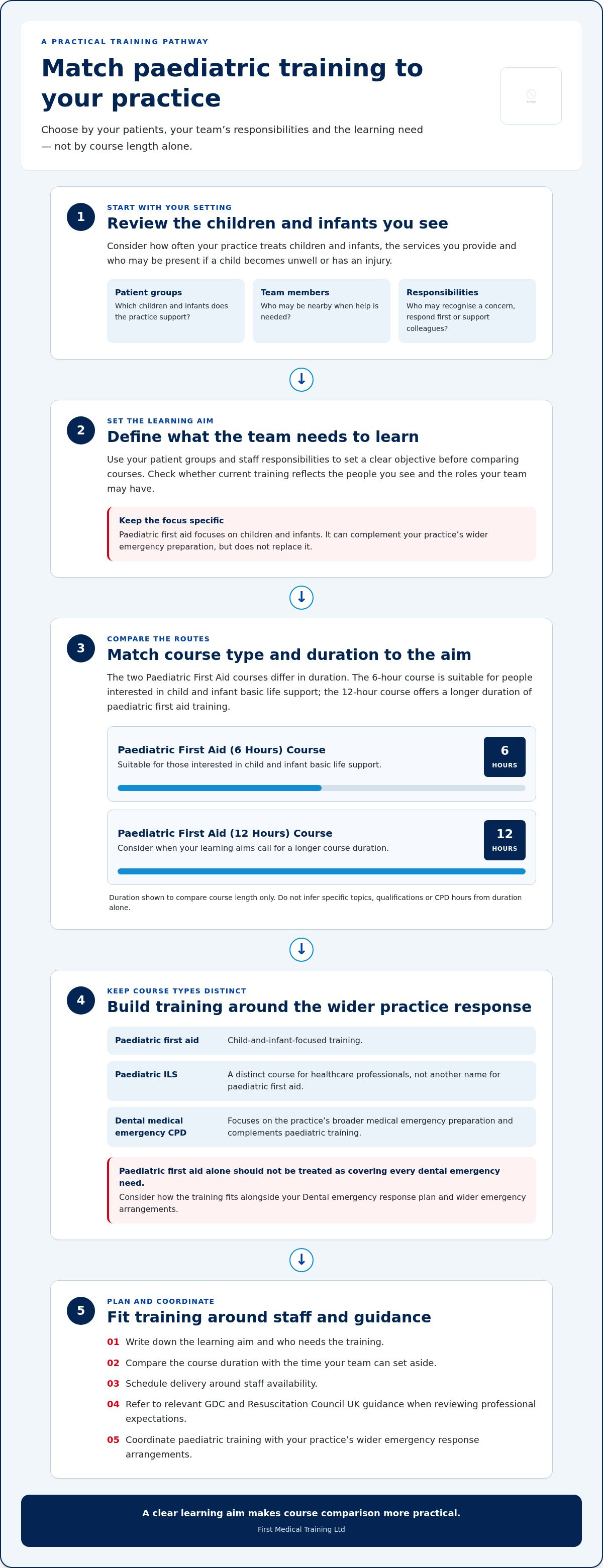
How to choose and organise paediatric first aid training
A clear plan helps you choose training that fits your team and your practice’s operations. Follow these four steps, from identifying a need to arranging delivery. Keep the decision linked to your patient groups and staff responsibilities, rather than choosing a course solely because it is familiar or convenient.
Match learners and course duration to the practice
Start by identifying who needs paediatric-focused learning. Do not use job title alone as your guide. Consider who may be present when a child or infant needs help, and what role each person may have. Then compare the team’s learning priorities with the course durations. The 6-hour course suits people interested in child and infant basic life support; the 12-hour option provides a longer period of training without implying a particular syllabus or outcome.
- Identify learners. List team members whose responsibilities or working arrangements make paediatric-focused learning relevant.
- Define learning needs. Agree what learners need to gain and how this fits alongside the practice’s wider emergency preparation.
- Compare duration. Consider the 6-hour and 12-hour options against those priorities and the time staff can set aside.
- Schedule delivery. Choose an arrangement that enables the intended learners to attend and take part without avoidable disruption to clinical operations.
Plan delivery and evidence of learning
Group learning gives staff an opportunity to discuss their responsibilities together. Practical, scenario-based learning with guided hands-on practice provides a supportive setting for learners to practise. First Medical Training Ltd delivers training at business premises, subject to approval. Consider how the space, team availability and clinical schedule will support the session. In-practice training can help relate learning to the practice environment, while the delivery arrangements should still suit the session and team.
Build the booking around realistic staff cover. Identify who needs to attend, arrange clinical sessions accordingly and give learners the opportunity to focus on training rather than competing duties. Course dates are agreed with the booking team, so plan your preferred arrangements in advance without relying on fixed dates or assumed lead times.
After training, record who attended and note any learning points that should inform team discussions or your Dental emergency response plan. Use this as a practical record of the session, not as a substitute for reviewing wider training arrangements or relevant professional guidance.
Use your learner list and agreed learning aims to take the next step. Explore paediatric first aid training and identify an option that fits your practice’s needs and schedule.
Choose First Medical Training Ltd for paediatric first aid in your practice
Once you have identified who needs training and what the team needs to learn, choose a course that fits those priorities. First Medical Training Ltd provides the Paediatric First Aid (6 Hours) Course and Paediatric First Aid (12 Hours) Course. The 6-hour option is suitable for people interested in child and infant basic life support; the 12-hour option allows a longer period for paediatric first aid training. Match course duration to your learning aims instead of assuming that longer is automatically better.
First Medical Training Ltd has delivered specialist education since 2006. Courses are delivered by experienced medical professionals and use practical, scenario-based learning with guided hands-on practice. Learners have a supportive setting in which to practise and relate the session to their responsibilities.
A practical course pathway for dental teams
Paediatric first aid can form one part of a wider training plan. Keep its child-and-infant focus distinct from dental-specific medical emergency CPD, which supports preparation for emergencies in the dental practice context. If your team has a separate need for Paediatric Immediate Life Support (ILS), consider Paediatric ILS Training for Healthcare Professionals as another distinct option. Plan these courses according to their different purposes rather than treating one as a substitute for another.
Set learning objectives first, then choose the relevant training pathway. Consult current GDC and Resuscitation Council UK guidance when considering specific professional expectations, and do not assume that a single course covers every aspect of emergency readiness.
Arrange training for your practice
Training can be delivered at your business premises, subject to approval. Consider the space available, staff cover and how the intended learners can take part. Course dates are agreed with the booking team, so include your scheduling preferences when arranging the session.
Have your preferred course duration, intended learners and scheduling needs ready. Discuss paediatric first aid training for your team and take the next step towards training that fits your practice.
Make your next training decision with confidence
Turn your course choice into a clear staff-development action. Add the agreed training to your team’s development records, then set aside time after the session to discuss how the learning can inform your practice’s approach. This helps the team connect individual learning with shared responsibilities, without treating course attendance as the end of the process.
If you are ready to take the next step, discuss your paediatric first aid course for dental practices with First Medical Training Ltd. Share your preferred course option, intended learners and scheduling needs to plan training that suits your practice.
Discuss paediatric first aid training for your dental team.
Frequently Asked Questions
Is paediatric first aid suitable for a dental practice?
It may be suitable if your practice treats children and has team members who could be involved in responding to an incident. To assess the fit, review appointment patterns and identify who is present during those sessions, including staff who support patients outside the treatment room. Use this information to set a clear learning objective before selecting training, rather than assuming a course will be relevant to every practice in the same way.
Can paediatric first aid replace medical emergency training for dental teams?
No. Paediatric first aid should not be treated as an automatic substitute for the practice’s wider emergency preparation. Compare what learners need to do with the procedures and responsibilities in your practice arrangements, then note any areas needing separate attention. For specific professional expectations, refer to current General Dental Council (GDC) and Resuscitation Council UK guidance. Do not assume that one training option provides equivalence or fulfils every expectation.
What is the difference between the 6-hour and 12-hour Paediatric First Aid courses?
The Paediatric First Aid (6 Hours) Course lasts 6 hours, and the Paediatric First Aid (12 Hours) Course lasts 12 hours. The 6-hour course is suitable for people interested in child and infant basic life support. To decide between them, compare each duration with the time learners can commit and the objective you have set. Do not infer differences in syllabus, certificate or CPD allocation from course length alone.
Does paediatric first aid count towards dental CPD?
First Medical Training Ltd courses attract between 2 and 6 CPD hours, depending on the course. The specific allocation for either Paediatric First Aid course is not stated here, so record the hours attributed to the course you complete. Keep its title, attendance date and CPD hours together in your learning record, and add a brief note on how the learning relates to your professional development. Follow applicable GDC guidance for record keeping.
Can paediatric first aid training take place at a dental practice?
Training can be delivered at a business premises, subject to approval. Before arranging it, consider whether the proposed room is suitable for the session and whether learners can attend without disrupting the practice’s schedule. In-practice delivery places learning in the team’s working environment, but does not guarantee particular exercises or a specific format. Course dates are agreed with the booking team, so include your scheduling preferences when arranging the session.
How is Paediatric First Aid different from Paediatric Immediate Life Support?
Paediatric First Aid and Paediatric Immediate Life Support are separate training options, and Paediatric ILS is for healthcare professionals. Do not assume that one is an advanced version of the other or infer prerequisites or qualifications from the course names. Identify the learners, their responsibilities and the learning objective first. Then consider dental medical emergency CPD separately if your plan also needs to address the practice’s clinical context.