

UK first aider legal responsibilities: 2026 guide

If someone collapses at work, are you personally responsible for everything that follows? The legal responsibilities of a first aider at work uk are often confused with an employer’s duties. In Great Britain, the Health and Safety (First-Aid) Regulations 1981 require employers to provide adequate and appropriate first-aid provision. Your role is to respond within your training, follow workplace procedures and seek further help when needed.
It’s understandable to worry about consent, liability or doing the wrong thing in an emergency. A clear plan can help you act calmly: check the situation, gain consent where possible, stay within your competence and call 999 when needed. This guide explains how employer responsibilities differ from a first aider’s role, what to consider when giving assistance, and how training, equipment and incident records fit into workplace provision. It also covers practical ways to keep your skills current, including structured workplace training such as Emergency First Aid at Work. Training supports readiness, but it doesn’t replace an employer’s risk assessment or make every workplace arrangement suitable.
Key Takeaways
- Understand how the legal responsibilities of a first aider at work uk differ from the employer’s duty to arrange suitable workplace provision.
- In an emergency, check immediate safety, follow your training, call for appropriate help and give a clear handover.
- Consider consent, the limits of your competence and possible liability without assuming every situation has the same legal answer.
- See how a workplace risk assessment helps inform first-aid arrangements, including training, equipment and procedures.
- Use practical checks to confirm your training is current, locate first-aid equipment and raise any gaps with your employer.
Legal responsibilities of a first aider at work: who does the law make responsible?
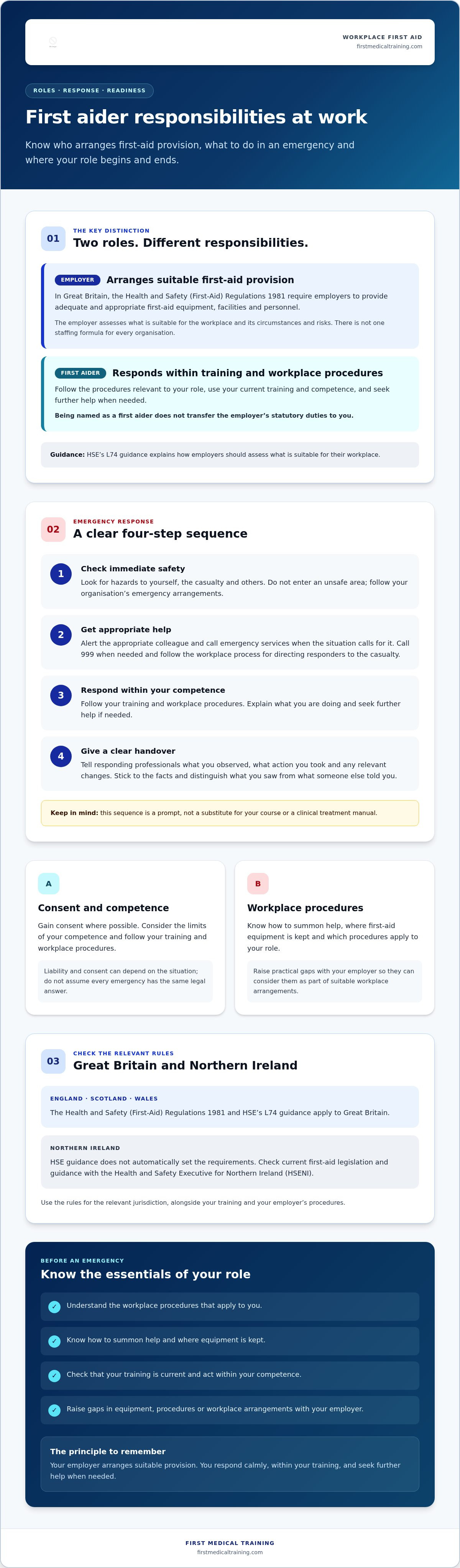
The employer is responsible for arranging suitable workplace first-aid provision. A first aider’s role is different: respond to an emergency within their training and competence, and follow the workplace procedures in place. Understanding the legal responsibilities of a first aider at work uk starts with separating these two roles. Being named as a first aider doesn’t transfer the employer’s statutory duties to you.
What does the Health and Safety (First-Aid) Regulations 1981 require?
In Great Britain, the Health and Safety (First-Aid) Regulations 1981 require employers to provide adequate and appropriate first-aid equipment, facilities and personnel. HSE guidance, including its L74 guidance, explains how employers should assess what is suitable for their workplace. What’s needed depends on the workplace’s circumstances and risks, rather than one staffing formula for every organisation.
For example, workplace hazards, layout and working arrangements can affect the support required. The employer must assess these needs and make suitable arrangements. As a first aider, make sure you understand the procedures relevant to your role, such as how to summon help and where equipment is kept. Raise any practical gaps with your employer.
Does the same legal framework apply across the whole UK?
The 1981 Regulations and HSE’s L74 guidance apply to Great Britain: England, Scotland and Wales. HSE guidance does not automatically set the requirements in Northern Ireland. If your workplace is there, check current first-aid legislation and guidance with the Health and Safety Executive for Northern Ireland (HSENI). This distinction helps you find the relevant rules without treating general UK information as legal advice.
You may encounter the term Good Samaritan laws in discussions about helping someone who is ill or injured. That general overview isn’t a substitute for the rules that apply to your workplace. Focus on your training, your employer’s procedures and the requirements in the relevant jurisdiction.
In short: the employer assesses and arranges suitable provision; the first aider responds within their training and workplace role. Knowing where one responsibility ends and the other begins helps you act confidently and raise wider provision concerns with your employer.
What should a first aider at work do when an emergency happens?
In an emergency, focus on a calm, clear sequence rather than trying to manage everything at once. Your actions should reflect the situation, your current training and your employer’s arrangements. The Health and Safety (First-Aid) Regulations 1981 guidance helps employers plan provision. Workplace procedures should turn that plan into practical steps, including who calls for help and where equipment is kept.
How should a first aider respond within their training?
A first aider should act within their current training and workplace procedures. Use this sequence as a prompt, not as a substitute for your course or a clinical treatment manual:
- Check immediate safety. Look for hazards to yourself, the casualty and others. Don’t enter an unsafe area; follow your organisation’s emergency arrangements.
- Get help. Alert the appropriate colleague and contact emergency services if the situation calls for it. Follow the workplace process for making the call and directing responders to the casualty.
- Respond within your competence. Follow your training, explain what you’re doing and seek further help if the casualty’s condition or your level of training makes that necessary.
- Hand over clearly. Tell the responding professionals what you observed, what action you took and any relevant changes. Stick to the facts and distinguish what you saw from what someone else told you.
In a dental practice, for example, colleagues may need to coordinate the response: one person contacts emergency services while another prepares relevant equipment. The practice’s procedures should make responsibilities and escalation arrangements clear. A workplace first-aid response is distinct from the clinical medical-emergency procedures a dental team may also need.
What information should be passed on after an incident?
Once immediate needs have been addressed, follow your employer’s incident-reporting process. Record or pass on factual, relevant details, such as what happened and the actions taken, in line with workplace policy. Don’t guess, add opinions or include unnecessary personal information. Your employer’s process should explain where the record belongs and who should receive it. Reporting forms and deadlines can differ between workplaces.
Clear procedures make it easier to act promptly, coordinate responsibilities and give an accurate handover. If your workplace arrangements or skills need review, structured Emergency First Aid at Work training is one way to support readiness. Training helps develop your response, but it doesn’t replace the employer’s assessment of workplace needs.
Can a first aider refuse, exceed their training, or be held liable?
Concern about personal liability is understandable, but no one can responsibly promise that a first aider will never face a complaint or legal claim. The employer’s statutory duty to arrange suitable first-aid provision is separate from questions about your conduct during an incident. The practical safeguard is to act within your current training and competence, follow workplace procedures, and call for appropriate help if the situation is beyond your role.
What are the limits of a workplace first aider’s role?
First aid is not a licence to diagnose an illness or provide treatment you haven’t been trained to give. If you’re unsure what to do, don’t improvise beyond your competence. Follow your training, use the organisation’s escalation arrangements and seek help from emergency services when appropriate. The legal responsibilities of a first aider at work uk shouldn’t be reduced to a blanket instruction to intervene or refuse: the circumstances, your role and the relevant rules all matter.
What should you consider about consent and liability?
Where possible, explain what you propose to do and seek the person’s consent. If they can’t communicate or you’re concerned about their ability to make a decision, follow your training and workplace procedures, and seek appropriate help. Capacity and consent can depend on the circumstances and applicable law, so don’t treat this general guidance as a legal ruling. Share personal information only as needed for the response and reporting process, in line with workplace policy.
Acting carefully and within your role is sensible, but it doesn’t guarantee that no complaint or claim can be made. If a specific dispute arises, preserve relevant records in line with your employer’s process and seek qualified legal advice.
| Area | Practical distinction |
|---|---|
| Employer responsibilities | Assess workplace needs and arrange suitable first-aid provision, including appropriate equipment, facilities and personnel. |
| Your actions as a first aider | Respond within your training and competence, follow workplace procedures, seek further help when needed, and communicate relevant facts. |
| Questions needing legal verification | Specific disputes about consent, capacity, confidentiality, refusal to assist or personal liability. Check the rules for the relevant UK jurisdiction and seek qualified legal advice. |
Keep the distinction clear: the employer arranges the system; you act carefully within your role. If you’re uncertain about a procedure or boundary, raise it with your employer before an emergency occurs.
How do risk assessment, training, and records shape first aid at work?
A workplace risk assessment connects the hazards people may face with the first-aid arrangements needed to respond. It helps the employer decide what personnel, facilities and equipment are suitable, rather than relying on a fixed number of first aiders or a standard kit for every workplace. Assessed workplace needs should determine suitable first-aid equipment, facilities and personnel.
How does a workplace Risk assessment guide first-aid provision?
Consider the work being done, its hazards and risks, the workplace’s size and layout, and how people work across the site. These factors can affect how quickly help or equipment can be reached. The employer uses the assessment to plan suitable provision and should review it if workplace conditions or risks change. Your role is to understand the arrangements that apply to you and raise any gaps, not to set staffing levels yourself.
How can you maintain workplace readiness?
Keep your practical knowledge current and make sure you can quickly identify:
- the workplace first-aid procedures and who to contact;
- where first-aid equipment is kept and how to access it;
- how to summon further help and guide responders to the incident; and
- how to report an incident under your employer’s process.
Ask your employer how your training will be kept current and what to do if you’re unsure about a procedure. Suitable workplace training can support your confidence, but it doesn’t replace the employer’s risk assessment or prove that provision is suitable by itself. First Medical Training Ltd provides an Emergency First Aid at Work Course for people who need structured workplace training.
Dental teams may also need to distinguish workplace first aid from clinical preparedness for medical emergencies in a practice. Dental professionals should check current General Dental Council (GDC) guidance for their CPD expectations. Workplace first-aid training and professional CPD both relate to readiness, but they aren’t interchangeable requirements. Use the GDC CPD requirements for medical emergencies guide as a starting point, then confirm current requirements with the GDC. For practical planning, review this dental practice emergency preparedness checklist.
Records support the employer’s oversight of incidents and first-aid arrangements. Follow your organisation’s reporting process, provide factual information and handle records as instructed. Understanding the legal responsibilities of a first aider at work uk includes knowing your part in that system: stay prepared, follow procedures and tell your employer when training, equipment or arrangements need attention.
What practical next steps help you meet first aider responsibilities at work?
Turn your understanding of the legal responsibilities of a first aider at work uk into a few practical checks. You should know what your role involves and how to respond, while your employer remains responsible for assessing workplace needs and arranging suitable first-aid provision.
What should you check before taking on a first aider role?
Before accepting or continuing in the role, speak with your employer or responsible manager. Confirm:
- what you’re expected to do and which workplace procedures apply;
- how to summon further help and who is responsible for making the call;
- where first-aid equipment is kept and how to access it;
- how to report an incident under workplace policy; and
- what training is expected for the role, and how to raise concerns if your skills or the arrangements need review.
Don’t assume that the title of first aider tells you what to do in every situation. Ask for clarification if the procedure, escalation route or limits of your role are unclear. If you notice missing or inaccessible equipment, tell the responsible manager rather than trying to fix a wider provision gap on your own.
When is further first-aid training a sensible next step?
Training needs should reflect the employer’s assessment of workplace risks and the tasks you’re expected to perform. Emergency First Aid at Work is one structured training option, but it isn’t a universal answer for every workplace or a substitute for suitable provision. First Medical Training Ltd provides an Emergency First Aid at Work course guide to help you understand the course and consider whether it fits your workplace needs.
Discuss the role and any training gaps with your employer, then check that the course content matches the responsibilities you’ll have. Completing training can support your confidence and readiness, but it doesn’t by itself establish that the employer’s first-aid arrangements are suitable.
To review training options, explore workplace first-aid training, then speak with your employer about how it fits the workplace assessment and your role.
Build confidence through clear preparation
Understanding the legal responsibilities of a first aider at work uk begins with knowing where your role sits within the workplace arrangements. Your employer assesses first-aid needs and arranges suitable provision; you respond within your training, follow procedures and seek further help when needed.
Before an incident occurs, confirm who to contact, where equipment is kept, how to raise concerns and how to report an incident. Keep your training current and tell your employer if your role or workplace arrangements are unclear. For dental teams, workplace first aid and clinical medical-emergency preparedness are connected but distinct responsibilities.
First Medical Training Ltd provides specialised education, including Emergency First Aid at Work and dental emergency training. If structured workplace training is your next step, explore Emergency First Aid at Work training and discuss how it fits your employer’s assessment. Training can help you prepare, while suitable workplace provision remains the employer’s responsibility. Contact First Medical Training Ltd to explore training options for your workplace.
Frequently Asked Questions
Is a first aider legally responsible for treating everyone at work?
No. An individual first aider isn’t responsible for arranging treatment for every person at work; the employer must assess workplace needs and arrange suitable first-aid provision. If you’re designated as a workplace first aider, you’re expected to carry out your role according to your training and workplace procedures. The legal responsibilities of a first aider at work uk are distinct from the employer’s duties and don’t make you a substitute for emergency services or a healthcare professional.
Does UK law require every workplace to have a trained first aider?
Not necessarily. In Great Britain, the Health and Safety (First-Aid) Regulations 1981 require employers to provide adequate and appropriate first-aid equipment, facilities and personnel. The employer’s assessment of workplace risks and circumstances determines what provision is suitable. This may involve trained first aiders or other arrangements, so don’t assume every workplace needs the same number or type of responder. Northern Ireland has separate requirements, which should be checked with HSENI.
Can a first aider refuse to help at work?
There isn’t a simple rule that every first aider must intervene in every situation or can always refuse. Your designated role and the circumstances matter. Don’t put yourself in danger; follow your training and workplace procedures, and summon appropriate help if you can’t safely provide assistance or the situation exceeds your competence. If you’re concerned about your responsibilities, clarify them with your employer before an emergency occurs. Seek qualified legal advice about a specific dispute.
Can a first aider be sued for giving first aid at work?
A complaint or legal claim can’t be ruled out, but that doesn’t mean a claim would succeed. The outcome would depend on the circumstances and the first aider’s conduct. Act in good faith, within your training and competence, and follow workplace procedures. Don’t rely on general assurances about immunity or insurance as a guarantee. If a claim or formal complaint arises, follow your employer’s process and obtain qualified legal advice.
Can a first aider give treatment beyond their training?
No. Don’t attempt treatment you haven’t been trained or authorised to provide. Follow your course guidance and workplace procedures, and contact emergency services or seek appropriate assistance if the casualty’s needs go beyond your competence. For example, don’t try to diagnose the cause of someone’s symptoms. Explain what you’ve observed and what help is needed. Training can build practical skills, but it doesn’t extend your role beyond its taught scope.
What should a first aider do after an incident at work?
Follow your employer’s reporting process once the immediate response is complete. Provide a factual account of what happened, what you observed and what actions you took, then share it with the appropriate person. Don’t speculate or add unnecessary personal details. Use the workplace’s approved record-keeping arrangements and handle information confidentially. Reporting forms and processes differ between organisations, so ask your employer where incidents should be recorded and who needs to be informed.
How often should a workplace first aider renew their training?
In Great Britain, Emergency First Aid at Work and First Aid at Work certificates are valid for three years. The Health and Safety Executive strongly recommends a half-day refresher each year to help maintain skills. Check your certificate’s expiry date and ask your employer how refresher training is arranged. The right training also depends on the workplace’s assessed needs and your role. Check current guidance for your jurisdiction, including separate requirements in Northern Ireland.