

Verifiable CPD for Dental Professionals: A Guide to GDC Compliance in 2026

Could your next GDC audit be the moment your registration hangs in the balance because of a simple administrative oversight? It's a question that keeps many clinicians awake at night, particularly as the 2026 requirements for verifiable cpd for dental professionals demand more than just a collection of certificates. You likely feel that your clinical duties are demanding enough without the added pressure of deciphering complex regulatory frameworks or worrying if your training hours truly count towards your five-year cycle.
We understand that compliance shouldn't feel like a hurdle to your career; it should be a foundation for safer practice. This guide will help you master the Enhanced CPD scheme, ensuring you remain both clinically confident and fully compliant with GDC standards. We'll clarify the essential differences between verifiable and general learning, explore the highly recommended core topics like medical emergencies, and provide a streamlined path to earning your hours whilst maintaining a busy practice amongst your daily patient commitments.
Key Takeaways
- Understand the crucial distinction between general reading and verifiable cpd for dental professionals to ensure every hour recorded satisfies GDC auditors.
- Identify the 'highly recommended' core topics you must prioritise to maintain your registration and protect patient safety.
- Learn how to vet training providers and verify that their quality assurance processes meet the strict GDC Enhanced CPD criteria.
- Determine the best balance between flexible online learning and essential hands-on training for life-saving skills such as Immediate Life Support (ILS).
- Streamline your five-year cycle by aligning your Personal Development Plan with practical, evidence-based training that builds team confidence.
What is Verifiable CPD for Dental Professionals?
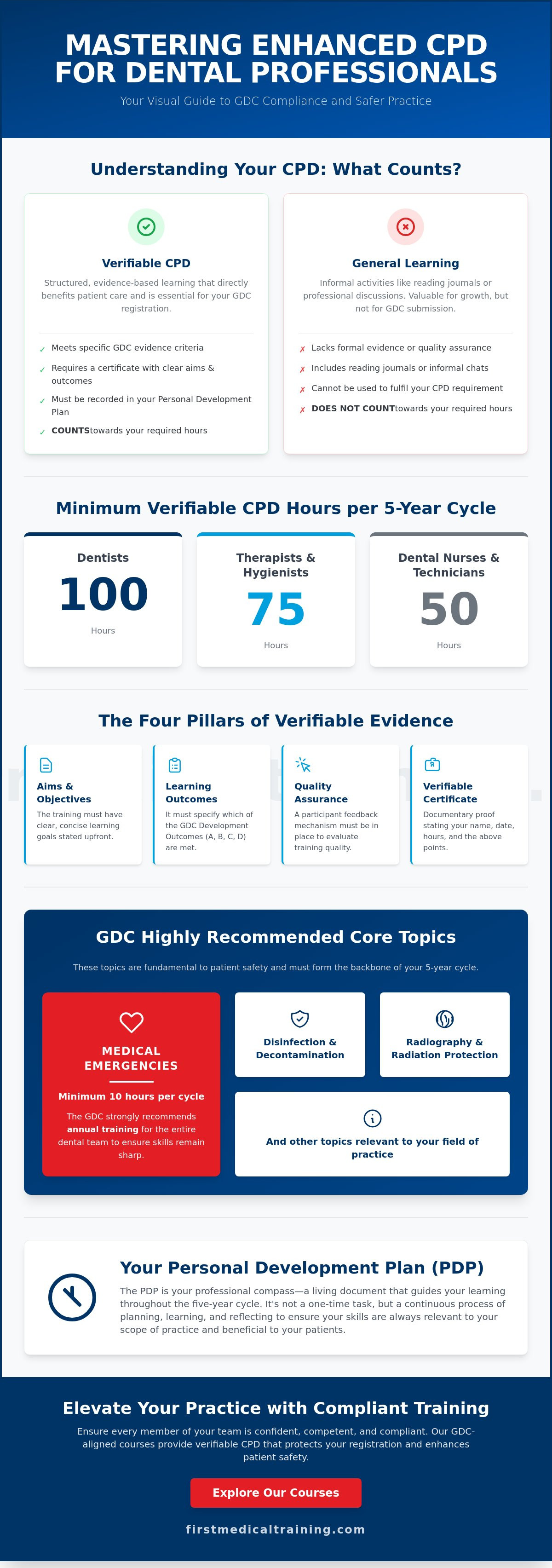
The GDC Enhanced CPD scheme represents a fundamental shift in how the regulator views professional growth. It isn't just about accumulating 100 or 50 hours over five years anymore. Instead, the focus is on a structured, planned approach to learning that directly benefits patient care. This is where verifiable cpd for dental professionals differs from general learning. General CPD, such as reading a dental journal or having an informal chat with a colleague, remains valuable for your growth but no longer counts towards your official GDC submission. Verifiable training must meet specific evidence criteria to be accepted during an audit.
Every registrant must now maintain a Personal Development Plan (PDP). Think of this as your professional compass. It's a living document where you identify your specific learning needs, plan how to address them, and reflect on the results whilst keeping your records updated. This transition from the old system to the current outcome-based model ensures that your training is relevant to your specific field of practice. Continuing professional development in dentistry is now less about ticking boxes and more about demonstrating that you've genuinely improved your skills for the benefit of your patients.
The Four Pillars of Verifiable Evidence
For a learning activity to qualify as verifiable, it must stand up to GDC scrutiny. You can't simply claim hours; you must provide evidence that the training was rigorous and relevant. The regulator looks for four specific pillars to confirm the validity of your certificates. First, you need documentary evidence from the provider that includes your name, the date, and the total hours. Second, the training must have clear, concise aims and objectives. Third, it must state which GDC learning outcomes were met. Finally, there must be a participant feedback loop. This ensures you've had the opportunity to evaluate the quality of the training, which helps maintain high standards amongst educational providers.
GDC Learning Outcomes Explained
The GDC categorises all verifiable cpd for dental professionals into four development outcomes, labelled A through D. Your training should ideally cover a spread of these across your cycle to show a well-rounded approach to your career. Outcome A focuses on effective communication and team working. Outcome B covers management and leadership within the dental centre, which often involves improving technical proficiency; to support your team's growth in this area, you can check out Square Skills for accredited IT training and career development. Outcome C is likely where you'll spend much of your time, as it concentrates on the maintenance and development of clinical knowledge. Finally, Outcome D addresses professional behaviour and ethical principles. By aligning your training with these outcomes, you ensure that every hour spent learning contributes directly to your professional standing and the safety of your practice.
GDC Highly Recommended Topics: The Core of Your Cycle
The GDC classifies certain subjects as 'highly recommended' because they are fundamental to patient safety and professional standards. While the Enhanced CPD scheme allows you to choose topics relevant to your specific field, these core areas are expected to form the backbone of your five-year cycle. For dentists, who must complete 100 hours of verifiable cpd for dental professionals, and dental care professionals (DCPs) such as therapists or hygienists who require 75 hours, the stakes are high. Even dental nurses and technicians, with a 50-hour requirement, must ensure their core learning is robust and evidence-based. A minimum of 10 hours must be dedicated to medical emergencies within every cycle, regardless of your specific role.
Beyond emergency response, you must also prioritise disinfection and decontamination to maintain a sterile clinical environment. If your role involves taking or processing radiographs, then radiography and radiation protection are non-negotiable. These topics ensure that your practice remains a safe space for both staff and patients. The British Dental Association CPD guidelines provide an excellent framework for understanding how these requirements integrate with your daily clinical responsibilities, helping you stay ahead of regulatory shifts.
Medical Emergencies: Annual Training Requirements
Annual training is the gold standard for emergency preparedness in the UK. The GDC strongly recommends that the entire dental team engages in medical emergencies training at least once a year. This consistent approach ensures that life-saving skills remain sharp and that every team member knows their exact role during a crisis. Our medical emergencies in dental practice course is designed to meet these rigorous standards, providing the verifiable evidence you need for your PDP. For practices performing sedation or handling more complex cases, Dental Immediate Life Support (ILS) Training offers an advanced level of compliance that aligns with Resuscitation Council UK protocols.
Emerging CPD Priorities: Mental Health and Safeguarding
Modern dentistry demands a broader range of skills than ever before. Mental health first aid is rapidly becoming a staple for forward-thinking teams, providing the tools to support both colleagues and patients who may be in distress. This isn't just about 'soft skills'; it's about creating a safe, supportive practice environment. This sits alongside your legal requirements for safeguarding children and vulnerable adults, which is a mandatory aspect of modern healthcare. Integrating these topics into your verifiable cpd for dental professionals doesn't just satisfy an auditor; it builds a more resilient and empathetic team. If you're looking to broaden your expertise, you might consider our specialised online CPD modules which allow you to earn hours in these critical areas at your own pace.
Criteria for Verifiable CPD: Ensuring Your Training Counts
Accumulating hours is only half the battle. If those hours don't meet the GDC's strict quality criteria, they won't protect your registration during an audit. Compliance is built on the substance of the training, not just the presence of a certificate. Finding high-quality verifiable cpd for dental professionals requires a discerning eye for detail and an understanding of what the regulator actually expects to see in your portfolio. A certificate is merely a receipt; the true value lies in the quality assurance process that sits behind the course materials.
The GDC requires that all verifiable training has a clear set of aims and objectives, is subject to quality control, and provides an opportunity for feedback. If a provider cannot demonstrate how they keep their content updated or who oversees their educational standards, you're taking a risk with your professional standing. You must be able to prove that the activity was relevant to your practice and that you've actively engaged with the learning outcomes.
Vetting Your CPD Provider
Before you book any session, check the provider's credentials. For life-saving topics, ensure the training aligns with current Resuscitation Council UK guidelines. Your training should reflect the 2026 standards of care, as outdated protocols can be dangerous in a clinical crisis. We believe the best educators are those with real-world experience. A trainer who has worked in emergency medicine or spent years in a high-pressure dental environment brings a level of practical depth that a purely theoretical course cannot match. Ask about their quality assurance process. A reputable provider will be transparent about how they maintain their standards and update their curriculum.
This emphasis on expert-led instruction is a hallmark of high-quality professional education across all clinical sectors. For instance, in the field of facial aesthetics, resources from Advanced PMU highlight how understanding physiological recovery, such as the eyebrow healing process, is essential for maintaining patient safety and professional standards.
The Audit Trail: What to Keep
Your record-keeping must be meticulous. You're required to keep your CPD records for at least five years after the end of your five-year cycle. Whether you prefer a physical folder or a secure digital drive, your audit trail needs to be organised and accessible. Each entry should include your certificate, the course aims, and the specific GDC learning outcomes it addressed. However, the most overlooked element is the reflection. To truly satisfy an auditor, you should include a brief statement for each activity. A single sentence explaining how the training improved your clinical practice or patient communication is often enough to demonstrate genuine professional development. This bridges the gap between simply attending a course and actually evolving as a clinician.
Matching your certificates to your Personal Development Plan (PDP) is the final piece of the puzzle. If you've identified a need for better emergency response skills in your PDP, your verifiable cpd for dental professionals should clearly reflect that goal. This logical flow shows the GDC that you're a proactive, organised professional who takes their development seriously. It transforms your CPD from a list of dates into a coherent story of your commitment to patient safety.
Choosing Between Online and In-Practice Training
Deciding between digital learning and face-to-face instruction is often a matter of balancing clinical necessity with logistical reality. For theoretical subjects, such as legal and ethical issues or the latest updates in decontamination protocols, online platforms offer an efficient way to stay current without disrupting the practice schedule. However, when it comes to life-saving skills, the physical environment of your own surgery provides a context that a screen simply cannot replicate. A truly resilient practice strategy blends both formats to ensure every team member is prepared for the specific challenges of their role.
Cost-effectiveness is a major factor for practice managers. Whilst individual online modules allow staff to progress at their own pace, group in-practice sessions foster team cohesion and ensure everyone is operating from the same playbook. This hybrid approach allows you to maximise your training budget, using online modules for foundational knowledge and reserving in-person sessions for high-impact, hands-on drills like Dental Immediate Life Support (ILS) Training.
The Rise of Verifiable Online CPD
Achieving high-quality verifiable CPD for dental professionals has never been more accessible. Digital platforms now offer interactive assessments and real-time feedback, ensuring that the learning is robust enough to meet GDC audit standards. This is particularly beneficial for remote or part-time staff members who might find it difficult to attend every practice-wide session. By utilising online modules, you ensure that no one falls behind in their five-year cycle, regardless of their working hours or location.
In-Practice Training for Team Cohesion
There is no substitute for practicing medical emergency scenarios in the very rooms where you treat patients. In-practice training allows your team to locate emergency equipment, such as the AED or oxygen cylinders, under simulated pressure. It's also vital to include the wider team in these sessions. Whilst clinicians focus on ILS, reception and support staff benefit immensely from an Emergency First Aid at Work Course (EFAW). This one-day qualification ensures that the first person a patient encounters in a crisis is just as capable as the dentist. Organising annual resuscitation updates for the entire clinical team creates a culture of safety that patients can feel the moment they walk through the door.
If you're ready to streamline your team's learning path, you can browse our full range of online verifiable CPD modules here to get started today.
Elevate Your Practice with First Medical Training’s Accredited Courses
Choosing the right educational partner is a critical decision for any clinician. First Medical Training has served as a cornerstone of dental education for over 20 years, providing the steady reliability you need to manage your professional development. We understand that the pressure of a busy surgery doesn't always leave room for complex administrative tasks. That's why our approach is designed to be as efficient as it is rigorous. We act as a bridge between strict GDC regulations and the practical realities of your daily work, ensuring that your verifiable cpd for dental professionals is both high-impact and fully compliant.
Our commitment to excellence is reflected in our strict adherence to GDC standards and Resuscitation Council UK protocols. Every course we offer is developed with clinical accuracy at its heart, demystifying complex emergency procedures and turning them into manageable, actionable skills. We don't just provide a certificate; we provide a comprehensive evidence trail. Our documentation clearly outlines the aims, objectives, and specific GDC learning outcomes (A, B, C, or D) for every hour you complete. This level of detail simplifies the audit process, giving you the confidence to stand before any regulator with a robust, well-organised portfolio.
Our Core Dental CPD Offerings
We provide a diverse range of training solutions tailored to the needs of the modern dental team. Our Medical Emergencies in a Dental Practice Course remains our most popular option, making annual compliance straightforward for the entire practice. For those seeking advanced clinical safety, our Dental Immediate Life Support (ILS) Training provides the high-level skills required for complex cases and sedation. We also address the growing need for team wellbeing through Mental Health First Aid for Dental Practices. By supporting the mental health of your colleagues, you build a more resilient practice environment that benefits staff and patients alike. Whether you need a 1-day EFAW qualification for support staff or specialised clinical updates, our flexible learning options fit seamlessly into your schedule.
Secure Your Verifiable Hours Today
Taking control of your five-year cycle shouldn't be a source of stress. We've simplified the booking process for both individual clinicians and full practice teams, allowing you to secure your training with minimal fuss. Once you've completed your course, you can easily access your certificates and course materials through our dedicated online shop. This digital-first approach ensures your records are always at your fingertips, ready for your next annual declaration or an unexpected GDC inspection. Don't leave your compliance to chance amongst the demands of clinical life. You can browse our full range of verifiable CPD courses for dental professionals to find the right training for your team today.
Secure Your Professional Standing for 2026 and Beyond
Compliance is far more than a regulatory box-ticking exercise; it's a commitment to the highest standards of patient care. By mastering the criteria for verifiable cpd for dental professionals, you protect your registration whilst building a more capable and resilient clinical team. Focus on those 'highly recommended' core topics, maintain a meticulous audit trail, and ensure your Personal Development Plan reflects the real-world needs of your practice.
First Medical Training has provided accredited dental education since 2006, offering steady reliability in an ever-changing regulatory landscape. Our courses remain strictly aligned with Resuscitation Council UK guidelines, and we offer specialist Mental Health First Aid for dental teams to support your staff's wellbeing. Whether you choose flexible online modules or hands-on in-practice sessions, we are here to guide you through every stage of your five-year cycle.
Book your verifiable CPD courses and ensure GDC compliance today. You have the expertise to provide exceptional care; let us provide the tools to ensure your professional development is just as exemplary.
Frequently Asked Questions
How many hours of verifiable CPD do I need as a dentist?
Dentists must complete 100 hours of verifiable CPD over a five-year cycle to maintain their professional registration. This requirement ensures that clinicians keep their skills current in line with evolving GDC standards. You must also complete a minimum of 10 hours of verifiable learning in any two-year period within that cycle to demonstrate consistent engagement with your professional development.
What happens if I do not meet my GDC CPD requirements by the end of the cycle?
Failing to meet your CPD requirements puts your registration at significant risk and may lead to removal from the GDC register. If you don't complete the required hours or fail to make an annual statement, the regulator may initiate an administrative process. This can result in you being unable to practice legally in the UK until the situation is resolved and your registration is restored.
Can online training count as verifiable CPD for dental professionals?
Online training absolutely counts as verifiable cpd for dental professionals as long as it meets the GDC criteria for evidence-based learning. The course must provide clear aims and objectives, offer a feedback mechanism, and issue a certificate that details the specific learning outcomes. Digital platforms are an efficient way to cover theoretical topics whilst ensuring your team remains compliant with current regulations.
How often should a dental practice perform medical emergency training?
The GDC highly recommends that dental practices undertake medical emergency training at least once every year. This annual frequency ensures that life-saving skills stay sharp and that the entire team is prepared to act decisively in a crisis. Regular drills in your own clinical environment help identify potential equipment issues and clarify team roles before a real emergency occurs.
What is the difference between ILS and BLS for dental professionals?
Basic Life Support (BLS) covers fundamental CPR and AED use, whereas Immediate Life Support (ILS) includes advanced airway management and the administration of emergency drugs. Whilst BLS is a core requirement for all staff, ILS is essential for clinicians who perform sedation or handle complex surgical cases. ILS training provides a deeper level of clinical confidence for responding to life-threatening scenarios in the surgery.
Is Emergency First Aid at Work (EFAW) mandatory for dental receptionists?
While the GDC doesn't mandate EFAW for receptionists, it's a vital component of workplace health and safety compliance. Having trained first responders at the front desk ensures that non-clinical emergencies are managed professionally from the moment a patient enters the building. This training bridges the gap between clinical response and general workplace safety, creating a more secure environment for everyone.
How do I link my CPD to the GDC learning outcomes?
You link your CPD to GDC learning outcomes by identifying which of the four categories (A, B, C, or D) the training addresses. Most high-quality verifiable cpd for dental professionals will state these outcomes clearly on the certificate. You should then record these in your Personal Development Plan to demonstrate a balanced approach to your professional growth and clinical maintenance throughout your cycle.
Do I need to submit my CPD certificates to the GDC every year?
No, you don't need to submit your certificates annually; you only need to make a declaration of your completed hours. However, you must keep all certificates and evidence for at least five years after your cycle ends. The GDC may request to see your full audit trail at any time, especially if you're selected for a random compliance check or fail to make a statement.