

What Happens If a Business Has No First Aider?

What happens if a business has no first aider? It doesn’t automatically mean the business is breaking the law, but it does mean you need to assess whether its first-aid arrangements are adequate. A trained first aider and an appointed person have different responsibilities, and the right provision depends on the workplace.
It’s understandable to worry about how an injury or sudden illness would be managed if no trained colleague were available. Under the Health and Safety (First-Aid) Regulations 1981, employers must provide adequate and appropriate first-aid equipment, facilities and personnel. A Risk assessment helps you decide what that means for your team by considering workplace hazards, work patterns and the people on site.
This guide explains the difference between having no named first aider and having inadequate provision, what your responsibilities involve and how to assess your needs. It also sets out practical steps for improving cover, including when to consider Emergency First Aid at Work training. Clear arrangements help your team understand what to do when an emergency happens.
Key Takeaways
- What happens if a business has no first aider depends on its circumstances and whether its overall first-aid provision is adequate.
- Use a Risk assessment to identify hazards and decide what equipment, arrangements and trained personnel your workplace needs.
- Consider how first-aid cover could differ across offices, mobile teams, higher-risk work and dental practices.
- If nobody is trained, review your arrangements, identify gaps and plan cover for shifts, absences, locations and lone-working situations.
- Choose training after assessing your needs, so staff can practise their roles and respond within their competence.
What does it mean if a business has no first aider?
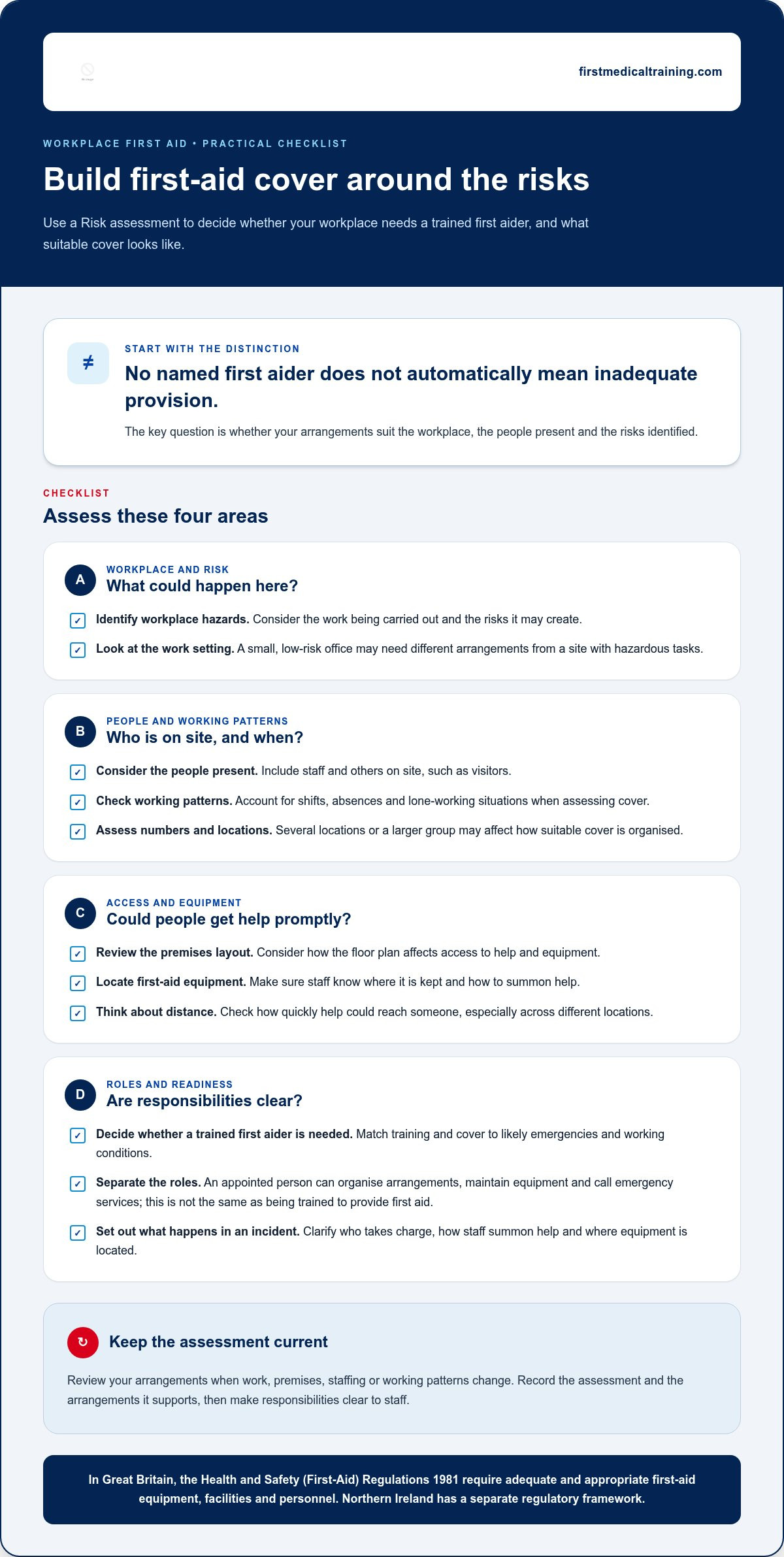
A business without a named, trained first aider doesn’t automatically have inadequate provision. The key question is whether its arrangements suit the workplace, the people present and the risks identified. A small, low-risk office may need different arrangements from a site with hazardous tasks, several locations or lone workers.
In Great Britain, the Health and Safety (First-Aid) Regulations 1981 require employers to provide adequate and appropriate first-aid equipment, facilities and personnel. Northern Ireland has a separate regulatory framework, so check the relevant guidance for the jurisdiction where your workplace operates. This First aid overview explains the purpose of immediate assistance, but it doesn’t replace guidance on the rules that apply to your workplace.
Does every UK business need a trained first aider?
There isn’t one staffing formula that sets the number of trained first aiders every business must have. Assess your workplace instead. Consider its hazards, how many people are present, working patterns, different locations and how quickly help could reach someone. Your assessment should establish whether a trained first aider is needed and what suitable cover looks like.
Keep responsibilities clear. An appointed person can take charge of first-aid arrangements, such as maintaining equipment and calling emergency services, but that role is not the same as being trained to provide first aid. In a dental practice or another clinical setting, consider relevant professional and clinical standards alongside general workplace guidance.
What counts as adequate first aid provision?
Start with a Risk assessment. Use it to decide what people, equipment and procedures your workplace needs, then check that they work together. A first-aid kit alone may not address the risks you have identified. A trained person may not provide reliable cover if they are absent or based at another site.
A first aider is someone trained to provide first aid within their competence. Match training and cover to the likely emergencies and the conditions in which staff work. Set out how employees can summon help, where equipment is kept and who takes charge if an incident occurs.
Review the assessment when your work, premises, staffing or working patterns change. This helps you distinguish between having no named first aider and having a genuine gap in provision. It also gives you a practical basis for deciding what to put in place.
What could happen if a business has no first aider?
If an employee becomes unwell or is injured, the absence of a trained first aider can leave colleagues unsure who should take charge, where equipment is kept and who should call for emergency help. Confusion may delay a clear response. Colleagues may hesitate or duplicate tasks, while customers or visitors nearby may not know where to go. The incident can also interrupt work as staff focus on managing the situation and supporting those affected.
These are risks, not guaranteed outcomes. What happens if a business has no first aider depends on the incident, the arrangements already in place and whether the employer has met the requirements that apply to the workplace. An injury occurring does not, by itself, prove that a legal breach took place. Equally, the absence of a named first aider alone doesn’t establish liability. The wider provision and the employer’s assessment matter.
How can missing cover affect an emergency response?
Imagine an employee suddenly becoming unwell during a busy working day. If responsibilities haven’t been agreed, one colleague might try to find a manager while another searches for equipment. Nobody may be certain who is contacting emergency services. Clear arrangements help staff act promptly: identify who takes charge, how to summon help and where first-aid equipment is located. This clarity supports a coordinated response without asking anyone to act beyond their training.
Could a business face enforcement or legal action?
Possible consequences depend on the circumstances, the evidence and the applicable legal requirements. If concerns arise, the relevant enforcing body may assess whether the employer’s first-aid provision was suitable. For current guidance, consult the Health and Safety Executive (HSE) for Great Britain or the Health and Safety Executive for Northern Ireland (HSENI) for Northern Ireland. Use the guidance for the jurisdiction where your workplace operates.
Rules vary between countries. For example, the US Occupational Safety and Health Administration’s OSHA first aid requirements discuss access to trained first aiders in relation to proximity to medical care. This is a US interpretation, not a source of UK legal duties, so don’t use it to decide what your business must provide.
Reduce uncertainty by documenting your assessment, recording the arrangements it supports and making responsibilities clear to staff. If the assessment identifies a training need, Emergency First Aid at Work training can help you build the skills your workplace needs.
How does inadequate first aid cover affect different workplaces?
First-aid arrangements should reflect how work is done, not just the number of people on the payroll. Work patterns, hazards, premises layout and the distance between staff and equipment can all affect how quickly someone can get help. Use the examples below to guide your assessment, not as a fixed staffing formula.
| Workplace | Factors to assess |
|---|---|
| Office | Floor layout, staff and visitor numbers, first-aid equipment locations, working hours and cover during meetings or absences. |
| Mobile or dispersed teams | Where workers are based, lone-working arrangements, travel between sites, access to equipment and how staff can summon help. |
| Higher-risk work | Workplace hazards, likely injuries, protective arrangements, site access and how quickly assistance can reach the work area. |
| Dental practice | Patients and staff on site, treatment-room layout, clinical activities, equipment access and how the team allocates emergency roles. |
Which workplace factors change first aid needs?
Assess hazards alongside the size and layout of your premises, workforce distribution, shift patterns and access to emergency assistance. A colleague who provides cover on one shift may not be present on another, or may work in a separate location. Record how each identified risk affects your arrangements, including cover during absences and lone-working periods. Review the record when work patterns, staffing or premises change.
What should a dental practice consider?
In a dental surgery, an emergency could involve a patient receiving treatment while other patients and staff are elsewhere in the practice. Consider who will respond, who will summon help, how other patients will be supported and whether equipment can be reached promptly from treatment areas. Keep general workplace first-aid planning distinct from clinical medical emergency preparedness. Check current General Dental Council (GDC) and Care Quality Commission (CQC) guidance for relevant professional or regulatory expectations.
Use this dental emergency preparedness checklist for practical prompts on roles, equipment and procedures. The US OSHA first aid requirements page describes US workplace provisions. It is not UK guidance and shouldn’t be used to determine your UK duties.
These differences help explain why what happens if a business has no first aider depends on its actual working conditions. Assess access to help at each site and on each shift, then document why your chosen arrangements are suitable.
What should an employer do if nobody is trained?
If you discover that nobody at work has first-aid training, take a structured approach. Don’t assume buying equipment or asking a colleague to take charge resolves the gap. First establish what your workplace needs, then assign and record actions to address any shortfall.
- Review the risks. Revisit your Risk assessment and note hazards, work activities and who may need assistance.
- Check current arrangements. Confirm what equipment is available, who is responsible for it and how staff can summon help.
- Identify gaps. Check whether suitable trained people and equipment are accessible across shifts, locations, absences and lone-working situations.
- Assign actions. Name who will arrange training, check equipment and communicate emergency procedures to the team.
- Set a review date. Record when you’ll revisit the assessment and what changes should prompt an earlier review.
How should you complete a first aid needs assessment?
Work through the workplace systematically. List hazards, staff numbers and work patterns, site layout, lone-working arrangements and other people who may be present, such as visitors or customers. Then assess whether trained staff and equipment can be reached wherever and whenever work takes place. Record your reasoning, the actions needed and a review date. A clear record helps you explain how identified risks shaped your arrangements.
What arrangements can you put in place straight away?
Make sure staff know how to raise the alarm, contact emergency services and find first-aid equipment. Identify who will coordinate the response, without treating that responsibility as a substitute for suitable training. Check that equipment is accessible, easy to identify and included in regular checks. If your assessment identifies a need for trained cover, arrange appropriate training. Interim arrangements don’t replace the need to assess and address that requirement.
Once you’ve assessed the workplace, consider whether the Emergency First Aid at Work Course suits the needs you identified. For further information about the course and its workplace context, read the Emergency First Aid at Work guidance. Knowing what happens if a business has no first aider should prompt documented decisions, clear responsibilities and appropriate preparation.
How can training help a business build first aid readiness?
Training helps staff prepare to respond, but it should follow an assessment of workplace risks and the provision you need. First identify hazards, likely emergencies and responsibilities in your setting. Then choose training that equips the relevant people to act within their competence and fits the cover you need across shifts and locations.
Practising how to raise the alarm, locate equipment and communicate responsibilities can help organise the team’s response. Staff can clarify who takes charge, who contacts emergency services and how to guide responders to the incident. Training doesn’t replace suitable equipment or clear procedures, but it helps employees understand their role instead of having to work it out during an emergency.
Understanding what happens if a business has no first aider is a reason to turn your assessment into a practical training plan. First Medical Training provides an Emergency First Aid at Work course for employers whose assessment identifies this type of training as suitable.
How do you choose training that fits the workplace?
Match course content to the hazards you’ve identified, the responsibilities staff will hold and the environment where they work. Consider whether the team needs general workplace first-aid training or additional preparation for specific clinical emergencies. Dental teams may need medical emergency and CPD training alongside their workplace first-aid arrangements. Explore the medical emergencies in a dental practice course for training focused on that clinical context.
How can you maintain readiness after training?
Keep arrangements current. Review them when work activities, staffing, shift patterns or premises change. Revisit who is responsible, how to contact emergency services and where equipment is kept. Practising at work can help staff familiarise themselves with the route to equipment and the steps for communicating an incident. Record any problems and assign follow-up actions, then check that they have been completed.
Choose training based on your assessment and give your team opportunities to understand and practise their responsibilities. Explore first aid training and build your team’s first aid readiness.
Turn your first-aid assessment into practical action
What happens if a business has no first aider depends on its assessed needs and the arrangements in place. A missing named first aider doesn’t automatically mean provision is inadequate, but it should prompt you to review your risks, equipment, responsibilities and cover across shifts and locations.
Record what your workplace needs, address any gaps and make sure staff understand how to raise the alarm and access help. Then choose training that fits the risks and responsibilities you’ve identified. First Medical Training has provided specialist education since 2006, including Emergency First Aid at Work and dental medical emergency courses. Its training follows Resuscitation Council UK guidelines.
Take the next step towards a prepared team. Explore first aid training for your team and build readiness around your workplace needs.
Frequently Asked Questions
Is it illegal for a business to have no first aider?
Not automatically. In Great Britain, employers must provide first-aid arrangements that are adequate and appropriate for their workplace, but this doesn’t always mean appointing a trained first aider. A Risk assessment helps determine what personnel, equipment and arrangements are needed. Northern Ireland has a separate regulatory framework, so check the applicable HSENI guidance if your workplace is there. The absence of a named first aider alone doesn’t establish whether provision is adequate.
Does every business in the UK need a trained first aider?
No single rule requires every UK business to have the same number of trained first aiders. The level of cover depends on the workplace’s assessed risks and circumstances, including hazards, work patterns, layout and access to help. A business may need trained first-aid personnel, while different arrangements may suit another workplace. Assess your workplace rather than relying on a staffing ratio, and check the relevant guidance for Great Britain or Northern Ireland.
Can a business be fined if nobody is trained in first aid?
A fine isn’t automatic simply because nobody holds a first-aid qualification. If concerns arise, the relevant enforcing body may consider whether the employer’s overall arrangements meet applicable requirements. The outcome depends on the facts and evidence. For current jurisdiction-specific guidance, consult the Health and Safety Executive (HSE) in Great Britain or the Health and Safety Executive for Northern Ireland (HSENI) in Northern Ireland. Keep your assessment and records of actions taken up to date.
What happens if an employee has an accident and there is no first aider?
Assistance may be delayed, or staff may be unclear about who should take charge, locate equipment or call emergency services. Follow your workplace emergency arrangements, summon emergency help promptly when needed and make sure colleagues act within their training and competence. An accident doesn’t automatically prove a breach of requirements. The employer’s assessment, arrangements and response are relevant when considering whether first-aid provision was suitable.
How many first aiders does a business need?
There’s no universal number that applies to every business. Use your Risk assessment to determine appropriate cover, considering hazards, workforce size and distribution, shifts, locations, lone working and absences. For example, one trained person may not provide accessible cover across separate sites or at times when they aren’t working. Record how these factors inform your decision, and review the arrangements if the workplace or working patterns change.
What should an employer do if their only first aider leaves?
Review your first-aid needs assessment promptly and check whether the remaining arrangements still meet your workplace’s needs. Consider cover across shifts, sites, absences and lone-working situations. Make responsibilities, emergency contact procedures and equipment locations clear to staff, then arrange suitable training if your assessment identifies a gap. Record the actions taken and set a review date. Don’t assume temporary arrangements replace trained cover if your assessment shows it’s needed.
Does a dental practice need separate medical emergency training?
A dental practice should consider clinical medical emergency preparedness as well as general workplace first-aid arrangements. Assess the patients, staff, treatment areas, equipment and emergency roles involved in your setting, and check current General Dental Council (GDC) and Care Quality Commission (CQC) guidance for relevant expectations. Training focused on medical emergencies in a dental practice can help the team practise its clinical response. Match course choices to assessed needs and staff responsibilities.