

Workplace Defibrillator Risk Assessment: A UK Checklist for 2026

An AED can be on site and still be out of reach when it’s needed. A workplace defibrillator risk assessment should consider more than whether to buy a device. It should help you decide whether an AED is appropriate for your workplace and whether people can access it quickly.
It’s understandable to be unsure. There’s no general UK law requiring every workplace to have a defibrillator, but employers must assess first-aid needs and make provision that’s adequate and appropriate for their circumstances. Consider your people, work activities, site layout and access to emergency support instead of relying on a one-size-fits-all answer.
This practical UK checklist will help you document those factors, decide whether an AED is appropriate and assess where it should be placed. It also covers the steps that keep a device ready for use, including routine checks, staff familiarity and review when your workplace changes. By the end, you’ll have a clear plan for AED provision and readiness.
Key Takeaways
- A workplace defibrillator risk assessment should identify workplace hazards and determine the first-aid provision needed for your specific setting.
- Consider who may need help, including employees, contractors and visitors, as well as work activities, lone working and site-specific hazards.
- Compare AED options for accessibility, visibility and likely use, including whether the device can be reached during all relevant shifts.
- Assign responsibility for staff briefings and recorded checks of battery status, pad expiry and device condition.
- Document the evidence behind your decision, the provision chosen and a review date. Staff awareness and CPR and AED training can support readiness.
What a workplace defibrillator risk assessment needs to establish
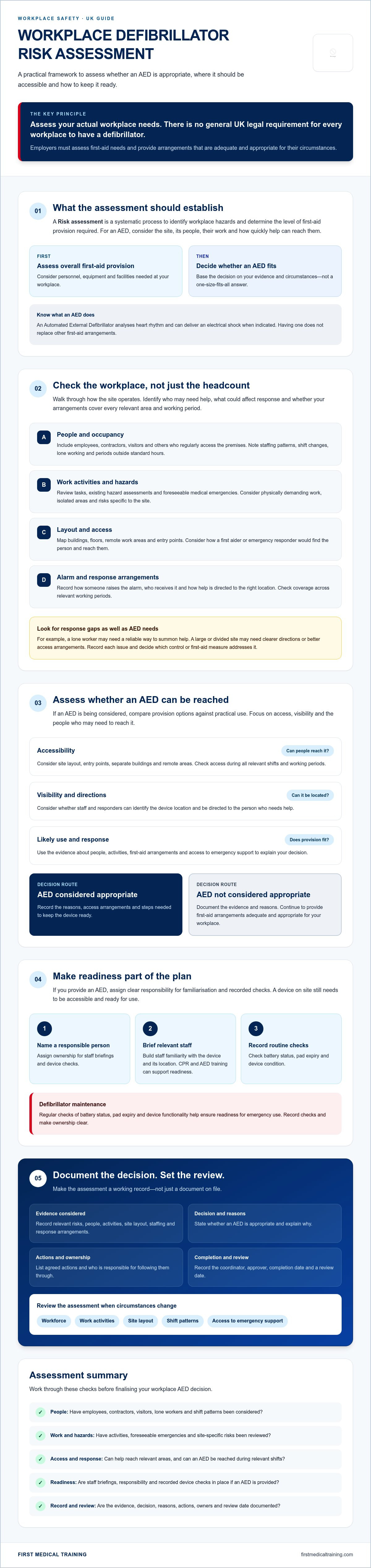
A risk assessment identifies workplace hazards and determines the first-aid provision needed to respond to them. For an AED, look beyond a generic checklist. Your decision should reflect your site, the people who use it, the work they do and how quickly help can reach them.
A workplace defibrillator risk assessment is a documented review of workplace risks, people and response arrangements. It helps you decide whether an AED is appropriate, where it should be accessible and how it will be kept ready.
This decision forms part of the wider first-aid needs assessment. First consider the overall provision required, such as first-aid personnel, equipment and facilities. Then assess whether an AED is a suitable part of that provision. An Automated External Defibrillator (AED) analyses heart rhythm and can deliver an electrical shock when indicated, but having one does not replace other first-aid arrangements.
Record the evidence you considered, your decision and its reasons, who is responsible for actions, and when the assessment will be reviewed. Revisit it if relevant circumstances change, such as the workforce, activities, layout, shift patterns or access to emergency support. This makes the assessment useful in practice, not just a document on file.
Does every UK workplace need a defibrillator?
No. There is no general UK legal requirement for every workplace to provide an AED. Employers must assess their first-aid needs and provide what is adequate and appropriate for their circumstances. That risk-based duty is not the same as a blanket AED requirement. Assess your own setting and document why an AED is or isn’t appropriate, rather than relying on a universal checklist or assuming provision is automatically necessary.
Who should complete and approve the assessment?
The employer should ensure the assessment is completed, or appoint a workplace lead to coordinate it and gather relevant evidence. Involve people who understand the work activities, site layout, staffing patterns and existing first-aid arrangements. Record the coordinator, the person who approved the decision, the completion date and a review date. Clear ownership helps ensure agreed actions, including a decision to provide an AED, are followed through.
Workplace AED risk assessment checklist: identify people, hazards and response gaps
Start with how the workplace actually operates, not just its headcount. A workplace defibrillator risk assessment should consider who is on site, what they do and whether first aid can reach someone quickly if they become seriously unwell. Include employees, contractors, visitors and others who regularly access the premises.
Use these prompts to identify relevant risks and practical gaps:
- Work activities and hazards: Review the tasks people perform, existing hazard assessments and foreseeable medical emergencies. Consider whether work is physically demanding, takes place in isolated areas or involves site-specific risks.
- People and occupancy: Note who is present, when they’re there and how staffing levels change across shifts. Include lone workers and periods outside standard hours.
- Layout and access: Map separate buildings, floors, remote work areas and entry points. Consider how a first aider or emergency responder would locate the person and reach them.
- Alarm and response arrangements: Record how someone can raise the alarm, who receives it and how help is directed to the right location. Check whether existing first-aid arrangements cover all relevant working periods.
An AED may be one part of the response plan, but it won’t resolve every gap. A lone worker may need a reliable way to summon help. A large or divided site may need clearer directions or better access arrangements. Record each issue and decide which control or first-aid measure addresses it.
Which workplace factors can affect the assessment?
Consider the size and layout of the premises, staffing patterns and how long it takes trained help to reach different areas. Check whether people work alone, across multiple buildings or outside standard hours. Include contractors and visitors who use the site, particularly if they may be unfamiliar with alarm procedures or how to find assistance.
What evidence should the assessor record?
Review first-aid records, incident information, relevant workplace hazard assessments, staffing and shift details, site plans and access procedures. Note where first-aid equipment is kept, how responders can enter the site and how they’ll be directed to someone needing help. HSE guidance confirms that AEDs aren’t a universal workplace requirement. If an employer’s needs assessment identifies one as necessary, relevant equipment duties under PUWER 1998 apply. Read the Health and Safety Executive (HSE) guidance when documenting the decision.
Evidence summary: “Incident records show [relevant pattern], staff and visitors are present across [areas and working periods], and current first-aid arrangements provide [response]; therefore, an AED is [appropriate/not identified as necessary] because [site-specific reason].” Adapt the wording to your actual findings, rather than using it as a template conclusion.
If you work in dentistry, use this dental practice emergency preparedness checklist to consider practice-specific arrangements. Once you’ve assessed the need, AED training can help staff understand how to respond as part of the workplace’s wider first-aid plan.
Compare AED provision options against access, response time and workplace use
If your assessment identifies a possible need, compare practical provision options against the evidence you’ve gathered. A device’s presence alone doesn’t make it ready for use. Staff need to know where it is, be able to reach it during relevant working periods and have a plan for keeping it serviceable. Your workplace defibrillator risk assessment should explain why the chosen option suits the site, rather than rely on an assumed response-time threshold.
How should you assess AED location and access?
Mark likely work areas, entrances, access-controlled doors and routes on a site plan. Walk those routes during normal activity and check whether staff can identify and retrieve the device. Consider separate buildings, restricted areas, shift changes and times when reception or security arrangements differ. Record any access barrier and how responders will be directed to the AED and the person needing help.
What should you compare when choosing a defibrillator?
Compare user prompts, visible status indicators, maintenance requirements and suitability for the intended setting. Check details against the manufacturer’s instructions and current device information instead of assuming all models have identical features. Consider who will check the device and whether it will remain accessible during every relevant shift. For dental teams, cardiac arrest management in dental practice provides more specific response context.
Use the comparison to document the chosen arrangement and any unresolved gaps. If access depends on a keyholder, for example, record how the device can be reached when that person isn’t present. Choose the option supported by workplace evidence and a workable plan for access and readiness.
Turn the assessment into a workable AED readiness and review plan
A decision only helps if people can act on it and the device is ready. Turn your workplace defibrillator risk assessment findings into named actions, with clear ownership and a record of completion.
- Assign responsibility. Name a lead for AED readiness and a deputy where appropriate. Make clear who handles routine checks and who is contacted if a problem is found.
- Arrange access. Confirm the AED’s location, how to reach it during relevant shifts and whether doors or access controls could delay retrieval. Make the location easy to identify.
- Brief staff. Explain how to raise the alarm, where to find the AED and how to follow the workplace emergency procedure. Include relevant shift teams and people who may direct responders to the casualty.
- Check the device. Follow the manufacturer’s instructions for checking battery status, pad expiry and device functionality. Record each check and any action taken.
- Record and review. Keep the assessment, responsibilities, checks and decisions together. Set a review date and note what would trigger an earlier review.
What should an AED maintenance record include?
Log the date of each check, the person completing it, the battery status, pad expiry and any device status indicator or functionality check required by the manufacturer. If pads are expired, a warning appears, or the device is missing or damaged, report it promptly to the named lead. Record the issue, the action taken and when the AED was confirmed ready again. Follow the manufacturer’s instructions rather than attempting unapproved tests or repairs.
When should the workplace risk assessment be reviewed?
Set a planned review date, then revisit the assessment sooner if work activities, site layout, staffing patterns or first-aid arrangements change. A move to a different building or a change in access during certain shifts may affect whether the current location remains suitable. Record the review date, what changed and why the decision was retained or updated. Treat the date as a practical management prompt, not as a legally prescribed review interval.
For dental teams, staff development should sit alongside the practice’s emergency arrangements. See this guide to GDC CPD requirements for medical emergencies. First Medical Training Ltd provides an Automated External Defibrillator training course to help staff build familiarity with AED response as part of wider workplace readiness.
Choose the next step: document the decision and prepare staff to respond
The workplace defibrillator risk assessment should end with a decision people can act on, whether that means providing an AED or recording why one hasn’t been identified as appropriate. Training and staff awareness help put the arrangements into practice, but they don’t replace the assessment or resolve access and maintenance issues.
How can a workplace match training to its assessment?
Identify who needs to understand how to raise the alarm, where the AED is located and what role they may have in an emergency. Consider practical CPR and AED training in light of staff responsibilities, shift patterns and the site’s response procedure. Make sure staff who may need to direct responders or fetch equipment know the arrangements. For dental teams, workplace AED planning is distinct from the practice’s wider clinical emergency training needs. See the medical emergencies in a dental practice course for relevant clinical-team training information.
What should a documented AED decision contain?
Keep a concise record that another workplace lead can understand and act on. Include:
- Evidence considered: Relevant workplace hazards, people and working patterns, site layout, existing first-aid arrangements, and any response or access gaps.
- Decision and rationale: Whether an AED will be provided, where it will be located and why that option fits the assessment findings.
- Named responsibilities: Who manages access, completes and records checks, communicates arrangements to staff and coordinates review.
- Actions and dates: Unresolved issues, the person responsible for addressing each one, the planned review date and any triggers for an earlier review.
Be specific about outstanding work. For example, if staff on a particular shift haven’t yet been briefed on the AED’s location, record who will arrange that briefing and by when. Keep the record alongside maintenance logs so the decision and readiness plan can be reviewed together. Documentation supports clear management, but it isn’t a guarantee of regulatory compliance.
Once responsibilities are clear, use staff awareness and relevant CPR and AED training to help people understand the agreed response. First Medical Training Ltd provides an AED training course as an option to consider when planning staff development. Select training that fits your workplace arrangements, then record who needs it and how it supports the response plan.
Make your AED decision practical and ready to use
A sound workplace defibrillator risk assessment connects the needs of your people and site with a clear decision about provision, access and ongoing readiness. Record the evidence behind your choice, assign responsibility for checks and staff communication, and set a review date so the plan can keep pace with workplace changes.
An AED is only one part of emergency preparedness. Staff also need to know how to raise the alarm, find equipment and follow the workplace response procedure. Practical CPR and AED training can build familiarity with those steps, but it doesn’t replace the assessment or routine device checks.
First Medical Training Ltd has operated since 2006, providing defibrillators and AED training that includes CPR and AED awareness. If your assessment identifies staff development as a next step, explore AED training with First Medical Training Ltd. A documented decision and a team that understands its role can help your workplace plan for emergency readiness.
Frequently Asked Questions
Is a defibrillator a legal requirement in every UK workplace?
No. There’s no general UK law requiring every workplace to have an AED. Employers must assess their first-aid needs and provide what’s adequate and appropriate for their workplace. An AED may be a suitable part of that provision, depending on the evidence, but it isn’t an automatic requirement. Record why you’ve decided to provide one or why your assessment hasn’t identified a need, and check current HSE guidance if you’re unsure.
What should a workplace defibrillator risk assessment include?
It should consider workplace hazards, activities, who may need assistance and how first aid can reach them. Include employees, contractors and visitors, along with shift patterns, lone working, site layout, alarm arrangements and existing first-aid provision. Record the evidence, your AED decision and its reasons, who is responsible for actions, and when the assessment will be reviewed. The workplace defibrillator risk assessment should reflect your actual site, not just a generic checklist.
Who is responsible for completing a workplace AED risk assessment?
The employer is responsible for ensuring first-aid needs are assessed and can appoint a workplace lead to coordinate the work. That person should gather input from people who understand the site, work activities, staffing patterns and current first-aid arrangements. Record who completed and approved the assessment, the date and who will carry out follow-up actions. Involving relevant staff helps ensure the findings reflect how the workplace operates across different shifts and areas.
How often should a workplace defibrillator risk assessment be reviewed?
Set a planned review date and review sooner if something changes that could affect the decision or arrangements. Triggers may include changes to work activities, staffing, site layout, shift patterns or first-aid provision. Record what prompted the review and whether the decision has changed. There isn’t a single review interval that suits every workplace, so choose a schedule that keeps the assessment relevant and follow any applicable HSE guidance.
Where should a workplace defibrillator be located?
Place an AED where people can identify and reach it promptly from the areas covered by your assessment. Consider visibility, site layout, entrances, access controls and whether it remains available during all relevant shifts. The 2026 update to BS 8599-1 recommends that sites with five or more people present have an AED accessible and ready within two minutes. This is a best-practice benchmark, not a general legal requirement. Record how staff will find and access the device.
Does a workplace need AED training if it has a defibrillator?
Formal AED training isn’t a prerequisite to using a defibrillator. AEDs provide spoken instructions, and lack of training shouldn’t delay their use in an emergency. However, training and CPR practice can help staff become familiar with the device, alarm process and workplace roles. Match training to your assessment and make sure staff know where the AED is and how to summon help. Training supports preparedness; it doesn’t replace risk assessment or device checks.
What checks does a workplace defibrillator need?
Follow the manufacturer’s instructions and your workplace check schedule. Check the device’s status indicator, battery status, electrode pad expiry and general condition, and confirm it’s present and accessible. Record the date, checker and outcome. If the device is missing, damaged, showing a fault or has expired pads, report it to the person responsible, arrange appropriate action and document when the issue is resolved. Keep maintenance records with the workplace’s AED arrangements so readiness can be reviewed.