

Avoiding Common CQC Failings: A Dental Compliance Checklist for 2026

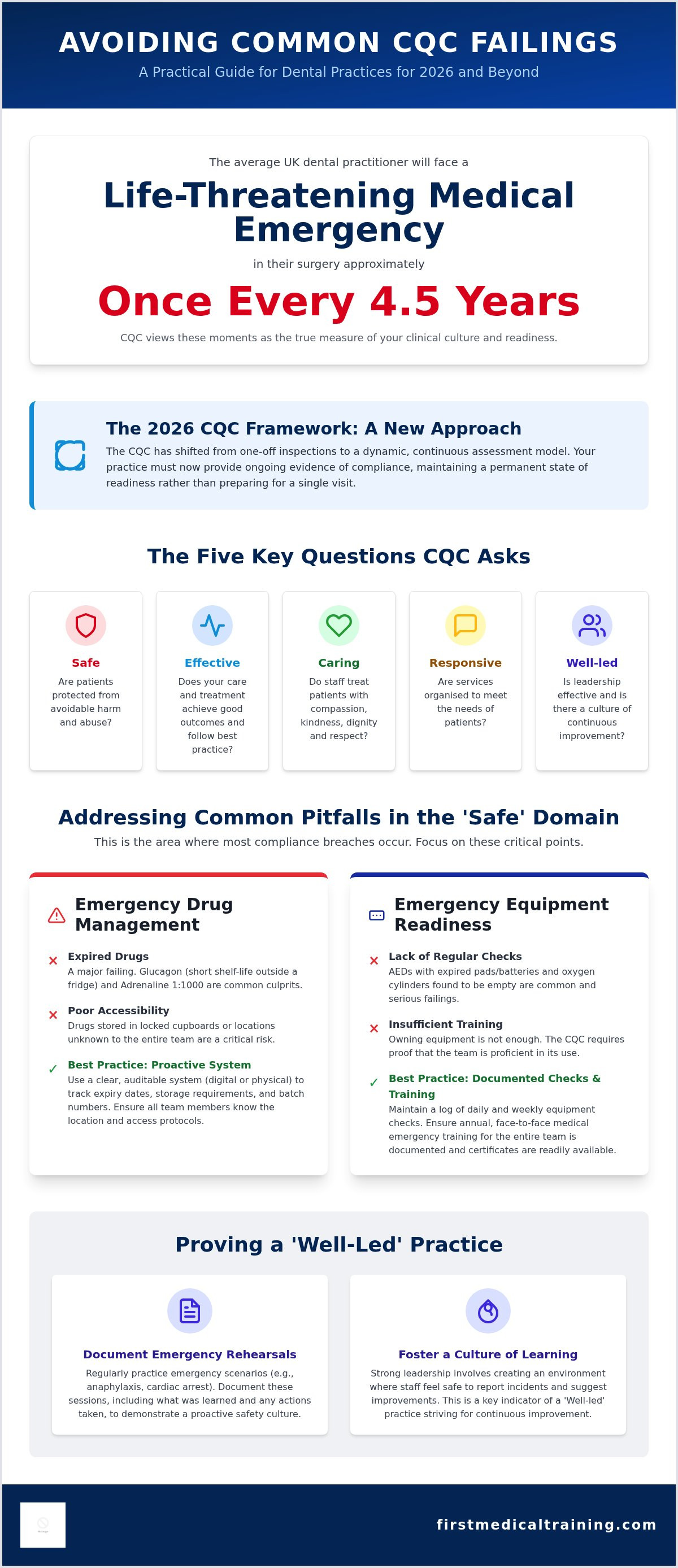
The average UK dental practitioner will face a life-threatening medical emergency in their surgery approximately once every four and a half years. Whilst this might feel like a rare occurrence, the Care Quality Commission views these high-stakes moments as the true measure of your clinical culture. Successfully avoiding common cqc failings dental teams often struggle with requires more than a last-minute folder review; it demands a consistent, evidence-based approach to safety and leadership.
It's understandable if the shift to sector-specific frameworks in 2026 feels overwhelming. Managing complex training schedules whilst ensuring emergency drug kits remain compliant is a significant administrative burden. We promise to demystify these requirements with a practical checklist that transforms regulatory stress into professional certainty. You'll learn exactly how to rectify frequent pitfalls and secure a "Good" or "Outstanding" rating for your practice.
This guide previews the essential updates to the primary care and community services assessment framework, focusing on the "Safe" and "Well-led" domains. We'll explore mandatory equipment protocols, the necessity of annual face-to-face training, and the robust governance systems needed to keep your practice inspection-ready at all times.
Key Takeaways
- Understand the 2026 transition to sector-specific frameworks and how to provide continuous evidence for the five key domains of inspection.
- Discover a practical strategy for avoiding common cqc failings dental teams encounter; specifically regarding the management of emergency drug expiry dates and equipment functionality.
- Learn the importance of documenting regular emergency scenario rehearsals to prove a proactive safety culture within the "Well-led" domain.
- Identify why annual, face-to-face medical emergency training remains the benchmark for meeting both GDC requirements and CQC expectations.
- Access a practical 2026 compliance checklist to audit your physical environment and staff records, ensuring you are prepared for a "Good" or "Outstanding" rating.
Understanding the CQC Single Assessment Framework in 2026
The Care Quality Commission (CQC) has shifted its methodology to a more dynamic, continuous assessment model. In 2026, the focus isn't on a one-off inspection date but on the ongoing flow of evidence your practice provides. This evolution means that avoiding common cqc failings dental surgeries often encounter requires a permanent state of readiness. Instead of preparing for a visit, you're now maintaining a culture of compliance that is visible through remote data, statutory notifications, and site visits.
Central to this framework are the "Quality Statements." These serve as the benchmarks for your practice, replacing the old Key Lines of Enquiry. They describe what good care looks like from a provider's perspective, written as "we" statements to reflect your commitment. For many dental teams, the "Safe" domain remains the most challenging hurdle. Failings here often stem from gaps in clinical safety protocols or a lack of robust evidence regarding medical emergency readiness. If you can't prove your systems work, the CQC will assume they don't; to ensure your Legionella risk assessments and environmental safety protocols are up to standard, you can visit The Testing Lab PLC.
The Five Key Questions for Dental Practices
The CQC continues to assess your practice based on five fundamental questions. Each one represents a pillar of patient care. It's vital to understand how these apply to a clinical setting.
- Safe: This domain asks if patients are protected from avoidable harm. It's the area where most compliance breaches occur, often due to inadequate risk assessments or outdated emergency protocols.
- Effective: Inspectors look at whether your treatment provides good outcomes based on the latest clinical evidence and GDC standards.
- Caring: This focuses on the dignity and respect shown to patients during their journey through your practice.
- Responsive: This assesses how well the service meets people's needs and how effectively you handle feedback or complaints.
- Well-led: This is critical for 2026. It examines your leadership, governance, and whether you foster a culture of transparency and continuous improvement.
Evidence Categories: What Inspectors Look For
To determine your rating, the CQC gathers evidence across specific categories. For a dental surgery, three of these are particularly vital. First, they prioritise "People's Experience," which includes direct feedback from your patients and staff. Second, "Observation" allows inspectors to see your clinical environment in action, checking that equipment is functional and well-maintained.
Finally, "Processes" are the backbone of your compliance. This involves a rigorous review of your dental practice emergency preparedness and your internal audit results. If your processes are fragmented or poorly documented, it's difficult to prove that your practice operates safely on a day-to-day basis. Maintaining clear, accessible records is the simplest way to demonstrate that you're meeting every regulatory requirement. When your team knows where the evidence is kept, it builds confidence for everyone involved.
Common Pitfalls in the "Safe" Domain: Medical Emergency Readiness
Ensuring patient safety is the cornerstone of any clinical practice, yet it remains the area where inspectors find the most frequent gaps. Avoiding common cqc failings dental practitioners encounter often starts with a rigorous audit of your emergency response capabilities. It's not enough to simply possess the correct equipment; you must demonstrate that it's maintained, accessible, and that your team is proficient in its use. When safety protocols are treated as a paperwork exercise rather than a living culture, risks escalate.
Emergency Drugs and Equipment Failings
A recurring issue in dental inspections is the presence of expired emergency drugs. Glucagon, for instance, has a significantly shorter shelf-life if not stored in a refrigerator; this is a detail often missed during busy clinical weeks. Adrenaline 1:1000 must also be monitored closely for expiry. According to the CQC guidance for dental providers, weekly checks of all emergency equipment and drugs are a non-negotiable requirement. Relying on memory isn't enough. You need a structured log that records the batch numbers and expiry dates of every item in your kit.
Your Automated External Defibrillator (AED) must be rescue-ready at all times. This means more than just having the unit visible on a wall. Pads must be in-date and batteries must have sufficient charge to deliver a shock if required. Similarly, oxygen cylinders should be checked to ensure they are full and the flow rate is functional. If an inspector finds a flat battery or an empty cylinder, it suggests a fundamental failure in your governance systems. To ensure your practice remains compliant and your team feels empowered, consider booking our Medical Emergencies in a Dental Practice Course to refresh your practical skills in your own environment.
Training Deficiencies and the GDC Link
Compliance isn't just about the tools; it's about the people using them. Failing to meet the gdc cpd requirements for dentists can directly impact your CQC rating, as it signals a lack of professional development in critical safety areas. While online theory has its place, the CQC prioritises practical, in-practice emergency drills that involve the entire team. This hands-on approach ensures that everyone knows their role when seconds count.
Receptionists and non-clinical staff are often the first to witness a medical emergency in the waiting room. If they aren't trained in basic life support, your practice isn't truly safe. Practical training allows your team to rehearse scenarios in your actual surgery layout, identifying exactly where equipment is stored and how to coordinate a response. This rehearsed coordination moves your practice beyond mere tick-box compliance to a standard of genuine patient protection that inspectors recognise and value.
Governance and Leadership: Addressing "Well-led" Deficiencies
One of the most frequent pitfalls is the "if it isn't written down, it didn't happen" rule. You might run excellent emergency scenario rehearsals every quarter, but without a formal record of who attended and what was learned, that work is invisible to an inspector. Robust governance means documenting every drill, every "near miss" in the chair, and every training update with precision. Documenting this is essential.
Your training folder should be the heartbeat of your compliance. Organising this effectively allows you to demonstrate gdc cpd requirements medical emergencies compliance at a glance. A "Skills Matrix" is a highly effective tool here. It provides a visual overview of team competencies, highlighting exactly when a staff member's Basic Life Support (BLS) or Immediate Life Support (ILS) training is due for renewal. Don't forget to document informal "Lunch and Learn" sessions; these are valuable evidence of a continuous learning culture.
Learning from Incidents
When a medical emergency or a significant event occurs, it provides a vital learning opportunity. A well-led practice conducts a thorough root cause analysis after any patient collapse or clinical complication. Instead of assigning blame, focus on how the response protocol could be improved. Discussing these findings in staff meetings and updating your protocols accordingly shows a "Culture of Safety." This transparency is a key strategy for avoiding common cqc failings dental inspectors highlight; it proves you are a learning organisation that prioritises patient welfare over avoiding scrutiny.
Finally, ensure your recruitment and induction processes are airtight. New clinical staff should never start treating patients until they've been briefed on the location of emergency drugs and the practice's specific emergency response plan. A signed induction checklist is a simple but powerful piece of evidence for the "Well-led" domain. It ensures that every team member, from the senior associate to the newest trainee, is prepared to act with confidence in a crisis.
The 2026 Dental Compliance Checklist: Avoiding Common Pitfalls
Moving from theory into practice requires a systematic approach. Avoiding common cqc failings dental practices often face is best achieved through a structured, recurring audit. This isn't about achieving perfection in a single day; it's about identifying gaps before an inspector does. By establishing a monthly compliance review cycle, you transform regulatory requirements into a manageable routine that protects your patients and your rating.
Step 1: The Medical Emergency Audit
To support this transition, CQC Consultancy provides the expertise needed to develop these audit cycles and ensure your practice remains inspection-ready throughout the year.
Your first priority must be the equipment and drugs that save lives. Check every item in your emergency kit against the latest Resuscitation Council UK (RCUK) guidelines. It's common to find that Glucagon or Midazolam has slipped past its expiry date, or that the AED pads have been overlooked. Verify that your defibrillator performs its self-test successfully and that the status indicator is green. Clinical safety is only as strong as the team's ability to use these tools. Ensure every team member has completed a practical medical emergencies in dental practice course within the last 12 months. If you need to bring your team up to date, you can book your annual in-practice training here to ensure full compliance.
Step 2: Documentation and Governance
Inspectors will look for clinical consistency and clear evidence of patient involvement. Audit ten random patient records each month to check for clear clinical notes and documented consent. This process helps identify if any clinicians are drifting from practice protocols. Review your safeguarding folder to ensure all staff have the correct level of training, typically Level 2 for non-clinical staff and Level 3 for clinicians. Finally, verify that your "Duty of Candour" policy is more than just a document in a folder. Every staff member should understand their responsibility to be open and honest with patients when things go wrong.
Step 3: Staff Wellbeing and Mental Health
The "Caring" domain now extends significantly to how you treat your own team. Incorporating Mental Health First Aid into your practice shows a commitment to staff wellbeing that inspectors highly value. It's vital to document the support provided to staff after stressful clinical incidents or "near misses." This might include debriefing sessions or access to professional counselling. When you document how you support staff development beyond mandatory training, you demonstrate a culture of care that filters down to patient treatment. Avoiding common cqc failings dental inspectors report often comes down to proving that you value the human element of your practice as much as the clinical outcomes.
Establishing this monthly rhythm ensures that no detail is left to chance. When compliance becomes a habit rather than a hurdle, the entire team operates with greater confidence and clarity.
Securing Your Rating with Professional Emergency Training
Whilst online modules provide a baseline of knowledge, the CQC considers annual, face-to-face medical emergency training to be a mandatory requirement for compliance. This is because clinical safety isn't a solitary pursuit; it's a team-based response that must be coordinated under intense pressure. In-practice training is the gold standard for avoiding common cqc failings dental teams experience, as it allows your staff to rehearse life-saving protocols in the very environment where they'll be applied. Knowing the theory is one thing, but navigating your specific surgery layout during a crisis is what builds genuine clinical confidence. Inspectors value seeing that your team has rehearsed in-situ, identifying exactly where the AED is stored and how to move a patient safely from a dental chair to the floor.
Accredited Training Solutions
Our Medical Emergencies in a Dental Practice Course is designed to meet every regulatory benchmark. We focus on realistic simulations that test your team's communication and technical skills. For practices providing sedation, our Dental Immediate Life Support (ILS) Training offers the advanced airway management and resuscitation skills required for high-risk environments. These sessions do more than just check a box; they provide the high-quality, verifiable CPD evidence that inspectors look for in your training logs. By choosing an accredited partner, you ensure that your certification stands up to the closest scrutiny. We provide clear, professional certificates that map directly to the GDC's enhanced CPD requirements, making your next inspection a much smoother process.
Beyond the Training Room
Compliance is an ongoing commitment, not a yearly event. We act as your guide, providing reminders for annual refreshers and helping you maintain your emergency equipment. Beyond the clinical chair, we help you secure your waiting room by supplying the LifeVac anti-choking device, an essential tool for airway management that requires no power and is simple to use in a crisis. This comprehensive approach demonstrates to the CQC that you are a proactive, well-led organisation that prioritises patient welfare at every touchpoint. It bridges the gap between rigorous regulatory requirements and the real-world application of skills. To stay ahead of regulatory changes, you can ensure your practice is CQC-ready with our expert-led dental training and build a team that is prepared for any eventuality.
By investing in practical, site-specific training, you aren't just preparing for an inspection; you're protecting your patients and your colleagues. This proactive stance is the most effective way to secure a "Good" or "Outstanding" rating whilst ensuring that every member of your team feels empowered to act when it matters most.
Build a Culture of Compliance and Clinical Confidence
Maintaining a "Good" or "Outstanding" rating in 2026 requires a shift from reactive preparation to a permanent state of readiness. By focusing on the "Safe" and "Well-led" domains through rigorous audits and transparent record-keeping, you protect both your patients and your professional reputation. Avoiding common cqc failings dental surgeries often face is simply a matter of turning regulatory requirements into consistent, daily habits that your entire team understands and supports.
Practical, site-specific simulations are the most effective way to ensure every staff member is prepared for a crisis. Since 2006, we've supported dental practices nationwide with training delivered by experienced medical professionals. We provide accredited CPD certificates instantly, giving you the immediate evidence needed for your governance folders. Our approach demystifies complex protocols, replacing inspection anxiety with the quiet confidence of a well-prepared team.
Don't leave your compliance to chance. Take the lead in your practice's professional development and ensure your team is rescue-ready. Book Your In-Practice Medical Emergencies Training Today. You've built a practice dedicated to care; let's work together to ensure your standards are recognised and rewarded.
Frequently Asked Questions
How often does a dental practice need medical emergency training for CQC?
Every dental practice must conduct annual medical emergency training to remain compliant. The CQC considers yearly, face-to-face sessions for the entire team a mandatory requirement. Whilst the GDC suggests ten hours of verifiable CPD every five years, the CQC focus on operational safety means that annual practical updates are the expected standard. Documenting these sessions is vital for avoiding common cqc failings dental inspectors often highlight during their visits.
What emergency drugs are mandatory for a UK dental surgery in 2026?
UK dental surgeries are required to stock a specific list of emergency medications. These include Adrenaline 1:1000, Aspirin 300mg, Glucagon, Glyceryl Trinitrate (GTN) spray, Salbutamol inhalers, and Midazolam. You must also have a functional oxygen cylinder with appropriate delivery masks. Regularly checking these drugs against Resuscitation Council UK guidelines ensures your kit is always rescue-ready and meets the current 2026 standards for clinical safety and compliance.
Can a dental practice fail CQC based on one out-of-date drug?
A single out-of-date drug can lead to a negative rating in the "Safe" domain. Inspectors view expired medication as a symptom of failing governance systems rather than an isolated oversight. It suggests that your weekly check protocols aren't robust enough to protect patients from avoidable harm. Maintaining a precise log of batch numbers and expiry dates is the most effective way of ensuring your practice remains compliant and safe.
Is an AED mandatory for CQC compliance in dental practices?
Yes, an Automated External Defibrillator (AED) is a mandatory piece of equipment for every dental practice. The CQC expects the device to be on-site, fully functional, and easily accessible to all staff members. You must conduct regular checks to ensure the pads are in-date and the battery has sufficient charge. Training your entire team to use the AED with confidence is a fundamental part of your emergency preparedness.
How does the CQC assess the "Well-led" domain in small dental surgeries?
For small surgeries, the "Well-led" domain is assessed through your internal governance and leadership culture. Inspectors look for clear evidence of risk management, such as completed audit cycles and up-to-date training matrices. They want to see that the practice manager and principal dentist foster an environment where staff feel empowered to report concerns. Demonstrating a proactive approach to compliance proves that your leadership is effective and patient-focused.
What is the role of the Duty of Candour in dental CQC inspections?
The Duty of Candour is a legal requirement to be open and transparent with patients when a significant event or mistake occurs. During an inspection, the CQC will look for evidence that your team understands this duty and has a process for informing patients if something goes wrong. This includes offering an apology and providing a full explanation. It's a critical component of the "Caring" and "Well-led" assessment domains.
Does every member of the dental team need to be trained in Basic Life Support?
Every team member, including non-clinical staff like receptionists, must be trained in Basic Life Support. Emergencies don't always happen in the clinical chair; they can occur in the waiting room or at the entrance. Having a receptionist who can recognise a collapse and initiate a response is vital for patient safety. Our Medical Emergencies in a Dental Practice Course ensures everyone knows their specific role during a crisis.
How can I demonstrate that my team learns from medical emergency drills?
You can demonstrate learning by keeping detailed records of your emergency drills and "near miss" discussions. After each rehearsal, document what went well and what needed improvement in your staff meeting minutes. Showing that you've updated your protocols or changed the location of equipment based on these drills provides concrete evidence of a learning culture. This transparency is a powerful way of avoiding common cqc failings dental practitioners often face.