

GDC CPD Requirements for Dentists: The 2026 Medical Emergencies Compliance Guide

Your GDC registration shouldn't be a source of constant administrative dread, yet the complexity of the Enhanced CPD scheme often makes it feel that way. It's understandable if you feel overwhelmed by the terminology of the five-year cycle or the fear of a surprise audit whilst managing a busy practice. You want to focus on patient outcomes, not worrying if your training certificates meet the strict criteria for verifiable standards.
This guide simplifies the gdc cpd requirements for dentists for 2026, giving you total confidence that your professional development plan is both compliant and clinically relevant. We'll outline exactly how to structure your 100 hours of verifiable CPD, clarify the specific recommendations for medical emergency training, and provide a straightforward path to maintaining your team's life-saving skills. You will gain a clear roadmap to ensure your practice remains fully compliant and prepared for any clinical crisis, allowing you to meet your regulatory obligations with ease.
Key Takeaways
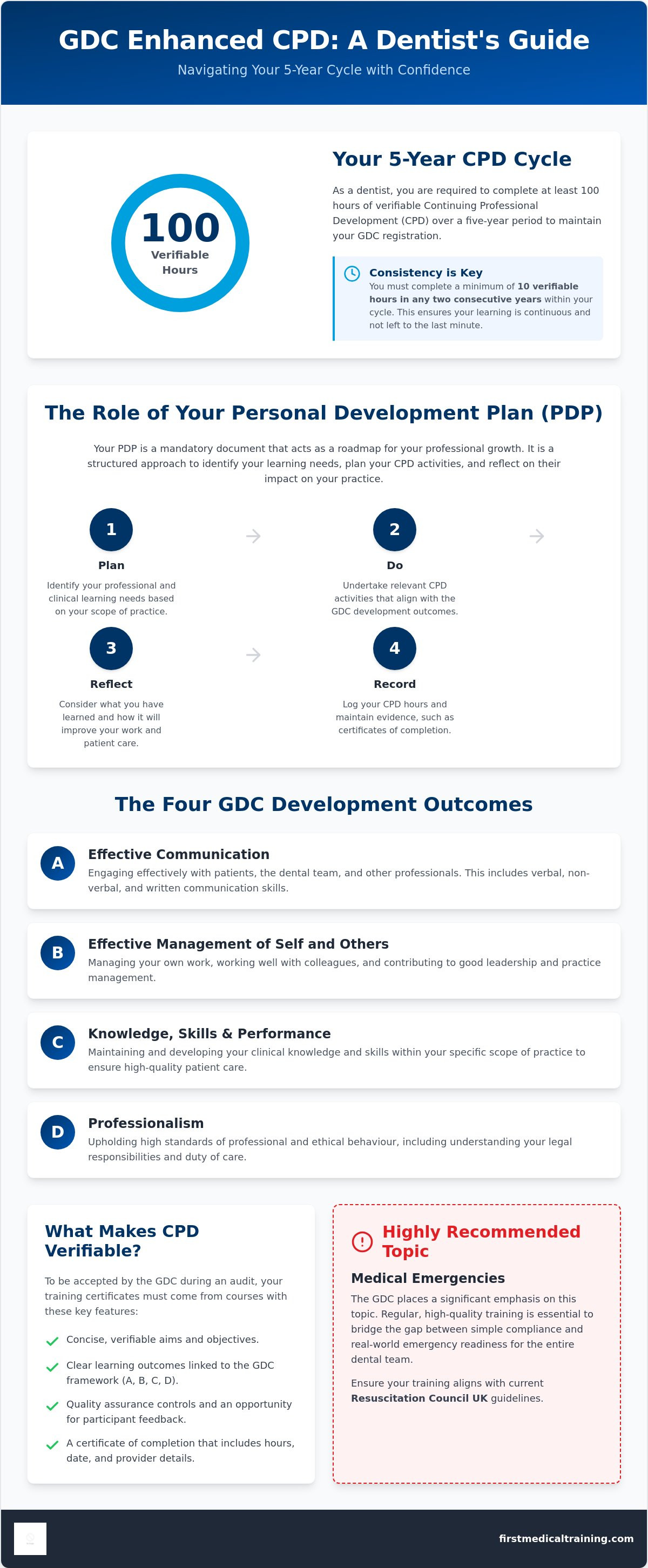
- Understand the GDC development outcomes (A, B, C, and D) and how they must be integrated into your 2026 Personal Development Plan.
- Navigate the specific gdc cpd requirements for dentists, including the 100-hour verifiable cycle and the "highly recommended" medical emergencies quota.
- Identify the essential criteria for verifiable CPD to ensure your training certificates meet every regulatory standard during a GDC audit.
- Align your clinical training with Resuscitation Council UK guidelines to bridge the gap between simple compliance and real-world emergency readiness.
- Explore the benefits of accredited, in-practice medical emergency courses that simplify team-wide certification and maintain high safety standards.
Understanding the GDC Enhanced CPD Framework for Dental Professionals
Maintaining your registration with the General Dental Council (GDC) is contingent upon more than just clinical skill; it requires a dedicated commitment to the Enhanced CPD (ECPD) framework. This system moved the profession away from a passive accumulation of hours towards a reflective, quality-driven approach to learning. For practitioners, a deep understanding of the gdc cpd requirements for dentists is essential to ensure that every hour spent in training translates into improved patient safety and higher professional standards. By focusing on planned learning rather than reactive attendance, the GDC ensures that your development remains relevant to your specific scope of practice.
The transition from a simple "hours-based" model to a "quality-based" one reflects a modernised approach to healthcare regulation. In the past, professionals could technically meet their requirements by attending arbitrary lectures. Today, the 2026 standards demand that you demonstrate how your learning has impacted your daily practice. This shift prioritises reflection and planning, ensuring that the time you invest in professional development actually benefits your patients and your career progression.
This commitment to quality also applies to the delivery of educational content; for those organising large-scale hybrid conferences or professional seminars, technical experts like Straight Street Event Services provide the essential production support needed to ensure every participant receives a clear and engaging learning experience.
The Four Development Outcomes
The GDC categorises all verifiable activities into four distinct development outcomes. These categories help you map your learning to the diverse demands of modern dentistry. When you choose a training provider like First Medical Training Ltd, you must ensure they specify which of these outcomes their course covers. This alignment is critical for your end-of-year statements.
- Outcome A: Focuses on effective communication with patients and the wider dental team, including the use of various communication tools and methods.
- Outcome B: Relates to effective management of the self and others, covering business leadership, team working, and practice management.
- Outcome C: Concentrates on the maintenance and development of your clinical knowledge and skills within your scope of practice.
- Outcome D: Addresses the maintenance of ethical and professional standards, including the legal and ethical responsibilities of being a registered professional.
Your Personal Development Plan (PDP)
A Personal Development Plan (PDP) is a legal necessity for every dental professional. Your PDP serves as the foundation for your 2026 cycle, helping you identify gaps in your knowledge and select training that offers the highest value. It's not a static form to be filled out once every five years; it requires regular review to stay aligned with your evolving professional needs. By linking your chosen courses to the four development outcomes, you create a robust audit trail that demonstrates your commitment to excellence. The PDP is a living document for professional growth.
To remain compliant with gdc cpd requirements for dentists, your PDP must identify the specific learning you need for your current role and your future goals. This structured approach removes the stress of the end-of-cycle rush, replacing it with a methodical journey toward professional readiness. It's your roadmap for the five-year cycle, providing clarity and confidence in your regulatory standing.
Essential CPD Hours and the 'Highly Recommended' Medical Emergencies Topic
Navigating the specifics of the gdc cpd requirements for dentists requires a clear understanding of your professional role and the associated hourly obligations. Whilst the framework is designed to be flexible, the GDC is explicit about the minimum verifiable hours you must complete over your five-year cycle. This structured approach ensures that every member of the dental team is consistently updating their skills to meet modern clinical standards. It's not just about hitting a number; it's about ensuring your clinical competence remains at the highest possible level throughout your career.
The GDC places a significant emphasis on the GDC Enhanced CPD Framework, which mandates that all dental professionals complete at least 10 hours of verifiable CPD in any two consecutive years. This rule prevents professionals from leaving all their learning to the final months of their cycle. By distributing your training, you ensure that your knowledge remains fresh and applicable to your daily practice, which is the core intention of the 2026 standards.
Hours by Professional Role
The total number of required hours depends on your specific registration. These hours must be verifiable, meaning they must meet the GDC's strict criteria for evidence and quality assurance.
- Dentists: 100 hours of verifiable CPD per 5-year cycle.
- Hygienists, Therapists, and Technicians: 75 hours of verifiable CPD per 5-year cycle.
- Dental Nurses and Dental Technicians: 50 hours of verifiable CPD per 5-year cycle.
Highly Recommended Topics for 2026
The GDC identifies certain subjects as 'highly recommended' because they are critical to patient safety. Whilst these aren't mandatory minimums in the same way the total hourly requirement is, the GDC expects you to prioritise them within your Personal Development Plan. Failing to include these topics could lead to difficulties during an audit.
- Medical Emergencies: At least 10 hours per five-year cycle, with a recommendation of at least 2 hours each year.
- Disinfection and Decontamination: At least 5 hours per cycle.
- Radiography and Radiation Protection: At least 5 hours per cycle.
The recommendation to complete at least two hours of medical emergency training annually is purposeful. Skills in resuscitation and emergency response are perishable; they fade without regular practice. Waiting until the final year of your cycle to cram in 10 hours of training creates an 'end-of-cycle rush' that diminishes the quality of your learning. By spreading this training across the five years, you maintain a state of constant readiness. This is where reflective practice becomes vital. Rather than just collecting a certificate, you should consider how a Medical Emergencies in a Dental Practice Course changes your team's response protocols. This deeper engagement ensures that your gdc cpd requirements for dentists serve as a genuine tool for professional improvement rather than just a regulatory hurdle.
Verifiable CPD vs. General Learning: Meeting the GDC Standards
Distinguishing between general learning and verifiable activity is a cornerstone of the gdc cpd requirements for dentists. Whilst reading a dental journal or discussing a case with a colleague is valuable for your professional development, these activities usually fall under "general" learning. To meet the legal standards for your five-year cycle, your training must be "verifiable". This means the activity must have a clear set of aims and objectives, a defined link to GDC development outcomes, and a mechanism for quality control, such as participant feedback. Simply holding a certificate of attendance is no longer sufficient for a GDC audit.
The GDC guidance on medical emergency CPD emphasises that high-quality training shouldn't just be a tick-box exercise but a structured educational event. For a course to be classified as verifiable, the provider must give you documentary evidence that includes the date, the number of hours, and the specific GDC development outcomes covered. This rigorous approach ensures that your time is spent on training that actually enhances patient safety and clinical outcomes. It's about moving beyond passive listening to active, evidence-based participation.
What Makes CPD Verifiable?
For training to be considered verifiable, it must meet several strict criteria. First Medical Training Ltd ensures every session is mapped directly to the 2026 standards, providing the necessary evidence for your portfolio. Key requirements include:
- Clear aims and objectives: The training must state exactly what it intends to achieve.
- Anticipated learning outcomes: You should know what skills or knowledge you will gain to improve patient care.
- Quality assurance: The provider must have a robust process to ensure the training is accurate and delivered by experts.
- Feedback mechanism: You must be able to provide an honest appraisal of the learning experience.
The Importance of Reflective Practice
A major gap in many compliance strategies is the failure to engage in reflective practice. The GDC expects you to look back at your training and record how it has influenced your work. When writing a reflective statement, don't just summarise the course content. Instead, explain how the training has changed your clinical behaviour or improved your practice's emergency protocols. For instance, after completing a Medical Emergencies in a Dental Practice Course, you might reflect on how your team's communication during a simulated cardiac arrest became more efficient.
Maintaining an organised CPD log is essential. Whether you prefer digital records or paper files, your log should link every verifiable hour back to your Personal Development Plan. This creates a cohesive narrative of your professional journey, proving to auditors that you're not just meeting the gdc cpd requirements for dentists, but actively striving for clinical excellence. It's this level of detail that provides peace of mind during your five-year cycle.
Planning Your 5-Year Cycle: Best Practices for Medical Emergency Training
Strategic planning transforms the gdc cpd requirements for dentists from a regulatory hurdle into a framework for practice excellence. Whilst online modules offer convenience for theoretical knowledge, the Resuscitation Council UK emphasises the necessity of practical, hands-on training to maintain life-saving skills. This is why in-practice sessions are superior; they allow your entire team to train in their actual clinical environment using their own emergency equipment. By simulating scenarios in your own surgery, you identify potential bottlenecks in your response before a real crisis occurs. It builds a level of muscle memory that a digital screen simply cannot replicate.
Establishing a recurring annual date for your team's emergency drills ensures that compliance never slips through the cracks. This methodical approach satisfies the GDC recommendation for annual updates and fosters a culture of safety. It's also the ideal time to integrate newer areas of professional development, such as Mental Health First Aid. Supporting the psychological wellbeing of your team and patients aligns perfectly with GDC Development Outcomes B and D, proving that your commitment to care extends beyond physical interventions.
The Annual Training Schedule
To avoid the end-of-cycle rush, your Personal Development Plan should outline a consistent schedule. Spreading your 10-hour medical emergency requirement over five years ensures skills remain sharp. A robust annual programme should include:
- Year 1-5: A dedicated 2-hour Medical Emergencies update covering the latest Resuscitation Council UK protocols.
- Core Skills: Consistent refresher training on AED use and Basic Life Support (BLS) for all staff members.
- Audit: Use this time to complete a Dental Practice Emergency Preparedness audit to ensure your kit is in date and fully functional.
Beyond Basic Compliance
For practices providing sedation, basic compliance is the floor, not the ceiling. In these environments, Dental Immediate Life Support (ILS) is highly recommended to manage the increased clinical risks. Furthermore, a "whole-practice" response means training isn't just for the clinical team. Receptionists and non-clinical staff are often the first to spot a patient in distress in the waiting room. Including them in your drills ensures a seamless transition of care from the front desk to the dental chair.
Broadening your training to include a Staff Wellbeing Training for Dental Practices resource can further strengthen your practice culture. This holistic approach to professional development ensures your team is resilient, capable, and ready for any challenge. To secure your team's compliance and confidence, book your next hands-on session with First Medical Training to ensure you meet the highest industry standards.
Accredited Medical Emergency Training: Secure Your GDC Compliance with First Medical Training Ltd
Choosing the right training partner is the final step in mastering the gdc cpd requirements for dentists. Since 2006, First Medical Training Ltd has acted as a seasoned mentor to dental practices across the UK, providing the clinical expertise needed to bridge the gap between regulatory theory and real-world application. Our programmes are specifically designed to meet the 2026 verifiable standards, ensuring that every minute your team spends in training is high-impact and fully compliant. We understand that your time is a valuable resource, so we focus on delivering structured, methodical sessions that respect your schedule whilst prioritising patient safety.
Static online modules often fail to provide the muscle memory required to act decisively during a clinical crisis. Our approach prioritises hands-on, practical drills that allow your staff to familiarise themselves with emergency equipment in their own surgery environment. This practical focus is what transforms a simple certificate into genuine clinical confidence. First Medical Training Ltd provides all necessary documentation, including clear learning aims, objectives, and mapped GDC development outcomes, giving you total peace of mind during any potential registration review.
Our Core Dental Courses
We offer a suite of accredited courses tailored to the specific needs of modern dental practices. Each session is delivered by industry veterans who understand the practical realities of the healthcare sector.
- Medical Emergencies in a Dental Practice Course: This is the gold standard solution for meeting the 10-hour cycle recommendation, providing comprehensive training for the entire team.
- Dental Immediate Life Support (ILS) Training: An advanced programme designed for clinical teams, particularly those involved in dental sedation, focusing on airway management and stabilising patients.
- Emergency First Aid at Work Course (EFAW) – 1 Day: A vital course for broader workplace safety, ensuring your practice meets general health and safety obligations alongside clinical standards.
Book Your Practice Training Today
Our booking process is designed for maximum efficiency, allowing you to organise national in-practice training sessions with ease. We don't believe in a one-size-fits-all approach; instead, we customise our training to suit your specific surgery layout and team dynamic. This ensures that when an emergency occurs, your response is coordinated, calm, and effective. By setting a recurring date for your annual training with First Medical Training Ltd, you remove the administrative burden of compliance and foster a culture of continuous professional improvement.
Ensure your team is GDC compliant with our Medical Emergencies course. Our commitment to your professional development ensures you are always ready to act when it matters most. Secure your practice's future and maintain your professional standing by choosing a training partner that values clinical excellence as much as you do.
Secure Your Professional Standing for 2026 and Beyond
Mastering the gdc cpd requirements for dentists is about more than just maintaining your place on the register; it's about fostering a culture of safety that protects your patients and your team. By aligning your Personal Development Plan with the four GDC outcomes and committing to annual, hands-on drills, you move beyond simple compliance into genuine clinical excellence. We've explored how verifiable training must include clear aims and how practical simulation in your own surgery is far superior to static online modules. This proactive approach ensures you're always audit-ready whilst maintaining the highest standards of care.
First Medical Training is here to support your journey with a specialised dental curriculum accredited by major UK awarding bodies. Our national coverage ensures that your entire team can access high-quality, in-practice sessions that meet the 2026 standards. Don't leave your registration to chance or wait for an end-of-cycle rush. You've worked hard for your professional status. We're dedicated to helping you protect it.
Book Your GDC-Compliant Medical Emergencies Training Now and lead your team with the confidence that only expert-led preparation can provide.
Frequently Asked Questions
How many hours of CPD do I need as a dentist in 2026?
Dentists must complete a minimum of 100 hours of verifiable CPD over each five-year cycle to maintain their professional registration. Within this framework, you're also required to complete at least 10 hours of verifiable activity in any two consecutive years. This structured approach ensures a steady pace of learning and prevents professionals from falling behind on the essential gdc cpd requirements for dentists.
Is medical emergency training mandatory every year for GDC compliance?
Annual medical emergency training is officially classified as "highly recommended" rather than a mandatory minimum, but the GDC strongly suggests completing at least two hours every year. This adds up to the recommended 10 hours per five-year cycle. Regular updates are vital because life-saving skills are perishable and require frequent practice to remain effective in a clinical crisis.
What counts as verifiable CPD for the GDC?
For training to count as verifiable CPD, it must meet four specific criteria: clear learning aims and objectives, anticipated learning outcomes, quality assurance, and a mechanism for participant feedback. You must also receive a certificate from the provider that includes the date, hours, and the specific GDC development outcomes covered. General interest reading or peer discussions without this formal structure don't meet these standards.
Can I do all my medical emergency CPD online?
Whilst the GDC accepts online certificates, the Resuscitation Council UK and industry experts strongly recommend hands-on, practical training for medical emergencies. Theoretical knowledge is important, but it can't replace the muscle memory gained from physical drills using your practice's actual equipment. Most dental professionals find that in-person sessions provide the highest level of clinical confidence and team coordination.
What happens if I do not meet my GDC CPD requirements?
Failure to comply with the gdc cpd requirements for dentists can result in your removal from the GDC register. If you don't submit your annual statement or fail to complete the required hours by the end of your five-year cycle, you risk losing your license to practise. Restoring your name to the register is a complex and often costly process that requires full proof of compliance.
Do dental nurses need the same medical emergency training as dentists?
Dental nurses are required to complete the same type of medical emergency training as dentists to ensure a coordinated whole-practice response. Whilst dental nurses only need 50 hours of verifiable CPD per five-year cycle, compared to the 100 hours required for dentists, the GDC recommendation for 10 hours of medical emergency training per cycle applies to all registered dental professionals.
How long should I keep my CPD records?
You should keep all your verifiable CPD records and your Personal Development Plan for at least five years after the end of the cycle they relate to. The GDC may audit your records at any time, and you must be able to produce evidence of your learning and your reflections. Maintaining an organised digital or paper portfolio is the most reliable way to handle these requests quickly.
What are the GDC development outcomes for medical emergencies?
Medical emergency training primarily aligns with Development Outcome C, which focuses on the maintenance and development of clinical knowledge and skills. Depending on the course structure, it may also cover Outcome A by improving communication during a crisis or Outcome B through better management of emergency protocols. Your training provider should clearly state which outcomes are covered on your verifiable certificate.