

CPD for Dental Nurses UK: The 2026 Guide to GDC Compliance and Course Selection

Did you know that although there are now over 65,000 registered dental nurses in the UK, a significant number of professionals still feel anxious about the transition to the MyGDC portal and the strict 28 August deadline? It's a common pressure; trying to track verifiable cpd for dental nurses uk across a five-year cycle while maintaining a busy surgery schedule is often overwhelming. You deserve to feel confident that your training is compliant, rather than fearing a registration suspension because of a simple administrative oversight.
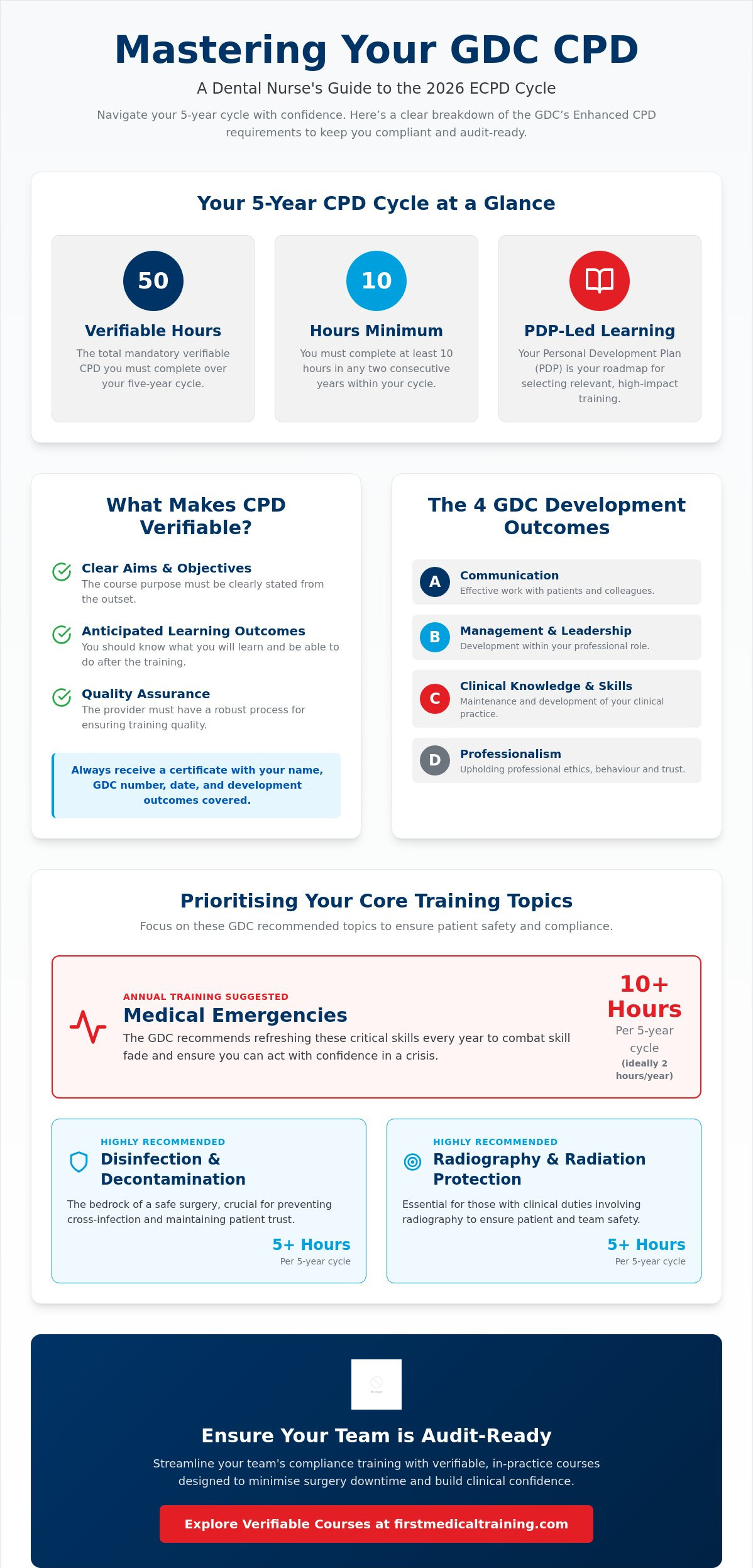
This expert guide will help you master your GDC requirements for the 2026 cycle, ensuring your professional development plan is both high-impact and audit-ready. We'll provide a clear strategy to help you navigate the 50-hour requirement and the mandatory 10-hour minimum for any two-consecutive-year period. We'll preview the most effective ways to choose training that builds your clinical confidence, from medical emergencies to disinfection, so you can focus on what matters most: your patients and your career.
Key Takeaways
- Understand the precise GDC cycle requirements for 2026, including the mandatory 50-hour minimum and the rolling two-year threshold for verifiable hours.
- Identify which core topics require annual updates to ensure your cpd for dental nurses uk meets the highest standards of patient safety and regulatory compliance.
- Evaluate the benefits of hands-on, in-practice clinical training over digital alternatives for critical skills like resuscitation and medical emergency response.
- Learn how to align your course selection with your Personal Development Plan (PDP) to build clinical confidence and support long-term career progression.
- Discover how to streamline your team's compliance training to minimise surgery downtime while maintaining verifiable certificates that pass any GDC audit.
Understanding GDC CPD Requirements for Dental Nurses in 2026
The Enhanced CPD (ECPD) scheme ensures that every professional remains fit to practise and provides the highest standard of patient care. For dental nurses, this translates to a mandatory 50 hours of verifiable cpd for dental nurses uk over a five-year cycle. This system is designed for steady, consistent progress. You can't leave your learning until the final year; the General Dental Council (GDC) requires at least 10 hours of verifiable CPD to be completed in any two consecutive years. This structure supports continuous professional growth and prevents the clinical knowledge gaps that occur when training is neglected.
Your Personal Development Plan (PDP) is the foundation of this entire process. It isn't just a document to be filed away for an audit. It's a living roadmap that identifies your specific learning needs based on your current clinical role and your future aspirations. By mapping your 2026 career goals against your PDP, you ensure that every hour of training adds genuine value to your practice. It helps you focus on areas where you feel less confident, turning potential weaknesses into professional strengths.
The Four GDC Development Outcomes (A, B, C, D)
To be considered verifiable, your training must link to at least one of the four development outcomes. These categories help you maintain a balanced and comprehensive skillset. Outcome A focuses on communication and effective teamworking skills, which are essential for patient rapport. Outcome B covers management and leadership within the dental environment, supporting those who take on more responsibility. Outcome C is the most critical for day-to-day safety, focusing on the maintenance and development of clinical knowledge and skills. Finally, Outcome D addresses ethical and professional behaviour, ensuring you uphold the public's trust in the profession.
Verifiable vs. General CPD: What Counts?
Distinguishing between verifiable and general CPD is vital for your annual declaration. Verifiable training must meet three strict criteria: clear aims and objectives, anticipated learning outcomes, and a robust quality assurance process. You must obtain a certificate that includes your name, your GDC registration number, the date of the course, and the specific development outcomes covered. Without these details, the GDC may not accept the hours during an inspection.
General CPD includes activities like reading dental journals or informal discussions with colleagues. While the GDC no longer requires you to submit hours for general CPD, it remains a valuable part of your growth. However, only verifiable hours count toward your 50-hour total. Always check that your chosen cpd for dental nurses uk provides a certificate that passes a GDC audit before you commit your time. This proactive approach keeps your registration secure and your clinical skills sharp.
Core vs. Recommended Topics: Prioritising Your Training
Not all cpd for dental nurses uk is created equal. The GDC organises topics into two distinct categories: 'Highly Recommended' and 'Recommended'. This isn't just a suggestion; it's a structured hierarchy designed to keep patient safety at the forefront of every procedure. Whilst you have the freedom to choose courses that suit your specific PDP, these core topics must form the backbone of your learning schedule to ensure you remain compliant and clinically capable.
Medical Emergencies stands alone as the only topic the GDC suggests for annual training. The reason is simple: skills fade. In a crisis, you don't have time to look up a protocol. You need to act with muscle memory and quiet confidence. The GDC recommends at least 10 hours per cycle, ideally broken down into 2 hours every year. This ensures your team stays sharp and ready for any scenario. For a deeper dive into how to structure this, see our GDC CPD requirements medical emergencies guide for annual planning.
The 'Highly Recommended' Trinity for Dental Nurses
Beyond medical emergencies, the 'Highly Recommended' list includes disinfection and decontamination, alongside radiography and radiation protection for those with clinical duties. You must complete at least 5 hours in each of these areas per five-year cycle. These topics are the bedrock of a safe surgery. Organisations like the British Association of Dental Nurses (BADN) emphasise that staying current with these standards is a mark of professional excellence. It's about protecting yourself as much as your patients by ensuring every protocol is followed with clinical precision.
Legal, Ethical, and Safeguarding Essentials
Safeguarding remains a vital pillar of cpd for dental nurses uk. Most staff require Level 2 training, but those with lead responsibilities or those working in complex environments may need Level 3. Team-based safeguarding training is often more effective than solo online modules because it allows you to discuss real-world scenarios and practice your practice's specific reporting protocols. This collaborative approach builds a culture of vigilance and support within the surgery.
Legal and ethical issues, such as patient consent and confidentiality, are also categorised as 'Recommended'. Don't overlook complaints handling. It's a skill that transforms a potentially negative patient experience into a demonstration of professional integrity. Balancing these softer skills with clinical training creates a well-rounded professional profile. If you're looking to refresh these core competencies, consider exploring our range of specialist dental courses to find the right fit for your team.
Choosing the Right Format: In-Practice vs. Online CPD
Selecting the right format for cpd for dental nurses uk involves more than just comparing costs or ticking boxes. Whilst digital platforms offer undeniable convenience for theoretical subjects, they cannot replicate the tactile reality of a clinical crisis. You need to decide which parts of your Personal Development Plan require a screen and which require a manikin. Striking this balance is the key to building a team that's not just compliant, but genuinely capable in the surgery environment.
Accreditation is your first line of defence. Before booking any training, ensure the provider is recognised and reputable. A verifiable certificate is only as good as the quality assurance behind it. If a course doesn't offer clear learning outcomes or a robust assessment process, it may not stand up to a GDC audit. High-quality training should feel like an investment in your professional standing, not just a hurdle to clear for registration renewal.
The need for high-quality, accredited training isn't unique to the dental sector. Professionals in other fields, such as construction, also rely on reputable centres like YTA Training to provide the intensive, short-term courses necessary to maintain their vocational standards.
When to Invest in In-Practice Training
Clinical skills, particularly resuscitation and airway management, demand physical intervention. Our Medical Emergencies in a Dental Practice Course is specifically designed to be delivered within your own surgery. This allows your team to practise with the actual oxygen cylinders, suction units, and AEDs you use every day. There's no substitute for this "whole practice" approach. It builds the muscle memory required to act instinctively when every second counts.
Scenario-based workshops help eliminate the hesitation that often occurs when staff only learn from a slide deck. By training together in your specific clinical setting, you resolve logistical bottlenecks, such as knowing exactly where the emergency drug kit is kept or how to navigate a narrow corridor with a stretcher. These interactive group sessions also reduce training fatigue, as they're far more engaging than hours spent clicking through online slides. This shared experience strengthens team cohesion and builds collective confidence.
When Online Modules are Appropriate
Online learning serves a vital purpose for the more academic elements of cpd for dental nurses uk. Topics such as dental ethics, legal frameworks, or updates to patient confidentiality are well-suited to the digital format. These modules provide essential flexibility for part-time staff or those returning from maternity leave who may need to catch up on hours at their own pace. Digital learning is also an efficient way to stay informed about rapidly changing regulations or new safeguarding protocols without the need to close the surgery for a full day. It's an excellent tool for individual top-up hours that cater to specific clinical interests or soft skills, allowing for a highly personalised learning journey.
Standout CPD Courses for Dental Nurses and Teams
Choosing cpd for dental nurses uk shouldn't be a random selection of the cheapest available modules. It should be a strategic alignment with your Personal Development Plan. High-quality training is an investment in your clinical safety and professional reputation. When you choose accredited education, you're ensuring that your certificates will pass any GDC audit without question. You need training that translates from the classroom to the chairside, giving you the confidence to act when it matters most.
Many teams struggle to decide between Basic Life Support (BLS) and Immediate Life Support (ILS). BLS covers the essential foundations of CPR and AED use, which is the baseline requirement. However, for practices performing sedation or those wanting a higher tier of preparedness, ILS provides advanced airway management and complex scenario-based drills. It's the difference between knowing the steps and mastering the response. Selecting the right level depends entirely on your clinical environment and the types of procedures you perform daily.
Clinical Excellence: Medical Emergencies and Resuscitation
Scenario-based training has largely replaced traditional lecture-style learning because it's far more effective at building confidence. It moves beyond theory and places you in the heart of a simulated crisis. For clinical details on how these sessions are structured, read our medical emergencies in dental practice course pillar. These sessions are essential for maintaining the "Highly Recommended" hours required by the GDC.
- Medical Emergencies in a Dental Practice Course: £510.0-£870.0
- Dental Immediate Life Support (ILS) Training: £630.0-£960.0
- Scenario-Based Dental Workshop (CPD-Accredited): £630.0-£960.0
Specialised Skills: Sedation and Aesthetics
Career progression often requires formal qualifications that go beyond standard cpd for dental nurses uk. The NEBDN Certificate in Dental Sedation Nursing (£1440.0) is a gold standard for those looking to specialise and take on more clinical responsibility. For teams supporting conscious sedation, a Sedation Awareness course (£630.0-£960.0) ensures everyone understands the specific emergency protocols involved. Even non-medical aesthetic practitioners can benefit from focused training on Aesthetic Emergencies (£120.0) to manage complications safely and professionally.
Soft Skills and Wellbeing: Supporting the Modern Team
The 2026 GDC landscape places a high value on the human element of care. Mental Health First Aid for Dental Practices (£360.0-£564.0) is no longer a luxury; it's an essential tool for supporting colleagues and patients in a high-pressure environment. Similarly, a dedicated Communication Skills Course (£360.0-£600.0) or a Managing Complaints Course (£360.0-£600.0) can significantly reduce workplace stress. These courses provide clear frameworks for turning potential conflict into a positive resolution, protecting both the practice's reputation and your own wellbeing.
Beyond clinical training, many dental professionals look for holistic ways to manage the daily pressures of the surgery; you can discover London Hypnotherapy & NLP to see how clinical hypnotherapy and NLP can support personal growth and behavioural change.
Ready to secure your compliance for the upcoming cycle? Browse our full range of CPD-accredited dental courses to find the perfect match for your practice's needs.
Why First Medical Training is the Choice for 15,000 Practices
Reliability is paramount when choosing a training provider. With over 19 years of experience, First Medical Training has become the trusted partner for 15,000 practices across the country. We understand that cpd for dental nurses uk isn't just about collecting hours; it's about ensuring your team is prepared for the unexpected. Our programmes are strictly aligned with the latest Resuscitation Council UK guidelines, providing you with the peace of mind that your clinical standards are beyond reproach. We act as a steady, reliable guide through the complexities of GDC compliance.
We prioritise your time and administrative ease. Once your training is complete, we issue verifiable certificates promptly. This allows you to update your MyGDC portal immediately, avoiding the stress of last-minute submissions before the August deadline. Our methodical approach to education mirrors the organised nature of a well-run surgery, ensuring that every session is purposeful and high-impact. By providing clear, declarative instructions and practical solutions, we help you bridge the gap between regulatory requirements and real-world clinical application.
Expert Instructors with Dental Context
Our trainers aren't just medical experts; they understand the specific constraints of the dental environment. They know how to navigate the space around a dental chair and how to coordinate an emergency response within a small team. Training alongside your colleagues in a familiar setting eliminates the gap between theory and practice. It allows you to identify exactly where your emergency equipment is located and how to use it effectively. We also act as a mentor for practice managers, helping to organise and schedule annual training calendars so that compliance never feels like a burden.
Ready to Secure Your 2026 CPD Hours?
Securing your cpd for dental nurses uk should be a straightforward, stress-free process. By choosing a provider with nearly two decades of specialist experience, you're choosing clinical excellence and regulatory certainty. Whether you need an individual top-up for your Personal Development Plan or a full-team refresher to build collective confidence, we have the resources to support your professional journey. Our sessions are designed to be engaging and accessible, demystifying complex procedures so every staff member feels empowered to act in a crisis.
Booking a group session is often the most efficient way to manage your compliance. It allows the entire practice to learn together, fostering a culture of safety whilst reducing the overall cost per head. It's a pragmatic solution that respects your surgery's operational needs and ensures that no one is left behind in their professional development. We're here to ensure your team remains at the forefront of patient care and safety.
Browse and book your accredited Dental CPD Courses here to ensure your team is ready for the 2026 cycle.
Secure Your Compliance and Clinical Confidence for 2026
Maintaining your GDC registration requires more than just ticking boxes; it's about ensuring your clinical skills remain sharp and your patient care stays at the highest level. By prioritising "Highly Recommended" topics like annual medical emergencies training and balancing your five-year cycle with a robust Personal Development Plan, you protect both your career and your patients. Remember that while online modules offer flexibility for theory, hands-on, in-practice training is the gold standard for developing the muscle memory needed in a crisis.
First Medical Training brings over 19 years of specialist experience to your surgery, having been trusted by over 15,000 dental practices. All our resuscitation and emergency courses strictly follow Resuscitation Council UK standards, providing you with the peace of mind that your cpd for dental nurses uk is of the highest possible quality. We act as your dependable guide, turning regulatory requirements into practical, life-saving skills. Our methodical approach ensures you receive verifiable certificates promptly, keeping your records audit-ready at all times.
View the Full Collection of Accredited Dental CPD Courses
Take the stress out of your 2026 declaration and focus on what you do best: delivering exceptional dental care to your community with confidence.
Frequently Asked Questions
How many verifiable CPD hours do dental nurses need in the UK?
Dental nurses must complete a minimum of 50 hours of verifiable cpd for dental nurses uk over a five-year cycle. You also need to ensure you complete at least 10 hours of verifiable CPD in any two-consecutive-year period. This rolling requirement prevents professionals from leaving all their learning until the final year, ensuring that clinical knowledge remains current and patient safety is never compromised.
Is medical emergencies training mandatory every year for dental nurses?
The GDC highly recommends that you complete at least two hours of medical emergencies training every year. Over your five-year cycle, you should accumulate at least 10 hours in this specific subject. Because resuscitation skills and emergency protocols can fade quickly, annual practice is the only way to maintain the muscle memory needed to act confidently during a real clinical crisis.
What is the 2026 deadline for GDC CPD submission?
The deadline to submit your annual CPD statement for the 2026 period is 28 August 2026. It's vital to remember that this is separate from the Annual Retention Fee (ARF) deadline, which is 31 July 2026. All declarations must now be made through the MyGDC portal, which replaced the previous eGDC system in March 2026. Missing these dates can result in administrative removal from the register.
Can I do all my verifiable CPD hours online?
You can technically complete your hours online, but the GDC expects your training to be relevant to your clinical practice. Whilst theoretical topics like dental ethics are well-suited to digital modules, "Highly Recommended" subjects like medical emergencies are far more effective when delivered as hands-on, in-practice sessions. Physical practice with your own surgery equipment provides a level of preparedness that a screen simply cannot replicate.
What happens if I don't meet my GDC CPD requirements?
Failing to meet your CPD requirements or missing the submission deadline can lead to your removal from the GDC register. If your registration is suspended, you'll be legally unable to use the protected title of "Dental Nurse" or perform clinical duties. Restoring your name to the register is a costly process that often requires a 50-hour CPD bundle to prove your clinical readiness.
How do I know if a CPD course is 'verifiable'?
A course is verifiable if it provides clear learning outcomes, specific aims, and a robust quality assurance process. Your certificate must include your name, GDC registration number, the date, and the total number of hours. It also needs to specify which GDC development outcomes the training covered. Always check these details before booking your cpd for dental nurses uk to ensure the hours count toward your total.
Is Mental Health First Aid now a GDC requirement?
Mental Health First Aid is not currently a "Highly Recommended" core topic like radiography, but it's highly valued under the GDC's development outcomes. In 2026, many practices view this training as essential for staff wellbeing and patient support. It provides a framework for managing workplace stress and identifying patients who may be experiencing crisis, making it a powerful addition to any modern Personal Development Plan.
How should I record my CPD hours for the GDC?
All CPD hours must be recorded through the MyGDC online portal. You're required to maintain a Personal Development Plan (PDP) that outlines your learning goals and includes a reflective log for each course you complete. This log should explain how the training has influenced your clinical practice. Keep all your verifiable certificates safe, as the GDC can audit your records at any point during your five-year cycle.