
Dental Immediate Life Support Course: The 2026 Clinical Standard for UK Practices

What if the difference between a successful resuscitation and a tragic outcome in your surgery isn't just the equipment you own, but the clinical framework your team uses to manage it? You likely feel that familiar knot of anxiety when considering a real-life patient collapse in the chair. It's a heavy responsibility, and the confusion between Basic Life Support (BLS) and the more advanced requirements of a dental immediate life support course only adds to the pressure. You need your team to act as a single, organised unit rather than a group of individuals reacting to a crisis.
In this article, you will learn how to master the advanced clinical skills and team protocols required to manage life-threatening emergencies with absolute confidence. We will demystify the 2026 GDC standards and the critical ABCDE assessment approach used by healthcare professionals. We also outline how integrating airway adjuncts and AEDs into your routine ensures full compliance whilst building a cohesive emergency response plan for the entire practice. From understanding the nuances of oxygen therapy to synchronising your staff’s roles, we provide the roadmap to professional readiness.
Key Takeaways
- Understand the critical distinctions between BLS and ILS to ensure every staff member meets their specific professional requirements for the 2026 cycle.
- Master the ABCDE framework to provide a systematic clinical assessment when every second counts during a patient collapse in the chair.
- Learn how a dental immediate life support course provides the advanced airway management skills necessary to bridge the gap until an ambulance arrives.
- Coordinate your team effectively by assigning structured roles, such as the Airway Assistant and Emergency Runner, for a synchronised and calm response.
- Secure your GDC compliance and boost team confidence by choosing in-practice training that allows you to rehearse with your own emergency equipment.
What is a Dental Immediate Life Support Course?
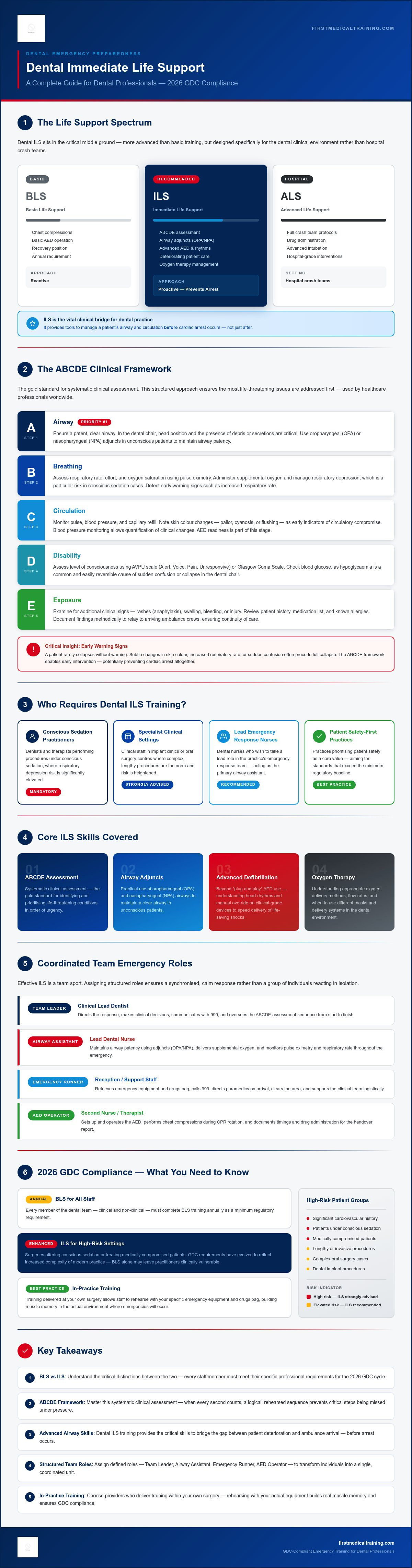
A dental immediate life support course represents a significant step up from standard annual basic training. Whilst Basic Life Support (BLS) focuses on chest compressions and simple AED use, and Advanced Life Support (ALS) is typically reserved for hospital crash teams, ILS serves as the vital clinical bridge. Understanding What is Immediate Life Support (ILS) is crucial for dental teams because it provides the tools to manage a patient's airway and circulation before a cardiac arrest occurs. It's about being prepared for the reality of a clinical environment where you have access to specialised equipment and drugs.
The primary focus of this training is the recognition and treatment of the deteriorating patient. In a dental surgery, a patient rarely collapses without warning signs; there's usually a window where effective intervention can change the trajectory. ILS training equips you to identify these subtle physiological changes using a structured approach. By intervening early, you can often prevent a full cardiac arrest, which is the ultimate goal of any clinical emergency protocol. This proactive stance is what separates ILS from the reactive nature of basic life support.
For many practitioners, this level of training is no longer optional. The GDC CPD requirements for medical emergencies have evolved to reflect the increasing complexity of modern dental practice. If your surgery provides conscious sedation or treats medically compromised patients, relying on BLS alone may leave you clinically vulnerable. High-risk patients, such as those with significant cardiovascular history or those undergoing lengthy, invasive procedures, require a team that can manage more than just chest compressions.
The Core Objectives of Dental ILS Training
The curriculum is designed to move beyond the basics, ensuring your team can handle complex scenarios with professional composure. The core objectives include:
- The ABCDE Approach: You will master the ABCDE approach, which is the gold standard for systematic clinical assessment, allowing you to prioritise life-threatening problems in a logical order.
- Airway Management: Gaining practical experience with airway adjuncts, such as oropharyngeal and nasopharyngeal airways, to maintain a clear path for oxygen in an unconscious patient.
- Advanced Defibrillation: Moving beyond "plug and play" AED use to understand heart rhythms and, where appropriate, using manual overrides on clinical-grade devices to speed up the delivery of a life-saving shock.
Who is Required to Undertake ILS Training?
Whilst every member of the team should understand the basics, certain roles require the advanced depth of a dental immediate life support course to ensure patient safety. These include:
- Dentists and therapists who perform procedures under conscious sedation, where the risk of respiratory depression is higher.
- Clinical staff working in specialised environments, such as implant clinics or oral surgery centres, where complex surgeries are the norm.
- Dental nurses who wish to take a lead role in the practice’s emergency response team, acting as the primary airway assistant.
- Practices that prioritise patient safety as a core brand value, aiming for standards that exceed the minimum regulatory baseline to provide peace of mind for both staff and patients.
The ABCDE Clinical Framework in the Dental Surgery
Applying a clinical framework in a restricted surgery space requires more than just theoretical knowledge; it requires a rehearsed strategy. When a patient is reclined in the dental chair, access to the head and chest is physically limited, and the team must work in close proximity without obstructing one another. The ABCDE approach is the gold standard for systematic clinical assessment. By following this sequence, you ensure that the most life-threatening issues are addressed first. Early warning signs, such as a subtle change in skin colour, an increased respiratory rate, or sudden confusion, often precede a full collapse. Utilising pulse oximetry and blood pressure monitoring allows the team to quantify these changes, moving from subjective observation to objective clinical data.
Airway and Breathing Management
Maintaining a patent airway is the absolute priority in any dental immediate life support course. In the dental setting, you may need to use oropharyngeal airways or supraglottic devices to manage a compromised airway effectively, especially if the patient is unconscious. High-flow oxygen must be administered at 15 litres per minute via a non-rebreather mask or a bag-valve-mask (BVM) if the patient's own ventilation is inadequate. If a foreign body or dental material causes an obstruction, the team must be proficient in back blows and abdominal thrusts. Having access to a LifeVac anti-choking device provides an additional layer of safety for cases where standard manual protocols fail to clear the airway.
Circulation and Disability Assessment
Assessing circulation involves checking the pulse, capillary refill time, and identifying heart rhythms via the AED. Recognising the transition from a perfusing rhythm to a non-shockable or shockable rhythm that requires CPR is a core competency. Many surgery emergencies are non-cardiac, such as vasovagal episodes or diabetic crises. Proper syncope management dental training ensures your team can differentiate between a simple faint and a more serious neurological or cardiovascular event. You must also be prepared to manage hypoglycaemia with oral glucose or Glucagon. Your emergency kit should be organised so that Adrenaline, Aspirin, and Salbutamol are immediately accessible. If you want to ensure your team is fully prepared for these scenarios, our Dental Immediate Life Support (ILS) Training provides the hands-on practice needed to master these protocols in your own environment.
BLS vs ILS Training: Key Differences for Dental Professionals
Many dental teams view annual training as a simple compliance exercise, but the gap between Basic Life Support (BLS) and a comprehensive dental immediate life support course is vast. BLS provides the fundamental skills to keep a patient's heart and lungs functioning through manual intervention. Whilst BLS keeps a patient alive, ILS focuses on stabilising them for the arrival of the ambulance. This distinction is critical in a clinical setting where you have the tools and professional responsibility to intervene more effectively than a bystander in the street.
For non-clinical staff, such as receptionists, BLS remains the appropriate standard. Their primary role involves identifying a crisis, alerting the clinical team, and liaising with emergency services. However, clinicians and dental nurses must move beyond simple chest compressions. You're expected to use the specialised equipment within your surgery to manage a deteriorating patient. A clinician who only holds BLS certification may find themselves unprepared to use the airway adjuncts or high-flow oxygen sitting in their own emergency kit when a real crisis occurs.
Technical Skill Comparison
The technical shift from BLS to ILS involves moving from basic manoeuvres to advanced clinical interventions. In a dental immediate life support course, you'll progress from simple head-tilt chin-lifts to the use of oropharyngeal (OP) airways and supraglottic devices like i-gels. There's also a significant change in how you interact with technology. Rather than just following the automated voice prompts of an AED, ILS participants learn to recognise cardiac rhythms and understand manual defibrillation requirements. This allows for a more nuanced response, such as performing pulse checks and identifying non-shockable rhythms, which ensures that CPR is only paused for the minimum time necessary. It transforms the response from an individual effort into a highly organised team leadership protocol.
Regulatory and Compliance Standards
Compliance expectations for 2026 are becoming increasingly specific, particularly for practices offering conscious sedation. The GDC expects these practitioners to maintain a higher level of emergency readiness, making ILS the de facto requirement. The Resuscitation Council UK Quality Standards for 2026 emphasise that clinical staff should be trained to a level compatible with their expected roles. Maintaining ILS certification doesn't just satisfy the GDC; it also provides a robust defence during CQC inspections. Many professional indemnity insurers now look favourably on practices that implement ILS, as it demonstrates a commitment to patient safety that exceeds the bare minimum. This level of training ensures your practice is not just compliant, but clinically resilient.
Managing Patient Collapse: The Dental Team’s Emergency Response
In a crisis, clinical expertise counts for little if the team lacks coordination. A dental immediate life support course moves beyond individual skills to establish a structured command system. This involves defining clear roles: the Lead Clinician, the Airway Assistant, and the Emergency Runner. The Lead Clinician directs the overall response, whilst the Airway Assistant focuses on ventilating the patient and maintaining a patent airway. The Emergency Runner retrieves the AED, oxygen, and emergency drugs, whilst also alerting emergency services. This division of labour prevents the "bystander effect" and ensures no critical task is missed.
Effective communication is the backbone of this response. Using the SBAR (Situation, Background, Assessment, Recommendation) hand-over tool provides a clear, concise framework when paramedics arrive. It prevents vital information from being lost in the chaos. For this system to work, your "Emergency Box" and high-flow oxygen must be stored in a known, accessible location, checked daily, and ready for immediate deployment. If you want to ensure your staff can execute these roles under pressure, you can book a dental immediate life support course tailored specifically to your practice environment.
Ergonomics of Resuscitation in the Surgery
Managing a collapse whilst the patient is in the dental chair presents unique physical challenges. Whilst the chair can be reclined for simple faints, cardiac arrest requires the patient to be moved to the floor. High-quality chest compressions cannot be performed on a soft, moving dental unit; they require a firm, flat surface. Teams must rehearse the safe manual handling techniques needed to lower a patient without causing injury to the staff or the individual. In the restricted space of a surgery, knowing exactly where each person stands ensures compressions and airway management happen simultaneously without staff members obstructing one another.
Human Factors and Stress Management
Stress significantly impairs cognitive function and decision-making during a dental emergency. Simulation-based training helps desensitise the team to the panic that often accompanies a real-life patient collapse. By rehearsing in your own environment, the response becomes muscle memory rather than a frantic reaction. After any incident, a structured debriefing session is essential for the team’s long-term health. This allows everyone to process the event, identify improvements, and access mental health support. Addressing these human factors is just as important as mastering the clinical protocols themselves.
Selecting Your Dental ILS Training Provider for 2026 Compliance
Choosing the right partner for your dental immediate life support course is a decision that directly impacts both clinical safety and regulatory standing. First Medical Training, founded in 2006, brings 20 years of expertise to the dental sector. This longevity represents a deep understanding of how GDC standards have evolved and how surgeries actually operate during a crisis. It's not enough to simply tick a box; you need a training provider that acts as a seasoned mentor, bridging the gap between theoretical guidelines and the practical realities of a busy practice.
Compliance for the 2026 cycle isn't a static target. Our training is strictly aligned with the latest Resuscitation Council UK guidelines, ensuring your team learns the most current protocols for airway management and cardiac rhythm recognition. By integrating this training into your annual CPD cycle, you avoid the last-minute scramble for credits whilst maintaining a high level of clinical readiness. It's a methodical, purposeful approach to professional development that respects your time and your patients' safety.
In-practice training offers a significant advantage over external centres. Rehearsing with your own oxygen cylinders, AED, and emergency drug kits in the actual space where a collapse might occur builds a level of familiarity that external courses cannot match. It allows you to identify potential logistical bottlenecks in your own surgery layout before an emergency happens. When every second counts, knowing exactly where your equipment is stored and how it functions in your specific environment is invaluable.
The First Medical Training Advantage
Our instructors are specialists who understand the specific pressures and restricted spaces of the dental environment. We provide comprehensive coverage of advanced airway adjuncts and the correct use of your emergency drugs, moving beyond the basics to ensure clinical confidence. Additionally, we are suppliers of specialised equipment like the LifeVac anti-choking device. This means we can provide the latest technology alongside the expert skills required to use it, positioning your practice at the forefront of patient care standards.
Booking Your Practice Training
To ensure a synchronised response, we recommend organising a full-team training day. This ensures that every member, from the lead dentist to the clinical support staff, understands their specific role in the emergency response plan. It builds the team cohesion necessary to act as a single, organised unit during a patient collapse. Upon completion, we provide verifiable CPD certification immediately, ensuring your compliance records are always up to date and ready for inspection.
Book your Dental Immediate Life Support course with First Medical Training today to secure your practice's safety and compliance for the 2026 cycle.
Elevating Your Surgery’s Emergency Readiness for 2026
Implementing a high standard of emergency care is about more than just meeting GDC requirements; it's about protecting your patients and your professional reputation. By moving beyond Basic Life Support and mastering the ABCDE framework, your team transitions from reactive responders to proactive clinical experts. You've seen how defined roles and hands-on practice in your own surgery can transform a chaotic collapse into a managed, synchronised event. This level of preparation ensures that your practice is ready for any clinical challenge the 2026 cycle may bring.
Choosing a dental immediate life support course is the most effective way to ensure every staff member is prepared for modern clinical standards. First Medical Training has been trusted by UK dental practices since 2006 to deliver a Resuscitation Council UK aligned curriculum. Our on-site training is tailored specifically to your surgery layout, ensuring your team rehearses with the exact equipment they will use in a crisis. This practical focus builds genuine confidence that theoretical learning alone cannot provide.
Secure your team’s clinical confidence with our Dental ILS course and ensure your practice remains at the forefront of patient safety. We look forward to helping your team build the skills and composure needed to act decisively in an emergency.
Frequently Asked Questions
How long is a dental ILS certificate valid for in the UK?
A dental ILS certificate is valid for exactly one year from the date of completion. The General Dental Council (GDC) and Resuscitation Council UK recommend annual updates to ensure clinical skills remain sharp and compliant. Completing a dental immediate life support course every 12 months ensures your practice meets the latest quality standards. Regular training prevents skill fade, which is a significant risk when emergency procedures are rarely performed in a real-world setting.
Is the ILS course mandatory for all dental nurses?
Whilst the GDC requires all dental professionals to complete medical emergencies training, ILS is specifically mandatory for nurses assisting with conscious sedation. For general practice, it's classified as "highly recommended" rather than a universal requirement for every nurse. However, many modern practices adopt ILS for their entire clinical team to ensure a superior standard of patient safety. This approach guarantees that every nurse can competently manage airway adjuncts and assist the lead clinician during a crisis.
What is the difference between ILS and ALS for dentists?
ILS provides the essential skills to stabilise a patient until an ambulance arrives, whereas Advanced Life Support (ALS) involves more complex interventions like manual rhythm interpretation and intravenous drug administration. ALS is typically reserved for hospital-based emergency teams or specialists. For the majority of UK dental practices, a dental immediate life support course offers the perfect balance of advanced airway management and AED use without the overwhelming technicality of a full ALS curriculum.
Does the dental ILS course include training on emergency drugs?
Yes, the curriculum covers the administration and protocols for all standard emergency drugs found in a dental surgery. You will learn the correct dosages and indications for Adrenaline, Aspirin, Glucagon, Glyceryl Trinitrate (GTN), and Salbutamol. Understanding when and how to use these medications is a core component of the ABCDE assessment. This training ensures that you can act decisively when managing conditions like anaphylaxis, myocardial infarction, or acute asthma attacks in the chair.
Can our whole dental team be trained at our own surgery?
We specialise in providing national on-site training that allows your entire team to learn together in their own environment. Rehearsing in your actual surgery is highly beneficial as it helps you identify logistical challenges and familiarise yourself with the location of your own emergency equipment. This team-based approach improves communication and ensures that everyone, from receptionists to senior clinicians, understands their specific role when a patient collapse occurs.
Do I need to complete a BLS course before taking an ILS course?
You don't need to complete a separate BLS course first, as the ILS curriculum includes all the fundamental elements of Basic Life Support. The course starts with these basics and then progresses into more advanced clinical skills. It's designed for healthcare professionals who already have a baseline understanding of clinical care but want to elevate their emergency response capabilities. Starting directly with ILS is an efficient way to meet your annual CPD requirements.
How many CPD hours are awarded for a dental ILS course?
A comprehensive ILS session typically provides 6 hours of verifiable CPD. This contributes significantly to the GDC requirement of 10 hours of medical emergencies CPD over each five-year cycle. Our certificates are issued immediately upon completion, providing the necessary evidence for your Personal Development Plan (PDP). This structured approach ensures your practice remains fully compliant with the latest regulatory standards whilst enhancing the clinical skills of your staff.
Does the course cover the use of the LifeVac anti-choking device?
Our training includes practical instruction on the use of the LifeVac anti-choking device alongside standard manual techniques like back blows and abdominal thrusts. As a supplier of LifeVac technology, we ensure your team understands how to integrate this equipment into their emergency protocols. This is particularly useful in dental settings where foreign body airway obstructions are a constant risk. Having this additional tool provides an extra layer of protection for your patients.