

Dental team CPD tracking for certificates and deadlines

A dental practice can plan CPD for the whole team and still miss an individual’s GDC requirement if records are not tracked separately. Dentists must complete at least 100 hours of verifiable CPD in each five-year cycle and submit an annual CPD statement by 28 January. A clear process for how to track CPD for the whole dental team keeps each person’s hours, evidence and deadlines visible.
Managing different professional roles and CPD cycles alongside the day-to-day demands of a practice can be challenging. Keep an individual record for every registrant, then use a shared tracker to monitor progress without confusing one person’s requirements with another’s.
This guide explains what dentists need to complete and how to organise team records, certificates, learning outcomes and annual statements. It also covers the separate CPD-year deadlines for dentists and dental care professionals, the evidence to retain, and how regular reviews can help you spot gaps before a submission is due.
Key Takeaways
- Track CPD separately for each registrant, matching their professional title to the relevant five-year requirement.
- Use a shared tracker to record completed hours, learning outcomes, evidence and upcoming deadlines.
- Store certificates and participation records so they can support the hours declared in annual statements.
- Keep dentists’ and dental care professionals’ CPD-year dates distinct to avoid missing submission deadlines.
- Review progress regularly to identify gaps early and plan relevant learning for each team member.
Why is continuing professional development important in the dental industry?
Continuing professional development (CPD) helps dental professionals maintain relevant knowledge and skills throughout their careers. For professionals registered with the General Dental Council (GDC), it is also a registration requirement, with minimum hours determined by professional title.
CPD obligations for registered professionals
The General Dental Council’s Enhanced CPD scheme began in 2018. Each registrant must complete the minimum verifiable hours for their title during their five-year cycle, keep a CPD record and submit annual statements. A personal development plan should connect learning to the registrant’s field and set out when they expect to complete CPD. The GDC’s four development outcomes cover communication, teamwork, knowledge and skills, and professional behaviour.
Minimum hours for dental care professionals
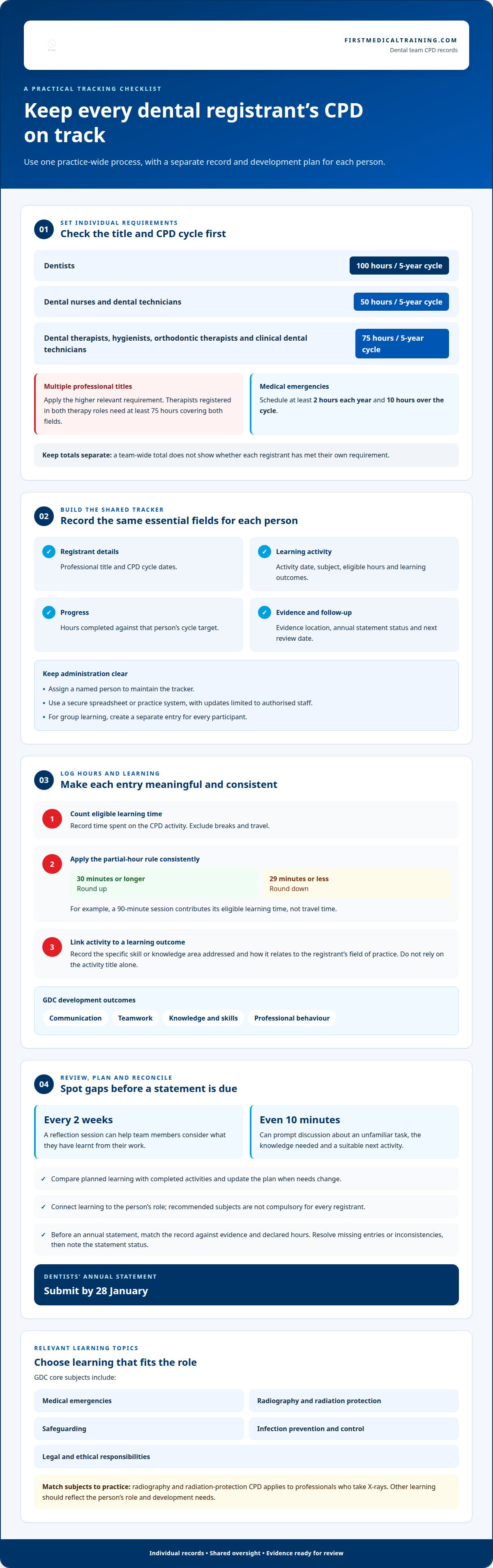
Check the registrant’s professional title before setting an hours target. Dentists need at least 100 verifiable hours in each five-year cycle; dental nurses and dental technicians each need 50. Dental therapists, dental hygienists, orthodontic therapists and clinical dental technicians each need 75. If a professional holds multiple titles, the higher applicable requirement applies. Therapists registered in both therapy roles need at least 75 hours covering both fields.
CPD totals are not interchangeable across a practice. Set an individual target for each person, then review progress against that person’s cycle and development plan. This makes gaps easier to identify without treating a team-wide total as proof that every registrant has met their own requirement.
Choose learning that relates to each professional’s work and development needs. GDC core subjects include medical emergencies, radiography and radiation protection, safeguarding, infection prevention and control, and legal and ethical responsibilities. Not every recommended subject is compulsory for every registrant. For example, radiography and radiation-protection CPD applies to professionals who take X-rays, while other learning should reflect the person’s role and practice.
Medical emergencies have a defined CPD requirement: at least 2 hours each year and 10 hours over the cycle. Schedule this learning alongside other relevant topics, rather than leaving it until a cycle is nearly complete. Courses should have clear learning outcomes and participation evidence, so completed activity can be recorded as verifiable CPD.
CPD supports current skills, sound judgement and professional conduct in dental care. Planned learning helps each team member identify development needs, while records provide evidence of completed activity. Informal learning can support development, but it does not replace verifiable CPD. Build a learning plan around the role, required hours and relevant subjects, then review it as work needs change.
How should a dental practice track CPD hours and learning outcomes for the whole team?
Use one practice-wide process, but keep a separate CPD record and development plan for every registrant. This gives you an overview of team progress without confusing individual requirements, learning needs or responsibilities.
Assign a named person to maintain the tracker and use consistent fields for every team member. To track CPD for the whole dental team, record:
- Each registrant’s professional title and CPD cycle dates.
- Activity dates, subjects, eligible hours and learning outcomes.
- Progress against the person’s cycle target.
- Evidence locations, annual statement status and next review date.
Use a secure spreadsheet or practice system that authorised staff can update. Link each entry to its supporting evidence, and limit editing access to those responsible for administration. For group learning, create a separate entry for each participant. Attending the same session does not make individual records interchangeable.
Record time spent on the CPD activity, excluding breaks and travel. Apply the reporting rule consistently: round a partial hour of 30 minutes or longer up, and a partial hour of 29 minutes or less down. For example, a 90-minute session contributes its eligible learning time, not time spent travelling to the venue.
Set regular reviews to identify learning needs and update plans. A reflection session every 2 weeks can help team members consider what they have learned from their work. Even 10 minutes can prompt a useful discussion about a task that felt unfamiliar, the knowledge needed, and a suitable next activity. Record agreed development actions against the individual plan.
Connect each activity to a stated learning outcome instead of relying on its title alone. The GDC’s development outcomes can help structure reflection on communication, teamwork, professional knowledge and conduct. Record the specific skill or knowledge area addressed, then explain how it relates to the registrant’s field of practice.
At each review, compare planned learning with completed activities and update the remaining plan if needs change. If a team member takes on different responsibilities, discuss whether their development priorities have shifted. A consistent team-wide process keeps these changes visible without treating everyone’s learning as identical.
Before submitting an annual statement, reconcile the person’s record with its evidence and declared hours. Resolve missing entries or inconsistencies, then note the statement’s status. This final check gives the practice a clear overview while keeping each registrant’s CPD record specific to their learning and progress.
Certificate tracking, storage and downloads
A certificate is useful evidence when it can be matched to the correct person, activity and CPD entry. Use a consistent filing process so every record supports the hours claimed.
Tracking hours and certificates
Give each team member an individual CPD folder and tracker, even when staff attend the same course. For every activity, log its title, date, subject, duration and certificate file location. Add the registrant’s name and professional title so records stay distinct when files are downloaded together or shared after a group session.
Record eligible learning time, not the full time away from the practice. CPD logs must exclude breaks and travel. When reporting a partial hour, round 30 minutes or longer up to the next whole hour; round 29 minutes or less down. Apply the same method consistently across entries.
Storing and evidencing certificates
Save certificates in a secure digital folder organised by registrant and year cycle. Use a clear file name, such as the person’s name, course topic and completion date, and link the file to the matching tracker entry. If you also keep paper certificates, file them using the same structure so digital and paper records are easy to reconcile.
Verifiable CPD evidence should identify the subject, duration and learning outcomes, and confirm participation. If a certificate omits a detail, retain supporting course documentation with it. Keep related evidence together, such as a completion record and an outline of the topics covered, so the activity is clear without searching unrelated files.
Keeping records and downloading certificates
Download each certificate when it becomes available and save it in the registrant’s folder. Do not rely on an email inbox or course account as the only archive. Staff access can change, and messages can be difficult to find later. A practice-controlled folder gives authorised staff a consistent place to find current and past records.
Use a simple file structure with separate folders for each registrant and cycle. Restrict access to people responsible for CPD administration, and keep a record of where files are stored. The GDC may request CPD evidence, so each registrant’s record should be retrievable and match the hours in their annual statement.
Recording learning outcomes
Enter the learning outcomes beside each activity instead of relying on a course title to explain what someone gained. For example, a medical-emergencies course entry should capture the stated outcomes and connect them to the registrant’s development plan. This makes the record more useful when reviewing skills and planning relevant learning.
At each record review, compare the certificate, logged duration, subject and outcomes. Resolve mismatches before submitting the annual statement. Keep evidence aligned with the hours declared, and file any corrections with the original activity record. A complete entry shows what was studied, how long it lasted, the intended learning and that the registrant participated.
Annual CPD statements and renewal deadlines
Annual statements record CPD activity for the relevant registration year. Align each registrant’s hours and evidence before the submission deadline.
Annual CPD statements and declarations
Dentists submit an annual CPD statement by 28 January, covering the year that ended on 31 December. Dental care professionals submit theirs by 28 August, after their CPD year ends on 31 July. A statement is required even when the registrant completed zero CPD hours, so include every team member in the annual reporting schedule.
Before submission, reconcile the hours declared with the individual’s CPD record and supporting evidence. The evidence should match the hours in the annual statement. A clear review can identify missing certificates, incorrect dates or entries assigned to the wrong registration year before the declaration is made.
Renewal deadlines
Set separate calendar reminders for dentists and dental care professionals. Dentists’ statements are due by 28 January; dental care professionals’ are due by 28 August. The GDC renewal period opens around six weeks before the end of the year. Use that window to review each person’s annual record and identify any outstanding reporting steps.
Dental care professionals may make or amend an annual statement up to 28 days after the registration year ends. Dentists may submit their annual statement up to 28 January. Treat these dates as reporting deadlines, not extra time to complete CPD for the year that has ended.
Build the reporting process around the practice’s training schedule. An annual programme helps you plan development in advance, while individual course bookings can address a specific learning need as it arises. Either approach requires an accurate annual record for each registrant. Log completed activities promptly, then review each person’s CPD hours before their statement deadline.
For example, a dental nurse’s August activity belongs to the CPD year beginning on 1 August. A dentist’s January activity belongs to the CPD year beginning on 1 January. Label the registration year clearly in the tracker, so an activity is not carried into the wrong annual statement. Keep planned sessions distinct from completed learning.
Use a simple reporting sequence: close the relevant CPD year, reconcile logged hours with evidence, resolve discrepancies, then submit the statement by its deadline. If a registrant reports zero hours, record that accurately rather than omitting their annual declaration. Note submission completion in the individual record.
Current CPD supports dental professionals in keeping knowledge and skills up to date, but an annual statement is a separate reporting step. It does not replace the need to complete CPD across the five-year cycle. Keep both annual reporting and cycle progress visible in the practice tracker, with reminders assigned to the person responsible for administration.
How should a dental practice track CPD hours and learning outcomes for the whole team?
Use one practice-wide process, but keep a separate CPD record and development plan for every registrant. This gives you an overview of team progress without confusing individual requirements, learning needs or responsibilities.
Assign a named person to maintain the tracker and use consistent fields for every team member. To track CPD for the whole dental team, record:
- Each registrant’s professional title and CPD cycle dates.
- Activity dates, subjects, eligible hours and learning outcomes.
- Progress against the person’s cycle target.
- Evidence locations, annual statement status and next review date.
Use a secure spreadsheet or practice system that authorised staff can update. Link each entry to its supporting evidence, and limit editing access to those responsible for administration. For group learning, create a separate entry for each participant. Attending the same session does not make individual records interchangeable.
Record time spent on the CPD activity, excluding breaks and travel. Apply the reporting rule consistently: round a partial hour of 30 minutes or longer up, and a partial hour of 29 minutes or less down. For example, a 90-minute session contributes its eligible learning time, not time spent travelling to the venue.
Set regular reviews to identify learning needs and update plans. A reflection session every 2 weeks can help team members consider what they have learned from their work. Even 10 minutes can prompt a useful discussion about a task that felt unfamiliar, the knowledge needed, and a suitable next activity. Record agreed development actions against the individual plan.
Connect each activity to a stated learning outcome instead of relying on its title alone. The GDC’s development outcomes can help structure reflection on communication, teamwork, professional knowledge and conduct. Record the specific skill or knowledge area addressed, then explain how it relates to the registrant’s field of practice.
At each review, compare planned learning with completed activities and update the remaining plan if needs change. If a team member takes on different responsibilities, discuss whether their development priorities have shifted. A reliable process for tracking CPD across the dental team keeps these changes visible without treating everyone’s learning as identical.
Before submitting an annual statement, reconcile the person’s record with its evidence and declared hours. Resolve missing entries or inconsistencies, then note the statement’s status. This final check gives the practice a clear overview while keeping each registrant’s CPD record specific to their learning and progress.
First Medical Training Ltd
First Medical Training Ltd supports dental teams with CPD training relevant to practice needs. If your tracker identifies a development need in medical emergencies, consider the Medical Emergencies in a Dental Practice Course or Dental Immediate Life Support (ILS) Training. Record the learning alongside each participant’s individual CPD evidence and development plan.
Choose training that reflects each person’s role and learning goals, then log the activity and its outcomes in their individual CPD record. This connects course participation to the monitoring of hours, evidence and progress.
If you’d like to discuss relevant training for your dental team, contact First Medical Training Ltd.
Make CPD planning part of team development
Use your next team development conversation to connect professional learning with the work people want to do confidently. Invite each team member to identify a skill or area of knowledge they would like to strengthen, then consider how that goal fits their role and the practice’s priorities. This helps keep development purposeful, rather than treating CPD as an administrative task alone.
A practical approach to tracking CPD for the whole dental team also depends on making the process manageable for the people who maintain it. Agree who will update records, when progress will be discussed and how staff can raise a learning need. Keep these responsibilities clear as your team or its roles change.
Where a learning need relates to medical emergencies or life support, First Medical Training offers relevant training for dental teams. Discuss the training that fits your team’s development priorities by contacting First Medical Training Ltd. A considered next step can help your team move from planning to purposeful learning.
Frequently Asked Questions
What CPD do dentists need?
Dentists need at least 100 hours of verifiable CPD in each five-year cycle. Their learning should relate to their professional development and field of practice, rather than simply filling an hours total. For example, a dentist could plan medical-emergencies learning alongside other relevant subjects. Keep annual reporting distinct from cycle completion: the dentist must also submit an annual CPD statement by the applicable deadline.
How do I track CPD?
Give each registrant an individual record and log each completed activity promptly. Include its date, subject, eligible hours, learning outcomes and evidence location, then compare progress with that person’s cycle target. Review records at team development meetings and resolve missing details straight away. Keep the practice overview separate from individual records, so a shared course does not obscure who attended.
What can be counted as CPD?
Count structured learning that is relevant to a dental professional’s work and has clear documentation. For example, a medical-emergencies course may count when its record includes the subject, duration, learning outcomes and evidence of participation. The learning should support the registrant’s development plan and field of practice. Do not treat routine work or informal conversations as verifiable CPD simply because they provide useful experience.
What is verifiable vs non-verifiable CPD?
Verifiable CPD has a defined learning activity and evidence confirming participation, subject, duration and outcomes. A course certificate can support the record if it includes the required details. Non-verifiable learning may include reflection or informal discussion that supports professional development but lacks the documentation needed to verify attendance and learning. It can complement a development plan, but cannot replace the verifiable CPD requirement.
What are the GDC CPD requirements for UK dental professionals by role and registration cycle?
The General Dental Council sets five-year minimums by registered professional title. Dentists need 100 verifiable hours; dental nurses and dental technicians need 50 each. Dental therapists, dental hygienists, orthodontic therapists and clinical dental technicians each need 75. If a registrant holds more than one title, use the higher applicable requirement. A therapist registered in both therapy roles needs 75 hours covering both fields.
Which dental team members need to complete CPD, including nurses, hygienists and practice managers?
CPD is required for dental professionals registered with the GDC. This includes registered dental nurses and hygienists, as well as dentists and other registered dental care professionals. A practice manager’s requirement depends on whether they are also GDC-registered under a professional title. For team planning, record each person’s registration status and title rather than assigning requirements based only on their job description.
What records and evidence must UK dental professionals keep for CPD?
Keep an individual CPD record linking each activity to its supporting evidence and declared hours. Retain the record for five years after the end of the five-year cycle. Organise files so the registrant can retrieve relevant evidence if selected for a GDC audit. Send the CPD record to the GDC only when requested, and keep an accessible copy in the meantime.
What CPD tracking software or systems are available for UK dental practices, and how do they compare?
A practice can use a well-organised spreadsheet or a dedicated CPD tracking system. A spreadsheet is straightforward for recording individual targets, activity details and evidence locations; a dedicated system may suit practices that want records grouped in one structured workspace. Compare options against your needs, including individual cycle tracking, separate registrant records, deadline reminders and easy evidence retrieval. Whichever you choose, keep records accurate and accessible.